

Bro Lalith shares about his experince in Singapore during a prayer meeting at St Peters Colombo. I recommend if you have the time to watch the whole thing otherwise 1st mention 41:00 Thereafter from 57:00-1:05:00



Thy Will Be Done

 | CatholicJules on How Do You Know If The Holy Sp… |
 | Flora on How Do You Know If The Holy Sp… |
 | Gerald T King on From a homily on Ezekiel by Sa… |
 | Toncie on Statue Of Mary Stepping On A… |
 | AA1C on 19th Sunday in Ordinary Time w… |

 LISTEN LIVE
Bro Lalith shares about his experince in Singapore during a prayer meeting at St Peters Colombo. I recommend if you have the time to watch the whole thing otherwise 1st mention 41:00 Thereafter from 57:00-1:05:00
O God, sow your word once more in our hearts today; till patiently the soil of our souls; bring forth a rich harvest, so that all may find nourishment for body and spirit through the lives of your people. We ask this through Christ our Lord. Amen.
One day in Heaven we may all join hands and sing this song to Our God.
I absolutely LOVE this song~!
Lectio Divina, the chuch’s most ancient way of reading Scripture, can be done both individually and in a group. Though not a rigid method, it traditionally involves four basic levels. or movements. In each one, the same Bible passage is read from a different angle. Here is how Pope Benedict describes the process in Verbum Domini (87)”
1) Lectio, the first level, involves alert reading of the passage, with “a desire to understand it’s true content: what does the biblical text say in itself? Without this, there is always a risk that the text will become a pretext for never moving beyond our own ideas.”
2) Meditatio (meditation) prompts the question: What is this passage saying to us? “Here, each person, individually but also as a member of the community, must let himself or herself be moved and challenged.”
3) Oratio is the specific moment for prayer: ” What do we say to the Lord in response to His Word? Prayer, as petition, intercession,thanksgiving, and praise, is the primary way by which the Word transforms us.”
4) Finally, in contemplatio (contemplation),”we take up, as a gift from God, his own way of seeing and judging reality, and ask ourselves: what conversion of mind,heart and life is the Lord asking of us?” The process is not concluded “until it arrives at action (actio), which moves the believer to make his or her life a gift for others in charity.”
SUNDAY BIBLE REFLECTIONS BY DR. SCOTT HAHN
Alive in the Spirit
Readings:
Acts 8:5-8, 14-17
Psalm 66:1-7, 16, 20
1 Peter 3:15-18
John 14:15-21
Jesus will not leave us alone. He won’t make us children of God in Baptism only to leave us “orphans,” He assures us in today’s Gospel (see Romans 8:14-17) .
He asks the Father to give us His Spirit, to dwell with us and keep us united in the life He shares with the Father.
We see the promised gift of His Spirit being conferred in today’s First Reading.
The scene from Acts apparently depicts a primitive Confirmation rite. Philip, one of the first deacons (see Acts 6:5), proclaims the Gospel in the non-Jewish city of Samaria. The Samaritans accept the Word of God (see Acts 17:11; 1 Thessalonians 2:13) and are baptized.
It remains for the Apostles to send their representatives, Peter and John, to pray and lay hands on the newly baptized – that they might receive the Holy Spirit. This is the origin of our sacrament of Confirmation (see Acts 19:5-6), by which the grace of Baptism is completed and believers are sealed with the Spirit promised by the Lord.
We remain in this grace so long as we love Christ and keep His commandments. And strengthened in the Spirit whom Jesus said would be our Advocate, we are called to bear witness to our salvation – to the tremendous deeds that God has done for us in the name of His Son.
In today’s Psalm, we celebrate our liberation. As He changed the sea into dry land to free the captive Israelites, Christ suffered that He might lead us to God, as we hear in today’s Epistle.
This is the reason for our hope – the hope that sustains us in the face of a world that cannot accept His truth, the hope that sustains us when we are maligned and defamed for His name’s sake.
Put to death in the flesh, He was brought to life in the Spirit, Paul tells us today. And as He himself promises: “Because I live, you will live.”
Exodus and Easter
Israel’s exodus from Egypt forms the background for many of the readings we hear in Easter.
On the Third Sunday, both the Gospel and Epistle describe Jesus “redeeming” or “ransoming” Israel (see Luke 24:21; 1 Peter 1:18). The Greek word in both is only used elsewhere to refer to Israel’s redemption from Egypt (see Exodus 6:6; Deuteronomy 7:8). In the First Reading, Jesus is said to work “mighty deeds, wonders and signs” (see Acts 2:22) – the same words used to describe Moses’ work (see Exodus 7:3; Deuteronomy 34:10-12).
Moses told the Israelites not to fear but to trust that God would go before and find them a place in the promised land (see Deuteronomy 1:29-32). Jesus uses the same words in the Fifth Sunday’s Gospel. He also quotes Moses to claim that His words are God’s words and His works are God’s works (see Deuteronomy 18:18; 34:10-12).
There is much more exodus imagery in this month’s readings. The point is to show us that Jesus’ death and resurrection marked a new exodus (see Luke 9:31). The Christian life is like the sojourning of the Israelites in the wilderness. We have passed through the waters of Baptism and are now fed with bread from heaven as we make our way to the promised land of eternal life (see 1 Corinthians 10:1-4; 1 Peter 1:4).
I praise you, merciful Father, that you have not led me in a way bound by grim duty and joyless servitude, but in one that, though it transverses “the valley of the shadow,” always leads to “the house of the Lord.” Amen.
PSALM 69:30-36
30
But I am afflicted and in pain; let your saving help protect me, God,
31
6 That I may praise God’s name in song and glorify it with thanksgiving.
32
My song will please the LORD more than oxen, more than bullocks with horns and hooves:
33
“See, you lowly ones, and be glad; you who seek God, take heart!
34
For the LORD hears the poor, does not spurn those in bondage.
35
Let the heavens and the earth sing praise, the seas and whatever moves in them!”
36
God will rescue Zion, rebuild the cities of Judah. God’s servants shall dwell in the land and possess it;
37
7) it shall be the heritage of their descendants; those who love God’s name shall dwell there.
The love which our Blessed lady had for God was so great that she suffered keenly through her desire of union with Him; hence the Eternal Father, to console her, sent her his only and beloved Son. If you wish to come to where I am going, that is, to glory, you must come this road, that is, through thorns. Before communion, we ought to exercise ourselves in many acts of virtues. Prayer and communion are not to be made or desired for the sake of the devotion we feel in them, for that is seeking self, and not God; but we must be frequent in both the one and the other in order to become humble, obedient, gentle and patient. When we see these virtues in a man, then we know that he has really gathered the fruit of prayer and of communion. Our sweet Jesus, through the excess of his love and liberality, has left himself to us in the Most Holy Sacrament.
He who works purely for the love of God desires nothing but his honour, and thus is ready in everything either to act or not to act, and that is not in indifferent matters only, but even in good ones; and he is always resigned to the will of God. The Lord grants in a moment what we may have been unable to obtain in dozens of years. To obtain perfectly the gift of humility, four main things are required; to despise the world, to despise no person, to despise one’s self, to despise being despised. Perfection consists in leading captive our own will, and in playing the king over it. A man ought to mortify his understanding in little things, if he wishes to easily mortify it in great ones, and to advance in the way of virtue. Without mortification nothing can be done. We ought to hope for and love the glory of God by means of a good life.
SAINT PHILIP NERI
Saint Philip Neri (1595) was an Italian priest and the founder of the Oratory.

Dear God, teach me to love my enemies and do good to those who hate me, to bless those who curse me and pray for those who abuse me, to be merciful even as you, Father, are merciful, after the example of Jesus Christ. Amen.
People despise and reject what they do not understand, and they frequently misunderstand righteousness; this means that the righteous often experience contempt. Closeness to God sometimes means alienation from other people.
Prayer: Father, you know my inner heart, my secret motives, my basic desires. My sins and my virtues are both under your mercy, so that I have nothing to fear from men and everything to hope from You, even in Jesus Christ Amen.
Psalms 69:6-7
6 Do not let those who hope in you be put to shame because of me,
O Lord God of hosts;
do not let those who seek you be dishonored because of me,
O God of Israel.
7 It is for your sake that I have borne reproach,
that shame has covered my face.
Sunday Bible Reflections with Dr. Scott Hahn
Readings:
Acts 6:1-7
Psalm 33:1-2, 4-5, 18-19
1 Peter 2:4-9
John 14:1-12
By His death, Resurrection and Ascension, Jesus has gone ahead to prepare a place for us in His Father’s house.
His Father’s house is no longer a temple made by human hands. It is the spiritual house of the Church, built on the living stone of Christ’s body.
As Peter interprets the Scriptures in today’s Epistle, Jesus is the “stone” destined to be rejected by men but made the precious cornerstone of God’s dwelling on earth (see Psalm 118:22; Isaiah 8:14; 28:16).
Each of us is called to be a living stone in God’s building (see 1 Corinthians 3:9,16). In this edifice of the Spirit, we are to be “holy priests” offering up “spiritual sacrifices” – all our prayer, work and intentions – to God.
This is our lofty calling as Christians. This is why Christ led us out of the darkness of sin and death as Moses led the Israelites from bondage in Egypt.
God’s covenant with Israel made them a royal and priestly people who were to announce His praises (see Exodus 19:6). By our faith in Christ’s new covenant, we have been made heirs of this chosen race, called to glorify the Father in the temple of our bodies (see 1 Corinthians 6:19-20; Romans 12:1).
In today’s First Reading, we see the spiritual house of the Church being built up, as the Apostles consecrate seven deacons so they can devote themselves more fully to the “ministry of the Word.”
The Lord’s Word is upright and all His works trustworthy, we sing in today’s Psalm. So we can trust Jesus when He tells us never to be troubled, but to believe that His Word and works come from the Father.
His Word continues its work in the world through the Church. We see its beginnings today in Jerusalem. It is destined to spread with influence and power (see Acts 19:20), and to become the imperishable seed by which every heart is born anew (see 1 Peter 1:23).
O God, you are over all in all, beyond all. Open our eyes to see the wonders that surround us; open our hearts to know the wonders of our brothers and sisters; open our lips to sing your praise. Restore all peoples in your image, we pray through Jesus our Lord and savior. Amen
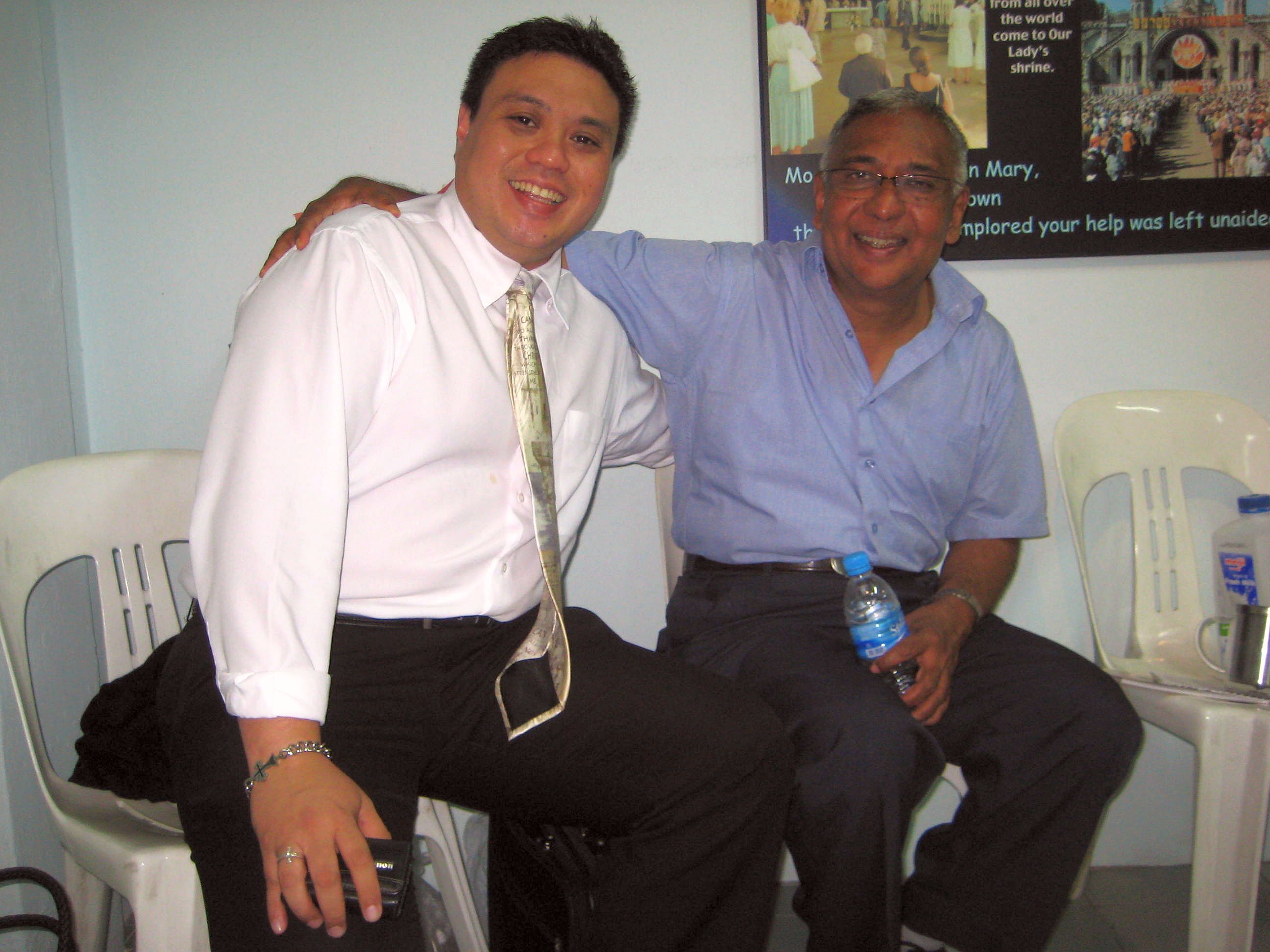
I decided to attend the 2 day four step retreat held at Our Lady of Lourdes Church which came highly recommended. It was over the weekend of 14th and 15th of May. Furthermore the pamphlet I had received about it, looked impressive with some of the testimonies from people who had attended in the past.
Without revealing too much about the retreat because it is something you should choose on your own to experience. The four step retreat in essence is four steps you undertake to have a personal encounter and lasting relationship with God our Father. I will stop here so that you will not have expectations or pre-conceived ideas except for the fact that you will definitely experience a change in your life should you desire it. 🙂
After the anointing with the Holy Spirit on the last day I must say I was overjoyed, as I had an extraordinary experience with the in-flowing of the Holy Spirit which lasted at least 15 minutes. A pure unadulterated, unconditional feeling of being loved! I decided that I was going to try and live my life in the Spirit.
Monday came and I attended the morning Eucharistic celebration before heading off to work feeling very elated as I was still very much in the Spirit. I was also looking forward to having dinner with my Dad in the evening as he turned 81 that day. Yes it was his birthday….
So after work I rushed home to meet the family at the restaurant nearby to have our dinner. I would later have to rush off once again to Church as we had our monthly EMC meeting. My wife who couldn’t join us for dinner as she was working, called to tell me that my younger son’s teacher had called her to inform her that she had passed his homework on to a classmate of his since he was on medical leave. I asked my elder son to help collect it for his brother but he insisted that his younger brother should follow him as well because the mother of the classmate was more familiar with him. My mum instructed the boys to carry my extra set of keys with them so that they could return home on their own. I was against the idea but relented because mum said that they could be trusted with the responsibility.
So after dinner mum, dad and I made our way home while the boys went to collect the homework. After showering I heard the doorbell and found that it was my boys outside. Apparently they were playing and started throwing the keys up in the air to see who could throw the highest when the bunch of keys got stuck up in the tree. Can you imagine the anger that was welling up in me? These bunch of keys were not only to my home but had at least 5 other personal keys of mine attached to the same keychain. After screaming at them, I marched them down to have a look to see if I could somehow retrieve it from the tree. As it was getting dark I could hardly see anything up the branches, I shook the tree but there was not even the slightest rattle of keys that could be heard. So I scanned the whole area surrounding the tree to see if they had somehow failed to see that it actually landed on the grass instead. After a while as the effort seemed more and more futile, I started screaming at them once again and even threatened to punish them severely.
Almost immediately after letting lose some expletives which I had not uttered in a very,very,very long while, I decided to walk away and pray. I prayed that Jesus would take away the anger from me and expressed how sorry I was about the outbursts. I surrendered to him and requested for Him to take over and that I would place all my trust in Him. Thereafter I began to feel the in-flowing of the Holy Spirit and soon I was calm. I then walked home silently with the kids. After getting changed I made my way to Church for the meeting but along the way I decided to call my elder son and tell him that although I was still a little annoyed, I will always love him no matter what happened. Our meeting began in the adoration room where I felt the overwhelming but wonderful presence of our Lord Jesus Christ. The rest of the meeting following was needless to say a success!
On Tuesday morning I made my way once again for the morning Eucharistic celebration, but before I got to the bus stop I decided to see if I could find the keys up in the tree in the daylight. I was secretly hoping to see if the ‘curse’ could be changed into a blessing as was preached about during the four step retreat. I was a little dismayed that the situation had not changed, as I still could not even see the bunch of keys anywhere. Still I decided to praise the Lord and thank him for my change of heart.
I was going to be working the afternoon shift and so while I was tempted to attend another talk by Brother Lalith the main speaker at the retreat which was scheduled to start at 1000hrs, I decided instead that I would spend some time with my family since it was a public holiday. When I got home, my wife informed me that she had made prior plans to bring the kids out with my mum-in-law! I took this as a sign that I was to attend the talk and so quickly got into a cab to to Church of the Risen Christ. I left the talk slightly after 5pm to make my way to the office, when I got a call from my mum saying that the ‘lost keys’ was upsetting to my father too, who then proceeded to pray to our blessed Mother Mary for help. ( This was amazing news to me as my father is not the prayerful type) He then had a feeling that he should go to the tree to have a look and LO and Behold! the bunch of keys was lying below! He is now convinced of the power of prayer! The ‘curse’ was truly transformed into blessings!
PRAISE THE LORD! PRAISE THE LORD! PRAISE THE LORD!
AMEN!
More on the four steps retreat can be found at www.crlmain.org


Sunday Bible Reflections by Dr. Scott Hahn
Readings:
Acts 2:14, 36-41
Psalm 23:1-6
1 Peter 2:20-25
John 10:1-10
Easter’s empty tomb is a call to conversion.
By this tomb, we should know for certain that God has made Jesus both Lord and Messiah, as Peter preaches in today’s First Reading.
He is the “Lord,” the divine Son that David foresaw at God’s right hand (see Psalms 110:1,3; 132:10-11; Acts 2:34). And He is the Messiah that God had promised to shepherd the scattered flock of the house of Israel (see Ezekiel 34:11-14, 23; 37:24).
As we hear in today’s Gospel, Jesus is that Good Shepherd, sent to a people who were like sheep without a shepherd (see Mark 6:34; Numbers 27:16-17). He calls not only to the children of Israel, but to all those far off from Him – to whomever the Lord wishes to hear His voice.
The call of the Good Shepherd leads to the restful waters of Baptism, to the anointing oil of Confirmation, and to the table and overflowing cup of the Eucharist, as we sing in today’s Psalm.
Again on this Sunday in Easter, we hear His voice calling us His own. He should awaken in us the response of those who heard Peter’s preaching. “What are we to do?” they cried.
We have been baptized. But each of us goes astray like sheep, as we hear in today’s Epistle. We still need daily to repent, to seek forgiveness of our sins, to separate ourselves further from this corrupt generation.
We are called to follow in the footsteps of the Shepherd of our souls. By His suffering He bore our sins in His body to free us from sin. But His suffering is also an example for us. From Him we should learn patience in our afflictions, to hand ourselves over to the will of God.
Jesus has gone ahead, driven us through the dark valley of evil and death. His Cross has become the narrow gate through which we must pass to reach His empty tomb – the verdant pastures of life abundant.
From the first apology in defense of the Christians by Saint Justin, martyr
Through Christ we received new life and we consecrated ourselves to God. I will explain the way in which we did this. Those who believe what we teach is true and who give assurance of their ability to live according to that teaching are taught to ask God’s forgiveness for their sins by prayer and fasting and we pray and fast with them. We then lead them to a place where there is water and they are reborn in the same way as we were reborn; that is to say, they are washed in the water in the name of God, the Father and Lord of the whole universe, of our Saviour Jesus Christ and of the Holy Spirit. This is done because Christ said: Unless you are born again you will not enter the kingdom of heaven, and it is impossible for anyone, having once been born, to re-enter his mother’s womb.
An explanation of how repentant sinners are to be freed from their sins is given through the prophet Isaiah in the words: Wash yourselves and be clean. Remove the evil from your souls; learn to do what is right. Be just to the orphan, vindicate the widow. Come, let us reason together, says the Lord. If your sins are like scarlet, I will make them white as wool; if they are like crimson, I will make them white as snow. But if you do not heed me, you shall be devoured by the sword. The mouth of the Lord has spoken.
The apostles taught us the reason for this ceremony of ours. Our first birth took place without our knowledge or consent because our parents came together, and we grew up in the midst of wickedness. So if we were not to remain children of necessity and ignorance, we needed a new birth of which we ourselves would be conscious, and which would be the result of our own free choice. We needed, too, to have our sins forgiven. This is why the name of God, the Father and Lord of the whole universe, is pronounced in the water over anyone who chooses to be born again and who has repented of his sins. The person who leads the candidate for baptism to the font calls upon God by this name alone, for God so far surpasses our powers of description that no one can really give a name to him. Anyone who dares to say that he can must be hopelessly insane.
This baptism is called “illumination” because of the mental enlightenment that is experienced by those who learn these things. The person receiving this enlightenment is also baptised in the name of Jesus Christ, who was crucified under Pontius Pilate, and in the name of the Holy Spirit, who through the prophets foretold everything concerning Jesus.
Church Of St Anthony Singapore
Church Of St Anthony Singapore
Question :- Often I see questions on here pertaining to whether someone can attend this wedding or that based on the religion of the bride and groom. Could you give a general list of when you should and should not support a given wedding? This will help me with all future decisions, although like most, I have a hindsight situation of my own.
My best friend growing up was married a few years ago (before I knew my faith as well as I do now). He has always been a Methodist and asked me to be a groomsmen. His wife was a Catholic however. I did not meet her till just before the wedding so I don’t know whether she was practicing or not. He had just told me that she was Catholic but would probably become Methodist after they married. The ceremony was done by a Methodist minister and I don’t believe she had a dispensation but I didn’t ask. Should I have participated in such a wedding? Is this something I need to confess?
Answer : In your own particular situation, we don’t know whether or not the wedding was presumptively valid because we don’t know whether the bride had the dispensations necessary to marry a non-Catholic in a non-Catholic ritual. Even presuming the wedding was presumptively invalid though, the Church does not explicitly forbid Catholics from attending invalid marriages and so Catholics must use their own prudential judgment in discerning attendance on a case-by-case basis. From what you’ve told me, it does not appear to me that you need to confess attending this wedding.
As for general rules:
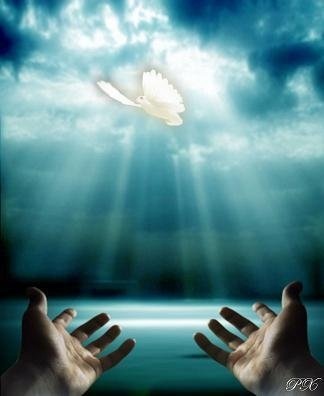
This picture speaks to me about my personal experience with the Holy Spirit. Kudos to the artist!
Sunday Bible Reflections with Dr. Scott Hahn
Readings:
Acts 2:14,22-28
Psalm 16:1-2, 5, 7-11
1 Peter 1:17-21
Luke 24:13-35
________________________________________
We should put ourselves in the shoes of the disciples in today’s Gospel. Downcast and confused they’re making their way down the road, unable to understand all the things that have occurred.
They know what they’ve seen – a prophet mighty in word and deed. They know what they were hoping for – that He would be the redeemer of Israel. But they don’t know what to make of His violent death at the hands of their rulers.
They can’t even recognize Jesus as He draws near to walk with them. He seems like just another foreigner visiting Jerusalem for the Passover.
Note that Jesus doesn’t disclose His identity until they they describe how they found His tomb empty but “Him they did not see.” That’s how it is with us, too. Unless He revealed himself we would see only an empty tomb and a meaningless death.
How does Jesus make himself known at Emmaus? First, He interprets “all the Scriptures” as referring to Him. In today’s First Reading and Epistle, Peter also opens the Scriptures to proclaim the meaning of Christ’s death according to the Father’s “set plan” – foreknown before the foundation of the world.
Jesus is described as a new Moses and a new Passover lamb. He is the One of whom David sang in today’s Psalm – whose soul was not abandoned to corruption but was shown the path of life.
After opening the Scriptures, Jesus at table took bread, blessed it, broke it, and gave it to the disciples – exactly what He did at the Last Supper (see Luke 22:14-20).
In every Eucharist, we reenact that Easter Sunday at Emmaus. Jesus reveals himself to us in our journey. He speaks to our hearts in the Scriptures. Then at the table of the altar, in the person of the priest, He breaks the bread.
The disciples begged him, “Stay with us.” So He does. Though He has vanished from our sight, in the Eucharist – as at Emmaus – we know Him in the breaking of the bread.
~~~
AT THE SCHOOL OF MARY,
“WOMAN OF THE EUCHARIST”
53. If we wish to rediscover in all its richness the profound relationship between the Church and the Eucharist, we cannot neglect Mary, Mother and model of the Church. In my Apostolic LetterRosarium Virginis Mariae, I pointed to the Blessed Virgin Mary as our teacher in contemplating Christ’s face, and among the mysteries of light I included the institution of the Eucharist.102 Mary can guide us towards this most holy sacrament, because she herself has a profound relationship with it.
At first glance, the Gospel is silent on this subject. The account of the institution of the Eucharist on the night of Holy Thursday makes no mention of Mary. Yet we know that she was present among the Apostles who prayed “with one accord” (cf. Acts 1:14) in the first community which gathered after the Ascension in expectation of Pentecost. Certainly Mary must have been present at the Eucharistic celebrations of the first generation of Christians, who were devoted to “the breaking of bread” (Acts 2:42).
But in addition to her sharing in the Eucharistic banquet, an indirect picture of Mary’s relationship with the Eucharist can be had, beginning with her interior disposition. Mary is a “woman of the Eucharist” in her whole life. The Church, which looks to Mary as a model, is also called to imitate her in her relationship with this most holy mystery.
54. Mysterium fidei! If the Eucharist is a mystery of faith which so greatly transcends our understanding as to call for sheer abandonment to the word of God, then there can be no one like Mary to act as our support and guide in acquiring this disposition. In repeating what Christ did at the Last Supper in obedience to his command: “Do this in memory of me!”, we also accept Mary’s invitation to obey him without hesitation: “Do whatever he tells you” (Jn 2:5). With the same maternal concern which she showed at the wedding feast of Cana, Mary seems to say to us: “Do not waver; trust in the words of my Son. If he was able to change water into wine, he can also turn bread and wine into his body and blood, and through this mystery bestow on believers the living memorial of his passover, thus becoming the ‘bread of life’”.
55. In a certain sense Mary lived her Eucharistic faith even before the institution of the Eucharist, by the very fact that she offered her virginal womb for the Incarnation of God’s Word. The Eucharist, while commemorating the passion and resurrection, is also in continuity with the incarnation. At the Annunciation Mary conceived the Son of God in the physical reality of his body and blood, thus anticipating within herself what to some degree happens sacramentally in every believer who receives, under the signs of bread and wine, the Lord’s body and blood.
As a result, there is a profound analogy between the Fiat which Mary said in reply to the angel, and the Amen which every believer says when receiving the body of the Lord. Mary was asked to believe that the One whom she conceived “through the Holy Spirit” was “the Son of God” (Lk1:30-35). In continuity with the Virgin’s faith, in the Eucharistic mystery we are asked to believe that the same Jesus Christ, Son of God and Son of Mary, becomes present in his full humanity and divinity under the signs of bread and wine.
“Blessed is she who believed” (Lk 1:45). Mary also anticipated, in the mystery of the incarnation, the Church’s Eucharistic faith. When, at the Visitation, she bore in her womb the Word made flesh, she became in some way a “tabernacle” – the first “tabernacle” in history – in which the Son of God, still invisible to our human gaze, allowed himself to be adored by Elizabeth, radiating his light as it were through the eyes and the voice of Mary. And is not the enraptured gaze of Mary as she contemplated the face of the newborn Christ and cradled him in her arms that unparalleled model of love which should inspire us every time we receive Eucharistic communion?
56. Mary, throughout her life at Christ’s side and not only on Calvary, made her own the sacrificial dimension of the Eucharist. When she brought the child Jesus to the Temple in Jerusalem “to present him to the Lord” (Lk 2:22), she heard the aged Simeon announce that the child would be a “sign of contradiction” and that a sword would also pierce her own heart (cf. Lk 2:34-35). The tragedy of her Son’s crucifixion was thus foretold, and in some sense Mary’s Stabat Mater at the foot of the Cross was foreshadowed. In her daily preparation for Calvary, Mary experienced a kind of “anticipated Eucharist” – one might say a “spiritual communion” – of desire and of oblation, which would culminate in her union with her Son in his passion, and then find expression after Easter by her partaking in the Eucharist which the Apostles celebrated as the memorial of that passion.
What must Mary have felt as she heard from the mouth of Peter, John, James and the other Apostles the words spoken at the Last Supper: “This is my body which is given for you” (Lk22:19)? The body given up for us and made present under sacramental signs was the same body which she had conceived in her womb! For Mary, receiving the Eucharist must have somehow meant welcoming once more into her womb that heart which had beat in unison with hers and reliving what she had experienced at the foot of the Cross.
57. “Do this in remembrance of me” (Lk 22:19). In the “memorial” of Calvary all that Christ accomplished by his passion and his death is present. Consequently all that Christ did with regard to his Mother for our sake is also present. To her he gave the beloved disciple and, in him, each of us: “Behold, your Son!”. To each of us he also says: “Behold your mother!” (cf. Jn 19: 26-27).
Experiencing the memorial of Christ’s death in the Eucharist also means continually receiving this gift. It means accepting – like John – the one who is given to us anew as our Mother. It also means taking on a commitment to be conformed to Christ, putting ourselves at the school of his Mother and allowing her to accompany us. Mary is present, with the Church and as the Mother of the Church, at each of our celebrations of the Eucharist. If the Church and the Eucharist are inseparably united, the same ought to be said of Mary and the Eucharist. This is one reason why, since ancient times, the commemoration of Mary has always been part of the Eucharistic celebrations of the Churches of East and West.
58. In the Eucharist the Church is completely united to Christ and his sacrifice, and makes her own the spirit of Mary. This truth can be understood more deeply by re-reading the Magnificat in a Eucharistic key. The Eucharist, like the Canticle of Mary, is first and foremost praise and thanksgiving. When Mary exclaims: “My soul magnifies the Lord and my spirit rejoices in God my Saviour”, she already bears Jesus in her womb. She praises God “through” Jesus, but she also praises him “in” Jesus and “with” Jesus. This is itself the true “Eucharistic attitude”.
At the same time Mary recalls the wonders worked by God in salvation history in fulfilment of the promise once made to the fathers (cf. Lk 1:55), and proclaims the wonder that surpasses them all, the redemptive incarnation. Lastly, the Magnificat reflects the eschatological tension of the Eucharist. Every time the Son of God comes again to us in the “poverty” of the sacramental signs of bread and wine, the seeds of that new history wherein the mighty are “put down from their thrones” and “those of low degree are exalted” (cf. Lk 1:52), take root in the world. Mary sings of the “new heavens” and the “new earth” which find in the Eucharist their anticipation and in some sense their programme and plan. The Magnificat expresses Mary’s spirituality, and there is nothing greater than this spirituality for helping us to experience the mystery of the Eucharist. The Eucharist has been given to us so that our life, like that of Mary, may become completely a Magnificat!
Extracted From Blessed Pope John Paul II Encyclical Ecclesia De Eucharistia
49. With this heightened sense of mystery, we understand how the faith of the Church in the mystery of the Eucharist has found historical expression not only in the demand for an interior disposition of devotion, but also in outward forms meant to evoke and emphasize the grandeur of the event being celebrated. This led progressively to the development of a particular form of regulating the Eucharistic liturgy, with due respect for the various legitimately constituted ecclesial traditions. On this foundation a rich artistic heritage also developed. Architecture, sculpture, painting and music, moved by the Christian mystery, have found in the Eucharist, both directly and indirectly, a source of great inspiration.
Such was the case, for example, with architecture, which witnessed the transition, once the historical situation made it possible, from the first places of Eucharistic celebration in the domus or “homes” of Christian families to the solemn basilicas of the early centuries, to the imposing cathedrals of the Middle Ages, and to the churches, large and small, which gradually sprang up throughout the lands touched by Christianity. The designs of altars and tabernacles within Church interiors were often not simply motivated by artistic inspiration but also by a clear understanding of the mystery. The same could be said for sacred music, if we but think of the inspired Gregorian melodies and the many, often great, composers who sought to do justice to the liturgical texts of the Mass. Similarly, can we overlook the enormous quantity of artistic production, ranging from fine craftsmanship to authentic works of art, in the area of Church furnishings and vestments used for the celebration of the Eucharist?
It can be said that the Eucharist, while shaping the Church and her spirituality, has also powerfully affected “culture”, and the arts in particular.
___________________
Acts 2:46
46 Day by day, as they spent much time together in the temple, they broke bread at home and ate their food with glad and generous hearts,
 CatholicJules.net