




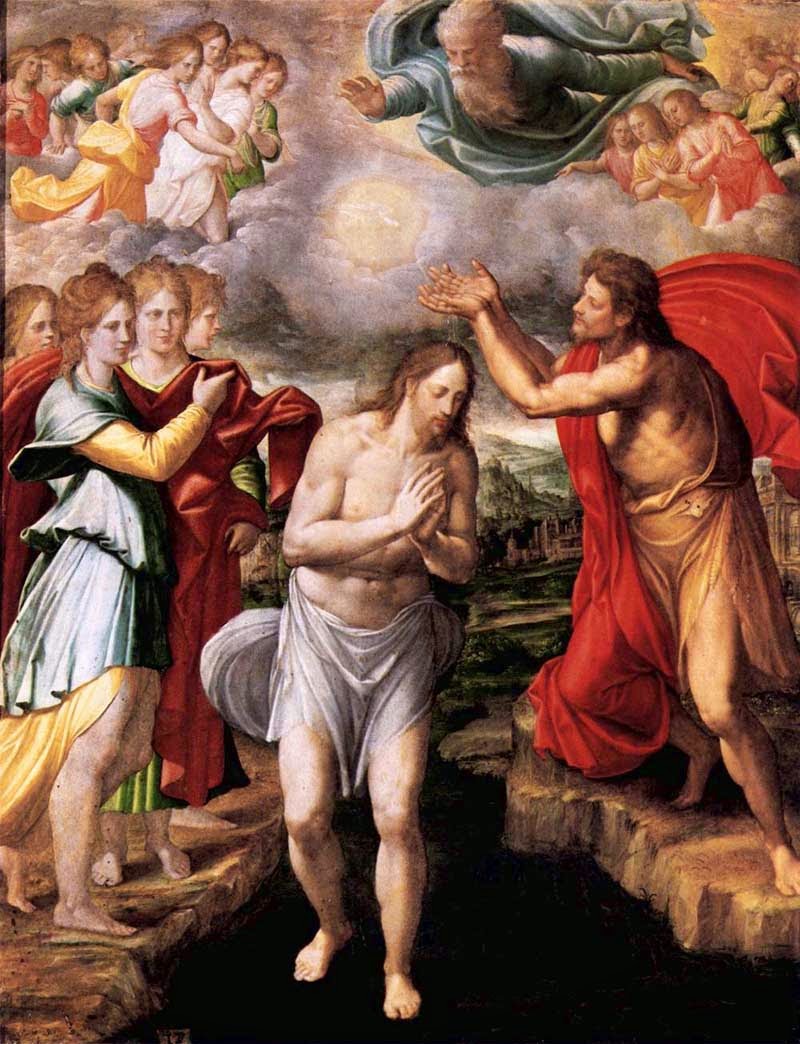
For today’s reflection on the feast of the Baptism of Our Lord, I recall reading Pope Benedict XVI’s Book Jesus Of Nazareth which was just brilliant! Before I share the extracts from the book, there is mention of how we can see the feast of Epiphany linked to the feast of our Lord’s Baptism and more….
The Eastern Church has further developed and deepened this understanding of Jesus’ Baptism in her liturgy and in her theology of icons. She sees a deep connection between the content of the feast of Epiphany (the heavenly voice proclaiming Jesus to be the Son of God: for the East the Epiphany is the day of the Baptism) and Easter.
In Jesus’ world, righteousness is man’s answer to the Torah, acceptance of the whole of God’s will, the bearing of the “yoke of God’s kingdom,” as one formulation had it. There is no provision for John’s baptism in the Torah, but this reply of Jesus is his way of acknowledging it as an expression of an unrestricted Yes to God’s will, as an obedient acceptance of his yoke. The act of descending into the waters of this Baptism implies a confession of guilt and a plea for forgiveness in order to make a new beginning. In a world marked by sin, then, this Yes to the entire will of God also expresses solidarity with men, who have incurred guilt but yearn for righteousness. The significance of this event could not fully emerge until it was seen in light of the Cross and Resurrection. Descending into the water, the candidates for Baptism confess their sin and seek to be rid of their burden of guilt. What did Jesus do in this same situation? Luke, who throughout his Gospel is keenly attentive to Jesus’ prayer, and portrays him again and again at prayer—in conversation with the Father—tells us that Jesus was praying while he received Baptism (cf. Lk 3:21). Looking at the events in light of the Cross and Resurrection, the Christian people realized what happened: Jesus loaded the burden of all mankind’s guilt upon his shoulders; he bore it down into the depths of the Jordan. He inaugurated his public activity by stepping into the place of sinners. His inaugural gesture is an anticipation of the Cross. He is, as it were, the true Jonah who said to the crew of the ship, “Take me and throw me into the sea” (Jon 1:12). The whole significance of Jesus’ Baptism, the fact that he bears “all righteousness,” first comes to light on the Cross: The Baptism is an acceptance of death for the sins of humanity, and the voice that calls out “This is my beloved Son” over the baptismal waters is an anticipatory reference to the Resurrection. This also explains why, in his own discourses, Jesus uses the word baptism to refer to his death (cf. Mk 10:38; Lk 12:50).
Only from this starting point can we understand Christian Baptism. Jesus’ Baptism anticipated his death on the Cross, and the heavenly voice proclaimed an anticipation of the Resurrection. These anticipations have now become reality. John’s baptism with water has received its full meaning through the Baptism of Jesus’ own life and death. To accept the invitation to be baptized now means to go to the place of Jesus’ Baptism. It is to go where he identifies himself with us and to receive there our identification with him. The point where he anticipates death has now become the point where we anticipate rising again with him.
Lord Jesus, rising from the water of my own baptism I have hope to rise to eternal life with You. For I am a child of God my Heavenly Father and therefore a child of light. Bless and anoint me afresh this day Lord as I seek to Your Will. Amen
First reading
Isaiah 55:1-11 ·
Come to me and your soul will live, and I will make an everlasting covenant with you
Thus says the Lord:
Oh, come to the water all you who are thirsty;
though you have no money, come!
Buy corn without money, and eat,
and, at no cost, wine and milk.
Why spend money on what is not bread,
your wages on what fails to satisfy?
Listen, listen to me, and you will have good things to eat
and rich food to enjoy.
Pay attention, come to me;
listen, and your soul will live.
With you I will make an everlasting covenant
out of the favours promised to David.
See, I have made of you a witness to the peoples,
a leader and a master of the nations.
See, you will summon a nation you never knew,
those unknown will come hurrying to you,
for the sake of the Lord your God,
of the Holy One of Israel who will glorify you.
Seek the Lord while he is still to be found,
call to him while he is still near.
Let the wicked man abandon his way,
the evil man his thoughts.
Let him turn back to the Lord who will take pity on him,
to our God who is rich in forgiving;
for my thoughts are not your thoughts,
my ways not your ways – it is the Lord who speaks.
Yes, the heavens are as high above earth
as my ways are above your ways,
my thoughts above your thoughts.
Yes, as the rain and the snow come down from the heavens and do not return without watering the earth, making it yield and giving growth to provide seed for the sower and bread for the eating, so the word that goes from my mouth does not return to me empty, without carrying out my will and succeeding in what it was sent to do.
________
Gospel
Mark 1:7-11
‘You are my Son, the Beloved; my favour rests on you’
In the course of his preaching John the Baptist said:
‘Someone is following me, someone who is more powerful than I am, and I am not fit to kneel down and undo the strap of his sandals. I have baptised you with water, but he will baptise you with the Holy Spirit.’
It was at this time that Jesus came from Nazareth in Galilee and was baptised in the Jordan by John. No sooner had he come up out of the water than he saw the heavens torn apart and the Spirit, like a dove, descending on him. And a voice came from heaven, ‘You are my Son, the Beloved; my favour rests on you.’
 CatholicJules.net