Today’s First Reading catches the prophet Jeremiah in a moment of weakness. His intimate lamentation contains some of the strongest language of doubt found in the Bible. Following God’s call, he feels abandoned. Preaching His Word has brought him only derision and reproach.
But God does not deceive—and Jeremiah knows this. God tests the just (see Jeremiah 20:11–12) and disciplines His children through their sufferings and trials (see Hebrews 12:5–7).
What Jeremiah learns is what Jesus states explicitly in today’s Gospel. To follow Him is to take up a cross, to deny yourself—your priorities, preferences, and comforts. It is to be willing to give it all up, even life itself, for the sake of His Gospel. As Paul says in today’s Epistle, we have to join ourselves to the Passion of Christ, to offer our bodies—our whole beings—as living sacrifices to God.
By His Cross, Jesus has shown us what Israel’s sacrifices of animals were meant to teach: we owe to God all that we have.
God’s kindness is a greater good than life itself, as we sing in today’s Psalm. The only thanks we can offer is our spiritual worship, giving our lives to the service of His will (see Hebrews 10:3–11; Psalm 50:14, 23).
Peter doesn’t yet get this in today’s Gospel. As it was for Jeremiah, the cross is a stumbling block for Peter (see 1 Corinthians 1:23). This is our natural temptation, as well: to refuse to believe that our sufferings play a necessary part in God’s plan.
That’s how people think, Jesus tells us today. But we are called to the renewal of our minds—to think as God thinks, to will what He wills.
In the Mass, we once again offer ourselves as perfect and pleasing sacrifices of praise (see Hebrews 13:15). We bless Him as we live, confident that we will find our lives in losing them, that with the riches of His banquet our souls will be satisfied.
You cannot be called or rather identified as a Christian if you do not love your neighbour! And the Lord has taught us how we should love our neighbour just as He loved us, by laying His life down and dying on the cross for us. St Paul reminds us in today’s reading that we cannot remain in our comfort zones, we must go on making even greater progress. We must seek out and care for our fellow sisters and brothers, even those who belong to a different denomination. All while remaining faithful to our duties and humbly walking with Christ and our neighbour in doing so.
Yes indeed we have a higher calling! For it is from on high, therefore our Lord has told us taught us that to be a Christian we must renounce ourselves; take up our cross and follow after Him. We are all therefore called to mission, yet we do not have to go at it alone, because we have fellow sisters and brothers in Christ. More than that we are grace filled and have been given varied gifts through the power of the Holy Spirit. So that together we work for His glory and the building up of His Kingdom.
So the one who receives all the mercy, love and grace and yet does not sow the seed of love to build upon what is given freely; is in essence a Christian who rejects his/her call. “Love the Lord your God with all your heart and with all your soul and with all your mind.” And the second is like it: ‘Love your neighbour as yourself.’ Matt 22:37-39
Lord Jesus through Your loving grace, I endeavour to multiply what You have given me for Your greater glory. Your Kingdom come, Your will be done now and forever. Amen
________
First reading
1 Thessalonians 4:9-11 ·
You have learnt from God how to love one another
As for loving our brothers, there is no need for anyone to write to you about that, since you have learnt from God yourselves to love one another, and in fact this is what you are doing with all the brothers throughout the whole of Macedonia. However, we do urge you, brothers, to go on making even greater progress and to make a point of living quietly, attending to your own business and earning your living, just as we told you to.
________
Gospel
Matthew 25:14-30
You have been faithful in small things: come and join in your master’s happiness
Jesus spoke this parable to his disciples: ‘The kingdom of Heaven is like a man on his way abroad who summoned his servants and entrusted his property to them. To one he gave five talents, to another two, to a third one; each in proportion to his ability. Then he set out.
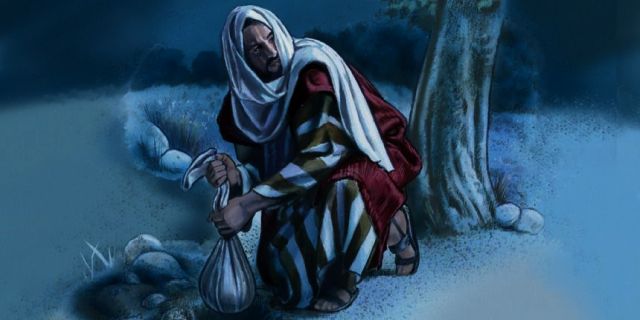
‘The man who had received the five talents promptly went and traded with them and made five more. The man who had received two made two more in the same way. But the man who had received one went off and dug a hole in the ground and hid his master’s money.
‘Now a long time after, the master of those servants came back and went through his accounts with them. The man who had received the five talents came forward bringing five more. “Sir,” he said “you entrusted me with five talents; here are five more that I have made.”
‘His master said to him, “Well done, good and faithful servant; you have shown you can be faithful in small things, I will trust you with greater; come and join in your master’s happiness.”
‘Next the man with the two talents came forward. “Sir,” he said “you entrusted me with two talents; here are two more that I have made.” His master said to him, “Well done, good and faithful servant; you have shown you can be faithful in small things, I will trust you with greater; come and join in your master’s happiness.”
‘Last came forward the man who had the one talent. “Sir,” said he “I had heard you were a hard man, reaping where you have not sown and gathering where you have not scattered; so I was afraid, and I went off and hid your talent in the ground. Here it is; it was yours, you have it back.” But his master answered him, “You wicked and lazy servant! So you knew that I reap where I have not sown and gather where I have not scattered? Well then, you should have deposited my money with the bankers, and on my return I would have recovered my capital with interest. So now, take the talent from him and give it to the man who has the five talents. For to everyone who has will be given more, and he will have more than enough; but from the man who has not, even what he has will be taken away. As for this good-for-nothing servant, throw him out into the dark, where there will be weeping and grinding of teeth.”’





 CatholicJules.net