




All you who thirst for love,
All you who thirst to fill an empty void,
All you who thirst for peace of mind,
All you who thirst for more than what the world can offer,
Come to me for I am the living water, I alone can grant you eternal life.
Archive for the ‘Memory Book’ Category
0
Today Before The Blessed Sacrament
Posted: January 5, 2013 by CatholicJules in Life's Journeys, Memory BookWhy do you come busy about your affairs? Come sit with me and experience my love for you, worship and adoration will come naturally for you in time…
Thank you Jesus, Praise You Jesus!
Solemnity Of Mary, the Holy Mother Of God
Posted: January 1, 2013 by CatholicJules in Life's Journeys, Memory Book
Let us pray….
O God of all the living, you brought to birth the day of salvation wrought through the One who is our ever lasting life and peace. Through the intercession of Mary, Mother of God and the world’s Mother, bring to perfection that which you have begun in Him who lives and reigns with You and The Holy Spirit, one God for ever and ever Amen.
~~~
The Blessed Virgin Mary is born to be Mother. The supreme consolation that Our Lady receives at the cross of her Son is the assurance that her vocation as Mother does not end with Christ’s death. The Lord commands the world, “Behold your Mother.” The Church begins for Mary – and for us – with these words. The Blessed Virgin’s womb remains for ever fruitful. Mary leads us to Christ, but Christ leads us back to his Mother, for without Mary’s maternity, Jesus would become a mere abstraction to us. The Lord wills to let His face shine upon us through the face of the Mother of God. We “serve a Mother who seems to grow more beautiful as new generations rise up and call her blessed” ( G.K. Chesterton ).

Because of you, Mary the light of the only begotten Son of God has shone upon those who sat in darkness and in the shadow of death; prophets pronounced the Word of God;the Apostles preached salvation to the Gentiles;the dead are raised to life, and kings rule by power of the holy Trinity.
Who can put Mary’s high honour into words? She is both Mother and Virgin. I am overwhelmed the wonder of this miracle. Of course no one could be prevented from living in the house he had built for himself, yet who would invite mockery by asking his own servant to become his mother?
Behold then the joy of the whole universe. let the union of God and man in the Son of the Virgin Mary fill us with awe and adoration. Let us fear and worship the undivided Trinity as we sing the praise of the ever-Virgin Mary, the holy temple of God, and of God himself, her Son and spotless Bridegroom. To Him be glory for ever and ever. Amen.
Saint Cyril of Alexandria +444
While In Adoration of the Blessed Sacrament 18 Dec
Posted: December 20, 2012 by CatholicJules in Memory BookSeeking hard to hear our Lord speak, a peaceful calm rested upon me and I heard His voice speaking to me as He spoke to Mother Mary and St John… “Woman, here is your son.” Then he said to the disciple, “Here is your mother.” Jn 19:26-27

I, the Lord, your God,
I am holding you by the right hand;
I tell you, ‘Do not be afraid,
I will help you.’ IS 41:13
The poor and needy ask for water, and there is none,
their tongue is parched with thirst.
I, the Lord, will answer them,
I, the God of Israel, will not abandon them. IS 41:17
From the rising of the sun, you will bathe in my Glory,for as you hold me close to your heart. So will I embrace you in mine.
From a letter to Proba by Saint Augustine, bishop
(Ep. 130, 11,21-12,22; CSEL 44, 63-64)
We need to use words so that we may remind ourselves to consider carefully what we are asking, not so that we may think we can instruct the Lord or prevail upon him.
Thus, when we say: Hallowed be your name, we are reminding ourselves to desire that his name, which in fact is always holy, should also be considered holy among men. I mean that it should not be held in contempt. But this is a help for men, not for God.
And as for our saying: Your kingdom come, it will surely come whether we will it or not. But we are stirring up our desires for the kingdom so that it can come to us and we can deserve to reign there.
When we say: Your will be done on earth as it is in heaven, we are asking him to make us obedient so that his will may be done in us as it is done in heaven by his angels.
When we say: Give us this day our daily bread, in saying this day we mean “in this world.” Here we ask for a sufficiency by specifying the most important part of it; that is, we use the word “bread” to stand for everything. Or else we are asking for the sacrament of the faithful, which is necessary in this world, not to gain temporal happiness but to gain the happiness that is everlasting.
When we say: Forgive us our trespasses as we forgive those who trespass against us, we are reminding ourselves of what we must ask and what we must do in order to be worthy in turn to receive.
When we say: Lead us not into temptation, we are reminding ourselves to ask that his help may not depart from us; otherwise we could be seduced and consent to some temptation, or despair and yield to it.
When we say: Deliver us from evil, we are reminding ourselves to reflect on the fact that we do not yet enjoy the state of blessedness in which we shall suffer no evil. This is the final petition contained in the Lord’s Prayer, and it has a wide application. In this petition the Christian can utter his cries of sorrow, in it he can shed his tears, and through it he can begin, continue and conclude his prayer, whatever the distress in which he finds himself. Yes, it was very appropriate that all these truths should be entrusted to us to remember in these very words.
Whatever be the other words we may prefer to say (words which the one praying chooses so that his disposition may become clearer to himself or which he simply adopts so that his disposition may be intensified), we say nothing that is not contained in the Lord’s Prayer, provided of course we are praying in a correct and proper way. But if anyone says something which is incompatible with this prayer of the Gospel, he is praying in the flesh, even if he is not praying sinfully. And yet I do not know how this could be termed anything but sinful, since those who are born again through the Spirit ought to pray only in the Spirit.
Gentle reminder if you had forgotten…..
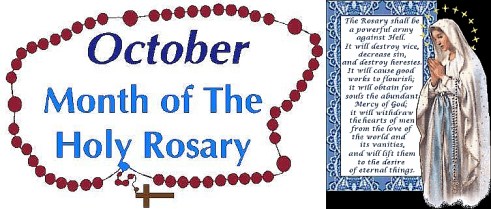
I invite you to join the Rosary Confraternity….Click on the image for more information…
While In Adoration…And In Praise & Worship
Posted: October 3, 2012 by CatholicJules in Life's Journeys, Memory BookWhile In Adoration of the Blessed Sacrament….
Cling to me and I will keep you safe. Put your head on my bosom and experience my deep love for you.
During a Praise and Worship session…..
To be a child of God is to do my Father’s Will.

Angel of God,
my guardian dear,
To whom God’s love
commits me here,
Ever this day,
be at my side,
To light and guard,
Rule and guide.
Amen.
“From infancy to death human life is surrounded by their (the angels) watchful care and intercession. Beside each believer stands an angel as protector and shepherd leading him to life. Already here on earth the Christian life shares by faith in the blessed company of angels and men united to God.”
– from the Catechism of the Catholic Church; 336.
The Church, Like A Vine, Spreads Everywhere In Her Growth
Posted: September 25, 2012 by CatholicJules in Memory BookFrom a sermon On Pastors by St. Augustine, bishop
They were scattered on every mountain and on every hill and over the entire face of the earth. What is the meaning of the phrase: They were scattered over the entire face of the earth? Some men continually strive for all the goods of the world, the goods that are so evident on the face of the earth; yes, they love and prize them. They do not want to die, to have their lives buried in Christ. Over the entire face of the earth: such men love earthly things; moreover such straying sheep are to be found over the entire face of the earth. They dwell in different places, but one mother, pride, has given birth to them all, just as one mother, our Catholic Church, has given birth to all faithful Christians scattered over the whole world.
Small wonder that pride gives birth to division, and love to unity. But our catholic mother is herself a shepherd; she seeks the straying sheep everywhere, strengthens the weak, heals the sick, and binds up the injured. They may not know one another, but she knows all of them because she reaches out to all her sheep.
Thus she is like a vine that is spread out everywhere in its growth. The straying sheep are like useless branches which because of their sterility are deservedly cut off, not to destroy the vine but to prune it. When these branches were cut down, they were left lying there. But the vine grew and flourished, and it knew both the branches that remained upon it and those that had been cut off and left lying beside it.
She calls the stray sheep back, however, because the Apostle said in reference to the broken branches: God has the power to graft them on again. Call them sheep straying from the flock or branches cut off from the vine, God is equally capable of calling back the sheep or of grafting the branches on again, for he is equally the chief shepherd and the true farmer. And they were scattered over the entire face of the earth, and there was no one to search for them, no one to call them back, that is to say, no one among those wicked shepherds. There was no one to search for them, that is, no one among men.
Therefore, shepherds, hear the word of the Lord: I live, says the Lord God. Notice the beginning of this passage; it is as if God were taking an oath, giving testimony to his own life. I live, says the Lord. The shepherds are dead, but the sheep are safe, for the Lord lives. I live, says the Lord God. Which shepherds are dead? Those who seek what is theirs and not what is Christ’s. But will there be shepherds who seek what is Christ’s and not what is theirs, and will they be found? There will indeed be such shepherds, and they will indeed be found; they are not lacking, nor will they be lacking in the future.
A Prayer Of Blessed John Henry Newman
Man… Is ever changing. Not a day passes but I am nearer the grave. Whatever my age, whatever the number of my years, I am ever narrowing the interval between time and eternity…. O my God I am crumbling away, as I go on! I am already dissolving into my first elements. My soul indeed cannot die, for you have made it immortal; but my bodily frame is continually resolving into that dust out of which it was taken.
Everything below heaven changes : spring, summer, autumn, each has its turn. The fortunes of the world change. What was high lies low; what was low rises high. Riches take wings and flee away; bereavements happen. Friends become enemies, and enemies friends. Our wishes, aims and plans change. There is nothing stable but you, O my God! And you are the center and life of all who change, who trust you as their Father, who look to you, and who are content to put themselves into your hands.
I know, O my God, I must change, if I am to see your face! I must undergo the change of death. Body and soul must die to this world. My real self, my soul must change by a true regeneration. Only the Holy can see you… Oh support me as I proceed in this great awful, happy change, with the grace of your unchangeableness…. Let me day by day be molded upon you, and be changed from glory to glory, by ever looking toward you, and ever leaning on your arm.
I know, O Lord, I must go through trial, temptation, and much conflict, if I am to come to you. I do not know what lies before me, but I know this. I know, too, that If you are not with me, my change will be for the worse, not for the better. Whatever fortune I have, rich or poor, healthy or sick, with friends or without, all will turn to evil if I am not sustained by the Unchangeable. All will turn to good if I have Jesus with me, yesterday and today, the same, and for ever.
“God has not created me for naught. I shall do good, I shall do his work, I shall be an angel of peace, a preacher of truth in my own place while not intending it if I just keep His commandments. Therefore I will trust Him. Whatever I am, I can never be thrown away. If I am in sickness, my sickness may serve Him; in perplexity, my perplexity may serve Him. If I am in sorrow, my sorrow may serve Him. He does nothing in vain… He knows what He is about.”
Blessed John Henry Newman
While In Adoration Of The Blessed Sacrament During A Retreat
Posted: August 21, 2012 by CatholicJules in Life's Journeys, Memory BookAn act of love is remaining silent even though our egos desires to speak.
An act of love is a decision to love even before seeing, hearing or touching.
An act of love is to always welcome the stranger in our midst.
A Christian may never think of belief as a private act. Faith is choosing to stand with the Lord so as to live with him. This “standing with him” points towards an understanding of the reasons for believing. Faith, precisely because it is a free act, also demands social responsibility for what one believes.
Pope Benedict XVI
Origins Of St Peter As Pope
Posted: July 18, 2012 by CatholicJules in Great Catholic Articles, Memory Book The New Testament contains five different metaphors for the foundation of the Church (Matt. 16:18, 1 Cor. 3:11, Eph. 2:20, 1 Pet. 2:5–6, Rev. 21:14). One metaphor that has been disputed is Jesus Christ’s calling the apostle Peter “rock”: “You are Peter, and on this rock I will build my Church, and the gates of hell will not prevail against it” (Matt. 16:18).
Some have tried to argue that Jesus did not mean that his Church would be built on Peter but on something else.
Some argue that in this passage there is a minor difference between the Greek term for Peter (Petros) and the term for rock (petra), yet they ignore the obvious explanation: petra, a feminine noun, has simply been modifed to have a masculine ending, since one would not refer to a man (Peter) as feminine. The change in the gender is purely for stylistic reasons.
These critics also neglect the fact that Jesus spoke Aramaic, and, as John 1:42 tells us, in everyday life he actually referred to Peter as Kepha or Cephas (depending on how it is transliterated). It is that term which is then translated into Greek as petros. Thus, what Jesus actually said to Peter in Aramaic was: “You are Kepha and on this very kepha I will build my Church.”
The Church Fathers, those Christians closest to the apostles in time, culture, and theological background, clearly understood that Jesus promised to build the Church on Peter, as the following passages show.
Tatian the Syrian
“Simon Cephas answered and said, ‘You are the Messiah, the Son of the living God.’ Jesus answered and said unto him, ‘Blessed are you, Simon, son of Jonah: flesh and blood has not revealed it unto thee, but my Father which is in heaven. And I say unto thee also, that you are Cephas, and on this rock will I build my Church; and the gates of hades shall not prevail against it” (The Diatesseron 23 [A.D. 170]).
Tertullian
“Was anything withheld from the knowledge of Peter, who is called ‘the rock on which the Church would be built’ [Matt. 16:18] with the power of ‘loosing and binding in heaven and on earth’ [Matt. 16:19]?” (Demurrer Against the Heretics 22 [A.D. 200]).
“[T]he Lord said to Peter, ‘On this rock I will build my Church, I have given you the keys of the kingdom of heaven [and] whatever you shall have bound or loosed on earth will be bound or loosed in heaven’ [Matt. 16:18–19]. . . . What kind of man are you, subverting and changing what was the manifest intent of the Lord when he conferred this personally upon Peter? Upon you, he says, I will build my Church; and I will give to you the keys” (Modesty 21:9–10 [A.D. 220]).
The Letter of Clement to James
“Be it known to you, my lord, that Simon [Peter], who, for the sake of the true faith, and the most sure foundation of his doctrine, was set apart to be the foundation of the Church, and for this end was by Jesus himself, with his truthful mouth, named Peter” (Letter of Clement to James 2 [A.D. 221]).
The Clementine Homilies
“[Simon Peter said to Simon Magus in Rome:] ‘For you now stand in direct opposition to me, who am a firm rock, the foundation of the Church’ [Matt. 16:18]” (Clementine Homilies 17:19 [A.D. 221]).
Origen
“Look at [Peter], the great foundation of the Church, that most solid of rocks, upon whom Christ built the Church [Matt. 16:18]. And what does our Lord say to him? ‘Oh you of little faith,’ he says, ‘why do you doubt?’ [Matt. 14:31]” (Homilies on Exodus 5:4 [A.D. 248]).
Cyprian of Carthage
“The Lord says to Peter: ‘I say to you,’ he says, ‘that you are Peter, and upon this rock I will build my Church, and the gates of hell will not overcome it. And to you I will give the keys of the kingdom of heaven . . . ’ [Matt. 16:18–19]. On him [Peter] he builds the Church, and to him he gives the command to feed the sheep [John 21:17], and although he assigns a like power to all the apostles, yet he founded a single chair [cathedra], and he established by his own authority a source and an intrinsic reason for that unity. Indeed, the others were that also which Peter was [i.e., apostles], but a primacy is given to Peter, whereby it is made clear that there is but one Church and one chair. . . . If someone does not hold fast to this unity of Peter, can he imagine that he still holds the faith? If he [should] desert the chair of Peter upon whom the Church was built, can he still be confident that he is in the Church?” (The Unity of the Catholic Church 4; 1st edition [A.D. 251]).
“There is one God and one Christ, and one Church, and one chair founded on Peter by the word of the Lord. It is not possible to set up another altar or for there to be another priesthood besides that one altar and that one priesthood. Whoever has gathered elsewhere is scattering” (Letters 43[40]:5 [A.D. 253]).
“There [John 6:68–69] speaks Peter, upon whom the Church would be built, teaching in the name of the Church and showing that even if a stubborn and proud multitude withdraws because it does not wish to obey, yet the Church does not withdraw from Christ. The people joined to the priest and the flock clinging to their shepherd are the Church. You ought to know, then, that the bishop is in the Church and the Church in the bishop, and if someone is not with the bishop, he is not in the Church. They vainly flatter themselves who creep up, not having peace with the priests of God, believing that they are
secretly [i.e., invisibly] in communion with certain individuals. For the Church, which is one and Catholic, is not split nor divided, but it is indeed united and joined by the cement of priests who adhere one to another” (ibid., 66[69]:8).
Firmilian
“But what is his error . . . who does not remain on the foundation of the one Church which was founded upon the rock by Christ [Matt. 16:18], can be learned from this, which Christ said to Peter alone: ‘Whatever things you shall bind on earth shall be bound also in heaven; and whatever you loose on earth, they shall be loosed in heaven’ [Matt. 16:19]” (collected in Cyprian’s Letters74[75]:16 [A.D. 253]).
“[Pope] Stephen [I] . . . boasts of the place of his episcopate, and contends that he holds the succession from Peter, on whom the foundations of the Church were laid [Matt. 16:18]. . . . [Pope] Stephen . . . announces that he holds by succession the throne of Peter” (ibid., 74[75]:17).
Ephraim the Syrian
“[Jesus said:] ‘Simon, my follower, I have made you the foundation of the holy Church. I betimes called you Peter, because you will support all its buildings. You are the inspector of those who will build on earth a Church for me. If they should wish to build what is false, you, the foundation, will condemn them. You are the head of the fountain from which my teaching flows; you are the chief of my disciples’” (Homilies 4:1 [A.D. 351]).
Optatus
“You cannot deny that you are aware that in the city of Rome the episcopal chair was given first to Peter; the chair in which Peter sat, the same who was head—that is why he is also called Cephas [‘Rock’]—of all the apostles; the one chair in which unity is maintained by all” (The Schism of the Donatists 2:2 [A.D. 367]).
Ambrose of Milan
“[Christ] made answer: ‘You are Peter, and upon this rock will I build my Church. . . . ’ Could he not, then, strengthen the faith of the man to whom, acting on his own authority, he gave the kingdom, whom he called the rock, thereby declaring him to be the foundation of the Church [Matt. 16:18]?” (The Faith 4:5 [A.D. 379]).
“It is to Peter that he says: ‘You are Peter, and upon this rock I will build my Church’ [Matt. 16:18]. Where Peter is, there is the Church. And where the Church is, no death is there, but life eternal” (Commentary on Twelve Psalms of David 40:30 [A.D. 389]).
Pope Damasus I
“Likewise it is decreed . . . that it ought to be announced that . . . the holy Roman Church has not been placed at the forefront [of the churches] by the conciliar decisions of other churches, but has received the primacy by the evangelic voice of our Lord and Savior, who says: ‘You are Peter, and upon this rock I will build my Church, and the gates of hell will not prevail against it; and I will give to you the keys of the kingdom of heaven. . . . ’ [Matt. 16:18–19]. The first see, therefore, is that of Peter the apostle, that of the Roman Church, which has neither stain nor blemish nor anything like it” (Decree of Damasus 3 [A.D. 382]).
Jerome
“‘But,’ you [Jovinian] will say, ‘it was on Peter that the Church was founded’ [Matt. 16:18]. Well . . . one among the twelve is chosen to be their head in order to remove any occasion for division” (Against Jovinian 1:26 [A.D. 393]).
“I follow no leader but Christ and join in communion with none but your blessedness [Pope Damasus I], that is, with the chair of Peter. I know that this is the rock on which the Church has been built. Whoever eats the Lamb outside this house is profane. Anyone who is not in the ark of Noah will perish when the flood prevails” (Letters 15:2 [A.D. 396]).
Augustine
“If the very order of episcopal succession is to be considered, how much more surely, truly, and safely do we number them [the bishops of Rome] from Peter himself, to whom, as to one representing the whole Church, the Lord said, ‘Upon this rock I will build my Church, and the gates of hell shall not conquer it.’ Peter was succeeded by Linus, Linus by Clement. … In this order of succession a Donatist bishop is not to be found” (Letters 53:1:2 [A.D. 412]).
Council of Ephesus
“Philip, the presbyter and legate of the Apostolic See [Rome], said: ‘There is no doubt, and in fact it has been known in all ages, that the holy and most blessed Peter, prince and head of the apostles, pillar of the faith, and foundation of the Catholic Church, received the keys of the kingdom from our Lord Jesus Christ, the Savior and Redeemer of the human race, and that to him was given the power of loosing and binding sins: who down even to today and forever both lives and judges in his successors’” (Acts of the Council, session 3 [A.D. 431]).
Sechnall of Ireland
“Steadfast in the fear of God, and in faith immovable, upon [Patrick] as upon Peter the [Irish] church is built; and he has been allotted his apostleship by God; against him the gates of hell prevail not” (Hymn in Praise of St. Patrick 3 [A.D. 444]).
Pope Leo I
“Our Lord Jesus Christ . . . has placed the principal charge on the blessed Peter, chief of all the apostles. . . . He wished him who had been received into partnership in his undivided unity to be named what he himself was, when he said: ‘You are Peter, and upon this rock I will build my Church’ [Matt. 16:18], that the building of the eternal temple might rest on Peter’s solid rock, strengthening his Church so surely that neither could human rashness assail it nor the gates of hell prevail against it” (Letters 10:1 [A.D. 445]).
Council of Chalcedon
“Wherefore the most holy and blessed Leo, archbishop of the great and elder Rome, through us, and through this present most holy synod, together with the thrice blessed and all-glorious Peter the apostle, who is the rock and foundation of the Catholic Church, and the foundation of the orthodox faith, has stripped him [Dioscorus] of the episcopate” (Acts of the Council, session 3 [A.D. 451]).
NIHIL OBSTAT: I have concluded that the materials
presented in this work are free of doctrinal or moral errors.
Bernadeane Carr, STL, Censor Librorum, August 10, 2004
IMPRIMATUR: In accord with 1983 CIC 827
permission to publish this work is hereby granted.
+Robert H. Brom, Bishop of San Diego, August 10, 2004
The Start of Repentance
Posted: July 17, 2012 by CatholicJules in Great Catholic Articles, Memory BookBut some one may say,”It is so very difficult to serve God, it is so much against my own mind, such an effort, such a strain upon my , strength to bear Christ’s yoke, I must give it over, or I must delay it at least. Can nothing be taken instead? I acknowledge his law to be most holy and true and the accounts I read about good men are most delightful. I wish I were like them with all my heart; and for a little while I feel in a mind to set about imitating them. I must have begun several times, I have had seasons of repentance, and set rules to myself; but for some reason or other, I fell back after a while, and was even worse than before. I know, but I cannot do. “O wretched man that I am!”
Now to such a one I say, You are in a much more promising state than if you were contented with yourself, and thought that knowledge was every thing, which is the grievous blindness which I have hitherto been speaking of; you are in a better state, if you do not feel too much comfort or confidence in your confession. For this is the fault of many men; they make such an acknowledgement as I have described a substitute for real repentance; or allow themselves, after making it, to put off repentance, as if they could be suffered to give a word of promise which did not become due (so to say) for many days. You are, I admit, in a better state than if you were satisfied with yourself.
Blessed John Henry Newman
+1890
More Notes On Evangelisation…
Posted: June 21, 2012 by CatholicJules in Life's Journeys, Memory Book, Personal Thoughts & ReflectionsBy virtue of our baptism we are all commissioned to go and spread the good news though each of us have been given different gifts to do so…..
- Evangelisation needs to come naturally. You must want to talk about Jesus.
- Evangelisation is about conversion, it is about planting a seed.
- You can start at home then the Church, community and then outside the community.
- Evangelisation reminds us all that God reigns overall, it is our responsibility to God to share His love with all.
- Let us not be paralysed by fear….
- Most think that the Devil uses the ultimate weapon ‘Hatred’ but over the years we can see that it is actually ‘Fear’ which causes inacti0n. “And in what we have failed to do…..”
- William Shakespeare once said,”A coward dies a thousand deaths, a brave one dies but one.
Here are four simple steps we can take to begin :-
- Prayer – We all can do at least one thing together and that is pray. We can pray for the conversion of others, healing, mercy, and most importantly for our enemies or those that most have given up on.
- Listen first then speak second. Listening is key, we have two ears and one mouth that should already be telling us that we should be listening twice as hard. But it is essential that we speak up too. We may not have all the answers but we can certainly speak about God’s love and mercy. And again most importantly we should speak in the name of Jesus.
- Do something. – We should all be doing something! Move our feet into action and walk…..We have been reminded over and over again that the kingdom of God is at hand. And He will come like a thief in the night…..so let us be prepared…let us start today…whatever we have been called to do…we start now!
- Inner Conversion – Our Transfiguration. We have to be a different people. We must change, we must want to change. We must strive to be a people of mercy and compassion. To be Holy and perfect as our Heavenly Father is Holy and perfect.
In my personal experience, I use to cringe at the thought of Evagelisation, because I had always thought that I had to be knowledgeable about my faith before I could even attempt to talk about Jesus. I also knew that if I didn’t at least try to start somewhere I would likely never ever do so. So with a prayer to the Holy Spirit, I began to try and talk about Jesus. I found it was easy to start with simply what Jesus has done for me in my life. How I have grown in faith and turned my life around and of how, I now experience inner joy and peace which I have not known before. Most people like to listen to stories, so why not tell my personal story? ( True living experience )
In my journey, I have found that family members and some closest friends are usually the toughest audience and more often than naught you will get grieve from them. But do not despair, you are not called to convert them but simply plant the seed of love. God will do the rest over time. I have witnessed this myself in my own family life.
Join me now as we participate with Jesus Christ to save the human race….
During a worship session…..
Posted: June 20, 2012 by CatholicJules in Life's Journeys, Meditations, Memory BookDo not let the cares of the world overwhelm you, sit by my side and I will give you living water to drink.
(SACCRE Ablaze Rally at Church Of The Holy Cross And A Talk by Jim Murphy ICCRS – Theme “The Royal Commission”)
Listen to this great interview with Country Singer by Marcus Grodi from the Journey Home. Click on the link below and enjoy..
As I Was Praying Before The Blessed Sacrament….
Posted: June 3, 2012 by CatholicJules in Life's Journeys, Memory Book“When you turn off the light of your heart to my love, you invite sin to manifest in you. Do not allow your shame to dishearten you or shy away from me, know that when you open your heart to me, I will bring forth my burning light of Love to illuminate your heart and set you free. Sin cannot prevail in the light of my love for you my son, my daughter. Remain in my love always…..”
A Fruitful Life Comes From Staying Close To Jesus, Pope Says
Posted: May 8, 2012 by CatholicJules in Memory Book(http://www.catholicnewsagency.com/new.php?n=24861)
VATICAN CITY, May 6 (CNA/EWTN News) .- Pope Benedict XVI told pilgrims May 6 that their lives will be fruitful and have meaning if they live in union with Jesus Christ.
“Dear friends, every one of us is like a vine, which lives only if it is growing every day in prayer, participation in the sacraments, in charity, in its union with the Lord,” said the Pope in his midday Regina Coeli address marking the fifth Sunday of Easter.
“And he who loves Jesus, the true vine, produces fruits of faith for an abundant spiritual harvest.”
The Pope spoke to large crowds in an overcast and drizzly St. Peter’s Square, reflecting upon the words of Jesus, as recorded in today’s Gospel of St. John; “I am the true vine, and my Father is the vinedresser.”
In this passage, the Pope explained to pilgrims, Jesus reveals himself as “the true vine of God, the true life” who “with his sacrifice of love gives us salvation” and “opens the way to be part of this vine.”
And just as Christ is in God the Father, so his followers “carefully pruned by the words of the Master, are united in a profound way to him, becoming fruitful branches, which produce an abundant harvest.”
The Pope then quoted the 16-17th century Swiss bishop St Frances de Sales who, in his Treatise on the Love of God, observed how in nature “the branches united and joined to the trunk bears fruit not by its own virtue.”
Similarly a Christian who is “joined by love to our Redeemer” will produce “good works, taking their value from him, merit life eternal.”
Pope Benedict explained that this union occurs in baptism when “the Church grafts us as branches into the paschal mystery of Christ, into his own person.”
>From there on, he said, “it is essential to remain united to Jesus, to depend upon him” because “without him we can do nothing.”
This proposition, however, does not contradict a belief in the freedom of man, said Pope Benedict. He highlighted the 5th century writing of St. John the Prophet from Gaza who told an enquirer that “if a man inclines his heart to the good and asks God’s help, he receives the necessary strength to accomplish his work.”
Therefore “the freedom of man and power of God go together” as the good act is “possible because the Lord is good” but “it is fulfilled, thanks to his faithful.”
Before going onto pray the Regina Coeli, Pope Benedict concluded his comments by commending those present to Mary, the mother of God.
“Let us beseech the Mother of God that we might remain firmly grafted in Jesus and that all our actions may have their beginning, and their fulfillment, in Him.”
Sometimes Christ comes with such great majesty that no one could doubt but that it is the Lord himself. Especially after receiving Communion – for we know that he is present, since our faith tells us this – he reveals himself as so much the lord of this dwelling that it seems the soul is completely dissolved; and it sees itself consumed in Christ. O my Jesus! Who could make known the majesty with which you reveal yourself! And, Lord of all the world and of the heavens, of a thousand other worlds and of numberless worlds, and of the heavens that you might create, how the soul understands by the majesty with which you reveal yourself that it is nothing for you to be Lord of the world!
In this vision the powerlessness of all the devils in comparison with your power is clearly seen, my Jesus; and it is seen how whoever is pleasing to you can trample all hell under foot. In this vision the reason is seen why the devils feared when you descended into limbo and why they would have preferred to be in another thousand lower hells in order to flee from such great majesty. I see that you want the soul to know how tremendous this majesty is and the power that his most sacred humanity joined with the divinity has.
Saint Teresa Of Avilla +1582
The Church As Sacrament Of Unity And Salvation
Posted: March 29, 2012 by CatholicJules in Memory BookFrom the dogmatic constitution on the Church of the Second Vatican Council
See, the days are coming, says the Lord, when I will make a new covenant with the house of Israel and the house of Judah… I will plant my law within them and inscribe it in their hearts. I will be their God and they shall be my people… All shall know me, from the least to the greatest, says the Lord.
It was Christ who established this new covenant, the new testament in his blood, calling into being, from Jews and Gentiles, a people that was to form a unity, not in human fashion but in the Spirit, as the new people of God. Those who believe in Christ, reborn not of corruptible but of incorruptible seed through the word of the living God, not from the flesh but from water and the Holy Spirit, are constituted in the fullness of time as a chosen race, a royal priesthood, a holy nation, a people God has made his own…, once no people but now the people of God.
This messianic people has Christ as its head: Christ who was given up for our sins and rose again for our justification; bearing now the name that is above every name, he reigns in glory in heaven. His people enjoy the dignity and freedom of the children of God, in whose hearts the Holy Spirit dwells as in a temple. They have as their law the new commandment of loving as Christ himself has loved us. They have as their goal the kingdom of God, begun on earth by God himself and destined to grow until it is also brought to perfection by him at the end of time, when Christ, our life, will appear, and creation itself will be freed from slavery to corruption and take on the freedom of the glory of God’s children.
This messianic people, then, though it does not in fact embrace all mankind and often seems to be a tiny flock, is yet the enduring source of unity, hope and salvation for the whole human race. It is established by Christ as a communion of life, of love and of truth; it is also used by him as an instrument for the redemption of all, and is sent out into the whole world as the light of the world and the salt of the earth.
The Israel of old was already called the Church of God while it was on pilgrimage through the desert. So the new Israel, as it makes its way in this present age, seeking a city that is to come, a city that will remain, is also known as the Church of Christ, for he acquired it by his own blood, filled it with his Spirit, and equipped it with appropriate means to be a visible and social unity. God has called together the assembly of those who in faith look on Jesus, the author of salvation and the principle of unity and peace, and so has established the Church to be for each and all the visible sacrament of this unity which brings with it salvation.
(This is a really beautiful take on Christ’s love for us, I’ve highligted a few really striking passages….Catholicjules )
Look at this cross, so much bigger than the man whose body will be stretched to fit it. So much higher than the height of the man who will be lifted up above the earth on it and who, being lifted up, will draw all peoples to himself. Christ receives it with joy because he knows that this is the dead weight that must have crushed humankind had he not lifted it from their backs. This is the dead wood which at his touch is transformed to a living tree. At his touch, the hewn tree takes root again, and the roots thrust down into the earth, and the tree breaks into flowers….
Because Christ is to be stretched to the size of the cross, those who love him will grow to the size of it, not only to the size of man’s suffering, which is bigger than man, but to the size of Christ’s love that is bigger than all suffering. Because Christ is to be lifted up on the cross, all those who love him will be lifted up above the world by the world’s sorrow. He, being lifted up, will draw all men to himself.
Because Christ has changed death to life, and suffering to redemption, the suffering of those who love him will be a communion between them. All that hidden daily suffering that seems insignificant will be redeeming the world, it will be healing the wounds of the world. The acceptance of pain, old age, of the fear of death, and of death will be our gift of Christ’s love to one another; our gift of Christ’s life to one another.
No man’s cross is laid upon him for himself alone, but for the healing of the whole world, for the mutual comforting and sweetening of sorrow, for the giving of joy and supernatural life to one another. For Christ receives our cross that we may receive his. Receiving this cross, the cross of the whole world made his, we receive him. He gives us his hands to take hold of, his power to make it a redeeming thing, a blessed thing, his life to cause it to flower, his heart to enable us rejoice in accepting our own and one another’s burdens.
Caryll Houselander + 1954
From a sermon by Saint Leo the Great, pope
(Sermo 15, De passione Domini, 3-4: PL 54, 366-367)
True reverence for the Lord’s passion means fixing the eyes of our heart on Jesus crucified and recognizing in him our own humanity.
The earth—our earthly nature—should tremble at the suffering of its Redeemer. The rocks—the hearts of unbelievers—should burst asunder. The dead, imprisoned in the tombs of their mortality, should come forth, the massive stones now ripped apart. Foreshadowings of the future resurrection should appear in the holy city, the Church of God: what is to happen to our bodies should now take place in our hearts.
No one, however weak, is denied a share in the victory of the cross. No one is beyond the help of the prayer of Christ. His prayer brought benefit to the multitude that raged against him. How much more does it bring to those who turn to him in repentance.
Ignorance has been destroyed, obstinacy has been overcome. The sacred blood of Christ has quenched the flaming sword that barred access to the tree of life. The age-old night of sin has given place to the true light.
The Christian people are invited to share the riches of paradise. All who have been reborn have the way open before them to return to their native land, from which they had been exiled. Unless indeed they close off for themselves the path that could be opened before the faith of a thief.
The business of this life should not preoccupy us with its anxiety and pride, so that we no longer strive with all the love of our heart to be like our Redeemer, and to follow his example. Everything that he did or suffered was for our salvation: he wanted his body to share the goodness of its head.
First of all, in taking our human nature while remaining God, so that the Word became man, he left no member of the human race, the unbeliever excepted, without a share in his mercy. Who does not share a common nature with Christ if he has welcomed Christ, who took our nature, and is reborn in the Spirit through whom Christ was conceived?
Again, who cannot recognize in Christ his own infirmities? Who would not recognize that Christ’s eating and sleeping, his sadness and his shedding of tears of love are marks of the nature of a slave?
It was this nature of a slave that had to be healed of its ancient wounds and cleansed of the defilement of sin. For that reason the only-begotten Son of God became also the son of man. He was to have both the reality of a human nature and the fullness of the godhead.
The body that lay lifeless in the tomb is ours. The body that rose again on the third day is ours. The body that ascended above all the heights of heaven to the right hand of the Father’s glory is ours. If then we walk in the way of his commandments, and are not ashamed to acknowledge the price he paid for our salvation in a lowly body, we too are to rise to share his glory. The promise he made will be fulfilled in the sight of all: Whoever acknowledges me before men, I too will acknowledge him before my Father who is in heaven.
From a sermon by Saint Bernadine of Siena, priest
There is a general rule concerning all special graces granted to any human being. Whenever the divine favor chooses someone to receive a special grace, or to accept a lofty vocation, God adorns the person chosen with all the gifts of the Spirit needed to fulfill the task at hand.
This general rule is especially verified in the case of Saint Joseph, the foster-father of our Lord and the husband of the Queen of our world, enthroned above the angels. He was chosen by the eternal Father as the trustworthy guardian and protector of his greatest treasures, namely, his divine Son and Mary, Joseph’s wife. He carried out this vocation with complete fidelity until at last God called him, saying: Good and faithful servant enter into the joy of your Lord.
What then is Joseph’s position in the whole Church of Christ? Is he not a man chosen and set apart? Through him and, yes, under him, Christ was fittingly and honorably introduced into the world. Holy Church in its entirety is indebted to the Virgin Mother because through her it was judged worthy to receive Christ. But after her we undoubtedly owe special gratitude and reverence to Saint Joseph.
In him the Old Testament finds its fitting close. He brought the noble line of patriarchs and prophets to its promised fulfillment. What the divine goodness had offered as a promise to them, he held in his arms.
Obviously, Christ does not now deny to Joseph that intimacy, reverence and very high honor which he gave him on earth, as a son to his father. Rather we must say that in heaven Christ completes and perfects all that he gave at Nazareth.
Now we can see how the last summoning words of the Lord appropriately apply to Saint Joseph: Enter into the joy of your Lord. In fact, although the joy of eternal happiness enters into the soul of a man, the Lord preferred to say to Joseph: Enter into joy. His intention was that the words should have a hidden spiritual meaning for us. They convey not only that this holy man possesses an inward joy, but also that it surrounds him and engulfs him like an infinite abyss.
Remember us, Saint Joseph, and plead for us to your foster-child. Ask your most holy bride, the Virgin Mary, to look kindly upon us, since she is the mother of him who with the Father and the Holy Spirit lives and reigns eternally. Amen.
Bring me the sign of true humility by being not overly ambitious in your position, but lowly. Don’t be impatient over any pain or abuse you might suffer, but endure within the body of holy Church by the firm power of patience, even to the point of death. When you speak and proclaim the truth, whether in giving counsel or in any other role, do it fearlessly, looking only to God’s honour, the salvation of souls, and the advancement of holy Church, as her true son, nurtured by so tender a Mother. In this way you will demonstrate gentle divine charity and patience as well. Be generous in your charity – spiritually, as I’ve already said, but materially too. Reflect that the hands of the poor are helping you to offer and receive divine grace. I want you begin a new life, a new way of living: slumber no more in the sleep of foolish indifference. Be a real champion for me, please.
I told you that I want you to be lamb, a follower of the true lamb. Now I’m telling you that I want you to be a lion, roaring loudly in holy Church, your virtue and your voice so strong that you help bring back to life the children lying dead with her. Perhaps you are asking: “Where can I get such a strong roaring voice?” From the lamb, who in his humility remains meek and does not cry out, but whose divinity lends power to the Son’s cry with the voice of it’s immeasurable charity. And so, by the strength and power of divine being and of the love that joined God with humanity, the lamb becomes a lion. From the chair of the cross he roared so loudly over the dead child, the human race, that he freed us from death and gave us life. It is from him, then, that we will receive strength, for the love we will drink from the gentle Jesus will give us a share in the Father’s power.
Saint Catherine Of Siena +1380
The Law Was Given Through Moses, Grace And Truth Came Through Jesus Christ
Posted: March 5, 2012 by CatholicJules in Meditations, Memory BookFrom a sermon by Saint Leo the Great, pope
The Lord reveals his glory in the presence of chosen witnesses. His body is like that of the rest of mankind, but he makes it shine with such splendor that his face becomes like the sun in glory, and his garments as white as snow.
The great reason for this transfiguration was to remove the scandal of the cross from the hearts of his disciples, and to prevent the humiliation of his voluntary suffering from disturbing the faith of those who had witnessed the surpassing glory that lay concealed.
With no less forethought he was also providing a firm foundation for the hope of holy Church. The whole body of Christ was to understand the kind of transformation that it would receive as his gift. The members of that body were to look forward to a share in that glory which first blazed out in Christ their head.
The Lord had himself spoken of this when he foretold the splendor of his coming: Then the just will shine like the sun in the kingdom of their Father. Saint Paul the apostle bore witness to this same truth when he said: I consider that the sufferings of the present time are not to be compared with the future glory that is to be revealed in us. In another place he says: You are dead, and your life is hidden with Christ in God. When Christ, your life, is revealed, then you also will be revealed with him in glory.
This marvel of the transfiguration contains another lesson for the apostles, to strengthen them and lead them into the fullness of knowledge. Moses and Elijah, the law and the prophets, appeared with the Lord in conversation with him. This was in order to fulfill exactly, through the presence of these five men, the text which says: Before two or three witnesses every word is ratified. What word could be more firmly established, more securely based, than the word which is proclaimed by the trumpets of both old and new testaments, sounding in harmony, and by the utterances of ancient prophecy and the teaching of the Gospel, in full agreement with each other?
The writings of the two testaments support each other. The radiance of the transfiguration reveals clearly and unmistakably the one who had been promised by signs foretelling him under the veils of mystery. As Saint John says: The law was given through Moses, grace and truth came through Jesus Christ. In him the promise made through the shadows of prophecy stands revealed, along with the full meaning of the precepts of the law. He is the one who teaches the truth of prophecy through his presence, and makes obedience to the commandments possible through grace.
In the preaching of the holy Gospel all should receive a strengthening of their faith. No one should be ashamed of the cross of Christ, through which the world has been redeemed.
No one should fear to suffer for the sake of justice; no one should lose confidence in the reward that has been promised. The way to rest is through toil, the way to life is through death. Christ has taken on himself the whole weakness of our lowly human nature. If then we are steadfast in our faith in him and in our love for him, we win the victory that he has won, we receive what he has promised.
When it comes to obeying the commandments or enduring adversity, the words uttered by the Father should always echo in our ears: This is my Son, the beloved, in whom I am well pleased; listen to him.
From the pastoral constitution on the Church in the modern world of the Second Vatican Council
The world of today reveals itself as at once powerful and weak, capable of achieving the best or the worst. There lies open before it the way to freedom or slavery, progress or regression, brotherhood or hatred. In addition, man is becoming aware that it is for himself to give the right direction to forces that he himself has awakened, forces that can be his master or his servant. He therefore puts questions to himself.
The tensions disturbing the world of today are in fact related to a more fundamental tension rooted in the human heart. In man himself many elements are in conflict with each other. On one side, he has experience of his many limitations as a creature. On the other, he knows that there is no limit to his aspirations, and that he is called to a higher kind of life.
Many things compete for his attention, but he is always compelled to make a choice among them. and to renounce some. What is more, in his weakness and sinfulness he often does what he does not want to do, and fails to do what he would like to do. In consequence, he suffers from a conflict within himself, and this in turn gives rise to so many great tensions in society.
Very many people, infected as they are with a materialistic way of life, cannot see this dramatic state of affairs in all its clarity, or at least are prevented from giving thought to it because of the unhappiness that they themselves experience.
Many think that they can find peace in the different philosophies that are proposed.
Some look for complete and genuine liberation for man from man’s efforts alone. They are convinced that the coming kingdom of man on earth will satisfy all the desires of his heart.
There are those who despair of finding any meaning in life: they commend the boldness of those who deny all significance to human existence in itself, and seek to impose a total meaning on it only from within themselves.
But in the face of the way the world is developing today, there is an ever increasing number of people who are asking the most fundamental questions or are seeing them with a keener awareness: What is man? What is the meaning of pain, of evil, of death, which still persist in spite of such great progress? What is the use of those successes, achieved at such a cost? What can man contribute to society, what can he expect from society? What will come after this life on earth?
The Church believes that Christ died and rose for all, and can give man light and strength through his Spirit to fulfill his highest calling; his is the only name under heaven in which men can be saved. So too the Church believes that the centre and goal of all human history is found in her Lord and Master.
The Church also affirms that underlying all changes there are many things that do not change; they have their ultimate foundation in Christ, who is the same yesterday, today and for ever.
He Has Given Us Life; He Has Also Taught Us How To Pray
Posted: February 29, 2012 by CatholicJules in Meditations, Memory BookFrom a treatise on the Lord’s Prayer by Saint Cyprian, bishop and martyr
Dear brothers, the commands of the Gospel are nothing else than God’s lessons, the foundations on which to build up hope, the supports for strengthening faith, the food that nourishes the heart. They are the rudder for keeping us on the right course, the protection that keeps our salvation secure. As they instruct the receptive minds of believers on earth, they lead safely to the kingdom of heaven.
God willed that many things should be said by the prophets, his servants, and listened to by his people. How much greater are the things spoken by the Son. These are now witnessed to by the very Word of God who spoke through the prophets. The Word of God does not now command us to prepare the way for his coming: he comes in person and opens up the way for us and directs us toward it. Before, we wandered in the darkness of death, aimlessly and blindly. Now we are enlightened by the light of grace, and are to keep to the highway of life, with the Lord to precede and direct us.
The Lord has given us many counsels and commandments to help us toward salvation. He has even given us a pattern of prayer, instructing us on how we are to pray. He has given us life, and with his accustomed generosity, he has also taught us how to pray. He has made it easy for us to be heard as we pray to the Father in the words taught us by the Son.
He had already foretold that the hour was coming when true worshipers would worship the Father in spirit and in truth. He fulfilled what he had promised before, so that we who have received the spirit and the truth through the holiness he has given us may worship in truth and in the spirit through the prayer he has taught.
What prayer could be more a prayer in the spirit than the one given us by Christ, by whom the Holy Spirit was sent upon us? What prayer could be more a prayer in the truth than the one spoken by the lips of the Son, who is truth himself? It follows that to pray in any other way than the Son has taught us is not only the result of ignorance but of sin. He himself has commanded it, and has said: You reject the command of God, to set up your own tradition.
So, my brothers, let us pray as God our master has taught us. To ask the Father in words his Son has given us, to let him hear the prayer of Christ ringing in his ears, is to make our prayer one of friendship, a family prayer. Let the Father recognize the words of his Son. Let the Son who lives in our hearts be also on our lips. We have him as an advocate for sinners before the Father; when we ask forgiveness for our sins, let us use the words given by our advocate. He tells us: Whatever you ask the Father in my name, he will give you. What more effective prayer could we then make in the name of Christ than in the words of his own prayer?
I seek the fruit which increases to your credit. The gain is yours, not mine, except that because it is yours, it is ours, too, the benefit glancing from you to us just like the reflected rays of the sun. Did you feed the poor? Did you show hospitality? Did you wash the feet of the saints?…
To preach the Gospel is a matter of necessity: the honour lies in doing so free of charge but so that you may learn to serve Christ by serving even one of the least. For just as, for my sake, he became everything that I am, except for sin, in the same way he accepts as his own even my smallest acts of kindness, whether you give of your shelter; whether of your clothing; whether you visit the prisons; whether you tend the sick; whether you just perform the most ordinary gesture of refreshing with a cup of cool water the tongue of a man parched with thirst, just as the rich man tormented in the flame asked of the beggar Lazarus but, in a measure of return for a life of indulgence on this earth and his neglect of Lazarus, who was hungry and full of sores, asked of Lazarus in the other and did not receive.
This, then, is what we require of you; and I know that you are not discomfited at the prospect of having an account asked of you either by us, or on the last day when all our affairs are gathered up. As Scripture says, And I am coming to gather your intentions and your actions; and Behold man, and his work, and his reward with him.
Saint Gregory Nazianzen +390
Because of its rebellion against God, here are the devils, holding this sheep as their own possession. Then along comes God’s infinite goodness and sees the sheep’s sorry state its ruin and damnation. He knows he cannot use wrath or war to entice it away from them. Supreme eternal Wisdom doesn’t want to do it that way, even though the sheep has wronged him (for humankind, by its rebellion in disobedience, was deserving of infinite punishment). No, he finds a delightful way – the most sweet and loving way possible; for he sees that the human heart is drawn by love as by nothing else, since it is made of love. This seems to be why human beings love so much, because they are made of nothing but love, body and soul. In love God created them in his own image and likeness, and in love father and mother conceive and bring forth their children, giving them a share in their own substance. So God, seeing that humankind is so quick to love, throws out to us right away the hook of love, giving us the Word, his only-begotten Son. He takes on our humanity to make a great peace….
This Word played life against death and death against life in tournament on the wood of the most holy cross, so that by his death he destroyed our death, and to give us life he spent his own bodily life. With love, then, he has so drawn us and with his kindness so conquered our malice that every heart should be won over. For a person can show no greater love (he said so himself) than to give his or her life for a friend. And if he praises the love that gives one’s life for a friend, what shall we say of the consummate blazing love that gave his life for his enemy? For through sin we had become God’s enemies. Oh, gentle loving Word, with love you recovered your little sheep, and with love gave them life. You brought them back to the fold by restoring to them the grace they had lost.
Saint Catherine of Siena +1380
Key Principle Of Catholic Social Teaching
Posted: February 26, 2012 by CatholicJules in Great Catholic Articles, Memory BookHuman Dignity
In a world warped by materialism and declining respect for human life, the Catholic Church proclaims that human life is sacred and that the dignity of the person is the foundation of a moral vision for society. Our belief in the sanctity of human life and the inherent dignity of the human person is the foundation of all the principles of our social teaching.
Community and the Common Good
In a global culture driven by excessive individualism, our tradition proclaims that the person is not only sacred but also social. How we organize our society — in economics and politics, in law and policy — directly affects human dignity and the capacity of individuals to grow in community. Our Church teaches that the role of the government and other institutions is to protect human life and promote the common good.
Rights and Responsibilities
Catholic tradition teaches that human dignity can be protected and a healthy community can be achieved only if human rights are protected and responsibilities are met. Therefore, every person has a fundamental right to life and a right to those things required for human decency. Corresponding to these rights are duties and responsibilities — to one another, to our families and to the larger society.
Option for the Poor And Vulnerable
Catholic teaching proclaims that a basic moral test is how our most vulnerable members are faring. In a society marred by deepening divisions between rich and poor, our tradition recalls the story of the Last Judgement (Mt.25) and instructs us to put the needs of the poor and vulnerable first.
Participation
All people have a right to participate in the economic, political and cultural life of society. It is a fundamental demand of justice and a requirement for human dignity that all people be assured a minimum level of participation in the community. Conversely, it is wrong for a person or a group to be excluded unfairly or to be unable to participate in society. In the words of the U.S. bishops, “The ultimate injustice is for a person or group to be treated actively or abandoned passively as if they were non-members of the human race. To treat people this way is effectively to say they simply do not count as human beings.”
Dignity of Work and Rights of Workers
In a marketplace where too often the quarterly bottom line takes precedence over the rights of workers, we believe that the economy must serve people, not the other way around. If the dignity of work is to be protected, then the basic rights of workers must be respected — the right to productive work, to decent and fair wages, to organize and join unions, to private property and to economic initiative.
Stewardship of Creation
Catholic tradition insists that we show our respect for the Creator by our stewardship of creation. We are called to protect people and the planet, living our faith in relationship with all of God’s creation. This environmental challenge has fundamental moral and ethical dimensions which cannot be ignored.
Solidarity
Catholic social teaching proclaims that we are our brothers’ and sisters’ keepers, wherever they live. We are one human family, whatever our national, racial, ethnic, economic, and ideological differences. Solidarity means that “loving our neighbour” has global dimensions in an interdependent world.
Role of Government
Because we are social beings, the state is natural to the person. Therefore, the state has a positive moral function. It is an instrument to promote human dignity, protect human rights, and build the common good. It’s purpose is to assist citizens in fulfilling their responsibility to others in society. Since, in a large and complex society these responsibilities cannot adequately be carried out on a one-to-one basis, citizens need the help of government in fulfilling these responsibilities and promoting the common good. According to the principle of subsidiarity, the functions of government should be performed at the lowest level possible, as long as they can be performed adequately. If they cannot, then a higher level of government should intervene to provide help.
Promotion of Peace
Catholic teaching promotes peace as a positive, action-oriented concept. In the words of Pope John Paul II, “Peace is not just the absence of war. It involves collaboration and binding agreements.” There is a close relationship in Catholic teaching between peace and justice. Peace is the fruit of justice and is dependent upon right order among human beings.
Prayer Is The Light Of The Spirit
Posted: February 25, 2012 by CatholicJules in Meditations, Memory BookFrom a homily by Saint John Chrysostom, bishop
Prayer and converse with God is a supreme good: it is a partnership and union with God. As the eyes of the body are enlightened when they see light, so our spirit, when it is intent on God, is illumined by his infinite light. I do not mean the prayer of outward observance but prayer from the heart, not confined to fixed times or periods but continuous throughout the day and night.
Our spirit should be quick to reach out toward God, not only when it is engaged in meditation; at other times also, when it is carrying out its duties, caring for the needy, performing works of charity, giving generously in the service of others, our spirit should long for God and call him to mind, so that these works may be seasoned with the salt of God’s love, and so make a palatable offering to the Lord of the universe. Throughout the whole of our lives we may enjoy the benefit that comes from prayer if we devote a great deal of time to it.
Prayer is the light of the spirit, true knowledge of God, mediating between God and man. The spirit, raised up to heaven by prayer, clings to God with the utmost tenderness; like a child crying tearfully for its mother, it craves the milk that God provides. It seeks the satisfaction of its own desires, and receives gifts outweighing the whole world of nature.
Prayer stands before God as an honored ambassador. It gives joy to the spirit, peace to the heart. I speak of prayer, not words. It is the longing for God, love too deep for words, a gift not given by man but by God’s grace. The apostle Paul says: We do not know how we are to pray but the Spirit himself pleads for us with inexpressible longings.
When the Lord gives this kind of prayer to a man, he gives him riches that cannot be taken away, heavenly food that satisfies the spirit. One who tastes this food is set on fire with an eternal longing for the Lord: his spirit burns as in a fire of utmost intensity.
Practice prayer from the beginning. Paint your house with the colors of modesty and humility. Make it radiant with the light of justice. Decorate it with the finest gold leaf of good deeds. Adorn it with the walls and stones of faith and generosity. Crown it with the pinnacle of prayer. In this way you will make it a perfect dwelling place for the Lord. You will be able to receive him as in a splendid palace, and through his grace you will already possess him, his image enthroned in the temple of your spirit.
Purification Of Spirit Through Fasting And Almsgiving
Posted: February 24, 2012 by CatholicJules in Meditations, Memory BookFrom a sermon by Saint Leo the Great, pope
Dear friends, at every moment the earth is full of the mercy of God, and nature itself is a lesson for all the faithful in the worship of God. The heavens, the sea and all that is in them bear witness to the goodness and omnipotence of their Creator, and the marvellous beauty of the elements as they obey him demands from the intelligent creation a fitting expression of its gratitude.
But with the return of that season marked out in a special way by the mystery of our redemption, and of the days that lead up to the paschal feast, we are summoned more urgently to prepare ourselves by a purification of spirit. The special note of the paschal feast is this: the whole Church rejoices in the forgiveness of sins. It rejoices in the forgiveness not only of those who are then reborn in holy baptism but also of those who are already numbered among God’s adopted children.
Initially, men are made new by the rebirth of baptism. Yet there still is required a daily renewal to repair the shortcomings of our mortal nature, and whatever degree of progress has been made there is no one who should not be more advanced. All must therefore strive to ensure that on the day of redemption no one may be found in the sins of his former life.
Dear friends, what the Christian should be doing at all times should be done now with greater care and devotion, so that the Lenten fast enjoined by the apostles may be fulfilled, not simply by abstinence from food but above all by the renunciation of sin.
There is no more profitable practice as a companion to holy and spiritual fasting than that of almsgiving. This embraces under the single name of mercy many excellent works of devotion, so that the good intentions of all the faithful may be of equal value, even where their means are not. The love that we owe both God and man is always free from any obstacle that would prevent us from having a good intention. The angels sang: Glory to God in the highest, and peace to his people on earth. The person who shows love and compassion to those in any kind of affliction is blessed, not only with the virtue of good will but also with the gift of peace.
The works of mercy are innumerable. Their very variety brings this advantage to those who are true Christians, that in the matter of almsgiving not only the rich and affluent but also those of average means and the poor are able to play their part. Those who are unequal in their capacity to give can be equal in the love within their hearts.
It is necessary to mention here a great deception that often befalls those who begin to serve God. Sometimes they read in spiritual books how great are the consolations of the Holy Spirit and how sweet charity is and they think that the whole path to perfection is filled with delights and that there is no effort or fatigue involved. As a result, they prepare themselves for it as for something easy and pleasant and do not arm themselves for entering battle. They do not realise that while the love of God is in itself very sweet and delectable, the way to perfect charity is arduous, because to attain it, one must completely conquer self-love, and this involves a constant struggle against self. Thus Isaiah says :” Shake yourself from the dust; arise, sit up, O Jerusalem.” In other words, the soul must shake off the dust of worldly affections and attachments and arise from it’s sins before it can enjoy the pleasure of seating itself in charity. However, God bestows marvellous consolations on those who faithfully struggle and on all those who trade the delights of earth for the joys of heaven. But if this barter is not made and a man does not want to surrender his spoils, this celestial refreshment will not be given to him. For we know that the heavenly manna was not given to the children of Israel until they finished the grain that they had brought with them out of Egypt.
Those who do not fortify themselves with courage are incapable of attaining what they seek, and until they are properly armed they will never find it. They should understand that rest is won only with effort, the crown is gained only after the battle, joy follows tears, and the most sweet love of God is gained only when one spiritually hates himself. That is why Scripture so often condemns and severely censures sloth and indifference, and praises fortitude so highly, because the Holy Spirit knows what a great impediment the one is to virtue and what a great help the other is.
Venerable Louis Of Granada O.P. +1588
The danger of Catholicism is its power to help. It is a faith that even to those who do not believe seems to carry with it comfort and reality. Yet it is not wise to come to the Catholic Church because you need comfort. It is never wise to join any cause or any ideal for what one can make out of it or get out of it. We should come in for what we can give….
I think that the best thing of all is your devotion to our Lord. It is to give ourselves to him that we must come. It must be under the inspiration of his unselfishness, of his service of God in man and of man in God, that we seek to join ourselves to him: there were those who followed because they had been fed in the wilderness. This wasn’t enough. “Signs and wonders” are not good enough proofs; the only great proof is that people have followed him down narrow lanes and over uneven paths and wearing thorns and carrying their cross. It is along that line then that you must pray that he would help you to give yourself to him, patiently, indeed serenely. You won’t then bother about arguing or the need of it. You will just follow where he leads you, sure that all will be well: “Be not solicitous.” For the past, remember his injunction to let the dead bury their dead; for the future, remember that the morrow, so he said would take care of itself. All that’s to be done is to hold oneself in the Everlasting Arms or rather be held by them. The rest is peace that comes of having nothing left.
Father Bede Jarret, O.P. (+1934)
Open Your lips, And Let God’s Word Be Heard
Posted: February 16, 2012 by CatholicJules in Meditations, Memory BookFrom the Explanations of the Psalms by Saint Ambrose, bishop
We must always meditate on God’s wisdom, keeping it in our hearts and on our lips. Your tongue must speak justice, the law of God must be in your heart. Hence Scripture tells you: You shall speak of these commandments when you sit in your house, and when you walk along the way, and when you lie down, and when you get up. Let us then speak of the Lord Jesus, for he is wisdom, he is the word, the Word indeed of God.
It is also written: Open your lips, and let God’s word be heard. God’s word is uttered by those who repeat Christ’s teaching and meditate on his sayings. Let us always speak this word. When we speak about wisdom, we are speaking of Christ. When we speak about justice, we are speaking of Christ. When we speak about peace, we are speaking of Christ. When we speak about truth and life and redemption, we are speaking of Christ.
Open your lips, says Scripture, and let God’s word be heard. It is for you to open, it is for him to be heard. So David said: I shall hear what the Lord says in me. The very Son of God says: Open your lips, and I will fill them. Not all can attain to the perfection of wisdom as Solomon or Daniel did, but the spirit of wisdom is poured out on all according to their capacity, that is, on all the faithful. If you believe, you have the spirit of wisdom.
Meditate, then, at all times on the things of God, and speak the things of God, when you sit in your house. By house we can understand the Church, or the secret place within us, so that we are to speak within ourselves. Speak with prudence, so as to avoid falling into sin, as by excess of talking. When you sit in your house, speak to yourself as if you were a judge. When you walk along the way, speak so as to never be idle. You speak along the way if you speak in Christ, for Christ is the way. When you walk along the way, speak to yourself, speak to Christ. Hear him say to you: I desire that in every place men should pray, lifting holy hands without anger or quarreling. When you lie down, speak so that the sleep of death may not steal upon you. Listen and learn how you are to speak as you lie down; I will not give sleep to my eyes or slumber to my eyelids until I find a place for the Lord, a dwelling place for the God of Jacob.
When you get up or rise again, speak of Christ, so as to fulfill what you are commanded. Listen and learn how Christ is to awaken you from sleep. Your soul says: I hear my brother knocking at the door. Then Christ says to you: Open the door to me, my sister, my spouse. Listen and learn how you are to awaken Christ. Your soul says: I charge you, daughters of Jerusalem, awaken or reawaken the love of my heart. Christ is that love.
From a sermon by Blessed Isaac of Stella, abbot
(Sermo 31: PL 194, 1292-1293)
Why, brothers, are we so little concerned to seek one another’s well-being, so that where we see a greater need, we might show a greater readiness to help and carry one another’s burdens? For this is what the blessed apostle Paul urges us to do in the words: Bear one another’s burdens, and so fulfill the law of Christ; and also: Support each other in charity. For this surely is the law of Christ.
Why can I not patiently bear the weaknesses I see in my brother which, either out of necessity or because of physical or moral weakness, cannot be corrected? And why can I not instead generously offer him consolation, as it is written: Their children shall be carried on their shoulders and consoled upon their knees? Is it because I lack that virtue which suffers all things, is patient enough to bear all, and generous enough to love?
This is indeed the law of Christ, who truly bore our weaknesses in his passion and carried our sorrows out of pity, loving those he carried and carrying those he loved. Whoever attacks a brother in need, or plots against him in his weakness of whatever sort, surely fulfills the devil’s law and subjects himself to it. Let us then be compassionate toward one another, loving all our brothers, bearing one another’s weaknesses, yet ridding ourselves of our sins.
The more any way of life sincerely strives for the love of God and the love of our neighbor for God’s sake, the more acceptable it is to God, no matter what be its observances or external form. For charity is the reason why anything should be done or left undone, changed or left unchanged; it is the initial principle and the end to which all things should be directed. Whatever is honestly done out of love and in accordance with love can never be blameworthy. May he then deign to grant us this love, for without it we cannot please him, and without him we can do absolutely nothing, God, who lives and reigns for ever. Amen.
Quote from Servant of God FJ Sheen
Posted: February 10, 2012 by CatholicJules in Meditations, Memory Book
From an explanation of Paul’s letter to the Galatians by Saint Augustine, bishop
( From the letter to the Galatians 4:8-31 )
The Apostle says, Be like me, for though born a Jew, by reason of spiritual discernment I now consider carnal things of small importance. And he adds, For I am as you are, that is to say: For I, like you, am a man. Then he tactfully reminds them of his love so that they will not look on him as an enemy: Brothers, I beseech you, he says, you did me no wrong, as if to say, “Do not imagine that I want to wrong you.” And to have them imitate him as they would a parent, he addresses them as little children:My little children, with whom I am again in labor until Christ be formed in you. Actually he is here speaking more in the person of Mother Church that his own. So too he says elsewhere: I was gentle among you like a nurse fondling her little ones.
Christ is formed in the believer by faith of the inner man, called to the freedom that grace bestows, meek and gentle, not boasting of nonexistent merits, but through grace making some beginning of merit. Hence he can be called “my least one” by him who said: Inasmuch as you did it to the least of my brethren you did it to me.
Christ is formed in him who receives Christ’s mold, who clings to him in spiritual love. By imitating him he becomes, as far as is possible to his condition, what Christ is. John says: He who remains in Christ should walk as he did.
Children are conceived in order to be formed in their mother’s womb, and when they have been so formed, mothers are in travail to give them birth. We can thus understand Paul’s words: With whom I am in labor until Christ be formed in you. By labor we understand his anxiety for those with whom he is in travail, that they be born unto Christ. And he is again in labor when he sees them in danger of being led astray. These anxieties, which can be likened to the pangs of childbirth, will continue until they come to full age in Christ, so as not to be moved by every wind of doctrine.
He is not therefore talking about the beginnings of faith by which they were born, but of strong and perfect faith when he says: With whom I am again in labor until Christ be formed in you. He also refers elsewhere in different words to his being in labor, when he says: There is the daily pressure upon me of my anxiety for all the churches. Who is weak and I am not weak? Who is made to fall, and I am not indignant?
From a homily on Genesis by Origen, priest
Abraham took wood for the burnt offering and placed it upon Isaac his son, and he took fire and a sword in his hands, and together they went off. Isaac himself carries the wood for his own holocaust: this is a figure of Christ. For he bore the burden of the cross, and yet to carry the wood for the holocaust is really the duty of the priest. He is then both victim and priest. This is the meaning of the expression: together they went off. For when Abraham, who was to perform the sacrifice, carried the fire and the knife, Isaac did not walk behind him, but with him. In this way he showed that he exercised the priesthood equally with Abraham.
What happens after this? Isaac said to Abraham his father: Father. This plea from the son was at that instant the voice of temptation. For do you not think the voice of the son who was about to be sacrificed struck a responsive chord in the heart of the father? Although Abraham did not waver because of his faith, he responded with a voice full of affection and asked: What is it, my son? Isaac answered him: Here are the fire and the wood, but where is the sheep for the holocaust? And Abraham replied: God will provide for himself a sheep for the holocaust, my son. The careful yet loving response of Abraham moves me greatly. I do not know what he saw in spirit, because he did not speak of the present but of the future: God will provide for himself a sheep. His reply concerns the future, yet his son inquires about the present. Indeed, the Lord himself provided a sheep for himself in Christ.
Abraham extended his hand to take the sword and slay his son, and the angel of the Lord called to him from heaven and said: Abraham, Abraham. And he responded: Here I am. And the angel said: Do not put your hand upon the boy or do anything to him, for now I know that you fear God. Compare these words to those of the Apostle when he speaks of God: He did not spare his own Son but gave him up for us all. God emulates man with magnificent generosity. Abraham offered to God his mortal son who did not die, and God gave up his immortal Son who died for all of us.
And Abraham, looking about him, saw a ram caught by the horns in a bush. We said before that Isaac is a type of Christ. Yet this also seems true of the ram. To understand how both are figures of Christ—Isaac who was not slain and the ram who was—is well worth our inquiry.
Christ is the Word of God, but the Word became flesh. Christ therefore suffered and died, but in the flesh. In this respect, the ram is the type, just as John said: Behold the lamb of God, behold him who takes away the sins of the world. The Word, however, remained incorruptible. This is Christ according to the spirit, and Isaac is the type. Therefore, Christ himself is both victim and priest according to the spirit. For he offers the victim to the Father according to the flesh, and he is himself offered on the altar of the cross.
How did the Saviour proceed in his preaching? We would expect to see him, as lawgiver and teacher, appearing with code of laws in hand, a complete body of doctrine embracing all the grand objectives he proposes. But he offers nothing of the kind: no text, no system, and nothing organised or presented according to any order whatsoever. He presents himself, and it is he who is the doctrine and the truth. He permits himself to be seen, and that is alreadly teaching; he acts, and that is teaching; he speaks, and the teaching becomes more precise, but without being fitted into the adapted framework of a system. His message exposes itself to the apparent chance of circumstances, and it is the ordinary environment of Jewish life that will be that of his apostolate….
What was true of his scene of action is therefore also true of the preaching itself. Jesus was not anxious to go everywhere; nor did he make a point of saying all there was to say, much less of saying it systematically. What has he to do with methods and systems? Why should he wish to express all things in one lump?…
The characteristics that distinguish the preaching of Jesus can be reduced to two: simplicity in depth and persuasive power resulting from the supernatural certitude of the speaker, of his character, and of his life.
Father Antonin Gilbert Sertillanges, O.P. +1948
Here we discover something that must be considered attentively: Mary’s mediation implies that we rest in her as the place God has given us to enable us to contemplate, to go to the end in love. To recognise Mary’s mediation practically and divinely is to rest in her in our contemplation. It is to rest in her heart, a heart transformed by the fullness of charity, to rest in her wounded heart, in the seven wounds of her heart. If we do not rest in Mary’s heart, we only live by her moral mediation, by her mediation as advocate. We do not live by the proper mystery of Mary’s mediation, which is that of the cross, where in unity with Jesus, she communicates grace to John- grace in superabundance – as instrument of the Holy Spirit for him. Under the motion of the Holy Spirit who has been given to us by Mary’s prayer, by the deep unity between Mary’s royal priesthood and the priesthood of Jesus(Jesus and Mary become sources for us – instrumental sources yet sources – of the gift of the Holy Spirit), we understand that having received the Holy Spirit through Mary, we must rest in her since an instrument is one with the principal cause. Thus the Holy Spirit can ask us to have in our contemplation this attitude of littleness, of trust, of love for Mary, this attitude that consists in resting in her and even accepting to find no rest except in her. Jesus and the Holy Spirit can remain hidden, the Father can remain silent in order for Mary to be alone, so that we may place all our trust in her and rest in here alone, as we rest in the one who carries us and is the maternal source of divine life for us.
Father Marie-Dominique Philippe O.P. +2006
On today’s feast we contemplate the Lord Jesus, whom Mary and Joseph bring to the temple “to present him to the Lord” (LK 2:22). This Gospel scene reveals the mystery of the Son of the Virgin, the consecrated One of the Father who came into the world to do his will faithfully (cf He 10:5-7).
Simeon identifies him as “a light for revelation to the Gentiles” (Lk 2:32) and announces with prophetic words his supreme offering to God and his final victory (cf Lk 2:32-35). This is the meeting point of the two Testaments, Old and New. Jesus enters the ancient Temple, he who is the new Temple of God:he comes to visit his people, thus bringing to fulfilment obedience to the Law and ushering in the last times of salvation.
It is interesting to take a close look at this entrance of the Child Jesus into the solemnity of the Temple, in the great comings and goings of many people, busy with their work: priests and Levites taking turns to be on duty, the numerous devout people and pilgrims anxious to encounter the Holy God of Israel. Yet none of them noticed anything. Jesus was a child like others, a first-born son of very simple parents.
Even the priests proved incapable of recognising the signs of the new and special presence of the Messiah and Saviour. Alone two elderly people, Simeon and Anna, discover this great newness. Led by the Holy Spirit, in this Child they find the fulfilment of their long waiting and watchfulness. They both contemplate the light of God that comes to illuminate the world and their prophetic gaze is opened to the future in the proclamation of the Messiah: “Lumen ad revelationem gentium!” (Lk 2:32). The prophetic attitude of the two elderly people contains the entire Old Covenant which expresses the joy of the encounter with the Redeemer: Upon seeing the Child, Simeon and Anna understood that he was the Awaited One.
Pope Benedict XVI
The Hearts And Minds Of All Believers Were One
Posted: January 31, 2012 by CatholicJules in Life's Journeys, Memory BookFrom a commentary on the psalms by Saint Hilary of Poitiers, bishop
(Ps. 132: PLS 1, 244-245)
Behold, how good and pleasant it is for brothers to dwell in unity! It is good and pleasant for brothers to dwell in unity, because when they do so their association creates the assembly of the Church. The term “brothers” describes the bond of affection arising from their singleness of purpose.
We read that when the apostles first preached, the chief instruction they gave lay in this saying: The hearts and minds of all believers were one. So it is fitting for the people of God to be brothers under one Father, to be united under one Spirit, to live in harmony under one roof, to be limbs of one body.
It is pleasant and good for brothers to dwell in unity. The prophet suggested a comparison for this good and pleasant activity when he said: It is like the ointment on the head which ran down over the beard of Aaron, down upon the collar of his garment. Aaron’s oil was made of the perfumes used to anoint a priest. It was God’s decision that his priest should have his consecration first, and that our Lord should be so anointed, but not visibly, by those who are joined with him. Aaron’s anointing did not belong to this world; it was not done with the horn used for kings, but with the oil of gladness. So afterward Aaron was called the anointed one as the Law prescribed.
When this oil is poured out upon men of unclean heart, it snuffs out their lives, but when it is received as an anointing of love, it exudes the sweet odor of harmony with God. As Paul says, we are the goodly fragrance of Christ. So just as it was pleasing to God when Aaron was anointed priest with this oil, so it is good and pleasant for brothers to dwell in unity.
Now the oil ran down from his head to his beard. A beard adorns a man of mature years. We must not be children before Christ except in the restricted scriptural sense of being children in wickedness but not in our way of thinking. Now Paul calls all who lack faith, children, because they are too weak to take solid food and still need milk. As he says: I fed you with milk rather than the solid food for which you were not yet ready; and you are still not ready.
In doing external acts we must use a certain measure of discretion. The attitude of a religious man towards the acts by which he acknowledges God to be God, is quite different according as those acts are internal or external. It is principally in the internal acts, the acts by which he believes, hopes and loves that man’s good consists and what makes man good in God’s sight. Whence it is written, The kingdom of God is within you (Lk 17:21). Man’s good and what makes man good in God’s sight does not, principally, consist in external acts. The Kingdom of God is not meat and drink, says Saint Paul (Rm 14:17)
Whence the internal acts are as the end, the thing, that is to say, which is sought for its own sake; the external acts, through which the body is shown as God’s creature, are but as means i.e. , things directed to and existing for the sake of the end.
Now when it is a question of seeking the end we do not measure our energy or resource, but the greater the end the better our endeavour.
When on the other hand, it is a question of things we only seek because of the end, we measure our energy according to the relation of the things to the end. Thus a physician restores health as much as he possibly can. He does not give as much medicine as he possibly can, but only just so much as he sees to be necessary for the attainment of health.
In a similar way man puts no measure to his faith, his hope, and charity, but the more he believes,hopes and loves, so much the better man he is. That is why it is said, Thou shalt love the Lord thy God with thy whole heart and with thy whole soul, and with thy whole strength (Dt 6:5).
But in the external actions, we must use discretion and make charity the measure of our use of them.
Saint Thomas Aquinas +1274
The Process Of Spiritual Growth
Posted: January 29, 2012 by CatholicJules in Meditations, Memory Book
It is important for the process of spiritual growth that you don’t just pray and study your faith at times when it happens to cross your mind, when it suits you, but that you observe some discipline…. I should say, never begin with thinking alone. For if you try to pull God toward you in the laboratory of rational thought and to attach him to you in what is to some extent a purely theoretical fashion, you find you can’t do it. You always have to combine the questions with action. Pascal once said to an unbelieving friend: Start by doing what believers do, even if it still makes no sense to you… You can never look for faith in isolation; it is only found in an encounter with people who believe, who can understand you, who have perhaps come by way of a similar situation themselves, who can in some way lead you and help you. It is always among us that faith grows. Anyone who wants to go it alone has thus got it wrong from the very start.
Pope Benedict XVI
 CatholicJules.net