Our God is a consuming fire, the Scriptures tell us (see Hebrews 12:29; Deuteronomy 4:24).
And in this week’s Gospel, Jesus uses the image of fire to describe the demands of discipleship. The fire He has come to cast on the earth is the fire that He wants to blaze in each of our hearts. He made us from the dust of the earth (see Genesis 2:7) and filled us with the fire of the Holy Spirit in Baptism (see Luke 3:16).
We were baptized into His death (see Romans 6:3). This is the baptism our Lord speaks of in the Gospel this week. The baptism with which He must be baptized is His passion and death, by which He accomplished our redemption and sent forth the fire of the Spirit on the earth (see Acts 2:3).
The fire has been set, but it is not yet blazing. We are called to enter deeper into the consuming love of God. We must examine our consciences and our actions, submitting ourselves to the revealing fire of God’s Word (see 1 Corinthians 3:13).
In our struggle against sin, we have not yet resisted to the point of shedding our own blood, Paul tells us in this week’s Epistle. We have not undergone the suffering that Jeremiah suffers in the First Reading this week.
But this is what true discipleship requires. To be a disciple is to be inflamed with the love of the God. It is to have an unquenchable desire for holiness and zeal for the salvation of our brothers and sisters.
Being His disciple does not bring peace in the false way that the world proclaims peace (see Jeremiah 8:11). It means division and hardship. It may bring us to conflict with our own flesh and blood.
But Christ is our peace (see Ephesians 2:14). By His Cross He has lifted us up from the mire of sin and death—as He will rescue the prophet Jeremiah (see Jeremiah 38:10).
And as we sing in the Psalm this week, we trust in our deliverer.
It’s easy enough for us to say that we worship and serve only one Lord and God, that we have no other gods before us. But is it true, or is it merely lip service? Do we really renounce all other things? We may not call them gods, but are things in our lives more important to us—like our work, our drama series that we follow, the games that we play, maybe even our children. Perhaps b even family members that we put above all else, instead of the Lord our God.
In today’s Gospel, we hear how Jesus says that we should allow all children to come unto Him. But that also means, that we must lead our lives faithfully and by example? Do we prevent them from seeing how good the Lord is because of our disobedience and our waywardness, that they do not see the light as they should? We may not turn people or children away from Jesus. But how many of us are leading them to our Lord and saviour Jesus Christ?
Lord Jesus, I truly love you, I want to honour and worship You alone all my life. I therefore renounce the work of the enemy and I wholeheartedly take up my cross to follow after you. Amen.
Saint Stephen of Hungary Pray for us…
________
First reading Joshua 24:14-29
‘The Lord is a holy God, a jealous God’
Joshua said to all the people, ‘Fear the Lord and serve him perfectly and sincerely; for you put away the gods that your ancestors served beyond the River and in Egypt, and serve the Lord. But if you will not serve the Lord, choose today whom you wish to serve, whether the gods that your ancestors served beyond the River, or the gods of the Amorites in whose land you are now living. As for me and my House, we will serve the Lord.’ The people answered, ‘We have no intention of deserting the Lord and serving other gods! Was it not the Lord our God who brought us and our ancestors out of the land of Egypt, the house of slavery, who worked those great wonders before our eyes and preserved us all along the way we travelled and among all the peoples through whom we journeyed? What is more, the Lord drove all those peoples out before us, as well as the Amorites who used to live in this country. We too will serve the Lord, for he is our God.’ Then Joshua said to the people, ‘You cannot serve the Lord, because he is a holy God, he is a jealous God who will not forgive your transgressions or your sins. If you desert the Lord to follow alien gods he in turn will afflict and destroy you after the goodness he has shown you.’ The people answered Joshua, ‘No; it is the Lord we wish to serve.’ Then Joshua said to the people, ‘You are witnesses against yourselves that you have chosen the Lord, to serve him.’ They answered, ‘We are witnesses.’ ‘Then cast away the alien gods among you and give your hearts to the Lord the God of Israel!’ The people answered Joshua, ‘It is the Lord our God we choose to serve; it is his voice that we will obey.’ That day, Joshua made a covenant for the people; he laid down a statute and ordinance for them at Shechem. Joshua wrote these words in the Book of the Law of God. Then he took a great stone and set it up there, under the oak in the sanctuary of the Lord, and Joshua said to all the people, ‘See! This stone shall be a witness against us because it has heard all the words that the Lord has spoken to us: it shall be a witness against you in case you deny your God.’ Then Joshua sent the people away, and each returned to his own inheritance. After these things Joshua son of Nun, the servant of the Lord, died; he was a hundred and ten years old.
________
Gospel Matthew 19:13-15
Do not stop the little children coming to me
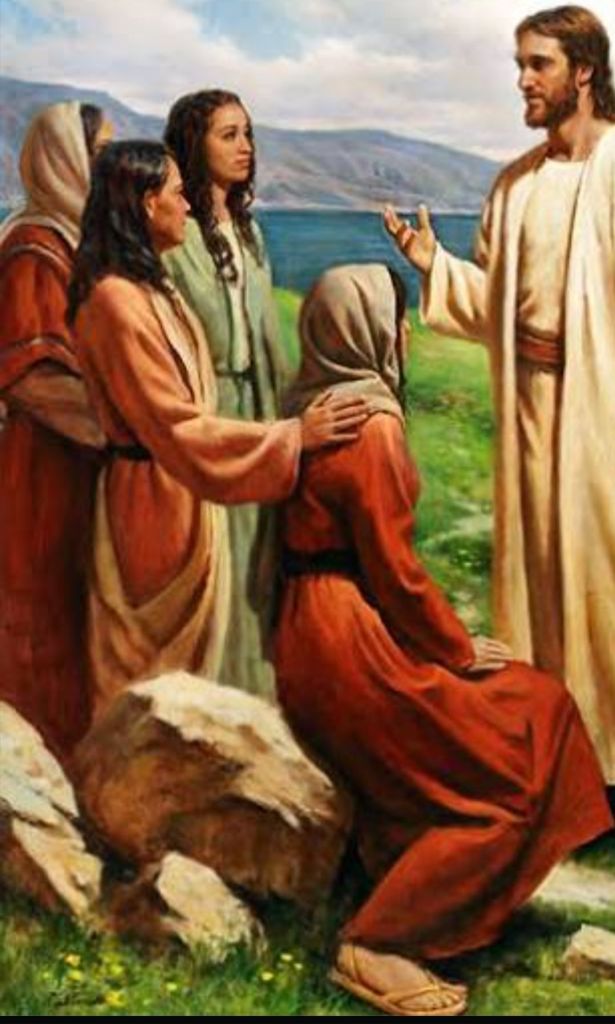
People brought little children to Jesus, for him to lay his hands on them and say a prayer. The disciples turned them away, but Jesus said, ‘Let the little children alone, and do not stop them coming to me; for it is to such as these that the kingdom of heaven belongs.’ Then he laid his hands on them and went on his way.
Anyone who has earnestly been trying to follow after our Lord, our God in obedience and in faith should be able to attest that He has always walked with us, sometimes even ahead of us in all the trials and challenges that we have faced in our lives. We should be able to attest to the miracles, signs, and wonders that He has worked not only in our lives, but in those whom He has empowered us to do those works and wonders for Him, for His glory.
It is sad that we sometimes forget, maybe in moments of weakness, in difficulties, we forget how He was with us then and how He will be with us going forward. Or sometimes when we have sinned, the evil one doesn’t want us to remember how good the Lord our God has been and how He had watched over us.
With that in mind, today’s Gospel reminds us that we are held to a higher calling. In the Lord’s prayer that He taught us, the line goes, forgive us our trespasses, as we forgive those who trespass against us. We cannot withhold forgiveness. For just as the Lord our God is merciful to us, we must be merciful. Not 7 times, but 77 times 7. In other words, we must be merciful all the time.
Lord Jesus, we love you, we adore you, we want to glorify you. Forgive us our many faults, as we forgive those who have faulted us. Amen.
Saint Maximilian Kolbe, Priest, Pray for us…
First reading Joshua 3:7-11,13-17
The Israelites cross the Jordan dry-shod
The Lord said to Joshua, ‘This very day I will begin to make you a great man in the eyes of all Israel, to let them be sure that I am going to be with you even as I was with Moses. As for you, give this order to the priests carrying the ark of the covenant: “When you have reached the brink of the waters of the Jordan, you are to stand still in the Jordan itself”.’ Then Joshua said to the Israelites, ‘Come closer and hear the words of the Lord your God.’ Joshua said, ‘By this you shall know that a living God is with you and without a doubt will expel the Canaanite, the Hittite, the Hivite, the Perizzite, the Girgashite, the Amorite andm the Jebusite. Look, the ark of the Lord, the Lord of the whole earth, is about to cross the Jordan at your head. As soon as the priests with the ark of the Lord, the Lord of the whole earth, have set their feet in the waters of the Jordan, the upper waters of the Jordan flowing down will be stopped in their course and stand still in one mass.’ Accordingly, when the people struck camp to cross the Jordan, the priests carried the ark of the covenant in front of the people. As soon as the bearers of the ark reached the Jordan and the feet of the priests who carried it touched the waters (the Jordan overflows the whole length of its banks throughout the harvest season) the upper waters stood still and made one heap over a wide space – from Adam to the fortress of Zarethan – while those flowing down to the Sea of the Arabah, that is, the Salt Sea, stopped running altogether. The people crossed opposite Jericho. The priests who carried the ark of the covenant of the Lord stood still on dry ground in mid-Jordan, and all Israel continued to cross dry-shod till the whole nation had finished its crossing of the river.
Gospel Matthew 18:21-19:1
‘How often must I forgive my brother?’
Peter went up to Jesus and said, ‘Lord, how often must I forgive my brother if he wrongs me? As often as seven times?’ Jesus answered, ‘Not seven, I tell you, but seventy-seven times. ‘And so the kingdom of heaven may be compared to a king who decided to settle his accounts with his servants. When the reckoning began, they brought him a man who owed ten thousand talents; but he had no means of paying, so his master gave orders that he should be sold, together with his wife and children and all his possessions, to meet the debt. At this, the servant threw himself down at his master’s feet. “Give me time” he said “and I will pay the whole sum.” And the servant’s master felt so sorry for him that he let him go and cancelled the debt. Now as this servant went out, he happened to meet a fellow servant who owed him one hundred denarii; and he seized him by the throat and began to throttle him. “Pay what you owe me” he said. His fellow servant fell at his feet and implored him, saying, “Give me time and I will pay you.” But the other would not agree; on the contrary, he had him thrown into prison till he should pay the debt. His fellow servants were deeply distressed when they saw what had happened, and they went to their master and reported the whole affair to him. Then the master sent for him. “You wicked servant,” he said “I cancelled all that debt of yours when you appealed to me. Were you not bound, then, to have pity on your fellow servant just as I had pity on you?” And in his anger the master handed him over to the torturers till he should pay all his debt. And that is how my heavenly Father will deal with you unless you each forgive your brother from your heart.’ Jesus had now finished what he wanted to say, and he left Galilee and came into the part of Judaea which is on the far side of the Jordan.
In today’s first reading, we are reminded that we must, for all time, bring forth the holiness and righteousness of the Lord, our God, in all that we say, in all that we do. While Moses was not allowed to enter into the Promised Land, God, our Heavenly Father, still showed him from the highest point all that He had promised for all His flock who would enter into the Promised Land. Very much like when Jesus was brought up to the pinnacle and shown all that He might possess if He had given in to the temptation of the devil. But our Lord Jesus remain steadfast in the Holiness and righteousness of God our Heavenly Father.
It is a reminder that we must likewise remain steadfast and faithful to love our God, His word, and His will for us. We do not have to be troubled that Moses was simply laid to rest in a place that fell short of the Promised Land, because we know that Moses appears in the Lord’s glory at the Transfiguration. And that he, therefore, was taken to the true, for all time, Promised Land.
Now, being children of God, our Heavenly Father, we are called to love, to be patient and to be merciful. Therefore, it’s not right for us to simply ostracize someone who has done wrong to us. We must make valiant attempts to reconcile with the errant brother or sister, to show them the error of their ways if necessary, and enlist the help of the community to reason with them. Then truly, we will follow after the heart of Christ, who is loving, patient, and merciful. Amen.
Saints Pontian, Pope, and Hippolytus, Pray for us… ________
First reading Deuteronomy 34:1-12
Moses dies and is buried
Leaving the plains of Moab, Moses went up Mount Nebo, the peak of Pisgah opposite Jericho, and the Lord showed him the whole land; Gilead as far as Dan, all Naphtali, the land of Ephraim and Manasseh, all the land of Judah as far as the Western Sea, the Negeb, and the stretch of the Valley of Jericho, city of palm trees, as far as Zoar. The Lord said to him, ‘This is the land I swore to give to Abraham, Isaac and Jacob, saying: I will give it to your descendants. I have let you see it with your own eyes, but you shall not cross into it.’ There in the land of Moab, Moses the servant of the Lord died as the Lord decreed; he buried him in the valley, in the land of Moab, opposite Beth-peor; but to this day no one has ever found his grave. Moses was a hundred and twenty years old when he died, his eye undimmed, his vigour unimpaired. The sons of Israel wept for Moses in the plains of Moab for thirty days. The days of weeping for the mourning rites of Moses came to an end. Joshua son of Nun was filled with the spirit of wisdom, for Moses had laid his hands on him. It was he that the sons of Israel obeyed, carrying out the order that the Lord had given to Moses. Since then, never has there been such a prophet in Israel as Moses, the man the Lord knew face to face. What signs and wonders the Lord caused him to perform in the land of Egypt against Pharaoh and all his servants and his whole land! How mighty the hand and great the fear that Moses wielded in the sight of all Israel!
________
Gospel Matthew 18:15-20
If your brother listens to you, you have won back your brother
Jesus said to his disciples: ‘If your brother does something wrong, go and have it out with him alone, between your two selves. If he listens to you, you have won back your brother. If he does not listen, take one or two others along with you: the evidence of two or three witnesses is required to sustain any charge. But if he refuses to listen to these, report it to the community; and if he refuses to listen to the community, treat him like a pagan or a tax collector. ‘I tell you solemnly, whatever you bind on earth shall be considered bound in heaven; whatever you loose on earth shall be considered loosed in heaven. ‘I tell you solemnly once again, if two of you on earth agree to ask anything at all, it will be granted to you by my Father in heaven. For where two or three meet in my name, I shall be there with them.’
We do not have to fear because we have a powerful ally, the Lord our God Himself, who goes ahead of us in our battles, in our challenges. He clears a path for us because of His great love for us. For we are His beloved children.
Being obedient and remaining as His beloved children, we must also see that our dearest brothers and sisters are also His beloved children. And He expects that we care and watch over His children, our brethren. We must have the heart of a child, a child who knows who his father is, a child who knows the motherly love, of God, our Heavenly Father.
He cares for each and every one of His children with His very being. And we, likewise, must care for one another. That is why we must never forget the commandment of our Lord Jesus Christ, that we must love one another just as He loved us. Amen.
Saint Jane Frances de Chantal, Pray for us…
________
Joshua shall cross the Jordan at your head
Moses proceeded to address these words to the whole of Israel, ‘I am one hundred and twenty years old now, and can no longer come and go as I will. The Lord has said to me, “You shall not cross this Jordan.” It is the Lord your God who will cross it at your head to destroy these nations facing you and dispossess them; and Joshua too shall cross at your head, as the Lord has said. The Lord will treat them as he treated Sihon and Og the Amorite kings and their land, destroying them. The Lord will hand them over to you, and you will deal with them in exact accordance with the commandments I have enjoined on you. Be strong, stand firm, have no fear of them, no terror, for the Lord your God is going with you; he will not fail you or desert you.’ Then Moses summoned Joshua and in the presence of all Israel said to him, ‘Be strong, stand firm; you are going with this people into the land the Lord swore to their fathers he would give them; you are to give it into their possession. The Lord himself will lead you; he will be with you; he will not fail you or desert you. Have no fear, do not be disheartened by anything.’
________
First reading Deuteronomy 31:1-8
Gospel Matthew 18:1-5,10,12-14
Anyone who welcomes a little child in my name welcomes me
The disciples came to Jesus and said, ‘Who is the greatest in the kingdom of heaven?’ So he called a little child to him and set the child in front of them. Then he said, ‘I tell you solemnly, unless you change and become like little children you will never enter the kingdom of heaven. And so, the one who makes himself as little as this little child is the greatest in the kingdom of heaven. ‘Anyone who welcomes a little child like this in my name welcomes me. ‘See that you never despise any of these little ones, for I tell you that their angels in heaven are continually in the presence of my Father in heaven. ‘Tell me. Suppose a man has a hundred sheep and one of them strays; will he not leave the ninety-nine on the hillside and go in search of the stray? I tell you solemnly, if he finds it, it gives him more joy than do the ninety-nine that did not stray at all. Similarly, it is never the will of your Father in heaven that one of these little ones should be lost.’
Having a relationship with the Lord, our God, also means that we know without a doubt that He’s watching over us. He knows our every thought, our every word, and our every action. And because He loves us all so dearly, He looks out for those who cannot fend for themselves—the orphans, the poor, the disabled. And he expects that all of us, His beloved children, will care for one another.
Our declaration of our love for Him means we put our love for Him into action, for Him and for our brethren. We must always be mindful that our actions and our words do not reflect badly on Him.
In today’s gospel, we hear that we should follow the laws of the land. And even if we feel or know we are exempt, we will still do so, so as not to offend, for we want to bring the glory of our Lord in everything that we do. Amen.
Saint Clare, Virgin Pray for us…
________
First reading Deuteronomy 10:12-22
The Lord your God is God of gods and Lord of lords
Moses said to the people: ‘Now, Israel, what does the Lord your God ask of you? Only this: to fear the Lord your God, to follow all his ways, to love him, to serve the Lord your God with all your heart and all your soul, to keep the commandments and laws of the Lord that for your good I lay down for you today. ‘To the Lord your God belong indeed heaven and the heaven of heavens, the earth and all it contains; yet it was on your fathers that the Lord set his heart for love of them, and after them of all the nations chose their descendants, you yourselves, up to the present day. Circumcise your heart then and be obstinate no longer; for the Lord your God is God of gods and Lord of lords, the great God, triumphant and terrible, never partial, never to be bribed. It is he who sees justice done for the orphan and the widow, who loves the stranger and gives him food and clothing. Love the stranger then, for you were strangers in the land of Egypt. It is the Lord your God you must fear and serve; you must cling to him; in his name take your oaths. He it is you must praise, he is your God: for you he has done these great and terrible things you have seen with your own eyes; and though your fathers numbered only seventy when they went down to Egypt, the Lord your God has made you as many as the stars of heaven.’
________
Gospel Matthew 17:22-27
‘They will put the Son of Man to death’
One day when they were together in Galilee, Jesus said to his disciples, ‘The Son of Man is going to be handed over into the power of men; they will put him to death, and on the third day he will be raised to life again.’ And a great sadness came over them. When they reached Capernaum, the collectors of the half-shekel came to Peter and said, ‘Does your master not pay the half-shekel?’ ‘Oh yes’ he replied, and went into the house. But before he could speak, Jesus said, ‘Simon, what is your opinion? From whom do the kings of the earth take toll or tribute? From their sons or from foreigners?’ And when he replied, ‘From foreigners’, Jesus said, ‘Well then, the sons are exempt. However, so as not to offend these people, go to the lake and cast a hook; take the first fish that bites, open its mouth and there you will find a shekel; take it and give it to them for me and for you.’
We are born of the faith of our fathers, descending from a great cloud of witnesses whose faith is attested to on every page of Scripture (see Hebrews 12:1). We have been made His people, chosen for His own inheritance, as we sing in this Sunday’s Psalm.
The Liturgy this week sings the praises of our fathers, recalling the defining moments in our “family history.” In the Epistle, we remember the calling of Abraham; in the First Reading we relive the night of the Exodus and the summons of the holy children of Israel.
Our fathers, we are told, trusted in the Word of God, put their faith in His oaths. They were convinced that what He promised, He would do.
None of them lived to see His promises made good. For it was not until Christ and His Church that Abraham’s descendants were made as countless as the stars and sands (see Galatians 3:16–17, 29). It was not until His Last Supper and the Eucharist that “the sacrifice . . . the divine institution” of that first Passover was truly fulfilled.
And now we too await the final fulfillment of what God has promised us in Christ. As Jesus tells us in this week’s Gospel, we should live with our loins girded—as the Israelites tightened their belts, cinched up their long robes and ate their Passover standing, vigilant and ready to do His will (see Exodus 12:11; 2 Kings 4:29).
The Lord will come at an hour we do not expect. He will knock on our door (see Revelation 3:20), inviting us to the wedding feast in the better homeland, the heavenly one that our fathers saw from afar, and which we begin to taste in each Eucharist.
As they did, we can wait with “sure knowledge,” His Word like a lamp lighting our path (see Psalm 119:105). Our God is faithful, and if we wait in faith, hope in His kindness, and love as we have been loved, we will receive His promised blessing and be delivered from death.
Are the words, “You shall love the Lord, your God, with all your heart, all your mind, and all your strength,” written on our hearts? Are they just words? For if we truly love the Lord, our God, with all our hearts, all our minds, all our strength, and all our souls,v then we know that the love for Him is not just mere words, but our very being in full communion with Him.
Just as we might sing, “God is dwelling in my heart.” He’s truly present in our thoughts, in our words, and in our deeds. And if He is truly present with us, then how can we not minister to our brethren with great confidence that He will work miracles and wonders in their lives? Because He is our living God and we are empowered to bring His living presence to all He sends our way.
Why are many of us not willing to try? Why are we so concerned about performance? It’s that performance mentality that holds us back from doing what needs to be done, for praying, for healing, for prophesying, for deliverance.
We are reminded in today’s Gospel that all it takes is one’s faith the size of a mustard seed, but that mustard seed is the living God that dwells within us, that enables us to do greater things according to His will. Amen.
Saint Teresa Benedicta of the Cross (Edith Stein), Virgin, Martyr pray for us…
________
First reading Deuteronomy 6:4-13
You shall love the Lord your God with all your heart
Moses said to the people: ‘Listen, Israel: the Lord our God is the one Lord. You shall love the Lord your God with all your heart, with all your soul, with all your strength. Let these words I urge on you today be written on your heart. You shall repeat them to your children and say them over to them whether at rest in your house or walking abroad, at your lying down or at your rising; you shall fasten them on your hand as a sign and on your forehead as a circlet; you shall write them on the doorposts of your house and on your gates. ‘When the Lord has brought you into the land which he swore to your fathers Abraham, Isaac and Jacob that he would give you, with great and prosperous cities not of your building, houses full of good things not furnished by you, wells you did not dig, vineyards and olives you did not plant, when you have eaten these and had your fill, then take care you do not forget the Lord who brought you out of the land of Egypt, out of the house of slavery. You must fear the Lord your God, you must serve him, by his name you must swear.’
________
Gospel Matthew 17:14-20
If your faith were the size of a mustard seed, the mountain would move
A man came up to Jesus and went down on his knees before him. ‘Lord,’ he said ‘take pity on my son: he is a lunatic and in a wretched state; he is always falling into the fire or into the water. I took him to your disciples and they were unable to cure him.’ ‘Faithless and perverse generation!’ Jesus said in reply ‘How much longer must I be with you? How much longer must I put up with you? Bring him here to me.’ And when Jesus rebuked it the devil came out of the boy who was cured from that moment. Then the disciples came privately to Jesus. ‘Why were we unable to cast it out?’ they asked. He answered, ‘Because you have little faith. I tell you solemnly, if your faith were the size of a mustard seed you could say to this mountain, “Move from here to there,” and it would move; nothing would be impossible for you.’
The Lord, our God, has made Himself known. He’s made His presence felt. He has revealed Himself through His Son, our Lord and Savior, Jesus Christ. He is never distant. He’s always close to His faithful. And we who have dwelled in His love and in His presence can see His hand in every aspect of our lives.
In order to continue this wonderful journey with and in Him, in His awesome presence, we must be prepared to take up our cross and follow after Him. We need to be prepared to die to the ways of the world, while we live in this world, we know that we do not belong to this world, for we belong to Him alone.
Lord Jesus, let me live my life in You, with You. Let me die to all that is not of You, so that I may rise to be with You and see once again, my Lord and God, in heaven. Amen.
Saint Dominic, Priest Pray for us…
________
First reading Deuteronomy 4:32-40
‘Did ever a people before you hear the voice of the living God, and remain alive?’
Moses said to the people: ‘Put this question to the ages that are past, that went before you, from the time God created man on earth: Was there ever a word so majestic, from one end of heaven to the other? Was anything ever heard? Did ever a people hear the voice of the living God speaking from the heart of the fire, as you heard it, and remain alive? Has any god ventured to take to himself one nation from the midst of another by ordeals, signs, wonders, war with mighty hand and outstretched arm, by fearsome terrors – all this that the Lord your God did for you before your eyes in Egypt? ‘This he showed you so that you might know that the Lord is God indeed and that there is no other. He let you hear his voice out of heaven for your instruction; on earth he let you see his great fire, and from the heart of the fire you heard his word. Because he loved your fathers and chose their descendants after them, he brought you out from Egypt, openly showing his presence and his great power, driving out in front of you nations greater and more powerful than yourself, and brought you into their land to give it you for your heritage, as it is still today. ‘Understand this today, therefore, and take it to heart: the Lord is God indeed, in heaven above as on earth beneath, he and no other. Keep his laws and commandments as I give them to you today, so that you and your children may prosper and live long in the land that the Lord your God gives you for ever.’
________
Gospel Matthew 16:24-28
Anyone who loses his life for my sake will find it
Jesus said to his disciples: ‘If anyone wants to be a follower of mine, let him renounce himself and take up his cross and follow me. For anyone who wants to save his life will lose it; but anyone who loses his life for my sake will find it. What, then, will a man gain if he wins the whole world and ruins his life? Or what has a man to offer in exchange for his life? ‘For the Son of Man is going to come in the glory of his Father with his angels, and, when he does, he will reward each one according to his behaviour. I tell you solemnly, there are some of these standing here who will not taste death before they see the Son of Man coming with his kingdom.’
We need to dwell on just how deep is our personal relationship with the Lord, our God. In times of difficulties and challenges or in times of need, do we grumble and blame him for our predicament? Or instead turn to him in prayer and confidence that he will come swiftly to our aid?
And for those of us chosen to lead others, do we bring forth the Holiness of the Lord, our God in our actions, in our words, always to Glorify him? Or do we, in frustration lash out, when the hearts of those we serve are not changed? Do we call them names like fool or rebel? When we should remain patient, and again turn to the Lord, our God, for His guidance.
When we minister to the flock that He sends us, how can we ever forget that it is through His grace alone that we are ministering to them? Whether it’s in signs, wonders, healing, or prophesying.
Let us always strive to be in full communion with Him, Body, mind, and spirit, as we serve Him and our brethren for His greater glory. Amen.
Saints Sixtus II, Pope, and his Companions, Martyrs, Saint Cajetan, Priest Pray for us…
________
First reading Numbers 20:1-13
Moses makes water flow from the rock at Meribah
The sons of Israel, the whole community, arrived in the first month at the desert of Zin. The people settled at Kadesh. It was there that Miriam died and was buried. There was no water for the community, and they were all united against Moses and Aaron. The people challenged Moses: ‘We would rather have died,’ they said, ‘as our brothers died before the Lord! Why did you bring the assembly of the Lord into this wilderness, only to let us die here, ourselves and our cattle? Why did you lead us out of Egypt, only to bring us to this wretched place? It is a place unfit for sowing, it has no figs, no vines, no pomegranates, and there is not even water to drink!’ Leaving the assembly, Moses and Aaron went to the door of the Tent of Meeting. They threw themselves face downward on the ground, and the glory of the Lord appeared to them. The Lord spoke to Moses and said, ‘Take the branch and call the community together, you and your brother Aaron. Then, in full view of them, order this rock to give water. You will make water flow for them out of the rock, and provide drink for the community and their cattle.’ Moses took up the branch from before the Lord, as he had directed him. Then Moses and Aaron called the assembly together in front of the rock and addressed them, ‘Listen now, you rebels. Shall we make water gush from this rock for you?’ And Moses raised his hand and struck the rock twice with the branch; water gushed in abundance, and the community drank and their cattle too. Then the Lord said to Moses and Aaron, ‘Because you did not believe that I could proclaim my holiness in the eyes of the sons of Israel, you shall not lead this assembly into the land I am giving them.’ These are the waters of Meribah, where the sons of Israel challenged the Lord and he proclaimed his holiness.
________
Gospel Matthew 16:13-23
You are Peter and on this rock I will build my Church
When Jesus came to the region of Caesarea Philippi he put this question to his disciples, ‘Who do people say the Son of Man is?’ And they said, ‘Some say he is John the Baptist, some Elijah, and others Jeremiah or one of the prophets.’ ‘But you,’ he said ‘who do you say I am?’ Then Simon Peter spoke up, ‘You are the Christ,’ he said, ‘the Son of the living God.’ Jesus replied, ‘Simon son of Jonah, you are a happy man! Because it was not flesh and blood that revealed this to you but my Father in heaven. So I now say to you: You are Peter and on this rock I will build my Church. And the gates of the underworld can never hold out against it. I will give you the keys of the kingdom of heaven: whatever you bind on earth shall be considered bound in heaven; whatever you loose on earth shall be considered loosed in heaven.’ Then he gave the disciples strict orders not to tell anyone that he was the Christ. From that time Jesus began to make it clear to his disciples that he was destined to go to Jerusalem and suffer grievously at the hands of the elders and chief priests and scribes, to be put to death and to be raised up on the third day. Then, taking him aside, Peter started to remonstrate with him. ‘Heaven preserve you, Lord;’ he said ‘this must not happen to you.’ But he turned and said to Peter, ‘Get behind me, Satan! You are an obstacle in my path, because the way you think is not God’s way but man’s.’
Can we imagine the great spectacle, the dazzling brilliance of our Lord’s transfiguration? Which likely took place for the sake of His disciples. Afterall our Lord was going to suffer a terrible death, where all hope would have been lost, and so it was for the disciples to remember. What he had said, that He will die and later rise again. They witnessed the glory of the Lord.
That same glory that was envisioned in Daniel’s prophecy. Where it is mentioned that the son of man will come on the clouds of Heaven. We too can expect that one day too we will rise with Him to His glory, to be in His presence for all eternity. And that is the hope of our faith, realized in Jesus Christ, our Lord. Whom God our Father commanded that we should listen to Him.
Hence we can with declare with Blessed assurance, “Death, where is your sting?” Let our bodies, minds, and spirits be transfigured in our Lord, so that we too may be His light for the world, bringing His truth to all so that together with them we shall all be reunited in Heaven. Amen.
________
First reading Daniel 7:9-10,13-14
His robe was white as snow
As I watched:
Thrones were set in place and one of great age took his seat. His robe was white as snow, the hair of his head as pure as wool. His throne was a blaze of flames, its wheels were a burning fire. A stream of fire poured out, issuing from his presence. A thousand thousand waited on him, ten thousand times ten thousand stood before him. A court was held and the books were opened.
I gazed into the visions of the night.
And I saw, coming on the clouds of heaven, one like a son of man. He came to the one of great age and was led into his presence. On him was conferred sovereignty, glory and kingship, and men of all peoples, nations and languages became his servants. His sovereignty is an eternal sovereignty which shall never pass away, nor will his empire ever be destroyed.
________
Gospel Luke 9:28-36
Jesus is transfigured before them
Jesus took with him Peter and John and James and went up the mountain to pray. As he prayed, the aspect of his face was changed and his clothing became brilliant as lightning. Suddenly there were two men there talking to him; they were Moses and Elijah appearing in glory, and they were speaking of his passing which he was to accomplish in Jerusalem. Peter and his companions were heavy with sleep, but they kept awake and saw his glory and the two men standing with him. As these were leaving him, Peter said to Jesus, ‘Master, it is wonderful for us to be here; so let us make three tents, one for you, one for Moses and one for Elijah.’ – He did not know what he was saying. As he spoke, a cloud came and covered them with shadow; and when they went into the cloud the disciples were afraid. And a voice came from the cloud saying, ‘This is my Son, the Chosen One. Listen to him.’ And after the voice had spoken, Jesus was found alone. The disciples kept silence and, at that time, told no one what they had seen. ________
We are reminded of God our Father’s maternal love for His people in today’s first reading. As Moses pleads for help in leading the obstinate flock entrusted to him. His prayer and intercession is heard and will be answered.
Jesus in today’s Gospel likewise extends the same maternal love for the flock gathered round Him. Through the power and Grace of God our Heavenly Father, He raises His eyes to Heaven, says the Blessing and feeds fine thousand men and more.
Let us likewise extend the maternal, nurturing love the Lord our God to all He sends our way. Amen
Saint John Mary Vianney, Priest Pray for us…
________
First reading Numbers 11:4-15
The sons of Israel complain in the desert
The sons of Israel began to wail, ‘Who will give us meat to eat?’ they said. ‘Think of the fish we used to eat free in Egypt, the cucumbers, melons, leeks, onions and garlic! Here we are wasting away, stripped of everything; there is nothing but manna for us to look at!’ The manna was like coriander seed, and had the appearance of bdellium. The people went round gathering it, and ground it in a mill or crushed it with a pestle; it was then cooked in a pot and made into pancakes. It tasted like cake made with oil. When the dew fell on the camp at night-time, the manna fell with it. Moses heard the people wailing, every family at the door of its tent. The anger of the Lord flared out, and Moses greatly worried over this. And he spoke to the Lord: ‘Why do you treat your servant so badly? Why have I not found favour with you, so that you load on me the weight of all this nation? Was it I who conceived all this people, was it I who gave them birth, that you should say to me, “Carry them in your bosom, like a nurse with a baby at the breast, to the land that I swore to give their fathers”? Where am I to find meat to give to all this people, when they come worrying me so tearfully and say, “Give us meat to eat”? I am not able to carry this nation by myself alone; the weight is too much for me. If this is how you want to deal with me, I would rather you killed me! If only I had found favour in your eyes, and not lived to see such misery as this!’
________
Gospel Matthew 14:13-21
The feeding of the five thousand
When Jesus received the news of John the Baptist’s death he withdrew by boat to a lonely place where they could be by themselves. But the people heard of this and, leaving the towns, went after him on foot. So as he stepped ashore he saw a large crowd; and he took pity on them and healed their sick. When evening came, the disciples went to him and said, ‘This is a lonely place, and the time has slipped by; so send the people away, and they can go to the villages to buy themselves some food.’ Jesus replied, ‘There is no need for them to go: give them something to eat yourselves.’ But they answered ‘All we have with us is five loaves and two fish.’ ‘Bring them here to me’ he said. He gave orders that the people were to sit down on the grass; then he took the five loaves and the two fish, raised his eyes to heaven and said the blessing. And breaking the loaves handed them to his disciples who gave them to the crowds. They all ate as much as they wanted, and they collected the scraps remaining; twelve baskets full. Those who ate numbered about five thousand men, to say nothing of women and children.
Trust in God—as the Rock of our salvation, as the Lord who made us His chosen people, as our shepherd and guide. This should be the mark of our following of Jesus.
Like the Israelites we recall in this week’s Psalm Response, we have made an exodus, passing through the waters of Baptism, freeing us from our bondage to sin. We too are on a pilgrimage to a promised homeland, the Lord in our midst, feeding us heavenly bread, giving us living waters to drink (see 1 Corinthians 10:1-4).
We must take care to guard against the folly that befell the Israelites, that led them to quarrel and test God’s goodness at Meribah and Massah.
We can harden our hearts in ways more subtle but no less ruinous. We can put our trust in possessions, squabble over earthly inheritances, kid ourselves that what we have we deserve, store up treasures and think they’ll afford us security and rest.
All this is “vanity of vanities,” a false and deadly way of living, as this week’s First Reading tells us.
This is the greed that Jesus warns against in this week’s Gospel. The rich man’s anxiety and toil expose his lack of faith in God’s care and provision. That’s why Paul calls greed “idolatry” in the Epistle this week. Mistaking having for being, possession for existence, we forget that God is the giver of all that we have, we exalt the things we can make or buy over our Maker (see
Romans 1:25).
Jesus calls the rich man a “fool”—a word used in the Old Testament for someone who rebels against God or has forgotten Him (see Psalm 14:1).
We should treasure most the new life we have been given in Christ and seek what is above, the promised inheritance of heaven. We have to see all things in the light of eternity, mindful that He who gives us the breath of life could at any moment—this night even—demand it back from us.
Everything we have comes from the Lord. He holds the title to our property and to our very being. And yet, we want to be in control. We want to believe that we have earned everything on our own. All too often, when we are blessed with more, we hoard it all for ourselves, without considering the needs of our brethren who may have nothing.
Today’s first reading reminds us that the Lord, our God, is our provider, and everything we have belongs to Him.
In today’s gospel, we have heard many times that Herod succumbed to his prideful ways. He did not want to be embarrassed, so he kept a promise that he should not have made. But how many of us have dwelled on the fact that it was Herodias who caused the death of Saint John the Baptist? Her spiteful tongue and cunning ways caused His murder. How many souls and reputations have been murdered by spiteful tongues, gossip? All by folks hidden in background often instigating others to perform treacherous acts. Nothing is hidden from the Lord our God!
Search me, God, and know my heart; test me and know my anxious thoughts. See if there is any offensive way in me, and lead me in the way everlasting. Amen
Saint Eusebius of Vercelli, Bishop, Saint Peter Julian Eymard, Priest pray for us…
________
First reading Leviticus 25:1,8-17
The law of the jubilee year
The Lord spoke to Moses on Mount Sinai. He said: ‘You are to count seven weeks of years – seven times seven years, that is to say a period of seven weeks of years, forty-nine years. And on the tenth day of the seventh month you shall sound the trumpet; on the Day of Atonement you shall sound the trumpet throughout the land. You will declare this fiftieth year sacred and proclaim the liberation of all the inhabitants of the land. This is to be a jubilee for you; each of you will return to his ancestral home, each to his own clan. This fiftieth year is to be a jubilee year for you: you will not sow, you will not harvest the ungathered corn, you will not gather from the untrimmed vine. The jubilee is to be a holy thing to you, you will eat what comes from the fields. ‘In this year of jubilee each of you is to return to his ancestral home. If you buy or sell with your neighbour, let no one wrong his brother. If you buy from your neighbour, this must take into account the number of years since the jubilee: according to the number of productive years he will fix the price. The greater the number of years, the higher shall be the price demanded; the less the number of years, the greater the reduction; for what he is selling you is a certain number of harvests. Let none of you wrong his neighbour, but fear your God; I am the Lord your God.’
________
Gospel Matthew 14:1-12
The beheading of John the Baptist
Herod the tetrarch heard about the reputation of Jesus, and said to his court, ‘This is John the Baptist himself; he has risen from the dead, and that is why miraculous powers are at work in him.’ Now it was Herod who had arrested John, chained him up and put him in prison because of Herodias, his brother Philip’s wife. For John had told him, ‘It is against the Law for you to have her.’ He had wanted to kill him but was afraid of the people, who regarded John as a prophet. Then, during the celebrations for Herod’s birthday, the daughter of Herodias danced before the company, and so delighted Herod that he promised on oath to give her anything she asked. Prompted by her mother she said, ‘Give me John the Baptist’s head, here, on a dish.’ The king was distressed but, thinking of the oaths he had sworn and of his guests, he ordered it to be given her, and sent and had John beheaded in the prison. The head was brought in on a dish and given to the girl, who took it to her mother. John’s disciples came and took the body and buried it; then they went off to tell Jesus.
We all know that the holy Eucharist at mass, be it a weekday or a Sunday mass, is a thanksgiving to God for all that He’s given us, provided for us, and for taking care of us.
The most precious gift for which we should be most thankful is our Lord and Savior, Jesus Christ. By His life, death, and resurrection, He had purchased for us the rewards of eternal life. Yet, He still gives of himself fully in the Holy Eucharist – body, blood, soul, and divinity.
So how many of us come before Him at mass to worship and thank Him? To offer all our gifts before Him during the offertory? If we have not been doing this with that kind of disposition, love, and reverence, then how different are we from those in today’s Gospel who did not recognize the Son of God before them?
How then do we expect the miracles that He wants to perform for us in our lives? Let us never again take, the Holy Eucharistic celebration for granted.
We adore You Lord Jesus, thank you for loving us.
Amen.
Saint Alphonsus Mary de’ Liguori, Bishop, Doctor Pray for us…
________
First reading Leviticus 23:1,4-11,15-16,27,34-37
The law of the festivals of the Lord
The Lord spoke to Moses. He said: ‘These are the Lord’s solemn festivals, the sacred assemblies to which you are to summon the sons of Israel on the appointed day. ‘The fourteenth day of the first month, between the two evenings, is the Passover of the Lord; and the fifteenth day of the same month is the feast of Unleavened Bread for the Lord. For seven days you shall eat bread without leaven. On the first day you are to hold a sacred assembly; you must do no heavy work. For seven days you shall offer a burnt offering to the Lord. The seventh day is to be a day of sacred assembly; you must do no work.’ The Lord spoke to Moses. He said: ‘Speak to the sons of Israel and say to them: ‘“When you enter the land that I give you, and gather in the harvest there, you must bring the first sheaf of your harvest to the priest, and he is to present it to the Lord with the gesture of offering, so that you may be acceptable. The priest shall make this offering on the day after the sabbath. ‘“From the day after the sabbath, the day on which you bring the sheaf of offering, you are to count seven full weeks. You are to count fifty days, to the day after the seventh sabbath, and then you are to offer the Lord a new oblation. ‘“The tenth day of the seventh month shall be the Day of Atonement. You are to hold a sacred assembly. You must fast, and you must offer a burnt offering to the Lord. ‘“The fifteenth day of this seventh month shall be the feast of Tabernacles for the Lord, lasting seven days. The first day is a day of sacred assembly; you must do no heavy work. For seven days you must offer a burnt offering to the Lord. On the eighth day you are to hold a sacred assembly, you must offer a burnt offering to the Lord. It is a day of solemn meeting; you must do no heavy work. ‘“These are the solemn festivals of the Lord to which you are to summon the children of Israel, sacred assemblies for the purpose of offering burnt offerings, holocausts, oblations, sacrifices and libations to the Lord, according to the ritual of each day.”’
________
Gospel Matthew 13:54-58
A prophet is only despised in his own country
Coming to his home town, Jesus taught the people in their synagogue in such a way that they were astonished and said, ‘Where did the man get this wisdom and these miraculous powers? This is the carpenter’s son, surely? Is not his mother the woman called Mary, and his brothers James and Joseph and Simon and Jude? His sisters, too, are they not all here with us? So where did the man get it all?’ And they would not accept him. But Jesus said to them, ‘A prophet is only despised in his own country and in his own house’, and he did not work many miracles there because of their lack of faith.
How awesome, wonderful even mind blowing, it is that our Lord and Saviour Jesus Christ has chosen to give the supreme gift of Himself in the Holy Eucharist, iHis Body, Blood, Soul, and Divinity!
He has even chosen to dwell in the tabernacles all of His Churches around the world, so that He can be physically and spiritually present to us whenever we come to Him. Do we then come to Him with the reverence and awe as we should, to lay prostrate before Him, the Lord of Lords, the King of Kings!
His love is truly without end, and we know this because He has chosen to dwell in the tabernacle of our hearts. How then are we living our lives in His presence, always ready and willing to givie testimony of our old lives transformed in the new life in Him. Let us continue to dwell on His ever living Word for us both in the old revealed in the new forever and ever.
Amen.
Saint Ignatius Loyola, Priest Pray for us….
________
First reading Exodus 40:16-21,34-38
The tabernacle is set up
Moses did exactly as the Lord had directed him. The tabernacle was set up on the first day of the first month in the second year. Moses erected the tabernacle. He fixed the sockets for it, put up its frames, put its crossbars in position, set up its posts. He spread the tent over the tabernacle and on top of this the covering for the tent, as the Lord had directed Moses. He took the Testimony and placed it inside the ark. He set the shafts to the ark and placed the throne of mercy on it. He brought the ark into the tabernacle and put the screening veil in place; thus he screened the ark of the Lord, as the Lord had directed Moses. The cloud covered the Tent of Meeting and the glory of the Lord filled the tabernacle. Moses could not enter the Tent of Meeting because of the cloud that rested on it and because of the glory of the Lord that filled the tabernacle. At every stage of their journey, whenever the cloud rose from the tabernacle the sons of Israel would resume their march. If the cloud did not rise, they waited and would not march until it did. For the cloud of the Lord rested on the tabernacle by day, and a fire shone within the cloud by night, for all the House of Israel to see. And so it was for every stage of their journey.
________
Gospel Matthew 13:47-53
The fishermen collect the good fish and throw away those that are no use
Jesus said to the crowds: ‘The kingdom of heaven is like a dragnet cast into the sea that brings in a haul of all kinds. When it is full, the fishermen haul it ashore; then, sitting down, they collect the good ones in a basket and throw away those that are no use. This is how it will be at the end of time: the angels will appear and separate the wicked from the just to throw them into the blazing furnace where there will be weeping and grinding of teeth. ‘Have you understood all this?’ They said, ‘Yes.’ And he said to them, ‘Well then, every scribe who becomes a disciple of the kingdom of heaven is like a householder who brings out from his storeroom things both new and old.’ When Jesus had finished these parables he left the district.
I have found over the years that there are some folks in church or in loving communities who are simply radiant and a joy to be with. I’m sure you might have also observed this.
I’ve also seen many who have gone through a lot of challenges and troubles in their life, and their faces were darkened. Perhaps it’s not just the wear and tear of living their lives, but also that God was far from them. Either they did not know Him or they had sinned against Him and never knew that He still loved them.
These same folks, having discovered or rather after having encountered our Lord Jesus Christ, had their darkness lifted from them. They too had become radiant and joyful because the peace of our Lord had entered into their hearts and lives.
This is what it means to have found treasure in the field and going out to sell everything just to purchase it, or to find a pearl of such value that we are willing to forego everything just for that pearl.
Jesus is that field. Jesus is that pearl. Jesus, I have found you and I love you.
Amen.
Saint Peter Chrysologus, Bishop, Pray for us…
________
First reading Exodus 34:29-35
Moses passes on to the people the orders given by the Lord
When Moses came down from the mountain of Sinai – as he came down from the mountain, Moses had the two tablets of the Testimony in his hands – he did not know that the skin on his face was radiant after speaking with the Lord. And when Aaron and all the sons of Israel saw Moses, the skin on his face shone so much that they would not venture near him. But Moses called to them, and Aaron with all the leaders of the community came back to him; and he spoke to them. Then all the sons of Israel came closer, and he passed on to them all the orders that the Lord had given him on the mountain of Sinai. And when Moses had finished speaking to them, he put a veil over his face. Whenever he went into the Lord’s presence to speak with him, Moses would remove the veil until he came out again. And when he came out, he would tell the sons of Israel what he had been ordered to pass on to them, and the sons of Israel would see the face of Moses radiant. Then Moses would put the veil back over his face until he returned to speak with the Lord.
________
Gospel Matthew 13:44-46
He sells everything he owns and buys the field
Jesus said to the crowds: ‘The kingdom of heaven is like treasure hidden in a field which someone has found; he hides it again, goes off happy, sells everything he owns and buys the field. ‘Again, the kingdom of heaven is like a merchant looking for fine pearls; when he finds one of great value he goes and sells everything he owns and buys it.’
Today we learn in the first reading that the Lord our God, whose name and nature are one, is merciful, compassionate, slow to anger, faithful, and kind. Though He is willing to forgive us our sins, He leaves nothing unchecked.
That is to say, if we were contrite of heart and remorseful, then we should be penitent and do our penance.
Today’s Gospel reminds us of the love of our Lord and Savior Jesus Christ, sent by God our Father, who loves us without end. A reminder that if we truly believe in Him, then we shall not die, we shall not perish in our sins. We will have eternal life with Him, through the power of His resurrection.
Let us cling to this hope, that just as we die in Him, we shall rise with Him.
Amen.
Saints Martha, Mary and Lazarus Pray for us…
________
First reading Exodus 33:7-11,34:5-9,28
‘They are a headstrong people; but forgive us our faults’
Moses used to take the Tent and pitch it outside the camp, at some distance from the camp. He called it the Tent of Meeting. Anyone who had to consult the Lord would go out to the Tent of Meeting, outside the camp. Whenever Moses went out to the Tent, all the people would rise. Every man would stand at the door of his tent and watch Moses until he reached the Tent; the pillar of cloud would come down and station itself at the entrance to the Tent, and the Lord would speak with Moses. When they saw the pillar of cloud stationed at the entrance to the Tent, all the people would rise and bow low, each at the door of his tent. The Lord would speak with Moses face to face, as a man speaks with his friend. Then Moses would turn back to the camp, but the young man who was his servant, Joshua son of Nun, would not leave the Tent. And the Lord descended in the form of a cloud, and Moses stood with him there. He called on the name of the Lord. The Lord passed before him and proclaimed, ‘The Lord, the Lord, a God of tenderness and compassion, slow to anger, rich in kindness and faithfulness; for thousands he maintains his kindness, forgives faults, transgression, sin; yet he lets nothing go unchecked, punishing the father’s fault in the sons and in the grandsons to the third and fourth generation.’ And Moses bowed down to the ground at once and worshipped. ‘If I have indeed won your favour, Lord,’ he said, ‘let my Lord come with us, I beg. True, they are a headstrong people, but forgive us our faults and our sins, and adopt us as your heritage.’ Moses stayed there with the Lord for forty days and forty nights, eating and drinking nothing. He inscribed on the tablets the words of the Covenant – the Ten Words.
________
Gospel John 11:19-27
I am the resurrection and the life
Many Jews had come to Martha and Mary to sympathise with them over their brother. When Martha heard that Jesus had come she went to meet him. Mary remained sitting in the house. Martha said to Jesus, ‘If you had been here, my brother would not have died, but I know that, even now, whatever you ask of God, he will grant you.’ ‘Your brother’ said Jesus to her ‘will rise again.’ Martha said, ‘I know he will rise again at the resurrection on the last day.’ Jesus said:
‘I am the resurrection and the life. If anyone believes in me, even though he dies he will live, and whoever lives and believes in me will never die. Do you believe this?’
‘Yes, Lord,’ she said ‘I believe that you are the Christ, the Son of God, the one who was to come into this world.’
Asked and Answered: Scott Hahn Reflects on the Seventeenth Sunday in Ordinary Time
Readings: Genesis 18:20–32 Psalm 138:1–3, 6–8 Colossians 2:12–14 Luke 11:1–13
Though we be “but dust and ashes,” we can presume to draw near and speak boldly to our Lord, as Abraham dares to do in this week’s First Reading.
But even Abraham—the friend of God (see Isaiah 41:8), our father in the faith (see Romans 4:12)—did not know the intimacy that we know as children of Abraham, heirs of the blessings promised to his descendants (see Galatians 3:7, 29).
The mystery of prayer, as Jesus reveals to His disciples in this week’s Gospel, is the living relationship of beloved sons and daughters with their heavenly Father. Our prayer is pure gift, made possible by the “good gift” of the Father—the Holy Spirit of His Son. It is the fruit of the New Covenant by which we are made children of God in Christ Jesus (see Galatians 4:6–7; Romans 8:15–16).
Through the Spirit given to us in Baptism, we can cry to Him as our Father—knowing that when we call He will answer.
Jesus teaches His disciples to persist in their prayer, as Abraham persisted in begging God’s mercy for the innocent of Sodom and Gomorrah.
For the sake of the one just Man, Jesus, God spared the city of man from destruction (see Jeremiah 5:1; Isaiah 53), “obliterating the bond against us,” as Paul says in this week’s Epistle.
On the Cross, Jesus bore the guilt of us all. He canceled the debt we owed to God, the death we deserved to die for our transgressions. We pray as ones who have been visited in our affliction and saved from our enemies, as ones who have been spared.
We pray always a prayer of thanksgiving, which is the literal meaning of “Eucharist.” We have realized the promise of this week’s Psalm: we worship in His holy temple, in the presence of angels, hallowing His name.
In confidence we ask, knowing that we will receive, that He will bring to completion what He has done for us—raising us from the dead, bringing us to everlasting life along with Him.
Our Lord and Saviour Jesus Christ has made a once-for-all eternal covenant with us through his body, blood, and divinity in the Holy Eucharist.
He offers us the blood of life, His precious blood, the eternal covenant for all time, so that we should be one with Him in Holy Communion. That is why at every Eucharist, it is a thanksgiving mass where we should offer our sacrifice of thanksgiving to the Lord because He came to us while we were still sinners, we are both wheat and Darnell standing together.
Until the day of judgment, in His patience and love, he gives us time to repent and to follow after him. So, let us turn our hearts back to him, if we have sinned, so that we can be restored through Him and live our lives to the full in Him.
Thank you, Jesus, for your mercy, patience, and love.
Amen.
Saint Joachim and Saint Anne, Pray for us…
________
First reading Exodus 24:3-8
This is the blood of the Covenant that the Lord has made with you
Moses went and told the people all the commands of the Lord and all the ordinances. In answer, all the people said with one voice, ‘We will observe all the commands that the Lord has decreed.’ Moses put all the commands of the Lord into writing, and early next morning he built an altar at the foot of the mountain, with twelve standing-stones for the twelve tribes of Israel. Then he directed certain young Israelites to offer holocausts and to immolate bullocks to the Lord as communion sacrifices. Half of the blood Moses took up and put into basins, the other half he cast on the altar. And taking the Book of the Covenant he read it to the listening people, and they said, ‘We will observe all that the Lord has decreed; we will obey.’ Then Moses took the blood and cast it towards the people. ‘This,’ he said, ‘is the blood of the Covenant that the Lord has made with you, containing all these rules.’
________
Gospel Matthew 13:24-30
Let them both grow till the harvest
Jesus put another parable before the crowds: ‘The kingdom of heaven may be compared to a man who sowed good seed in his field. While everybody was asleep his enemy came, sowed darnel all among the wheat, and made off. When the new wheat sprouted and ripened, the darnel appeared as well. The owner’s servants went to him and said, “Sir, was it not good seed that you sowed in your field? If so, where does the darnel come from?” “Some enemy has done this” he answered. And the servants said, “Do you want us to go and weed it out?” But he said, “No, because when you weed out the darnel you might pull up the wheat with it. Let them both grow till the harvest; and at harvest time I shall say to the reapers: First collect the darnel and tie it in bundles to be burnt, then gather the wheat into my barn.”’
There have been many times in my life when I have felt overwhelmed! With work, family, life’s challenges and seemingly impossible situations. Still the Lord saw me through it all, He was with me. All I needed to do was to be in His presence and be attentive to His will for me. Even serving others when it didn’t seem I had the time. So long as I was faithful He was ever present.
Of course there were times when I turned to the distractions of the world instead of remaining steadfast in Him. In those times I lost the peace that only He can give. In His great love, He forgave me when I turned back to Him. Fully reconciled and grace filled, I could once again serve Him and Brethren.
Let us choose to follow after the humble heart of our Lord and saviour Jesus Christ; take up our cross and follow after Him. Serving the least of our Brethren as we are called to. Amen
Saint James, Apostle Pray for us…
________
First reading 2 Corinthians 4:7-15
Such an overwhelming power comes from been God and not from us
We are only the earthenware jars that hold this treasure, to make it clear that such an overwhelming power comes from God and not from us. We are in difficulties on all sides, but never cornered; we see no answer to our problems, but never despair; we have been persecuted, but never deserted; knocked down, but never killed; always, wherever we may be, we carry with us in our body the death of Jesus, so that the life of Jesus, too, may always be seen in our body. Indeed, while we are still alive, we are consigned to our death every day, for the sake of Jesus, so that in our mortal flesh the life of Jesus, too, may be openly shown. So death is at work in us, but life in you. But as we have the same spirit of faith that is mentioned in scripture – I believed, and therefore I spoke – we too believe and therefore we too speak, knowing that he who raised the Lord Jesus to life will raise us with Jesus in our turn, and put us by his side and you with us. You see, all this is for your benefit, so that the more grace is multiplied among people, the more thanksgiving there will be, to the glory of God.
________
Gospel Matthew 20:20-28
‘Can you drink the cup that I am going to drink?’
The mother of the sons of Zebedee came to Jesus with her sons to make a request of him, and bowed low; and he said to her, ‘What is it you want?’ She said to him, ‘Promise that these two sons of mine may sit one at your right hand and the other at your left in your kingdom.’ ‘You do not know what you are asking’ Jesus answered. ‘Can you drink the cup that I am going to drink?’ They replied, ‘We can.’ ‘Very well,’ he said ‘you shall drink my cup, but as for seats at my right hand and my left, these are not mine to grant; they belong to those to whom they have been allotted by my Father.’ When the other ten heard this they were indignant with the two brothers. But Jesus called them to him and said, ‘You know that among the pagans the rulers lord it over them, and their great men make their authority felt. This is not to happen among you. No; anyone who wants to be great among you must be your servant, and anyone who wants to be first among you must be your slave, just as the Son of Man came not to be served but to serve, and to give his life as a ransom for many.’
I wonder if we have considered how blessed and fortunate we are that the veil has been lifted and we can experience the presence of God all because our Lord and Saviour Jesus Christ had come.
He suffered for our sins, died, and was resurrected. Through Him, we can see the face of God and experience the wonders of His love.
And yet how many of us come before Him in reverence?
Before the veil was lifted, we read in today’s First Reading how the Lord our God even told the people to prepare themselves through Moses. They should wear clean clothes, and stand ready. But only Moses was chosen to see Him face to face as he ascended to the mountaintop where God dwelt.
Today we can not only be in His presence but we can hear His words spoken to our hearts through Scripture. Whether it’s through parables, or His word for us,He leads us to the joy of the Gospel and to that deeper relationship with Him.
Yet there are still many of us with eyes that do not see, ears that cannot hear Him, or hearts that cannot perceive Him because of our attachment to ways of the world and our obstinacy of not following after our Lord and His will for us.
Lord open my eyes to see You, hear You and live my life with and in You. Amen
Saint Charbel Makhlouf, Pray for us…
________
First reading Exodus 19:1-2,9-11,16-20
Moses speaks with God on Sinai
Three months after they came out of the land of Egypt, on that day the sons of Israel came to the wilderness of Sinai. From Rephidim they set out again; and when they reached the wilderness of Sinai, there in the wilderness they pitched their camp; there facing the mountain Israel pitched camp. The Lord said to Moses, ‘I am coming to you in a dense cloud so that the people may hear when I speak to you and may trust you always.’ And Moses took the people’s reply back to the Lord. The Lord said to Moses, ‘Go to the people and tell them to prepare themselves today and tomorrow. Let them wash their clothing and hold themselves in readiness for the third day, because on the third day the Lord will descend on the mountain of Sinai in the sight of all the people.’ Now at daybreak on the third day there were peals of thunder on the mountain and lightning flashes, a dense cloud, and a loud trumpet blast, and inside the camp all the people trembled. Then Moses led the people out of the camp to meet God; and they stood at the bottom of the mountain. The mountain of Sinai was entirely wrapped in smoke, because the Lord had descended on it in the form of fire. Like smoke from a furnace the smoke went up, and the whole mountain shook violently. Louder and louder grew the sound of the trumpet. Moses spoke, and God answered him with peals of thunder. The Lord came down on the mountain of Sinai, on the mountain top, and the Lord called Moses to the top of the mountain; and Moses went up.
________
Gospel Matthew 13:10-17
Prophets and holy men longed to hear what you hear
The disciples went up to Jesus and asked, ‘Why do you talk to them in parables?’ ‘Because’ he replied, ‘the mysteries of the kingdom of heaven are revealed to you, but they are not revealed to them. For anyone who has will be given more, and he will have more than enough; but from anyone who has not, even what he has will be taken away. The reason I talk to them in parables is that they look without seeing and listen without hearing or understanding. So in their case this prophecy of Isaiah is being fulfilled:
You will listen and listen again, but not understand, see and see again, but not perceive. For the heart of this nation has grown coarse, their ears are dull of hearing, and they have shut their eyes, for fear they should see with their eyes, hear with their ears, understand with their heart, and be converted and be healed by me.
‘But happy are your eyes because they see, your ears because they hear! I tell you solemnly, many prophets and holy men longed to see what you see, and never saw it; to hear what you hear, and never heard it.’
Today we reflect on our relationship with the Lord our God.
Is our relationship with Him one of reverence, love, and worship? Do we recognize His hand in everything that we do, in every part of our lives? Are we aware that He is always present with us?
In today’s Gospel, we hear how the Lord scatters the seed of love, His Word to everyone, everywhere, regardless of their circumstances or status. All are given His seeds of love. It is our hearts that are the soil in which we receive that seed of love. And it comes once again, depending on our relationship with Him.
The Lord gave them bread from heaven! Yet instead of showing gratefulness and thanksgiving, the Israelites began to complain and murmur. Slowly over time, they became disobedient and turned away from the Lord our God. How different are we in this disregard? How grateful are we for all that He had done in our lives?
We have to decide today. Do we want to grow in our love and relationship with Him? If we do, then we must sit attentively listening to His Word and will for us daily and be in His presence in prayer.
As for me and my house, we will love and serve the Lord. Amen
Saint Bridget of Sweden, Pray for us…
________
First reading Exodus 16:1-5,9-15
The Lord sends quails and manna from heaven
From Elim they set out, and the whole community of the sons of Israel reached the wilderness of Sin – between Elim and Sinai – on the fifteenth day of the second month after they had left Egypt. And the whole community of the sons of Israel began to complain against Moses and Aaron in the wilderness and said to them, ‘Why did we not die at the Lord’s hand in the land of Egypt, when we were able to sit down to pans of meat and could eat bread to our heart’s content! As it is, you have brought us to this wilderness to starve this whole company to death!’ Then the Lord said to Moses, ‘Now I will rain down bread for you from the heavens. Each day the people are to go out and gather the day’s portion; I propose to test them in this way to see whether they will follow my law or not. On the sixth day, when they prepare what they have brought in, this will be twice as much as the daily gathering.’ Moses said to Aaron, ‘To the whole community of the sons of Israel say this, “Present yourselves before the Lord, for he has heard your complaints.”’ As Aaron was speaking to the whole community of the sons of Israel, they turned towards the wilderness, and there was the glory of the Lord appearing in the form of a cloud. Then the Lord spoke to Moses and said, ‘I have heard the complaints of the sons of Israel. Say this to them, “Between the two evenings you shall eat meat, and in the morning you shall have bread to your heart’s content. Then you will learn that I, the Lord, am your God.”’ And so it came about: quails flew up in the evening, and they covered the camp; in the morning there was a coating of dew all round the camp. When the coating of dew lifted, there on the surface of the desert was a thing delicate, powdery, as fine as hoarfrost on the ground. When they saw this, the sons of Israel said to one another, ‘What is that?’ not knowing what it was. ‘That,’ said Moses to them, ‘is the bread the Lord gives you to eat.
________
Gospel Matthew 13:1-9
A sower went out to sow
Jesus left the house and sat by the lakeside, but such large crowds gathered round him that he got into a boat and sat there. The people all stood on the beach, and he told them many things in parables. He said, ‘Imagine a sower going out to sow. As he sowed, some seeds fell on the edge of the path, and the birds came and ate them up. Others fell on patches of rock where they found little soil and sprang up straight away, because there was no depth of earth; but as soon as the sun came up they were scorched and, not having any roots, they withered away. Others fell among thorns, and the thorns grew up and choked them. Others fell on rich soil and produced their crop, some a hundredfold, some sixty, some thirty. Listen, anyone who has ears!’
Mary Magdalene epitomizes love in action for the Lord our God. She was present at His crucifixion and also when they laid Him in the tomb. And now, in the early morning, she is at his tomb seeking the Lord.
She did not know that our Lord would be resurrected. But out of deep love for Him, she probably went to pray at His tomb. She was distraught when she found his tomb opened and his body missing. She was comforted only when our Lord called out to her. How deep is our own love for the Lord our God? Do we cry out, to Him “For You my soul is thirsting, O Lord my God.”
Perhaps that is why Mary Magdalene was the first to witness the resurrected Lord. In our personal relationship with Him, He will surely be present to us. In our rising, in our sleeping, in our trials, and tribulations. For we truly cannot love Him more than how much He loves us.
Thank you, Jesus, for loving me.
Amen.
Saint Mary Magdalen – Feast
________
First reading Song of Songs 3:1-4
I found him whom my heart loves
The bride says this:
On my bed, at night, I sought him whom my heart loves. I sought but did not find him. So I will rise and go through the City; in the streets and in the squares I will seek him whom my heart loves. I sought but did not find him. The watchmen came upon me on their rounds in the City: ‘Have you seen him whom my heart loves?’ Scarcely had I passed them when I found him whom my heart loves.
________
Gospel John 20:1-2,11-18
‘Mary, go and find the brothers and tell them’
It was very early on the first day of the week and still dark, when Mary of Magdala came to the tomb. She saw that the stone had been moved away from the tomb and came running to Simon Peter and the other disciple, the one Jesus loved. ‘They have taken the Lord out of the tomb’ she said ‘and we don’t know where they have put him.’ Meanwhile Mary stayed outside near the tomb, weeping. Then, still weeping, she stooped to look inside, and saw two angels in white sitting where the body of Jesus had been, one at the head, the other at the feet. They said, ‘Woman, why are you weeping?’ ‘They have taken my Lord away’ she replied ‘and I don’t know where they have put him.’ As she said this she turned round and saw Jesus standing there, though she did not recognise him. Jesus said, ‘Woman, why are you weeping? Who are you looking for?’ Supposing him to be the gardener, she said, ‘Sir, if you have taken him away, tell me where you have put him, and I will go and remove him.’ Jesus said, ‘Mary!’ She knew him then and said to him in Hebrew, ‘Rabbuni!’ – which means Master. Jesus said to her, ‘Do not cling to me, because I have not yet ascended to the Father. But go and find the brothers, and tell them: I am ascending to my Father and your Father, to my God and your God.’ So Mary of Magdala went and told the disciples that she had seen the Lord and that he had said these things to her.
If we truly love the Lord our God and have a deep personal relationship with Him, then there is no reason to fear, especially in times of trials and tribulations when we cannot see a way out.
If we trust in the Lord our God, we know that He is not only with us but will also be the one fighting the battle for us. He will fight for us, and all we need to do is to stay still. It is when we lack that deep personal relationship with Him that we start to question or doubt. We may ask, “Where are you, Lord?” or “Show me a sign, Lord. Let me know that You are there.”
Let us remain steadfast in our love for Him and trust that He, who loves us dearly, will never abandon us. Together, with the psalmist, we shall declare, “I will sing to the Lord glorious His triumph!” For the battle has already been won through and in Him. Amen.
Saint Laurence of Brindisi, Priest, Doctor
________
First reading Exodus 14:5-18
Pharaoh sets out in pursuit of the sons of Israel
When Pharaoh, king of Egypt, was told that the Israelites had made their escape, he and his courtiers changed their minds about the people. ‘What have we done,’ they said ‘allowing Israel to leave our service?’ So Pharaoh had his chariot harnessed and gathered his troops about him, taking six hundred of the best chariots and all the other chariots in Egypt, each manned by a picked team. The Lord made Pharaoh, king of Egypt, stubborn, and he gave chase to the sons of Israel as they made their triumphant escape. So the Egyptians gave chase and came up with them where they lay encamped beside the sea – all the horses, the chariots of Pharaoh, his horsemen, his army – near Pi-hahiroth, facing Baal-zephon. And as Pharaoh approached, the sons of Israel looked round – and there were the Egyptians in pursuit of them! The sons of Israel were terrified and cried out to the Lord. To Moses they said, ‘Were there no graves in Egypt that you must lead us out to die in the wilderness? What good have you done us, bringing us out of Egypt? We spoke of this in Egypt, did we not? Leave us alone, we said, we would rather work for the Egyptians! Better to work for the Egyptians than die in the wilderness!’ Moses answered the people, ‘Have no fear! Stand firm, and you will see what the Lord will do to save you today: the Egyptians you see today, you will never see again. The Lord will do the fighting for you: you have only to keep still.’ The Lord said to Moses, ‘Why do you cry to me so? Tell the sons of Israel to march on. For yourself, raise your staff and stretch out your hand over the sea and part it for the sons of Israel to walk through the sea on dry ground. I for my part will make the heart of the Egyptians so stubborn that they will follow them. So shall I win myself glory at the expense of Pharaoh, of all his army, his chariots, his horsemen. And when I have won glory for myself, at the expense of Pharaoh and his chariots and his army, the Egyptians will learn that I am the Lord.’
________
Gospel Matthew 12:38-42
There is something greater than Solomon here
Some of the scribes and Pharisees spoke up. ‘Master,’ they said ‘we should like to see a sign from you.’ He replied, ‘It is an evil and unfaithful generation that asks for a sign! The only sign it will be given is the sign of the prophet Jonah. For as Jonah was in the belly of the sea-monster for three days and three nights, so will the Son of Man be in the heart of the earth for three days and three nights. On Judgement day the men of Nineveh will stand up with this generation and condemn it, because when Jonah preached they repented; and there is something greater than Jonah here. On Judgement day the Queen of the South will rise up with this generation and condemn it, because she came from the ends of the earth to hear the wisdom of Solomon; and there is something greater than Solomon here.’
Great is His love, love without end. In today’s first reading, we have a glimpse into the chaotic scene that took place when the Israelites were making their way out of Egypt during the great exodus. There were 600,000 men, excluding their families, their livestock, and their cattle, making the journey.
Where was the Lord in all this? He kept vigil to lead them out of slavery. He was there with them, present with them every step of the way.
In today’s Gospel, we hear about just how much He loves us and how patient He is in waiting for us. He will not crush the broken reed. He will not put out the smoldering wick until He has led the truth to victory. Again, He is the way, the truth, and the life.
Great is our Lord’s love for us, love without end. Amen.
________
First reading Exodus 12:37-42
The sons of Israel leave Egypt hurriedly by night
The sons of Israel left Rameses for Succoth, about six hundred thousand on the march – all men – not counting their families. People of various sorts joined them in great numbers; there were flocks, too, and herds in immense droves. They baked cakes with the dough which they had brought from Egypt, unleavened because the dough was not leavened; they had been driven out of Egypt, with no time for dallying, and had not provided themselves with food for the journey. The time that the sons of Israel had spent in Egypt was four hundred and thirty years. And on the very day the four hundred and thirty years ended, all the array of the Lord left the land of Egypt. The night, when the Lord kept vigil to bring them out of the land of Egypt, must be kept as a vigil in honour of the Lord for all their generations.
________
Gospel Matthew 12:14-21
He cured them all but warned them not to make him known
The Pharisees went out and began to plot against Jesus, discussing how to destroy him. Jesus knew this and withdrew from the district. Many followed him and he cured them all, but warned them not to make him known. This was to fulfil the prophecy of Isaiah:
Here is my servant whom I have chosen, my beloved, the favourite of my soul. I will endow him with my spirit, and he will proclaim the true faith to the nations. He will not brawl or shout, nor will anyone hear his voice in the streets. He will not break the crushed reed, nor put out the smouldering wick till he has led the truth to victory: in his name the nations will put their hope.
In today’s first reading, we learn about the institution of the Passover, a precursor of what God our Father would do through Jesus Christ His Son, leading from the sting of death through sin to be life in Him.
Just as Moses led the Israelites out of slavery from Egypt into the Promised Land, so will Jesus lead all of us into His kingdom. Through His life, death, and resurrection, He has won for us life everlasting. This sets the tone of what He will do eventually for us through the institution of the Holy Eucharist, where we become one body, mind, and spirit in Him.
In today’s Gospel, we are reminded that Jesus is the Lord of lords, King of kings, all and above all. He is the Lord of the Sabbath. The focus is on who He is for us. It is not about law-breaking, but understanding the underlying message that what the Lord wants from us is mercy, not sacrifice.
Do we follow rigidly to rules and regulations, which somehow prevents us from attending to the poor, to the hungry, to the broken? Mercy, not sacrifice! Then we shall proclaim with the psalmist in today’s responsorial psalm, “The cup of salvation I will shall raise; I will call on the Lord’s name.” Amen.
________
First reading Exodus 11:10-12:14
The institution of the Passover
Moses and Aaron worked many wonders in the presence of Pharaoh. But the Lord made Pharaoh’s heart stubborn, and he did not let the sons of Israel leave his country. The Lord said to Moses and Aaron in the land of Egypt: ‘This month is to be the first of all the others for you, the first month of your year. Speak to the whole community of Israel and say, “On the tenth day of this month each man must take an animal from the flock, one for each family: one animal for each household. If the household is too small to eat the animal, a man must join with his neighbour, the nearest to his house, as the number of persons requires. You must take into account what each can eat in deciding the number for the animal. It must be an animal without blemish, a male one year old; you may take it from either sheep or goats. You must keep it till the fourteenth day of the month when the whole assembly of the community of Israel shall slaughter it between the two evenings. Some of the blood must then be taken and put on the two doorposts and the lintel of the houses where it is eaten. That night, the flesh is to be eaten, roasted over the fire; it must be eaten with unleavened bread and bitter herbs. Do not eat any of it raw or boiled, but roasted over the fire, head, feet and entrails. You must not leave any over till the morning: whatever is left till morning you are to burn. You shall eat it like this: with a girdle round your waist, sandals on your feet, a staff in your hand. You shall eat it hastily: it is a passover in honour of the Lord. That night, I will go through the land of Egypt and strike down all the first-born in the land of Egypt, man and beast alike, and I shall deal out punishment to all the gods of Egypt. I am the Lord! The blood shall serve to mark the houses that you live in. When I see the blood I will pass over you and you shall escape the destroying plague when I strike the land of Egypt. This day is to be a day of remembrance for you, and you must celebrate it as a feast in the Lord’s honour. For all generations you are to declare it a day of festival, for ever.”’
________
Gospel Matthew 12:1-8
The Son of Man is master of the sabbath
Jesus took a walk one sabbath day through the cornfields. His disciples were hungry and began to pick ears of corn and eat them. The Pharisees noticed it and said to him, ‘Look, your disciples are doing something that is forbidden on the sabbath.’ But he said to them, ‘Have you not read what David did when he and his followers were hungry – how he went into the house of God and how they ate the loaves of offering which neither he nor his followers were allowed to eat, but which were for the priests alone? Or again, have you not read in the Law that on the sabbath day the Temple priests break the sabbath without being blamed for it? Now here, I tell you, is something greater than the Temple. And if you had understood the meaning of the words: What I want is mercy, not sacrifice, you would not have condemned the blameless. For the Son of Man is master of the sabbath.’
Riding on yesterday’s readings, we hear how the Lord our God draws us closer into the intimate relationship He wants to have with us.
Today we hear His name revealed to Moses. He not only intimately shares His name with Moses but also with all of us. He reminds us that He is the God of the living, the Living God, the God of Abraham, the God of Jacob and the God of Isaac. He is our God for all eternity, a loving God who hears our cries. He first sent Moses to free His children and eventually will send His only begotten Son to free us from the bondages of slavery and sin.
On our pilgrim journey home to Him, we will face many obstacles and challenges. But the Lord our God, through His unbreakable promises, will lead us back home to Him. In today’s Gospel, He calls all of us who are weary and burdened to come to Him, and He will give us rest. For that, we should be yoked to Him, yoked to His commands and His will for us. This is what He means when He says, “My burden is light.” This is how we are freed from all sin and sinful distractions. By attaching ourselves to the vine, the source of life, we are connected to Him the very source of life. This is what it means to be in communion with Him.
Thank you, Jesus, for being with me and allowing me to come to you with all my burdens, trials and tribulations. I know you will give me peace and rest. Amen.
________
First reading Exodus 3:13-20
God reveals his name to Moses
Moses, hearing the voice of God coming from the middle of the bush, said to him, ‘I am to go, then, to the sons of Israel and say to them, “The God of your fathers has sent me to you.” But if they ask me what his name is, what am I to tell them?’ And God said to Moses, ‘I Am who I Am. This,’ he added, ‘is what you must say to the sons of Israel: “I Am has sent me to you.”’ And God also said to Moses, ‘You are to say to the sons of Israel: “The Lord, the God of your fathers, the God of Abraham, the God of Isaac, and the God of Jacob, has sent me to you.” This is my name for all time; by this name I shall be invoked for all generations to come. ‘Go and gather the elders of Israel together and tell them, “The Lord, the God of your fathers, has appeared to me, the God of Abraham, of Isaac, and of Jacob; and he has said to me: I have visited you and seen all that the Egyptians are doing to you. And so I have resolved to bring you up out of Egypt where you are oppressed, into the land of the Canaanites, the Hittites, the Amorites, the Perizzites, the Hivites and the Jebusites, to a land where milk and honey flow.” They will listen to your words, and with the elders of Israel you are to go to the king of Egypt and say to him, “The Lord, the God of the Hebrews, has come to meet us. Give us leave, then, to make a three days’ journey into the wilderness to offer sacrifice to the Lord our God.” For myself, knowing that the king of Egypt will not let you go unless he is forced by a mighty hand, I shall show my power and strike Egypt with all the wonders I am going to work there. After this he will let you go.’
________
Gospel Matthew 11:28-30
My yoke is easy and my burden light
Jesus said, ‘Come to me, all you who labour and are overburdened, and I will give you rest. Shoulder my yoke and learn from me, for I am gentle and humble in heart, and you will find rest for your souls. Yes, my yoke is easy and my burden light.’
We often gloss over the fact that the Lord our God wants to have a deep, personal, intimate relationship with all of us.
Imagine having this kind of deep personal relationship with God our Father. Where He reveals to us His will and how He wants us to lead life to the full in Him through Jesus His Son. How He speaks to us everyday, to our hearts, He awakes us to hear His life giving Word.
There are many complicated things in life, and we can’t always see the truth in them. But through the intimate relationship He wants to have with us, and since He knows us through and through; He wants us to know Him so that we shall know all that is true in the world through Him.
In today’s first reading, we hear of how the Lord our God revealed Himself to Moses in the burning bush. This shows us that His love for us is like a burning fire. It purifies us, helps us to grow, and removes all that is not of Him from us. Yet, it does not harm us. It’s an embracing fire of His love.
Whatever He wills us to do, He will always be with us, walking with us. All He wishes of us is to lead the rest of our brothers and sisters, who are His children, to a deeper worship of Him. This worship should be the right kind, not one where we are irreverent by doing what we want or dressing the way we want. Doing things only the way we want with no thought of Him in our lives.
Instead, we should come before Him with all our hearts, minds, and souls. This way, He can continue to be with us in our journey, that is our pilgrim journey, home to eternal life with Him.
Amen.
________
First reading Exodus 3:1-6,9-12
The burning bush
Moses was looking after the flock of Jethro, his father-in-law, priest of Midian. He led his flock to the far side of the wilderness and came to Horeb, the mountain of God. There the angel of the Lord appeared to him in the shape of a flame of fire, coming from the middle of a bush. Moses looked; there was the bush blazing but it was not being burnt up. ‘I must go and look at this strange sight,’ Moses said, ‘and see why the bush is not burnt.’ Now the Lord saw him go forward to look, and God called to him from the middle of the bush. ‘Moses, Moses!’ he said. ‘Here I am,’ Moses answered. ‘Come no nearer,’ he said. ‘Take off your shoes, for the place on which you stand is holy ground. I am the God of your fathers,’ he said, ‘the God of Abraham, the God of Isaac and the God of Jacob.’ At this Moses covered his face, afraid to look at God. And the Lord said, ‘The cry of the sons of Israel has come to me, and I have witnessed the way in which the Egyptians oppress them, so come, I send you to Pharaoh to bring the sons of Israel, my people, out of Egypt.’ Moses said to God, ‘Who am I to go to Pharaoh and bring the sons of Israel out of Egypt?’ ‘I shall be with you,’ was the answer ‘and this is the sign by which you shall know that it is I who have sent you… After you have led the people out of Egypt, you are to offer worship to God on this mountain.’
________
Gospel Matthew 11:25-27
You have hidden these things from the wise and revealed them to little children
Jesus exclaimed, ‘I bless you, Father, Lord of heaven and of earth, for hiding these things from the learned and the clever and revealing them to mere children. Yes, Father, for that is what it pleased you to do. Everything has been entrusted to me by my Father; and no one knows the Son except the Father, just as no one knows the Father except the Son and those to whom the Son chooses to reveal him.’
Today’s first reading is very affirming as we see how the Lord our God can turn all curses into blessings.
Moses’ mother, desperate to save her child, places him in a basket on the river Nile and surrenders him into the hands of the Lord our God. He leads the basket into the hands of his foster mother, who then asks for someone to nurse him. Moses’ own mother is chosen to be his nursemaid.
Moses is a pre-figurement of what Jesus himself would have to endure as a child. He too would have been put to death as a first-born child by Herod. Ironically, he escapes into Egypt and is spared again through the hands of our loving Father in Heaven.
How then can we be so disobedient and not be steadfast to the commands and laws of our loving Father in Heaven? The consequence of our disobedience is not only separation from the Lord our God but eternal death.
In this Gospel reading, Jesus weeps for us, all is us who blatantly disregard the will of God our Father, His laws and commands. It is a loving call to conversion, a call to repentance, a call back into His loving embrace.
So let us turn away from all sin and be faithful to the Gospel.
Amen.
Saint Bonaventure, pray for us…
________
First reading Exodus 2:1-15
Pharaoh’s daughter finds Moses among the bulrushes
There was a man of the tribe of Levi who had taken a woman of Levi as his wife. She conceived and gave birth to a son and, seeing what a fine child he was, she kept him hidden for three months. When she could hide him no longer, she got a papyrus basket for him; coating it with bitumen and pitch, she put the child inside and laid it among the reeds at the river’s edge. His sister stood some distance away to see what would happen to him. Now Pharaoh’s daughter went down to bathe in the river, and the girls attending her were walking along by the riverside. Among the reeds she noticed the basket, and she sent her maid to fetch it. She opened it and looked, and saw a baby boy, crying; and she was sorry for him. ‘This is a child of one of the Hebrews,’ she said. Then the child’s sister said to Pharaoh’s daughter, ‘Shall I go and find you a nurse among the Hebrew women to suckle the child for you?’ ‘Yes, go,’ Pharaoh’s daughter said to her; and the girl went off to find the baby’s own mother. To her the daughter of Pharaoh said, ‘Take this child away and suckle it for me. I will see you are paid.’ So the woman took the child and suckled it. When the child grew up, she brought him to Pharaoh’s daughter who treated him like a son; she named him Moses because, she said, ‘I drew him out of the water.’ Moses, a man by now, set out at this time to visit his countrymen, and he saw what a hard life they were having; and he saw an Egyptian strike a Hebrew, one of his countrymen. Looking round he could see no one in sight, so he killed the Egyptian and hid him in the sand. On the following day he came back, and there were two Hebrews, fighting. He said to the man who was in the wrong, ‘What do you mean by hitting your fellow countryman?’ ‘And who appointed you,’ the man retorted, ‘to be prince over us, and judge? Do you intend to kill me as you killed the Egyptian?’ Moses was frightened. ‘Clearly that business has come to light,’ he thought. When Pharaoh heard of the matter he would have killed Moses, but Moses fled from Pharaoh and made for the land of Midian.
________
Gospel Matthew 11:20-24
It will not go as hard with Sodom on Judgement Day as with you
Jesus began to reproach the towns in which most of his miracles had been worked, because they refused to repent. ‘Alas for you, Chorazin! Alas for you, Bethsaida! For if the miracles done in you had been done in Tyre and Sidon, they would have repented long ago in sackcloth and ashes. And still, I tell you that it will not go as hard on Judgement day with Tyre and Sidon as with you. And as for you, Capernaum, did you want to be exalted as high as heaven? You shall be thrown down to hell. For if the miracles done in you had been done in Sodom, it would have been standing yet. And still, I tell you that it will not go as hard with the land of Sodom on Judgement day as with you.’
The first reading is a good reminder that our salvation is not guaranteed through our own efforts. We did not earn our salvation. Therefore, we must continue to be obedient to the will of God our Father and His commandments.
In today’s Gospel, we learn how important it is to never lose focus on Christ Jesus our Lord. We must love Him above all, for He is truly the only way, the truth, and the life. If the whole family has the same love for Him and are willing to take up our cross to follow Him, then we have nothing to fear. We will indeed be filled with His peace, mercy, love, and grace.
So, let us not be distracted by the wiles of the world. Instead, let’s stand united as one body in Christ. Family, friends, colleagues – all steadfast and focused on following after Jesus our Lord, who will lead us to eternal life. Amen.
Saint Camillus of Lellis, Pray for us…
________
First reading Exodus 1:8-14,22
The Egyptians force the sons of Israel into slavery
There came to power in Egypt a new king who knew nothing of Joseph. ‘Look,’ he said to his subjects ‘these people, the sons of Israel, have become so numerous and strong that they are a threat to us. We must be prudent and take steps against their increasing any further, or if war should break out, they might add to the number of our enemies. They might take arms against us and so escape out of the country.’ Accordingly they put slave-drivers over the Israelites to wear them down under heavy loads. In this way they built the store-cities of Pithom and Rameses for Pharaoh. But the more they were crushed, the more they increased and spread, and men came to dread the sons of Israel. The Egyptians forced the sons of Israel into slavery, and made their lives unbearable with hard labour, work with clay and with brick, all kinds of work in the fields; they forced on them every kind of labour. Pharaoh then gave his subjects this command: ‘Throw all the boys born to the Hebrews into the river, but let all the girls live.’
________
Gospel Matthew 10:34-11:1
It is not peace I have come to bring, but a sword
Jesus instructed the Twelve as follows: ‘Do not suppose that I have come to bring peace to the earth: it is not peace I have come to bring, but a sword. For I have come to set a man against his father, a daughter against her mother, a daughter-in-law against her mother-in-law. A man’s enemies will be those of his own household. ‘Anyone who prefers father or mother to me is not worthy of me. Anyone who prefers son or daughter to me is not worthy of me. Anyone who does not take his cross and follow in my footsteps is not worthy of me. Anyone who finds his life will lose it; anyone who loses his life for my sake will find it. ‘Anyone who welcomes you welcomes me; and those who welcome me welcome the one who sent me. ‘Anyone who welcomes a prophet will have a prophet’s reward; and anyone who welcomes a holy man will have a holy man’s reward. ‘If anyone gives so much as a cup of cold water to one of these little ones because he is a disciple, then I tell you solemnly, he will most certainly not lose his reward.’ When Jesus had finished instructing his twelve disciples he moved on from there to teach and preach in their towns.
We are to love God and our neighbor with all the strength of our being, as the scholar of the Law answers Jesus in this week’s Gospel.
This command is nothing remote or mysterious—it’s already written in our hearts, in the book of Sacred Scripture. “You have only to carry it out,” Moses says in this week’s First Reading.
Jesus tells His interrogator the same thing: “Do this and you will live.” The scholar, however, wants to know where he can draw the line. That’s the motive behind his question, “Who is my neighbor?”
In his compassion, the Samaritan in Jesus’ parable reveals the boundless mercy of God, Who came down to us when we were fallen in sin, close to dead, unable to pick ourselves up.
Jesus is “the image of the invisible God,” this week’s Epistle tells us. In Him, the love of God has come very near to us. By the “blood of His Cross”—by bearing His neighbors’ sufferings in His own body, being Himself stripped and beaten and left for dead—He saved us from the bonds of sin and reconciled us to God and to one another.
Like the Samaritan, He pays the price for us, heals the wounds of sin, pours out on us the oil and wine of the sacraments, and entrusts us to the care of His Church until He comes back for us.
Because His love has known no limits, ours cannot either. We are to love as we have been loved, to do for others what He has done for us, joining all things together in His Body, the Church.
We are to love like the singer of this week’s Psalm—like those whose prayers have been answered, like those whose lives have been saved, who have known the time of His favor, have seen God in His great mercy turn toward us.
This is the love that leads to eternal life, the love Jesus commands today of the scholar and of each of us: “Go and do likewise.”
In today’s first reading, we see how the guilt of sinning against their brother Joseph created a form of paranoia. They believed that after their father Jacob had passed on, that he might seek revenge against them. But Joseph, instead, when hearing their trickery about claiming that their father Jacob had wished for Joseph to forgive his brothers, on hearing that message, he cried, he wept, because he was faithful, not only to his father, but to his brothers, and most of all, to God.
For he recognised God’s hands in everything, from the time he was taken, to the time he was put in charge in Egypt. We are assured that God can turn all curses into blessings. And for those who are faithful, He watches over and takes care of them, fulfilling any promises that were made to the very end. Jacob, when he passed on, was buried in the place where he wanted to be. Although Joseph’s eventual burial, when he died, it says that he was embalmed and buried in Egypt. But later on in the Bible, we learn that through the leadership of Moses, Joseph’s bones were actually brought back to Shechem, where he was buried, as he wished.
In today’s Gospel, we are reminded of, or rather assured, that if we live and boldly proclaim the Lord whom we serve and love, He will protect us, He will be our Vindicator, He is our Rock. Likewise, should we be ashamed of Him, and not willing to speak up for our faith and our love for Him, then He too shall be ashamed of us.
If we were to dwell on how our Lord was always present to us in our lives, then we will surely see that He was with us, every step of the way, through every challenge and every obstacle.
So then, let us be bold in giving our testimony of the greatness and the great love of our Lord. For the testimony of Jesus is the spirit of prophecy. Amen.
________
First reading Genesis 49:29-33,50:15-26
‘God has turned the evil you planned into good’
Jacob gave his sons these instructions, ‘I am about to be gathered to my people. Bury me near my fathers, in the cave that is in the field of Ephron the Hittite, in the cave in the field at Machpelah, opposite Mamre, in the land of Canaan, which Abraham bought from Ephron the Hittite as a burial-plot. There Abraham was buried and his wife Sarah. There Isaac was buried and his wife Rebekah. There I buried Leah. I mean the field and the cave in it that were bought from the sons of Heth.’ When Jacob had finished giving his instructions to his sons, he drew his feet up into the bed, and breathing his last was gathered to his people. Seeing that their father was dead, Joseph’s brothers said, ‘What if Joseph intends to treat us as enemies and repay us in full for all the wrong we did him?’ So they sent this message to Joseph: ‘Before your father died he gave us this order: “You must say to Joseph: Oh forgive your brothers their crime and their sin and all the wrong they did you.” Now therefore, we beg you, forgive the crime of the servants of your father’s God.’ Joseph wept at the message they sent to him. His brothers came themselves and fell down before him. ‘We present ourselves before you’ they said ‘as your slaves.’ But Joseph answered them, ‘Do not be afraid; is it for me to put myself in God’s place? The evil you planned to do me has by God’s design been turned to good, that he might bring about, as indeed he has, the deliverance of a numerous people. So you need not be afraid; I myself will provide for you and your dependants.’ In this way he reassured them with words that touched their hearts. So Joseph stayed in Egypt with his father’s family; and Joseph lived a hundred and ten years. Joseph saw the third generation of Ephraim’s children, as also the children of Machir, Manasseh’s son, who were born on Joseph’s lap. At length Joseph said to his brothers, ‘I am about to die; but God will be sure to remember you kindly and take you back from this country to the land that he promised on oath to Abraham, Isaac and Jacob.’ And Joseph made Israel’s sons swear an oath, ‘When God remembers you with kindness be sure to take my bones from here.’ Joseph died at the age of a hundred and ten; they embalmed him and laid him in his coffin in Egypt.
________
Gospel Matthew 10:24-33
Everything now hidden will be made clear
Jesus instructed the Twelve as follows: ‘The disciple is not superior to his teacher, nor the slave to his master. It is enough for the disciple that he should grow to be like his teacher, and the slave like his master. If they have called the master of the house Beelzebul, what will they not say of his household? ‘Do not be afraid of them therefore. For everything that is now covered will be uncovered, and everything now hidden will be made clear. What I say to you in the dark, tell in the daylight; what you hear in whispers, proclaim from the housetops. ‘Do not be afraid of those who kill the body but cannot kill the soul; fear him rather who can destroy both body and soul in hell. Can you not buy two sparrows for a penny? And yet not one falls to the ground without your Father knowing. Why, every hair on your head has been counted. So there is no need to be afraid; you are worth more than hundreds of sparrows. ‘So if anyone declares himself for me in the presence of men, I will declare myself for him in the presence of my Father in heaven. But the one who disowns me in the presence of men, I will disown in the presence of my Father in heaven.’
God sent me to preserve your lives. This is what Joseph told his brothers in today’s first reading. In his love, compassion, and mercy, he had reconciled his family.
The same way Jesus came to preserve our lives by his life, death, and resurrection. He died for our sins so that we might live free and fully in him.
In today’s Gospel, we are reminded that we too are sent to preserve the lives of our sisters and brothers around the world. We do this by proclaiming the Good News of the Gospel and the joy that comes with it, making known the salvation of Christ to the nations.
By ministering to our brothers and sisters through the empowerment of Christ Jesus our Lord, we are sent to preserve the lives of God our Father’s children.
Amen.
________
First reading Genesis 44:18-21,23-29,45:1-5
Joseph reveals himself to his brothers
Judah went up to Joseph and said, ‘May it please my lord, let your servant have a word privately with my lord. Do not be angry with your servant, for you are like Pharaoh himself. My lord questioned his servants, “Have you father or brother?” And we said to my lord, “We have an old father, and a younger brother born of his old age. His brother is dead, so he is the only one left of his mother, and his father loves him.” Then you said to your servants, “Bring him down to me that my eyes may look on him.” But you said to your servants, “If your youngest brother does not come down with you, you will not be admitted to my presence again.” When we went back to your servant my father, we repeated to him what my lord had said. So when our father said, “Go back and buy us a little food,” we said, “We cannot go down. If our youngest brother is with us, we will go down, for we cannot be admitted to the man’s presence unless our youngest brother is with us.” So your servant our father said to us, “You know that my wife bore me two children. When one left me, I said that he must have been torn to pieces. And I have not seen him to this day. If you take this one from me too and any harm comes to him, you will send me down to Sheol with my white head bowed in misery.” If I go to your servant my father now, and we have not the boy with us, he will die as soon as he sees the boy is not with us, for his heart is bound up with him. Then your servants will have sent your servant our father down to Sheol with his white head bowed in grief.’ Then Joseph could not control his feelings in front of all his retainers, and he exclaimed, ‘Let everyone leave me.’ No one therefore was present with him while Joseph made himself known to his brothers, but he wept so loudly that all the Egyptians heard, and the news reached Pharaoh’s palace. Joseph said to his brothers, ‘I am Joseph. Is my father really still alive?’ His brothers could not answer him, they were so dismayed at the sight of him. Then Joseph said to his brothers, ‘Come closer to me.’ When they had come closer to him he said, ‘I am your brother Joseph whom you sold into Egypt. But now, do not grieve, do not reproach yourselves for having sold me here, since God sent me before you to preserve your lives.’
________
Gospel Matthew 10:7-15
You received without charge: give without charge
Jesus instructed the Twelve as follows: ‘As you go, proclaim that the kingdom of heaven is close at hand. Cure the sick, raise the dead, cleanse the lepers, cast out devils. You received without charge, give without charge. Provide yourselves with no gold or silver, not even with a few coppers for your purses, with no haversack for the journey or spare tunic or footwear or a staff, for the workman deserves his keep. ‘Whatever town or village you go into, ask for someone trustworthy and stay with him until you leave. As you enter his house, salute it, and if the house deserves it, let your peace descend upon it; if it does not, let your peace come back to you. And if anyone does not welcome you or listen to what you have to say, as you walk out of the house or town shake the dust from your feet. I tell you solemnly, on the day of Judgement it will not go as hard with the land of Sodom and Gomorrah as with that town.’
In all our struggles and challenges we face in life, including those temptations from the evil one; do we cling tightly to our Lord? Pleading with Him to Bless us and strengthen us. Or do we easily give up or give in?
If we remain steadfast and faithful, He will make haste to help us. He will bless and strengthen us with His grace. For He had said,“My grace is sufficient for you, for my power is made perfect in weakness.” 2 cor 12:9
We are His chosen ones, His labourers in the vineyard. We have been empowered to minister to His flock freeing them from all that is not of Him. And if needed we can cry out to Him for help, and He will surely send help. Amen
________
First reading Genesis 32:23-33
Jacob wrestles with God
Jacob rose, and taking his two wives and his two slave-girls and his eleven children he crossed the ford of the Jabbok. He took them and sent them across the stream and sent all his possessions over too. And Jacob was left alone. And there was one that wrestled with him until daybreak who, seeing that he could not master him, struck him in the socket of his hip, and Jacob’s hip was dislocated as he wrestled with him. He said, ‘Let me go, for day is breaking.’ But Jacob answered, ‘I will not let you go unless you bless me.’ He then asked, ‘What is your name?’ ‘Jacob’, he replied. He said, ‘Your name shall no longer be Jacob, but Israel, because you have been strong against God, you shall prevail against men.’ Jacob then made this request, ‘I beg you, tell me your name’, but he replied, ‘Why do you ask my name?’ And he blessed him there. Jacob named the place Peniel, ‘Because I have seen God face to face,’ he said ‘and I have survived.’ The sun rose as he left Peniel, limping because of his hip. That is the reason why to this day the Israelites do not eat the sciatic nerve which is in the socket of the hip; because he had struck Jacob in the socket of the hip on the sciatic nerve.
________
Gospel Matthew 9:32-37
The harvest is rich but the labourers are few
A man was brought to Jesus, a dumb demoniac. And when the devil was cast out, the dumb man spoke and the people were amazed. ‘Nothing like this has ever been seen in Israel’ they said. But the Pharisees said, ‘It is through the prince of devils that he casts out devils.’ Jesus made a tour through all the towns and villages, teaching in their synagogues, proclaiming the Good News of the kingdom and curing all kinds of diseases and sickness. And when he saw the crowds he felt sorry for them because they were harassed and dejected, like sheep without a shepherd. Then he said to his disciples, ‘The harvest is rich but the labourers are few, so ask the Lord of the harvest to send labourers to his harvest.’
How wonderful to experience what Jacob did, to know and feel the presence of our Lord where we are at. We do not have to die to experience heaven, where the Lord is, it is Heaven!
The reality is, if we are faithful and faith filled then we are already experiencing the awesome presence of our Lord and can bring heaven down for those who do not yet know Him as intimately as we do. We can minister to others as He did. Heal those hemorrhaging, restore life to those living in darkness, sin and more! For the Lord has told us, “Very truly I tell you, whoever believes in me will do the works I have been doing, and they will do even greater things than these, because I am going to the Father. And I will do whatever you ask in my name, so that the Father may be glorified in the Son. You may ask me for anything in my name, and I will do it. Amen (John 14:12-14)
________
First reading Genesis 28:10-22
Jacob’s dream of the ladder at Bethel
Jacob left Beersheba and set out for Haran. When he had reached a certain place he passed the night there, since the sun had set. Taking one of the stones to be found at that place, he made it his pillow and lay down where he was. He had a dream: a ladder was there, standing on the ground with its top reaching to heaven; and there were angels of God going up it and coming down. And the Lord was there, standing over him, saying, ‘I am the Lord, the God of Abraham your father, and the God of Isaac. I will give to you and your descendants the land on which you are lying. Your descendants shall be like the specks of dust on the ground; you shall spread to the west and the east, to the north and the south, and all the tribes of the earth shall bless themselves by you and your descendants. ‘Be sure that I am with you; I will keep you safe wherever you go, and bring you back to this land, for I will not desert you before I have done all that I have promised you.’ Then Jacob awoke from his sleep and said, ‘Truly, the Lord is in this place and I never knew it!’ He was afraid and said, ‘How awe-inspiring this place is! This is nothing less than a house of God; this is the gate of heaven!’ Rising early in the morning, Jacob took the stone he had used for his pillow, and set it up as a monument, pouring oil over the top of it. He named the place Bethel, but before that the town was called Luz. Jacob made this vow, ‘If God goes with me and keeps me safe on this journey I am making, if he gives me bread to eat and clothes to wear, and if I return home safely to my father, then the Lord shall be my God. This stone I have set up as a monument shall be a house of God.’
________
Gospel Matthew 9:18-26
‘Your faith has restored you to health’
While Jesus was speaking, up came one of the officials, who bowed low in front of him and said, ‘My daughter has just died, but come and lay your hand on her and her life will be saved.’ Jesus rose and, with his disciples, followed him. Then from behind him came a woman, who had suffered from a haemorrhage for twelve years, and she touched the fringe of his cloak, for she said to herself, ‘If I can only touch his cloak I shall be well again.’ Jesus turned round and saw her; and he said to her, ‘Courage, my daughter, your faith has restored you to health.’ And from that moment the woman was well again. When Jesus reached the official’s house and saw the flute-players, with the crowd making a commotion he said, ‘Get out of here; the little girl is not dead, she is asleep.’ And they laughed at him. But when the people had been turned out he went inside and took the little girl by the hand; and she stood up. And the news spread all round the countryside.
Jesus has a vision in this week’s Gospel: Satan falling like lightning from the sky, the enemy vanquished by the missionary preaching of His Church.
Sent out by Jesus to begin gathering the nations into the harvest of divine judgment (see Isaiah 27:12–13; Joel 4:13), the seventy are a sign of the continuing mission of the Church.
Carrying out the work of the seventy, the Church proclaims the coming of God’s kingdom. She offers His blessings of peace and mercy to every household on earth, “every town and place He intended to visit.”
Our Lord’s tone is solemn today, for in the preaching of the Church “the kingdom of God is at hand,” the time of decision has come for every person. Those who do not receive His messengers will be doomed like Sodom.
But those who believe will find peace and mercy, protection and nourishment in the bosom of the Church, the Mother Zion we celebrate in this week’s beautiful First Reading, the “Israel of God” Paul blesses in this week’s Epistle.
The Church is a new family of faith (see Galatians 6:10) in which we receive a new name that will endure forever (see Isaiah 66:22), a name written in heaven.
In this week’s Psalm, we sing of God’s “tremendous deeds among men” throughout salvation history. But of all the works of God, none has been greater than what He has wrought by the Cross of our Lord Jesus Christ. Changing the sea into dry land was but an anticipation and preparation for our passing over, for what Paul calls the “new creation.” And as the Exodus generation was protected in a wilderness of serpents and scorpions (see Deuteronomy 8:15), He has given His Church power now over “the full force of the enemy.” Nothing will harm us as we make our way through the wilderness of this world, awaiting the Master of the harvest, awaiting the day when all on earth will shout joyfully to the Lord and sing praise to the glory of His name.
Would you want a leader who sells his birthright for a bowl of soup? Today’s reading is not about leading a life of deception. But a reminder that we must be shrewd as serpents, innocent as doves.
Having chosen to follow after Jesus we must never go back to our old habits, our old way of life. We must enter and walk in the new life with and in Him. Ministering to all He sends our way, leading them into the joy of the Gospel. Amen
Saint Antony Mary Zaccaria, Pray for us…
________
First reading Genesis 27:1-5,15-29
Jacob obtains Isaac’s blessing by fraud
Isaac had grown old, and his eyes were so weak that he could no longer see. He summoned his elder son Esau. ‘My son!’ he said to him, and the latter answered, ‘I am here.’ Then he said, ‘See, I am old and do not know when I may die. Now take your weapons, your quiver and bow; go out into the country and hunt me some game. Make me the kind of savoury I like and bring it to me, so that I may eat, and give you my blessing before I die.’ Rebekah happened to be listening while Isaac was talking to his son Esau. So when Esau went into the country to hunt game for his father, Rebekah took her elder son Esau’s best clothes, which she had in the house, and dressed her younger son Jacob in them, covering his arms and the smooth part of his neck with the skins of the kids. Then she handed the savoury and the bread she had made to her son Jacob. He presented himself before his father and said, ‘Father.’ ‘I am here;’ was the reply ‘who are you, my son?’ Jacob said to his father, ‘I am Esau your first-born; I have done as you told me. Please get up and take your place and eat the game I have brought and then give me your blessing.’ Isaac said to his son, ‘How quickly you found it, my son!’ ‘It was the Lord your God’ he answered ‘who put it in my path.’ Isaac said to Jacob, ‘Come here, then, and let me touch you, my son, to know if you are my son Esau or not.’ Jacob came close to his father Isaac, who touched him and said, ‘The voice is Jacob’s voice but the arms are the arms of Esau!’ He did not recognise him, for his arms were hairy like his brother Esau’s, and so he blessed him. He said, ‘Are you really my son Esau?’ And he replied, ‘I am.’ Isaac said, ‘Bring it here that I may eat the game my son has brought, and so may give you my blessing.’ He brought it to him and he ate; he offered him wine, and he drank. His father Isaac said to him, ‘Come closer, and kiss me, my son.’ He went closer and kissed his father, who smelled the smell of his clothes. He blessed him, saying:
‘Yes, the smell of my son is like the smell of a fertile field blessed by the Lord. May God give you dew from heaven, and the richness of the earth, abundance of grain and wine! May nations serve you and peoples bow down before you! Be master of your brothers; may the sons of your mother bow down before you! Cursed be he who curses you; blessed be he who blesses you!’
________
Gospel Matthew 9:14-17
When the bridegroom is taken from them, then they will fast
John’s disciples came to him and said, ‘Why is it that we and the Pharisees fast, but your disciples do not?’ Jesus replied, ‘Surely the bridegroom’s attendants would never think of mourning as long as the bridegroom is still with them? But the time will come for the bridegroom to be taken away from them, and then they will fast. No one puts a piece of unshrunken cloth on to an old cloak, because the patch pulls away from the cloak and the tear gets worse. Nor do people put new wine into old wineskins; if they do, the skins burst, the wine runs out, and the skins are lost. No; they put new wine into fresh skins and both are preserved.’
With spiritual eyes opened through our relationship with our Lord Jesus Christ we will see the hand of God in every aspect of our lives. In today’s first reading the faith of Abraham is once again shown in that through his deep personal relationship with God our Father he knows without reservation that the Lord would send His angel ahead.
If we think that such things only happen to the virtuous or even only to the holy ones of God, then we do not have a real relationship with the Lord our God at all. For He did not come to call the virtuous, He came for sinners like you and me! Through Him alone are we justified made whole. Through Him alone can we love one another as we should.
Here I am lord, I come to do Your Will. Amen
Saint Elizabeth of Portugal pray for us…
________
First reading Genesis 23:1-4,19,24:1-8,62-67
‘Choose a wife for my son Isaac’
The length of Sarah’s life was a hundred and twenty-seven years. She died at Kiriath-arba, or Hebron, in the land of Canaan, and Abraham went in to mourn and grieve for her. Then leaving his dead, Abraham spoke to the sons of Heth: ‘I am a stranger and a settler among you,’ he said. ‘Let me own a burial-plot among you, so that I may take my dead wife and bury her.’ After this, Abraham buried his wife Sarah in the cave of the field of Machpelah opposite Mamre, in the country of Canaan. By now Abraham was an old man well on in years, and the Lord had blessed him in every way. Abraham said to the eldest servant of his household, the steward of all his property, ‘Place your hand under my thigh, I would have you swear by the Lord, God of heaven and God of earth, that you will not choose a wife for my son from the daughters of the Canaanites among whom I live. Instead, go to my own land and my own kinsfolk to choose a wife for my son Isaac.’ The servant asked him, ‘What if the woman does not want to come with me to this country? Must I take your son back to the country from which you came?’ Abraham answered, ‘On no account take my son back there. The Lord, God of heaven and God of earth, took me from my father’s home, and from the land of my kinsfolk, and he swore to me that he would give this country to my descendants. He will now send his angel ahead of you, so that you may choose a wife for my son there. And if the woman does not want to come with you, you will be free from this oath of mine. Only do not take my son back there.’ Isaac, who lived in the Negeb, had meanwhile come into the wilderness of the well of Lahai Roi. Now Isaac went walking in the fields as evening fell, and looking up saw camels approaching. And Rebekah looked up and saw Isaac. She jumped down from her camel, and asked the servant, ‘Who is that man walking through the fields to meet us?’ The servant replied, ‘That is my master’; then she took her veil and hid her face. The servant told Isaac the whole story, and Isaac led Rebekah into his tent and made her his wife; and he loved her. And so Isaac was consoled for the loss of his mother.
________
Gospel Matthew 9:9-13
It is not the healthy who need the doctor, but the sick
As Jesus was walking on, he saw a man named Matthew sitting by the customs house, and he said to him, ‘Follow me.’ And he got up and followed him. While he was at dinner in the house it happened that a number of tax collectors and sinners came to sit at the table with Jesus and his disciples. When the Pharisees saw this, they said to his disciples, ‘Why does your master eat with tax collectors and sinners?’ When he heard this he replied, ‘It is not the healthy who need the doctor, but the sick. Go and learn the meaning of the words: What I want is mercy, not sacrifice. And indeed I did not come to call the virtuous, but sinners.’
Today we remember the depth of what it means to be One in a Holy Communion with the Body of Christ, we are truly one with both the Saints in Heaven and the saints here on earth.
It is the Lord Himself who in His mercy and love who draws us closer to Him. He opens our eyes to His Glory, and in humility we shall raise our voice to exclaim, my Lord and my God. Amen
Saint Thomas, Apostle pray for us…
________
First reading Ephesians 2:19-22
In Christ you are no longer aliens, but citizens like us
You are no longer aliens or foreign visitors: you are citizens like all the saints, and part of God’s household. You are part of a building that has the apostles and prophets for its foundations, and Christ Jesus himself for its main cornerstone. As every structure is aligned on him, all grow into one holy temple in the Lord; and you too, in him, are being built into a house where God lives, in the Spirit.
________
Gospel John 20:24-29
‘My Lord and my God!’
Thomas, called the Twin, who was one of the Twelve, was not with them when Jesus came. When the disciples said, ‘We have seen the Lord’, he answered, ‘Unless I see the holes that the nails made in his hands and can put my finger into the holes they made, and unless I can put my hand into his side, I refuse to believe.’ Eight days later the disciples were in the house again and Thomas was with them. The doors were closed, but Jesus came in and stood among them. ‘Peace be with you’ he said. Then he spoke to Thomas, ‘Put your finger here; look, here are my hands. Give me your hand; put it into my side. Doubt no longer but believe.’ Thomas replied, ‘My Lord and my God!’ Jesus said to him:
‘You believe because you can see me. Happy are those who have not seen and yet believe.’
Our loving Lord hears us in our distress, young or old, He is ever present to us. He opens our eyes to the treasures that He had prepared for us. He is ever compassionate, patient, merciful and kind. He wills the good in us and leads us to become the best version of ourselves. His will be done always.
Free Will is given for love of us. However if we choose evil over Him, rationalize or even bargain. Know that evil will always lead to its own demise.
Jesus I choose You! Be it done to me according to Your Will in my life.
________
First reading Genesis 21:5,8-20
Hagar and Ishmael, expelled for Sarah’s sake, saved by the Lord
Abraham was a hundred years old when his son Isaac was born to him. The child grew and was weaned, and Abraham gave a great banquet on the day Isaac was weaned. Now Sarah watched the son that Hagar the Egyptian had borne to Abraham, playing with her son Isaac. ‘Drive away that amen slave-girl and her son,’ she said to Abraham; ‘this slave-girl’s son is not to share the inheritance with my son Isaac.’ This greatly distressed Abraham because of his son, but God said to him, ‘Do not distress yourself on account of the boy and your slave-girl. Grant Sarah all she asks of you, for it is through Isaac that your name will be carried on. But the slave-girl’s son I will also make into a nation, for he is your child too.’ Rising early next morning Abraham took some bread and a skin of water and, giving them to Hagar, he put the child on her shoulder and sent her away. She wandered off into the wilderness of Beersheba. When the skin of water was finished she abandoned the child under a bush. Then she went and sat down at a distance, about a bowshot away, saying to herself, ‘I cannot see the child die.’ So she sat at a distance; and the child wailed and wept. But God heard the boy wailing, and the angel of God called to Hagar from heaven. ‘What is wrong, Hagar?’ he asked. ‘Do not be afraid, for God has heard the boy’s cry where he lies. Come, pick up the boy and hold him safe, for I will make him into a great nation.’ Then God opened Hagar’s eyes and she saw a well, so she went and filled the skin with water and gave the boy a drink. God was with the boy. He grew up and made his home in the wilderness, and he became a bowman.
________
Gospel Matthew 8:28-34
The Gadarene swine
When Jesus reached the country of the Gadarenes on the other side of the lake, two demoniacs came towards him out of the tombs – creatures so fierce that no one could pass that way. They stood there shouting, ‘What do you want with us, Son of God? Have you come here to torture us before the time?’ Now some distance away there was a large herd of pigs feeding, and the devils pleaded with Jesus, ‘If you cast us out, send us into the herd of pigs.’ And he said to them, ‘Go then’, and they came out and made for the pigs; and at that the whole herd charged down the cliff into the lake and perished in the water. The swineherds ran off and made for the town, where they told the whole story, including what had happened to the demoniacs. At this the whole town set out to meet Jesus; and as soon as they saw him they implored him to leave the neighbourhood.
Our dear Lord is full of compassion and love. He listens to the prayers and intercessions of His faithful. For God did not send his Son into the world to condemn the world, but to save the world through him. Whoever believes in him is not condemned.
Therefore we who believe body mind and Spirit will carry our cross and follow after Him with no exception. For He is the Way, the Truth and the life. Amen
________
First reading Genesis 18:16-33
Abraham negotiates with the Lord
From Mamre the men set out and arrived within sight of Sodom, with Abraham accompanying them to show them the way. Now the Lord had wondered, ‘Shall I conceal from Abraham what I am going to do, seeing that Abraham will become a great nation with all the nations of the earth blessing themselves by him? For I have singled him out to command his sons and his household after him to maintain the way of the Lord by just and upright living. In this way the Lord will carry out for Abraham what he has promised him.’ Then the Lord said, ‘How great an outcry there is against Sodom and Gomorrah! How grievous is their sin! I propose to go down and see whether or not they have done all that is alleged in the outcry against them that has come up to me. I am determined to know.’ The men left there and went to Sodom while Abraham remained standing before the Lord. Approaching him he said, ‘Are you really going to destroy the just man with the sinner? Perhaps there are fifty just men in the town. Will you really overwhelm them, will you not spare the place for the fifty just men in it? Do not think of doing such a thing: to kill the just man with the sinner, treating just and sinner alike! Do not think of it! Will the judge of the whole earth not administer justice?’ The Lord replied, ‘If at Sodom I find fifty just men in the town, I will spare the whole place because of them.’ Abraham replied, ‘I am bold indeed to speak like this to my Lord, I who am dust and ashes. But perhaps the fifty just men lack five: will you destroy the whole city for five?’ ‘No,’ he replied ‘I will not destroy it if I find forty-five just men there.’ Again Abraham said to him, ‘Perhaps there will only be forty there.’ ‘I will not do it’ he replied ‘for the sake of the forty.’ Abraham said, ‘I trust my Lord will not be angry, but give me leave to speak: perhaps there will only be thirty there.’ ‘I will not do it’ he replied ‘if I find thirty there.’ He said, ‘I am bold indeed to speak like this, but perhaps there will only be twenty there.’ ‘I will not destroy it’ he replied ‘for the sake of the twenty.’ He said, ‘I trust my Lord will not be angry if I speak once more: perhaps there will only be ten.’ ‘I will not destroy it’ he replied ‘for the sake of the ten.’ When he had finished talking to Abraham the Lord went away, and Abraham returned home.
________
Gospel Matthew 8:18-22
The Son of Man has nowhere to lay his head
When Jesus saw the great crowds all about him he gave orders to leave for the other side. One of the scribes then came up and said to him, ‘Master, I will follow you wherever you go.’ Jesus replied, ‘Foxes have holes and the birds of the air have nests, but the Son of Man has nowhere to lay his head.’ Another man, one of his disciples, said to him, ‘Sir, let me go and bury my father first.’ But Jesus replied, ‘Follow me, and leave the dead to bury their dead.’
This Sunday’s celebration of the great Apostles Peter and Paul is a celebration of the Church. Peter’s deliverance from jail is compared to the deliverance of Israel from Egypt. Like Israel, he is rescued at Passover from “the hand” of his enemy by an “angel of the Lord” after girding himself with belt, sandals, and cloak (see Exodus 3:8; 12:11; 14:19).
As Peter affirms in his great confession of faith in Sunday’s Gospel, Jesus is “the Christ,” the Messiah for whom the prophets had taught Israel to hope. But He is more than what the Jewish people had been hoping for.
He is the Christ, but He is also, as Peter confesses, “the Son of the living God.” Born of the flesh of the Jewish people, He is a son of Abraham and David (see Matthew 1:1; Romans 1:3). Through Him and the Church founded on the rock of Peter’s faith, God fulfills the promise He made to Abraham: to bless all nations in his seed (see Genesis 22:16–18).
What Christ calls “my Church” is the new Israel, the kingdom of God, the family made up of all peoples—Jews and Gentiles—who believe that Jesus is the Christ, the Son of the living God (see Galatians 3:26–29; 6:15–16). And we must make this confession our own. Jesus’ question, “Who do you say that I am?” is addressed to each of us personally.
We must confess our faith in Christ not only with our tongues but with our lives. As Paul describes his discipleship in this week’s Epistle, we must make our lives an oblation, an offering of love for the sake of Jesus and His kingdom (see Romans 12:1).
We know, as we sing in this week’s Psalm, that the Lord has rescued us in Christ Jesus. We know that He will stand by us, giving us strength to face every evil—and that He will bring us to the heavenly kingdom we anticipate in this Eucharist.
How do we remain steadfast in the love of our Lord Jesus Christ? How do we want to be seen as servants of our loving savior?
First we must be tapped to our vine, one in Holy Communion with Him and with one another. Only then can all that we say and do be life giving, life affirming. Our mouths will utter our Lord’s wisdom.
Then we shall remain in Him and He in us, bearing fruit a plenty. Amen
Saint Irenaeus, Bishop, Immaculate heart of Mary pray for us…
________
First reading 2 Timothy 2:22-26
A servant of the Lord has to be kind to everyone and gentle when he corrects people
Fasten your attention on holiness, faith, love and peace, in union with all those who call on the Lord with pure minds. Avoid these futile and silly speculations, understanding that they only give rise to quarrels; and a servant of the Lord is not to engage in quarrels, but has to be kind to everyone, a good teacher, and patient. He has to be gentle when he corrects people who dispute what he says, never forgetting that God may give them a change of mind so that they recognise the truth and come to their senses, once out of the trap where the devil caught them and kept them enslaved.
________
Gospel John 17:20-26
Father, may they be completely one
Jesus raised his eyes to heaven and said:
‘Holy Father, I pray not only for these, but for those also who through their words will believe in me. May they all be one. Father, may they be one in us, as you are in me and I am in you, so that the world may believe it was you who sent me. I have given them the glory you gave to me, that they may be one as we are one. With me in them and you in me, may they be so completely one that the world will realise that it was you who sent me and that I have loved them as much as you loved me. Father, I want those you have given me to be with me where I am, so that they may always see the glory you have given me because you loved me before the foundation of the world. Father, Righteous One, the world has not known you, but I have known you, and these have known that you have sent me. I have made your name known to them and will continue to make it known, so that the love with which you loved me may be in them, and so that I may be in them.’
The readings for today on the solemnity of the most sacred heart of Jesus is most comforting, endearing and inspiring.
No one can love or care for us as much as our loving shepherd, our Lord and savior Jesus Christ. His watchful ever loving gaze is upon us, always ready to make haste to help us. So great is His love for us that He laid down His life so that we might be free from the bondages of sin. We now live free and to the full with and in Him.
Praise and glory forever be to Jesus my Lord!
“While ages course along, Blest be, with loudest song, The Sacred Heart of Jesus, By ev’ry heart and tongue, The Sacred Heart of Jesus, by ev’ry heart and tongue.” Amen
Most Sacred Heart of Jesus pray for us…
________
First reading Ezekiel 34:11-16
I will look after my flock myself and keep all of it in view
The Lord God says this: I am going to look after my flock myself and keep all of it in view. As a shepherd keeps all his flock in view when he stands up in the middle of his scattered sheep, so shall I keep my sheep in view. I shall rescue them from wherever they have been scattered during the mist and darkness. I shall bring them out of the countries where they are; I shall gather them together from foreign countries and bring them back to their own land. I shall pasture them on the mountains of Israel, in the ravines and in every inhabited place in the land. I shall feed them in good pasturage; the high mountains of Israel will be their grazing ground. There they will rest in good grazing ground; they will browse in rich pastures on the mountains of Israel. I myself will pasture my sheep, I myself will show them where to rest – it is the Lord who speaks. I shall look for the lost one, bring back the stray, bandage the wounded and make the weak strong. I shall watch over the fat and healthy. I shall be a true shepherd to them.
________
Second reading Romans 5:5-11
Now we have been reconciled by the death of his Son, surely we may count on being saved by the life of his Son
The love of God has been poured into our hearts by the Holy Spirit which has been given us. We were still helpless when at his appointed moment Christ died for sinful men. It is not easy to die even for a good man – though of course for someone really worthy, a man might be prepared to die – but what proves that God loves us is that Christ died for us while we were still sinners. Having died to make us righteous, is it likely that he would now fail to save us from God’s anger? When we were reconciled to God by the death of his Son, we were still enemies; now that we have been reconciled, surely we may count on being saved by the life of his Son? Not merely because we have been reconciled but because we are filled with joyful trust in God, through our Lord Jesus Christ, through whom we have already gained our reconciliation.
________
Gospel Luke 15:3-7
There will be rejoicing in heaven over one repentant sinner
Jesus spoke this parable to the scribes and Pharisees: ‘What man among you with a hundred sheep, losing one, would not leave the ninety-nine in the wilderness and go after the missing one till he found it? And when he found it, would he not joyfully take it on his shoulders and then, when he got home, call together his friends and neighbours? “Rejoice with me,” he would say “I have found my sheep that was lost.” In the same way, I tell you, there will be more rejoicing in heaven over one repentant sinner than over ninety-nine virtuous men who have no need of repentance.’
In today’s first reading we learn how merciful and wonderful our Lord is with not just His faithful but to those who belong to them. In spite of Hagar’s own shortcomings she is directed to go back and assured that both she and her son will be taken care of.
We too can be sure of our Lord’s presence and grace, if we are obedient to His word and will for us. For that is what it means to build our house upon rock. When His kingdom come, His will be done in all things, the foundation for which we have built our relationship with Him shall stand. Nothing and no one can separate us from Him.
I am Yours Lord, now and forever. Amen
________
First reading Genesis 16:1-12,15-16
Hagar bears Abram a son
Abram’s wife Sarai had borne him no child, but she had an Egyptian maidservant named Hagar. So Sarai said to Abram, ‘Listen, now! Since the Lord has kept me from having children, go to my slave-girl. Perhaps I shall get children through her.’ Abram agreed to what Sarai had said. Thus after Abram had lived in the land of Canaan for ten years Sarai took Hagar her Egyptian slave-girl and gave her to Abram as his wife. He went to Hagar and she conceived. And once she knew she had conceived, her mistress counted for nothing in her eyes. Then Sarai said to Abram, ‘May this insult to me come home to you! It was I who put my slave-girl into your arms but now she knows that she has conceived, I count for nothing in her eyes. Let the Lord judge between me and you.’ ‘Very well,’ Abram said to Sarai ‘your slave-girl is at your disposal. Treat her as you think fit.’ Sarai accordingly treated her so badly that she ran away from her. The angel of the Lord met her near a spring in the wilderness, the spring that is on the road to Shur. He said, ‘Hagar, slave-girl of Sarai, where have you come from, and where are you going?’ ‘I am running away from my mistress Sarai’ she replied. The angel of the Lord said to her, ‘Go back to your mistress and submit to her.’ The angel of the Lord said to her, ‘I will make your descendants too numerous to be counted.’ Then the angel of the Lord said to her:
‘Now you have conceived, and you will bear a son, and you shall name him Ishmael, for the Lord has heard your cries of distress. A wild-ass of a man he will be, against every man, and every man against him, setting himself to defy all his brothers.’
Hagar bore Abram a son, and Abram gave to the son that Hagar bore the name Ishmael. Abram was eighty-six years old when Hagar bore him Ishmael.
________
Gospel Matthew 7:21-29
The wise man built his house on a rock
Jesus said to his disciples: ‘It is not those who say to me, “Lord, Lord,” who will enter the kingdom of heaven, but the person who does the will of my Father in heaven. When the day comes many will say to me, “Lord, Lord, did we not prophesy in your name, cast out demons in your name, work many miracles in your name?” Then I shall tell them to their faces: I have never known you; away from me, you evil men! ‘Therefore, everyone who listens to these words of mine and acts on them will be like a sensible man who built his house on rock. Rain came down, floods rose, gales blew and hurled themselves against that house, and it did not fall: it was founded on rock. But everyone who listens to these words of mine and does not act on them will be like a stupid man who built his house on sand. Rain came down, floods rose, gales blew and struck that house, and it fell; and what a fall it had!’ Jesus had now finished what he wanted to say, and his teaching made a deep impression on the people because he taught them with authority, and not like their own scribes.
We are all called to extraordinary faith but can our faith match that of our Father Abraham? Imagine being called to leave everything behind at a ripe old age, no security blanket, nothing! To go forth into a strange land and wait on the Lord Your God. Trusting Him to provide, to walk with You and to keep His promises.
Extraordinary faith, such as this requires us to be obedient, patient and loving. As the Lord commanded, we shall not judge lest we be judged by the same standards or worst according to the Lord’s standard! If we were, then who can be saved? For that is why God our Father who so loved us, sent His only begotten Son, our Lord and savior Jesus Christ to die in our place so we might live fully in His love. Through His resurrection we can rise with Him.
Father let all things be done according to Your Will always. Amen
________
First reading Genesis 12:1-9
‘Leave your country, your family, and your father’s house’
The Lord said to Abram, ‘Leave your country, your family and your father’s house, for the land I will show you. I will make you a great nation; I will bless you and make your name so famous that it will be used as a blessing.
‘I will bless those who bless you: I will curse those who slight you. All the tribes of the earth shall bless themselves by you.’
So Abram went as the Lord told him, and Lot went with him. Abram was seventy-five years old when he left Haran. Abram took his wife Sarai, his nephew Lot, all the possessions they had amassed and the people they had acquired in Haran. They set off for the land of Canaan, and arrived there. Abram passed through the land as far as Shechem’s holy place, the Oak of Moreh. At that time the Canaanites were in the land. The Lord appeared to Abram and said, ‘It is to your descendants that I will give this land.’ So Abram built there an altar for the Lord who had appeared to him. From there he moved on to the mountainous district east of Bethel, where he pitched his tent, with Bethel to the west and Ai to the east. There he built an altar to the Lord and invoked the name of the Lord. Then Abram made his way stage by stage to the Negeb.
________
Gospel Matthew 7:1-5
Do not judge, and you will not be judged
Jesus said to his disciples: ‘Do not judge, and you will not be judged; because the judgements you give are the judgements you will get, and the amount you measure out is the amount you will be given. Why do you observe the splinter in your brother’s eye and never notice the plank in your own? How dare you say to your brother, “Let me take the splinter out of your eye,” when all the time there is a plank in your own? Hypocrite! Take the plank out of your own eye first, and then you will see clearly enough to take the splinter out of your brother’s eye.’
At the dawn of salvation history, God revealed our future in figures. That’s what’s going on in today’s First Reading: a priest-king comes from Jerusalem (see Psalm 76:3), offering bread and wine to celebrate the victory of God’s beloved servant, Abram, over his foes.
By his offering, Melchizedek bestows God’s blessings on Abram. He is showing us, too, how one day we will receive God’s blessings and in turn “bless God”—how we will give thanks to Him for delivering us from our enemies, sin and death.
As Paul recalls in today’s Epistle, Jesus transformed the sign of bread and wine, making it a sign of His body and blood, through which God bestows upon us the blessings of His “new covenant.”
Jesus is “the priest forever according to the order of Melchizedek,” that God, in today’s Psalm, swears will rule from Zion, the new Jerusalem (see Hebrews 6:20–7:3).
By the miracle of loaves and fishes, Jesus in today’s Gospel, again prefigures the blessings of the Eucharist. Notice that He takes the bread, blesses it, breaks it, and gives it to the Twelve. You find the precise order and words in the Last Supper (see Luke 22:19) and in His celebration of the Eucharist on the first Easter night (see Luke 24:30).
The Eucharist fulfills the offering of Melchizedek. It is the daily miracle of the heavenly high priesthood of Jesus.
It is a priesthood He conferred upon the Apostles in ordering them to feed the crowd, in filling exactly twelve baskets with leftover bread—in commanding them on the night He was handed over: “Do this in remembrance of Me.”
Through His priests He still feeds us in “the deserted place” of our earthly exile.
And by this sign He pledges to us a glory yet to come. For as often as we share in His body and blood. we proclaim His victory over death, until He comes again to make His victory our own.
We worry about many things, whether we have enough or are lacking in many ways. We are assured in today’s first reading that Jesus’s grace is sufficient for us. His power works best in weakness, in other words through Him with Him and in Him we can work wonders for the glory of His kingdom.
Therefore it we seek first His kingdom, His will for us, we will have everything we will ever need. How great is our God! Amen
Saint Aloysius Gonzaga, Pray for us…
________
First reading 2 Corinthians 12:1-10
‘My power is at its best in weakness’
Must I go on boasting, though there is nothing to be gained by it? But I will move on to the visions and revelations I have had from the Lord. I know a man in Christ who, fourteen years ago, was caught up – whether still in the body or out of the body, I do not know; God knows – right into the third heaven. I do know, however, that this same person – whether in the body or out of the body, I do not know; God knows – was caught up into paradise and heard things which must not and cannot be put into human language. I will boast about a man like that, but not about anything of my own except my weaknesses. If I should decide to boast, I should not be made to look foolish, because I should only be speaking the truth; but I am not going to, in case anyone should begin to think I am better than he can actually see and hear me to be. In view of the extraordinary nature of these revelations, to stop me from getting too proud I was given a thorn in the flesh, an angel of Satan to beat me and stop me from getting too proud! About this thing, I have pleaded with the Lord three times for it to leave me, but he has said, ‘My grace is enough for you: my power is at its best in weakness.’ So I shall be very happy to make my weaknesses my special boast so that the power of Christ may stay over me, and that is why I am quite content with my weaknesses, and with insults, hardships, persecutions, and the agonies I go through for Christ’s sake. For it is when I am weak that I am strong.
________
Gospel Matthew 6:24-34
Do not worry about tomorrow: your holy Father knows your needs
Jesus said to his disciples: ‘No one can be the slave of two masters: he will either hate the first and love the second, or treat the first with respect and the second with scorn. You cannot be the slave both of God and of money. ‘That is why I am telling you not to worry about your life and what you are to eat, nor about your body and how you are to clothe it. Surely life means more than food, and the body more than clothing! Look at the birds in the sky. They do not sow or reap or gather into barns; yet your heavenly Father feeds them. Are you not worth much more than they are? Can any of you, for all his worrying, add one single cubit to his span of life? And why worry about clothing? Think of the flowers growing in the fields; they never have to work or spin; yet I assure you that not even Solomon in all his regalia was robed like one of these. Now if that is how God clothes the grass in the field which is there today and thrown into the furnace tomorrow, will he not much more look after you, you men of little faith? So do not worry; do not say, “What are we to eat? What are we to drink? How are we to be clothed?” It is the pagans who set their hearts on all these things. Your heavenly Father knows you need them all. Set your hearts on his kingdom first, and on his righteousness, and all these other things will be given you as well. So do not worry about tomorrow: tomorrow will take care of itself. Each day has enough trouble of its own.’
In today’s first reading we learn how the great St Paul too faced challenges in which ‘super apostles’ or as it is written here as arch-apostles were preaching a different Gospel, even different ‘jesus’ to his beloved Corinthians. And some were easily swayed. Still he did what he could in all things for the love of them, to lead them back to the truth. In essence he laid down his life for them, sacrificing all as needed.
St Paul not only lived the Gospel, he lived out the beatitudes and we even see the Lord’s prayer lived out in his life too. Forgiving always, and placing our Father’s Will above all things, His will was done in and through his life. Amen
Saint Philip Minh, Priest, and Companions, Pray for us…
________
First reading 2 Corinthians 11:1-11
I was careful not to be a burden to you in any way
I only wish you were able to tolerate a little foolishness from me. But of course: you are tolerant towards me. You see, the jealousy that I feel for you is God’s own jealousy: I arranged for you to marry Christ so that I might give you away as a chaste virgin to this one husband. But the serpent, with his cunning, seduced Eve, and I am afraid that in the same way your ideas may get corrupted and turned away from simple devotion to Christ. Because any new-comer has only to proclaim a new Jesus, different from the one that we preached, or you have only to receive a new spirit, different from the one you have already received, or a new gospel, different from the one you have already accepted – and you welcome it with open arms. As far as I can tell, these arch-apostles have nothing more than I have. I may not be a polished speechmaker, but as for knowledge, that is a different matter; surely we have made this plain, speaking on every subject in front of all of you. Or was I wrong, lowering myself so as to lift you high, by preaching the gospel of God to you and taking no fee for it? I was robbing other churches, living on them so that I could serve you. When I was with you and ran out of money, I was no burden to anyone; the brothers who came from Macedonia provided me with everything I wanted. I was very careful, and I always shall be, not to be a burden to you in any way, and by Christ’s truth in me, this cause of boasting will never be taken from me in the regions of Achaia. Would I do that if I did not love you? God knows I do.
________
Gospel Matthew 6:7-15
How to pray
Jesus said to his disciples: ‘In your prayers do not babble as the pagans do, for they think that by using many words they will make themselves heard. Do not be like them; your Father knows what you need before you ask him. So you should pray like this:
‘Our Father in heaven, may your name be held holy, your kingdom come, your will be done, on earth as in heaven. Give us today our daily bread. And forgive us our debts, as we have forgiven those who are in debt to us. And do not put us to the test, but save us from the evil one.
‘Yes, if you forgive others their failings, your heavenly Father will forgive you yours; but if you do not forgive others, your Father will not forgive your failings either.’