Baptismal Regeneration

Posted: May 11, 2011 by CatholicJules in Memory Book

From the first apology in defense of the Christians by Saint Justin, martyr

Through Christ we received new life and we consecrated ourselves to God. I will explain the way in which we did this. Those who believe what we teach is true and who give assurance of their ability to live according to that teaching are taught to ask God’s forgiveness for their sins by prayer and fasting and we pray and fast with them. We then lead them to a place where there is water and they are reborn in the same way as we were reborn; that is to say, they are washed in the water in the name of God, the Father and Lord of the whole universe, of our Saviour Jesus Christ and of the Holy Spirit. This is done because Christ said: Unless you are born again you will not enter the kingdom of heaven, and it is impossible for anyone, having once been born, to re-enter his mother’s womb.

An explanation of how repentant sinners are to be freed from their sins is given through the prophet Isaiah in the words: Wash yourselves and be clean. Remove the evil from your souls; learn to do what is right. Be just to the orphan, vindicate the widow. Come, let us reason together, says the Lord. If your sins are like scarlet, I will make them white as wool; if they are like crimson, I will make them white as snow. But if you do not heed me, you shall be devoured by the sword. The mouth of the Lord has spoken.

The apostles taught us the reason for this ceremony of ours. Our first birth took place without our knowledge or consent because our parents came together, and we grew up in the midst of wickedness. So if we were not to remain children of necessity and ignorance, we needed a new birth of which we ourselves would be conscious, and which would be the result of our own free choice. We needed, too, to have our sins forgiven. This is why the name of God, the Father and Lord of the whole universe, is pronounced in the water over anyone who chooses to be born again and who has repented of his sins. The person who leads the candidate for baptism to the font calls upon God by this name alone, for God so far surpasses our powers of description that no one can really give a name to him. Anyone who dares to say that he can must be hopelessly insane.

This baptism is called “illumination” because of the mental enlightenment that is experienced by those who learn these things. The person receiving this enlightenment is also baptised in the name of Jesus Christ, who was crucified under Pontius Pilate, and in the name of the Holy Spirit, who through the prophets foretold everything concerning Jesus.

More Pics On Easter Vigil 2011

Posted: May 10, 2011 by CatholicJules in Photos

Church Of St Anthony Singapore

This slideshow requires JavaScript.

More Pics On Maundy Thursday

Posted: May 10, 2011 by CatholicJules in Photos

Church Of St Anthony Singapore

This slideshow requires JavaScript.


Question :- Often I see questions on here pertaining to whether someone can attend this wedding or that based on the religion of the bride and groom. Could you give a general list of when you should and should not support a given wedding? This will help me with all future decisions, although like most, I have a hindsight situation of my own.

My best friend growing up was married a few years ago (before I knew my faith as well as I do now). He has always been a Methodist and asked me to be a groomsmen. His wife was a Catholic however. I did not meet her till just before the wedding so I don’t know whether she was practicing or not. He had just told me that she was Catholic but would probably become Methodist after they married. The ceremony was done by a Methodist minister and I don’t believe she had a dispensation but I didn’t ask. Should I have participated in such a wedding? Is this something I need to confess?

Answer : In your own particular situation, we don’t know whether or not the wedding was presumptively valid because we don’t know whether the bride had the dispensations necessary to marry a non-Catholic in a non-Catholic ritual. Even presuming the wedding was presumptively invalid though, the Church does not explicitly forbid Catholics from attending invalid marriages and so Catholics must use their own prudential judgment in discerning attendance on a case-by-case basis. From what you’ve told me, it does not appear to me that you need to confess attending this wedding.

As for general rules:

  • Catholics may attend all presumptively-valid marriages of Catholics, non-Catholics, and non-Christians.
  • For Catholics marrying other Catholics or marrying a non-Catholic Christian or non-Christian, a wedding is presumptively valid if it is done in accordance with Catholic marital law. Catholics marrying non-Catholic Christians or non-Christians need a dispensation from cult to marry the non-Catholic party and a dispensation from form if they are marrying in a non-Catholic ritual.
  • For non-Catholics and non-Christians who are marrying other non-Catholics or non-Christians, a wedding can be considered presumptively valid if there are no known impediments to the marriage. The most common impediments that outsiders are likely to know about would be previous marriage, close blood relationship, or same-sex partners. If none of these impediments are known to exist, a prospective guest may presume that the wedding will be valid.
  • The Church does not explicitly forbid Catholics from attending presumptively-invalid marriages. Catholics must use their own prudential judgment in making the decision, keeping in mind the need to uphold the Catholic understanding of the sanctity of marriage. One rule of thumb that may be helpful in making such decisions might be to ask yourself if you believe the couple is doing the best that they can to act honorably and according to the truth that they have. So, for example, you might decide to attend the presumptively-invalid wedding of a couple who is expecting a child; but decline to attend the presumptively-invalid wedding of a couple who have engaged in adultery and destroyed previous marriages and families.
  • While there may be just reason to attend a particular wedding that will be presumptively-invalid, I cannot recommend participating as a member of the wedding party in such weddings. There is a difference between attending as a non-participating observer and actively involving yourself in the wedding as an honor attendant.
  • If you are not attending the wedding as a matter of principle, then I cannot recommend attending a reception or giving a gift to honor an occasion that you believe in conscience that you cannot celebrate. I do recommend though writing the couple a letter in which you express your love and that you will pray for them. (If prudence suggests it, it is fine to withhold from them what you will be praying to God that they obtain, such as the grace of repentance and conversion.)
  • In the case of same-sex partners, the Church has spoken so strongly against “same-sex marriage” that I cannot recommend attending or celebrating “same-sex weddings” under any circumstances.
Catholic Answers Apologist

Veni Creator Spiritus

Posted: May 9, 2011 by CatholicJules in Holy Pictures

This picture speaks to me about my personal experience with the Holy Spirit. Kudos to the artist!

20110509-045707.jpg

May 8th, 2011 – 3rd Sunday of Easter

Posted: May 7, 2011 by CatholicJules in Sunday Reflections

Sunday Bible Reflections with Dr. Scott Hahn

Emmaus and Us

Readings:

Acts 2:14,22-28
Psalm 16:1-2, 5, 7-11
1 Peter 1:17-21
Luke 24:13-35

________________________________________

We should put ourselves in the shoes of the disciples in today’s Gospel. Downcast and confused they’re making their way down the road, unable to understand all the things that have occurred.

They know what they’ve seen – a prophet mighty in word and deed. They know what they were hoping for – that He would be the redeemer of Israel. But they don’t know what to make of His violent death at the hands of their rulers.

They can’t even recognize Jesus as He draws near to walk with them. He seems like just another foreigner visiting Jerusalem for the Passover.

Note that Jesus doesn’t disclose His identity until they they describe how they found His tomb empty but “Him they did not see.” That’s how it is with us, too. Unless He revealed himself we would see only an empty tomb and a meaningless death.

How does Jesus make himself known at Emmaus? First, He interprets “all the Scriptures” as referring to Him. In today’s First Reading and Epistle, Peter also opens the Scriptures to proclaim the meaning of Christ’s death according to the Father’s “set plan” – foreknown before the foundation of the world.

Jesus is described as a new Moses and a new Passover lamb. He is the One of whom David sang in today’s Psalm – whose soul was not abandoned to corruption but was shown the path of life.

After opening the Scriptures, Jesus at table took bread, blessed it, broke it, and gave it to the disciples – exactly what He did at the Last Supper (see Luke 22:14-20).

In every Eucharist, we reenact that Easter Sunday at Emmaus. Jesus reveals himself to us in our journey. He speaks to our hearts in the Scriptures. Then at the table of the altar, in the person of the priest, He breaks the bread.

The disciples begged him, “Stay with us.” So He does. Though He has vanished from our sight, in the Eucharist – as at Emmaus – we know Him in the breaking of the bread.

Woman Of The Eucharist

Posted: May 5, 2011 by CatholicJules in Memory Book

Extracted From Blessed Pope John Paul II Encyclical Letter Ecclesia De Eucharistia

~~~

AT THE SCHOOL OF MARY,
“WOMAN OF THE EUCHARIST”

53. If we wish to rediscover in all its richness the profound relationship between the Church and the Eucharist, we cannot neglect Mary, Mother and model of the Church. In my Apostolic LetterRosarium Virginis Mariae, I pointed to the Blessed Virgin Mary as our teacher in contemplating Christ’s face, and among the mysteries of light I included the institution of the Eucharist.102 Mary can guide us towards this most holy sacrament, because she herself has a profound relationship with it.

At first glance, the Gospel is silent on this subject. The account of the institution of the Eucharist on the night of Holy Thursday makes no mention of Mary. Yet we know that she was present among the Apostles who prayed “with one accord” (cf. Acts 1:14) in the first community which gathered after the Ascension in expectation of Pentecost. Certainly Mary must have been present at the Eucharistic celebrations of the first generation of Christians, who were devoted to “the breaking of bread” (Acts 2:42).

But in addition to her sharing in the Eucharistic banquet, an indirect picture of Mary’s relationship with the Eucharist can be had, beginning with her interior disposition. Mary is a “woman of the Eucharist” in her whole life. The Church, which looks to Mary as a model, is also called to imitate her in her relationship with this most holy mystery.

54. Mysterium fidei! If the Eucharist is a mystery of faith which so greatly transcends our understanding as to call for sheer abandonment to the word of God, then there can be no one like Mary to act as our support and guide in acquiring this disposition. In repeating what Christ did at the Last Supper in obedience to his command: “Do this in memory of me!”, we also accept Mary’s invitation to obey him without hesitation: “Do whatever he tells you” (Jn 2:5). With the same maternal concern which she showed at the wedding feast of Cana, Mary seems to say to us: “Do not waver; trust in the words of my Son. If he was able to change water into wine, he can also turn bread and wine into his body and blood, and through this mystery bestow on believers the living memorial of his passover, thus becoming the ‘bread of life’”.

55. In a certain sense Mary lived her Eucharistic faith even before the institution of the Eucharist, by the very fact that she offered her virginal womb for the Incarnation of God’s Word. The Eucharist, while commemorating the passion and resurrection, is also in continuity with the incarnation. At the Annunciation Mary conceived the Son of God in the physical reality of his body and blood, thus anticipating within herself what to some degree happens sacramentally in every believer who receives, under the signs of bread and wine, the Lord’s body and blood.

As a result, there is a profound analogy between the Fiat which Mary said in reply to the angel, and the Amen which every believer says when receiving the body of the Lord. Mary was asked to believe that the One whom she conceived “through the Holy Spirit” was “the Son of God” (Lk1:30-35). In continuity with the Virgin’s faith, in the Eucharistic mystery we are asked to believe that the same Jesus Christ, Son of God and Son of Mary, becomes present in his full humanity and divinity under the signs of bread and wine.

“Blessed is she who believed” (Lk 1:45). Mary also anticipated, in the mystery of the incarnation, the Church’s Eucharistic faith. When, at the Visitation, she bore in her womb the Word made flesh, she became in some way a “tabernacle” – the first “tabernacle” in history – in which the Son of God, still invisible to our human gaze, allowed himself to be adored by Elizabeth, radiating his light as it were through the eyes and the voice of Mary. And is not the enraptured gaze of Mary as she contemplated the face of the newborn Christ and cradled him in her arms that unparalleled model of love which should inspire us every time we receive Eucharistic communion?

56. Mary, throughout her life at Christ’s side and not only on Calvary, made her own the sacrificial dimension of the Eucharist. When she brought the child Jesus to the Temple in Jerusalem “to present him to the Lord” (Lk 2:22), she heard the aged Simeon announce that the child would be a “sign of contradiction” and that a sword would also pierce her own heart (cf. Lk 2:34-35). The tragedy of her Son’s crucifixion was thus foretold, and in some sense Mary’s Stabat Mater at the foot of the Cross was foreshadowed. In her daily preparation for Calvary, Mary experienced a kind of “anticipated Eucharist” – one might say a “spiritual communion” – of desire and of oblation, which would culminate in her union with her Son in his passion, and then find expression after Easter by her partaking in the Eucharist which the Apostles celebrated as the memorial of that passion.

What must Mary have felt as she heard from the mouth of Peter, John, James and the other Apostles the words spoken at the Last Supper: “This is my body which is given for you” (Lk22:19)? The body given up for us and made present under sacramental signs was the same body which she had conceived in her womb! For Mary, receiving the Eucharist must have somehow meant welcoming once more into her womb that heart which had beat in unison with hers and reliving what she had experienced at the foot of the Cross.

57. “Do this in remembrance of me” (Lk 22:19). In the “memorial” of Calvary all that Christ accomplished by his passion and his death is present. Consequently all that Christ did with regard to his Mother for our sake is also present. To her he gave the beloved disciple and, in him, each of us: “Behold, your Son!”. To each of us he also says: “Behold your mother!” (cf. Jn 19: 26-27).

Experiencing the memorial of Christ’s death in the Eucharist also means continually receiving this gift. It means accepting – like John – the one who is given to us anew as our Mother. It also means taking on a commitment to be conformed to Christ, putting ourselves at the school of his Mother and allowing her to accompany us. Mary is present, with the Church and as the Mother of the Church, at each of our celebrations of the Eucharist. If the Church and the Eucharist are inseparably united, the same ought to be said of Mary and the Eucharist. This is one reason why, since ancient times, the commemoration of Mary has always been part of the Eucharistic celebrations of the Churches of East and West.

58. In the Eucharist the Church is completely united to Christ and his sacrifice, and makes her own the spirit of Mary. This truth can be understood more deeply by re-reading the Magnificat in a Eucharistic key. The Eucharist, like the Canticle of Mary, is first and foremost praise and thanksgiving. When Mary exclaims: “My soul magnifies the Lord and my spirit rejoices in God my Saviour”, she already bears Jesus in her womb. She praises God “through” Jesus, but she also praises him “in” Jesus and “with” Jesus. This is itself the true “Eucharistic attitude”.

At the same time Mary recalls the wonders worked by God in salvation history in fulfilment of the promise once made to the fathers (cf. Lk 1:55), and proclaims the wonder that surpasses them all, the redemptive incarnation. Lastly, the Magnificat reflects the eschatological tension of the Eucharist. Every time the Son of God comes again to us in the “poverty” of the sacramental signs of bread and wine, the seeds of that new history wherein the mighty are “put down from their thrones” and “those of low degree are exalted” (cf. Lk 1:52), take root in the world. Mary sings of the “new heavens” and the “new earth” which find in the Eucharist their anticipation and in some sense their programme and plan. The Magnificat expresses Mary’s spirituality, and there is nothing greater than this spirituality for helping us to experience the mystery of the Eucharist. The Eucharist has been given to us so that our life, like that of Mary, may become completely a Magnificat!


Extracted From Blessed Pope John Paul II Encyclical Ecclesia De Eucharistia

49. With this heightened sense of mystery, we understand how the faith of the Church in the mystery of the Eucharist has found historical expression not only in the demand for an interior disposition of devotion, but also in outward forms meant to evoke and emphasize the grandeur of the event being celebrated. This led progressively to the development of a particular form of regulating the Eucharistic liturgy, with due respect for the various legitimately constituted ecclesial traditions. On this foundation a rich artistic heritage also developed. Architecture, sculpture, painting and music, moved by the Christian mystery, have found in the Eucharist, both directly and indirectly, a source of great inspiration.

Such was the case, for example, with architecture, which witnessed the transition, once the historical situation made it possible, from the first places of Eucharistic celebration in the domus or “homes” of Christian families to the solemn basilicas of the early centuries, to the imposing cathedrals of the Middle Ages, and to the churches, large and small, which gradually sprang up throughout the lands touched by Christianity. The designs of altars and tabernacles within Church interiors were often not simply motivated by artistic inspiration but also by a clear understanding of the mystery. The same could be said for sacred music, if we but think of the inspired Gregorian melodies and the many, often great, composers who sought to do justice to the liturgical texts of the Mass. Similarly, can we overlook the enormous quantity of artistic production, ranging from fine craftsmanship to authentic works of art, in the area of Church furnishings and vestments used for the celebration of the Eucharist?

It can be said that the Eucharist, while shaping the Church and her spirituality, has also powerfully affected “culture”, and the arts in particular.

___________________

Acts 2:46

46 Day by day, as they spent much time together in the temple, they broke bread at home and ate their food with glad and generous hearts,


Understanding is the reward of faith.

Therefore seek not to understand that you may believe,

but believe that you may understand.

St. Augustine

*Finding Faith In Christ*

Posted: April 30, 2011 by CatholicJules in Videos/Audio

This is a beautiful breathtaking video done by Jesus of the Latter Day Saints aka Mormons.   However Catholics should beware that their Theology is warped and incomplete in so many ways.

So enjoy the video on it’s own merits….

FINDING FAITH IN CHRIST VIDEO

To read a little more about Mormons through the eyes of the Catholic faith click ->

http://www.catholic.com/projects/mormonism.asp

May 1st, 2011 – Divine Mercy Sunday

Posted: April 30, 2011 by CatholicJules in Sunday Reflections

Sunday Bible Reflections by Dr. Scott Hahn

His Mercy Endures

Readings:
Acts 2:42-47
Psalm 118:2-4, 13-15, 22-24
1 Peter 1:3-9
John 20:19-31

We are children of Jesus’ Resurrection from the dead. Through this wondrous sign of His great mercy, the Father of Jesus has given us new birth, as we hear in today’s Epistle.

Today’s First Reading sketches the “family life” of our first ancestors in the household of God (see 1 Peter 4:17). We see them doing what we still do – devoting themselves to the Apostles’ teaching, meeting daily to pray and celebrate “the breaking of the bread.”

The Apostles saw the Lord. He stood in their midst, showed them His hands and sides. They heard His blessing and received His commission – to extend the Father’s mercy to all peoples through the power and Spirit He conferred upon them.

We must walk by faith and not by sight, must believe and love what we have not seen (see 2 Corinthians 5:7). Yet the invisible realities are made present for us through the devotions the Apostles handed on.

Notice the experience of the risen Lord in today’s Gospel is described in a way that evokes the Mass.

Both appearances take place on a Sunday. The Lord comes to be with His disciples. They rejoice, listen to His Word, receive the gift of His forgiveness and peace. He offers His wounded body to them in remembrance of His Passion. And they know and worship Him as their Lord and their God.

Thomas’ confession is a vow of faith in the new covenant. As promised long before, in the blood of Jesus we can now know the Lord as our God and be known as His people (see Hosea 2:20-25).

This confession is sung in the heavenly liturgy (see Revelation 4:11). And in every Mass on earth we renew our covenant and receive the blessings Jesus promised for those who have not seen but have believed.

In the Mass, God’s mercy endures forever, as we sing in today’s Psalm. This is the day the Lord has made – when the victory of Easter is again made wonderful in our eyes.


While private revelations are not binding on all Christians and some having conflicting reports on them, this one however on the explanation of the Holy Mass, seems to contain lots of truth in them and is some what inspiring.  Theologians have come to similar conclusions as well as scripture texts from revelations can be found to draw the same beautiful and richness of the Holy Mass.  If you read this slowly and find it brings you closer to Jesus and God our father well…….You be the judge… 

Catalina Rivas of Cochabamba, Bolivia, who now dwells in Mérida, Yucatán, México. She is said to receive Messages from Jesus, Mary, and the angels. She has the approval of her Bishop, René Fernández Apaza, who has given his imprimatur to her Messages. The following text is the reproduction of booklet, “The Holy Mass,” in which Our Lord and Our Lady explain to Catalina what is really going on during the Mass in the spiritual realm, and how we should be more concentrated on the great mysteries that are taking place.

Bo. Daniel Gagnon, OMI, of the Commission for the Doctrine of the Faith of the Archdiocese of Mexico, wrote about this book: “I do not find anything against the faith or the customs of the Church. It is not my function to confirm its supernatural character; nevertheless, I recommend it for its spiritual inspiration.”

The testimony of Catalina
on the Holy Mass

In a marvelous catechesis, the Lord and the Virgin Mary have been instructing us first on how to pray the Rosary, that being to pray it with our hearts, and meditate and enjoy the moments when we encounter God and our Blessed Mother. They have also instructed us on the way to make a good confession and, in this document, a teaching on what happens during the Holy Mass and how to live it with our hearts.

This is the testimony that I must and want to give to the whole world, for the greater Glory of God and for the salvation of all of those who want to open their hearts to the Lord. It is also given so that many souls consecrated to God will rekindle the fire of their love for Christ, some of whom are the owners of the hands that have the power to bring Him to our world so that He can become our nourishment. It is also given for others so that they break lose of the “routine practice” of receiving Him, and relive the amazement of their daily encounter with Love. And it is given so that my lay brothers and sisters from the entire world live the greatest Miracle with their hearts: the celebration of the Eucharist.

It was the vigil of the Annunciation, and the members of our group had gone to the Sacrament of Reconciliation. Some of the ladies of the prayer group had not been able to do it, and so they left their reconciliation for the next day before the Mass.

When I arrived at church the next day, a little bit late, the Archbishop and priests were already coming out of the sacristy.  The Virgin Mary said with Her soft and feminine voice that sweetens one’s soul:

“Today is a day of learning for you, and I want you to pay close attention because of what you will witness today. Everything that you will experience today, you will have to share with all of humanity.” I was deeply moved without understanding why, but I tried to be very attentive.

The first thing I noticed was a choir of very beautiful voices that was singing as if it was far away. For moments the music came closer and, then, it went further away like the sound of the wind.
The Archbishop started Mass and, when he reached the Penitential Rite, the Blessed Virgin said:

“From the bottom of your heart, ask the Lord to forgive your faults that have offended Him. In this way, you will be able to participate worthily in this privilege of assisting at the Holy Mass.”

I thought for a fraction of a second: “Surely I am in a state of grace of God; I went to confession last night.”

She answered: “Do you think that since last night you have not offended the Lord?  Let Me remind you of a few things. When you left to come here, the girl who helps you approached to ask you for something and, as you were late and in a hurry, you did not answer her in a very nice way. There was a lack of charity on your part, and you say, you have not offended God…?

“While on the way here, a bus crossed over your lane and almost hit you. You expressed yourself in a very non-advisable way against that poor man, instead of saying your prayers and preparing yourself for Mass. You have failed in charity and lost your peace and patience. And you say you have not hurt the Lord?

“You arrive at the last minute when the procession of the celebrants is already coming out to celebrate the Mass…  and you are going to participate without previous preparation…”

I replied, “All right, my Mother, say no more to me. You do not have to remind me of more things because I am going to die of grief and shame.”

“Why must you all arrive at the last moment? You should have arrived earlier to be able to pray and ask the Lord to send His Holy Spirit that He may grant you a spirit of peace and cleanse you of the spirit of the world, your worries, your problems, and your distractions so as to enable you to live this so sacred a moment. However, you arrive almost when the celebration is about to commence, and you participate as if it is an ordinary event, without any spiritual preparation. Why? This is the greatest of Miracles. You are going to live the moment when the Most High God gives His greatest gift, and you do not know how to appreciate it.”

This was enough. I felt so bad that I had more than enough to ask for forgiveness from God. It was not only for the offenses of that day, but also for all the times that, like so many other people, I had waited for the priest to finish his homily before entering the Church. It was also for the times that I did not know or refused to understand what it meant to be there, and for the times that perhaps my soul was full of more serious sins, and I had dared to participate in the Holy Mass.

 It was a feast day, and the Gloria was to be recited. Our Lady  said“Glorify and bless with all your love the Holy Trinity, in  your acknowledgement of being one of Its creatures.”

How different was that Gloria! Suddenly I saw myself in a far off place  full of light, before the Majestic Presence of the Throne of God. With so  much love I went on thanking Him, as I repeated: “For your immense  Glory we praise You, we bless You, we adore You, we give You glory,  we give You thanks, Lord, God, Heavenly King, God the Father  Almighty.” And I recalled the paternal face of the Father, full of  kindness. “Lord Jesus Christ, only Son of the Father, Lord God, Lamb  of God, You take away the sins of the world…” And Jesus was in front  of me, with that face full of tenderness and Mercy… “For You alone  are the Holy One, You alone are the Lord, You alone are the most  High Jesus Christ, with the Holy Spirit…”, the God of beautiful Love.  He, Who at that moment, caused my whole being to tremble…

And I asked: “Lord, deliver me from all evil spirits. My heart belongs t  to You. My Lord, send me Your peace so that I can gain the finest  benefits from the Eucharist and that my life may produce the best  fruits. Holy Spirit of God, transform me, act within me, guide me. Oh  God, give me the gifts that I need to serve you better!”

The moment of the Liturgy of the Word arrived, and the Virgin  Mary made me repeat: “Lord, today I want to listen to Your Word  and produce abundant fruit. May Your Holy Spirit clean the interior  of my heart so that Your Word grows and develops in it, purifying  my heart so that it may be well disposed.”

Our Lady said: “I want you to be attentive to the readings and to all of the homily of the priest. Remember that the Bible says that the Word of God does not return without bearing fruit. If you are attentive, something from all that you heard will remain in you. You should try to recall, all day long, those Words that left an impression on you.  Sometimes it may be two verses, other times the reading of the entire Gospel, or perhaps only one word. Savor them for the rest of the day, and it will then become part of you, because that is the way to change one’s life, by allowing the Word of God to transform you.

“And now, tell the Lord that you are here to listen, that you want Him to speak to your heart today.”

Once again I thanked God for giving me the opportunity to hear His Word. And I asked Him for forgiveness for having had such a hard heart for so many years, and for having taught my children that they had to go to Mass on Sundays because it is commanded by the Church, and not for love and the need to be filled with God.

I had attended so many Eucharistic Celebrations mostly out of obligation and, because of this, I believed I was saved. But I did not live it and, much less, did I pay attention to the readings or to the priest’s homily!

How much pain I felt for so many years of needless loss because of my ignorance!  How superficial is our attendance at the Mass when we go only because someone is getting married, or for a funeral Mass, or because we have to be seen by society! How much ignorance about our Church and the Sacraments!  How much waste in trying to instruct and enlighten ourselves about the things of the world, which in a moment can disappear, leaving us with nothing and, at the end of our life, not serve to extend a minute to our existence! However, we know nothing of that which will give us a little of heaven on earth and, afterwards, eternal life. And we call ourselves cultured men and women!

A moment later the Offertory arrived, and the Holy Virgin said: “Pray like this: (and I repeated after Her) Lord, I offer all that I am, all that I have, all that I can. I put everything into Your Hands. Build it up, Lord, with the little thing that I am. By the merits of Your Son, transform me, God Almighty. I petition You for my family, for my benefactors, for each member of our Apostolate, for all the people who fight against us, for those who commend themselves to my poor prayers. Teach me to lay down my heart as if on the ground before them so that their walk may be less severe. This is how the saints prayed; this is how I want all of you to do it.”

Thus, this is how Jesus asks us to pray, that we put our hearts as if on the ground so that they do not feel its severity, but rather that we alleviate the pain of their steps.

Suddenly some characters, whom I had not seen before, began to stand up. It was as if from the side of each person present in the Cathedral, another person emerged, and soon the Cathedral became full of young, beautiful people. They were dressed in very white robes, and they started to move into the central aisle and, then, went towards the Altar.

Our Mother said: “Observe. They are the Guardian Angels of each one of the persons who are here. This is the moment in which your guardian angel carries your offerings and petitions before the Altar of the Lord.”

At that moment, I was completely astonished, because these beings had such beautiful faces, so radiant as one is unable to imagine. Their countenance was very beautiful with almost feminine faces; however, the structure of their body, their hands, their height were masculine. Their naked feet did not touch the floor, but rather they went as if gliding. That procession was very beautiful.

Some of them were carrying something like a golden bowl with something that shone a great deal with a golden-white light. The Virgin Mary said: “They are the Guardian Angels of the people who are offering this Holy Mass for many intentions, those who are conscious of what this celebration means. They have something to offer the Lord.”

“Offer yourselves at this moment; offer your sorrows, your pains, your hopes, your sadness, your joys, your petitions. Remember that the Mass has infinite value. Therefore, be generous in offering and in asking.”

Behind the first Angels came others who had nothing in their hands; they were coming empty handed. The Virgin Mary said: “Those are the angels of the people who are here but never offer anything. They have no interest in living each liturgical moment of the Mass, and they have no gifts to carry before the Altar of the Lord.”

At the end of the procession came other angels who were rather sad, with their hands joined in prayer but with their eyes downcast.  “These are the Guardian Angels of the people who are here, but do not want to be, that is to say, of the people who have been forced to come here, who have come out of obligation, but without any desire to participate in the Holy Mass. The angels go forth sadly because they have nothing to carry to the Altar, except for their own prayers.”

“Do not sadden your Guardian Angel.  Ask for much, ask for the conversion of sinners, for peace in the world, for your families, your neighbors, for those who ask for your prayers. Ask, ask for much, but not only for yourselves, but for everyone else.

“Remember that the offering which most pleases the Lord is when you offer yourselves as a holocaust so that Jesus, upon His descent, may transform you by His own merits. What do you have to offer the Father by yourselves? Nothingness and sin. But the offering of oneself united to the merits of Jesus, that offering is pleasing to the Father.”

That sight, that procession was so beautiful that it would be difficult to compare it to another. All those celestial creatures bowing before the Altar, some leaving their offerings on the floor, others prostrating themselves on their knees with their foreheads almost touching the floor. And as soon as they arrived at the Altar, they would disappear from my sight.

The final moment of the Preface arrived, and when the assembly said, “Holy, Holy, Holy”, suddenly everything that was behind the celebrants disappeared. Behind the left side of the Archbishop, thousands of Angels appeared in a diagonal line, small angels, big angels, angels with immense wings, angels with small wings, angels without wings. As the previous ones, all were dressed with tunics like the white robes of the priests or altar boys. Everyone knelt with their hands united in prayer, and bowed their heads in reverence. Beautiful music was heard as if there were many choirs with different voices, all singing in unison together with the people: Holy, Holy, Holy…

The moment of the Consecrationthe moment of the most marvelous of Miracles had arrived. Behind the right side of the Archbishop appeared a multitude of people also in a diagonal line. They were dressed in the same tunic, but in pastel colors of: rose, green, light blue, lilac, yellow, in short, in different and very soft colors. Their faces were also brilliant, full of joy. They all seemed to be the same age. You could note (I can’t say why) that they were people of different ages, but their faces looked the same, without wrinkles, happy. They all knelt down as well at the singing of “Holy, Holy, Holy Lord…”

Our Lady said: “These are all the Saints and the Blessed of Heaven, and among them are the souls of your relatives who already enjoy the Presence of God.” Then I saw Her, exactly to the right of the Archbishop, a step behind the celebrant. She was suspended a little off the floor, kneeling on some very fine, transparent but, at the same time, luminous fabric, as crystalline water. The Holy Virgin, with hands joined, was looking attentively and respectfully at the celebrant. She spoke to me from there, but silently, directly to the heart, without looking at me:

“It surprises you to see Me standing a little behind Monsignor [the Archbishop], does it not? This is how it should be… With all the love that My Son gives Me, He has not given Me the dignity that He has given the priests of being able to perform the daily Miracle with My hands as they do with their priestly hands. Because of this, I feel a deep respect for priests and for the miracle that God carries out through them, which compels Me to kneel here behind them.”

My God, how much dignity, how much grace the Lord pours over the priestly souls, and neither we, nor perhaps some of them, are conscious of this.


Before the Altar, there appeared some shadows of people in a gray color with their hands raised. The Holy Virgin said: “These are the blessed souls of Purgatory, who await your prayers to be refreshed. Do not stop praying for them. They pray for you, but they cannot pray for themselves. It is you who have to pray for them, in order to help them depart so that they can be with God and enjoy Him eternally.

“Now you now see it; I am here all the time. People go on pilgrimages, searching for the places where I have appeared. This is good, because of all the graces that they will receive there. But during no apparition, in no other place, am I more present than during the Holy Mass. You will always find Me at the foot of the Altar where the Eucharist is celebrated; at the foot of the Tabernacle, I remain with the angels because I am always with Him.”

To see that beautiful countenance of the Mother at that moment of the words “Holy, Holy, Holy…” as well as all the others with their radiant faces, with hands joined, awaiting that miracle which repeats itself continuously, was to be in Heaven itself. And to think there are people who can, at that moment, be distracted in conversation. It hurts me to tell you, many men, more than women, stand with their arms crossed, as if paying homage to the Lord as one equal to another.

The Virgin Mary said“Tell all people that never is a man more manly then when he bends his knees before God.”

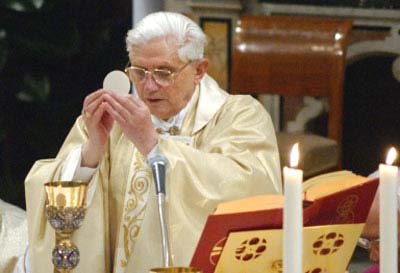
The celebrant said the words of the Consecration. He was a person of normal height, but suddenly, he began to grow, becoming filled with light, a supernatural light between white and gold that enveloped him and grew very strong around the face. And because of it, I could not see his features. When he raised the Host, I saw his hands, and on the back of his hands, he had some marks from which emanated a great deal of light. It was Jesus! It was Him Who was wrapping His Body around the celebrant, as if He were lovingly surrounding the hands of the Archbishop. At that moment, the Host began to grow and became enormous, and upon it the marvelous face of Jesus appeared looking at His people.

By instinct, I wanted to bow my head, and Our Lady said: “Do not look down. Look up to view and contemplate Him. Exchange your gaze with His, and repeat the prayer of Fatima: Lord, I believe, I adore, I trust, and I love You. I ask pardon for those who do not believe, do not adore, do not trust, and do not love You. Forgiveness and Mercy… Now tell Him how much you love Him, and pay your homage to the King of Kings.”

I told it to Him, and it seemed as if I was the only one He was looking at from the enormous Host. But I learned that this was the way He gazed at each person, with love to the fullest. Then I lowered my head until I had my forehead on the floor, as did all the Angels and the Blessed from Heaven. Perhaps for a fraction of a second, I wondered how Jesus was taking on the body of the celebrant and, at the same time, He was inside the Host. And as he lowered the Host, it returned to its normal size. Tears ran down my cheeks; I was unable to let go of my astonishment.

Immediately, the Archbishop said the words of the Consecration of the wine and, as the words were being said, lightning appeared from the heavens and in the background. The walls and ceiling of the church had disappeared. All was dark, but for that brilliant light from the Altar.

Suddenly, suspended in the air, I saw Jesus crucified. I saw Him from the head to the lower part of the chest. The cross beam of the Cross was sustained by some large, strong hands. From within this resplendent light, a small light, like a very brilliant, very small dove, came forth and flew swiftly all over the Church. It came to rest on the left shoulder of the Archbishop, who continued to appear as Jesus because I could distinguish His long hair, His luminous wounds, and His large body, but I could not see His Face.

Above was Jesus crucified, His head fallen upon His right shoulder. I was able to contemplate His face, beaten arms and torn flesh. On the right side of His chest, He had an injury, and blood was gushing out toward the left side, and toward the right side, what looked like water, but it was very brilliant.  They were more like jets of light coming forth towards the faithful, and moving to the right and to the left. I was amazed at the amount of blood that was flowing out toward the Chalice. I thought it would overflow and stain the whole Altar, but not a single drop was spilled.

At that moment, the Virgin Mary said: “This is the miracle of miracles. I have said to you before that the Lord is not constrained by time and space. At the moment of the Consecration, all the assembly is taken to the foot of Calvary, at the instant of the crucifixion of Jesus.”

Can anyone imagine that? Our eyes cannot see it, but we are all there at the very moment that they are crucifying Jesus. And He is asking for forgiveness to the Father, not only for those who killed Him, but also for each one of our sins: “Father, forgive them, because they know not what they do.”

From that day on, I do not care if the world thinks I am crazy, but I ask everybody to kneel and try to live, with their heart and with all their sensibility that they are capable of, this privilege that the Lord grants us.

When we were going to pray the Our Father, the Lord spoke for the first time during the celebration, and said: “Wait, I want you to pray with the deepest profundity which you can summon. At this moment, bring to mind that person or persons which have done you the greatest harm during your life, so that you embrace them close to your bosom, and tell them with all your heart: `In the Name of Jesus, I forgive you and wish you peace. In the Name of Jesus, I ask for your forgiveness and wish my peace.’ If the person is worthy of that peace, then the person will receive it, and feel better for it.  If that person is not capable of opening up to that peace, then peace will return to your heart. But I do not want you to receive nor offer peace when you are not capable of forgiving and feeling that peace in your heart first.

“Be careful of what you do,” continued the Lord, “you repeat in the Our Father: forgive us our trespasses as we forgive those who trespass against us. If you are capable of forgiving but not forgetting, as some people say, you are placing conditions upon the forgiveness of God. You are saying: You forgive me only as I am capable of forgiving, but no more.”

I do not know how to explain my pain, at the realization of how much we can hurt the Lord. And also how much we can injure ourselves by holding so many grudges, bad feelings and unflattering things that are born from our own prejudices and over-sensitivities. I forgave; I forgave from the heart, and asked for forgiveness from all the people whom I had hurt at one time or another, in order to feel the peace of the Lord.

The celebrant said, “…give us peace and unity…” and, then, “the peace of the Lord be with all of you.”

Suddenly, I saw that among some (not all) of the people who were embracing each other, a very intense light placed itself between them. I knew it was Jesus, and I practically threw myself to embrace the person next to me. I could truly feel the embrace of the Lord in that light. It was Him Who embraced me giving me His peace, because in that moment, I had been able to forgive and remove from my heart all grief against other people. That is what Jesus wants, to share that moment of joy, hugging us and wishing us His peace.

The moment of the celebrants’ Communion arrived. There I once again noticed the presence of all the priests next to the Archbishop. When he took Communion, the Virgin Mary said:

“This is the moment to pray for the celebrant and the priests who accompany him.  Repeat together with Me: `Lord, bless them, sanctify them, help them, purify them, love them, take care of them, and support them with Your Love.  Remember all the priests of the world, pray for all the consecrated souls…’

Dear brothers and sisters, that is the moment in which we should pray for them, because they are the Church as we, the laity, are also. Many times we, the laity, demand so much from the priests, but we are unable to pray for them, to understand that they are human, and to comprehend and appreciate the solitude that many times can surround a priest.

We should understand that the priests are people like ourselves and that they need to be understood, to be cared for. They need affection and attention from us because they are giving their life to each one of us, as Jesus did, by being consecrated to Him.

The Lord wants the people of the flock that God has entrusted to the priest to pray and help in his sanctification. Someday, when we are on the other side, we will understand the marvels that the Lord has done, giving us priests who help us to save our souls.

The people began to leave their pews on their way to Communion.  The great moment of the encounter had arrived. The Lord said to me: “Wait a moment; I want you to observe something…” An interior impulse made me raise my eyes towards the person who was going to receive Communion on the tongue from the hands of the priest.  

I should clarify that this person was one of the ladies from our group who the previous night was unable to go to confession, but this morning was able to do so before the Holy Mass. When the Priest placed the Sacred Host on her tongue, a flash of light, like a very golden white light, went right through this person, first through her back, then surrounding her from the back, around her shoulders, and then her head. The Lord said:

“This is how I Myself rejoice in embracing a soul who comes with a clean heart to receive Me.”The tone of voice of Jesus was that of a happy person.

I was astonished to see my friend return to her pew surrounded by light, embraced by the Lord. I thought of the marvel that we miss so many times by going to receive Jesus with our small or large offences, when it should be a feast.

Many times we say that there are no priests to whom to go to confess at any given moment. But the problem is not about confessing at each moment, but the problem resides in our ease of falling into evil again.  On the other hand, in the same way that we make an effort to search for a beauty parlor, or men search for a barber when we have a party, we have to also make an effort to seek a priest when we need to remove all that dirt from ourselves. We must not have the audacity to receive Jesus at any moment with our hearts full of ugly things.

When I went to receive communion, Jesus told me: “The Last Supper was the moment of the greatest intimacy with My own.  During that hour of love, I established what could be thought of as the greatest act of lunacy in the eyes of men, that of making Myself a prisoner of Love. I established the Eucharist.  I wanted to remain with you until the end of the centuries because My Love could not bear that you remained orphans, you whom I loved more than My life.”

I received that Host which had a different flavor. It was a mixture of blood and incense that inundated me entirely. I felt so much love that the tears ran down my cheeks without me being able to stop them.

When I returned to my seat, while kneeling down, the Lord said:“Listen…” A moment later, I began to hear the prayers of the lady who was seated in front of me and who had just received communion.

What she said, without opening her mouth, was more or less like this: “Lord, remember that we are at the end of the month, and I do not have the money to pay the rent, the car payments, nor the children’s school. You have to do something to help me… Please, make my husband stop drinking so much. I cannot bear any more his being intoxicated so often, and my youngest son is going to repeat the year again, if you do not help him. He has exams this week… And do not forget our neighbor who must move. Let her do it right away.  I cannot stand her anymore, etc., etc.”

Then the Archbishop said: “Let us pray,” and obviously all the congregation stood up for the final prayer. Jesus said in a sad tone: “Did you take note of her prayer? Not a single time did she tell Me that she loves Me.  Not a single time did she thank Me for the gift that I have given her by bringing down My Divinity to her poor humanity, in order to elevate her to Me. Not a single time has she said: thank You, Lord. It has been a litany of requests, and so are almost all of those who come to receive Me.”

“I have died for love, and I am risen. For love I await each one of you, and for love I remain with you… But you do not realize that I need your love. Remember that I am the Beggar of Love in this sublime hour for the soul.”

Do you all realize that He, Love, is begging for our love, and we do not give it to Him? Moreover, we avoid going to that encounter with the Love of Loves, with the only love who gives of itself in a permanent oblation.

When the celebrant was going to give the blessingthe Holy Virgin said: “Be attentive, take care… You do any old sign instead of the Sign of the Cross. Remember that this blessing could be the last one that you will receive from hands of a priest. You do not know when, leaving here, if you will die or not. You do not know if you will have the opportunity to receive a blessing from another priest. Those consecrated hands are giving you the blessing in the Name of the Holy Trinity. Therefore, make the Sign of the Cross with respect, as if it was the last one of your life.”

How much we miss in not understanding and not participating every day at the Holy Mass! Why not make an effort to begin the day a half hour earlier and run to the Holy Mass and receive all the blessings that the Lord wants to pour over us?

I am aware that, because of their obligations, not everybody can attend daily Mass, but at least two or three times a week. So many avoid Mass on Sundays with the smallest excuse, that they have a child, or two, or ten, and, therefore, they cannot attend Mass.  How do people manage when they have other important types of commitments? They take all the children, or take turns and the husband goes at one hour and the wife another, but they carry out their duty to God.

We have time to study, to work, to entertain, to rest, but WE DO NOT HAVE TIME, AT LEAST ON SUNDAY, TO GO TO THE HOLY MASS.

Jesus asked me to remain with Him a few minutes more after Mass had finished. He said: “Do not leave in a hurry after Mass is over. Stay a moment in My company and enjoy it, and let Me enjoy yours…”
As a child, I had heard someone say that the Lord remained with us for five or ten minutes, after Communion. I asked Him at this moment:

“Lord, truly, how much time do You stay with us after Communion?”

I suppose that the Lord must have laughed at my silliness, because He answered: “All the time that you want to have Me with you. If you speak to Me all day long, offering Me some words during your chores, I will listen to you. I am always with you. It is you who leaves Me. You leave the Mass, and the day of obligation ends. You kept the day of the Lord, and it is now finished for you. You do not think that I would like to share your family life with you, at least that day.”

“In your homes, you have a place for everything and a room for each activity: a room to sleep, another to cook, another to eat, etc. Which place have you made for Me? It should not be a place where you only have an image, which collects dust all the time, but a place where at least five minutes a day the family meets to give thanks for the day and for the gift of life, to ask for their needs of the day, to ask for blessings, protection, health. Everything has a place in your homes, except Me.”

“Men plan their day, their week, their semester, their vacations, etc. They know what day they are going to rest, what day they will go to the movies or to a party, or visit grandmother or the grandchildren, the children, their friends, and to their amusements.  How many families say at least once a month: `This is the day for our turn to go and visit Jesus in the Tabernacle,’ and the whole family comes to talk to M<%18>e<%0>? How many sit down in front of Me and have a conversation with Me, telling Me how it has been since the last time, telling Me their problems, the difficulties they have, asking Me about what they need, making Me part of these things? How many times?

“I know everything. I read even the deepest secrets of your hearts and minds.  But I enjoy your telling Me about your life, your letting Me participate as a family member, as your most intimate friend. Oh, how many graces does man lose by not giving Me a place in his life!”

When I remained with Him that day and on many other days, He continued to give us teachings. Today I want to share with you this mission that He has entrusted to me.  Jesus said:

“I wanted to save My creature, because the moment of opening the door to Heaven has been impregnated with too much pain…”  “Remember that not even one mother has fed her child with her own flesh. I have gone to that extreme of Love to communicate My merits to all of you.

“The Holy Mass is Myself prolonging My life and My sacrifice on the Cross among you. Without the merits of My life and My Blood, what do you have with which to come before the Father? Nothing, misery and sin…

“You should exceed in virtue the angels and archangels, because they do not have the joy of receiving Me as nourishment like you do. They drink a drop from the spring, but you that have the grace of receiving Me, you have the whole ocean to drink.”

The other thing that the Lord spoke about with pain concerned people who encounter Him out of habit, of those who have lost their awe of each encounter with Him. That routine turns some people so lukewarm that they have nothing new to tell Jesus when they receive Him. He also said that there were so many consecrated souls who lose their enthusiasm of falling in love with the Lord, and have made their vocation an occupation, a profession to which nothing more is given, except that which is demanded of one, but without feeling…

Then the Lord spoke to me about the fruits that must come from each Communion that we take. It does happen that there are people who receive the Lord daily but do not change their lives. They spend many hours in prayer and do many works, etc., but their life does not go on transforming, and a life that does not transform cannot bear true fruits for the Lord. The merits we receive in the Eucharist should bear the fruits of conversion in us and fruits of charity toward our brothers and sisters.

We the laity have a very important role in our Church. We do not have the right to be silent, because the Lord has sent us out, as all the baptized, to go forth and announce the Good News. We do not have the right to absorb all this knowledge and not share it with others, and to allow our brothers to die of hunger when we have so much bread in our hands.

We cannot watch our Church crumble as we stay comfortable in our parishes and homes, receiving and receiving so much from the Lord: His Word, the homilies of the priests, the pilgrimages, the Mercy of God in the Sacrament of Reconciliation, the marvelous union with the nourishment of Communion, the talks of preachers.

In other words, we are receiving so much and we do not have the courage to leave our comfort zone and go to a jail, to a correctional institution, to speak to the neediest. To go and tell them not to give up, that they were born Catholic and that their Church needs them there, suffering, because their suffering will serve to redeem others, because that sacrifice will gain for them eternal life.

We are not capable of going where the terminally ill are in the hospitals, and by praying the Divine Mercy Chaplet, helping them with our prayers during that time of struggle between good and evil to free them from the snares and temptations of the devil. Every dying person has fear, and just taking their hand and talking to them about the love of God and the marvel that awaits them in Heaven next to Jesus and Mary, next to their departed ones, gives them comfort.

The hour in which we currently live does not allow us to be indifferent. We must be an extension of the hands of our priests and go where they cannot reach. But for this, we need courage. We must receive Jesus, live with Jesus, nourish ourselves with Jesus.

We are afraid to commit ourselves a little more, and when the Lord says, “First seek the Kingdom of God, and the rest will be added onto you,” He says it all, brothers and sisters. It means to seek the Kingdom of God, by all possible means and with all means, and to open your hands in order to receive EVERYTHING in addition! This is because He is the Master Who pays the best, the only One Who is attentive to your smallest needs.

Brothers, sisters, thank you for allowing me to carry out the mission that was entrusted to me, that of having these pages reach you. The next time you attend Holy Mass, live it. I know the Lord will fulfill for you His promise that “your Mass will never again be the same.” And when you receive Him, love Him!

Experience the sweetness of feeling yourself resting against the folds of His side, pierced for you in order to leave you His Church and His Mother, to open for you the doors to His Father’s House. Experience this so that you are able to feel for yourself His Merciful Love by means of this testimony, and try to reciprocate with your childlike love.

May God bless you this Easter.

Your sister in the Living Jesus,

Catalina
Lay Missionary of the
 Eucharistic Heart of Jesus

Copyright © 2004 by The Great Crusade of Love and Mercy. All rights reserved. This booklet is published in coordination with The Apostolate of the New Evangelization. Translated from the April 2003 Revision of the original Spanish edition, published in Merida, Mexico. Permission is granted to reproduce this booklet in its entirety with no changes or additions and as long as the reproduction and distribution is done solely on a not-for-profit basis.

This document is available at no cost online, and can be downloaded and printed from the following Web Sites: in English at: http://www.greatcrusade.org and Spanish at: http://www.grancruzada.org

For information on ordering printed copies of this booklet and other books and videos, please write to: The Great Crusade of Love and Mercy, Inc., P.O. Box 857, Lithonia, Georgia 30058 USA, or visit the ministry’s Internet Site at: http://www.loveandmercy.org.

DOWNLOAD A WORD DOC OF THIS ARTICLE HERE

***** PRAYER *****

Posted: April 28, 2011 by CatholicJules in Memory Book, Personal Thoughts & Reflections

O God, wake me out of the nightmare fantasies of sin and temptation that threathens my peace with you, that I may live in the daylight of your purpose and be alert and attentive to your love for me in Jesus Christ, in whose name I pray.  Amen.

Emmanuel PW Session

Posted: April 26, 2011 by CatholicJules in Upcoming Events

VENUE CHANGED TO THE AUDITORIUM AND TIME CHANGED TO 7:30PM AS WE WILL BEGIN THE SESSION WITH THE EASTER OCTAVE.

CHURCH OF ST ANTHONY WOODLANDS

On Private Revelations

Posted: April 26, 2011 by CatholicJules in Great Catholic Articles

Public revelation is binding on all Christians, but private revelation is binding only on those who receive it. The Catholic Church teaches that public revelation was completed, and therefore was concluded, with the death of the last apostle (Vatican II, Dei Verbum 4), but private revelation has continued.

“Throughout the ages, there have been so-called ‘private’ revelations, some of which have been recognized by the authority of the Church. They do not belong, however, to the deposit of faith. It is not their role to improve or complete Christ’s definitive revelation, but to help live more fully by it in a certain period of history. Guided by the magisterium of the Church, the sensus fidelium[collective sense of the faithful] knows how to discern and welcome in these revelations whatever constitutes an authentic call of Christ or his saints to the Church. Christian faith cannot accept ‘revelations’ that claim to surpass or correct the revelation of which Christ is the fulfillment, as is the case in certain non-Christian religions and also in certain recent sects which base themselves on such ‘revelations’” (Catechism of the Catholic Church 67).

Some people tend to go to one extreme or the other on private revelation; they either completely reject the concept or they consider private revelation their chief rule of faith. The original sixteenth century Protestant Reformers denied all private revelation—they had to, for all the miracles that had occurred and all the private revelations that had been received over the previous fifteen hundred years had confirmed rather than attacked the Catholic faith. The original Reformers’ actions were in direct disobedience to the binding command of the New Testament: “Do not quench the Spirit. Do not despise prophetic utterances. Test everything; retain what is good” (1 Thess. 5:19–21).

The Reformers’ eradication of all new revelation led people to forget the distinction between public and private revelation. Thus when people appeared claiming to have new revleation, Protestants were left vulnerable to thinking any new revelations would be binding on all Christians. In the nineteenth and twentieth centuries, religious organizations which claim such new revelations have evolved in Protestant circles; for example, the Irvingites, the Mormons, the Seventh-Day Adventists, and the current “Word Faith” or “Prosperity Gospel” movement.

When the Pentecostal movement started in 1900, it faced the problem of explaining why private revelations had ceased for so many centuries, as the original Protestant Reformers claimed, only to begin again during this century. The correct answer, as the following passages from the early Church Fathers show, is that private revelation never did stop.

Hermas
“The vision which I saw, my brethren, was of the following nature . . . [An] old woman approached, accompanied by six young men . . . [And] she said to me . . . ‘Lo! do you not see opposite to you a great tower, built upon the waters, of splendid square stones?’ For the tower was built square by the six young men who had come with her. But myriads of men were carrying stones to it, some dragging them from the depths, others removing them from the land, and they handed them to these six young men. . . . [And the woman said:] ‘The tower which you see building is myself, the Church . . . the tower is built upon the waters . . . because your life has been and will be “saved through water” [1 Pet. 3:20–21] . . . the six young men . . . are the holy angels of God . . . the other persons who are engaged in carrying the stones . . . also are holy angels of the Lord . . . [And] when the tower is finished and built, then comes the end’” (The Shepherd 1:3:1–8 [A.D. 80]).

The Martyrdom of Polycarp
“While he [Polycarp] was thus at his prayers, three days before his arrest, he had a vision in which he saw flames reducing his pillow to ashes; whereupon he turned to his companions and said, ‘I must be going to be burnt alive.’ . . . [After his arrest, the crowd called] loud demands for the Asiarch Philip to let loose a lion at Polycarp. However, he told them that the rules would not allow him to do so, since he had already declared the beast-fighting closed; whereupon they decided to set up a unanimous outcry that he should have Polycarp burnt alive” (Martyrdom of Polycarp 5, 12 [A.D. 155]).

“Polycarp was . . . bishop of the Catholic Church at Smyrna, and a teacher in our own day who combined both apostle and prophet in his own person. For indeed, every word that ever fell from his lips either has had or will have its fulfillment” (ibid., 16).

Justin Martyr
“For the prophetical gifts remain with us [Christians], even to the present time. And hence you [Jews] ought to understand that [the gifts] formerly among your nation have been transferred to us” (Dialogue with Trypho the Jew 82 [A.D. 155]).

Irenaeus
“In like manner we do also hear many brethren in the Church who possess prophetic gifts and who through the Spirit speak all kinds of languages and who bring to light for the general benefit the hidden things of men, and declare the mysteries of God” (Against Heresies 5:6:1 [A.D. 189]).

Pionius
“I, Pionius, have made a fresh transcript of [The Martyrdom of Polycarp]. I found them after Polycarp the Blessed had revealed their whereabouts in a vision, as I will explain hereafter. Time had reduced them almost to tatters, but I gathered them carefully together in the hope that the Lord Jesus may likewise gather myself amongst his elect into his heavenly kingdom. To him, with the Father and the Holy Spirit, be glory forever and ever. Amen” (Martyrdom of Polycarp, copyist note 2 [A.D. 250]).

Constantine the Great
“And while he [the Emperor Constantine] was praying with fervent entreaty, a most marvelous sign appeared to him from heaven, the account of which it might have been hard to believe had it been related by any other person. But since the victorious emperor himself long afterwards declared it to the writer of this history [Eusebius], when he was honored with his acquaintance and society, and confirmed his statement by an oath, who could hesitate to accredit the relation, especially since the testimony of after-time has established its truth? He said that about noon, when the day was already beginning to decline, he saw with his own eyes a trophy of a cross of light in the heavens, above the sun, and bearing the inscription, ‘Conquer By This.’ At this sight he was struck with amazement, and his whole army also, which followed him on this expedition, and witnessed the miracle. He said [to me], moreover, that he doubted within himself what the import of this apparition could be. And while he continued to ponder and reason on its meaning, night suddenly came on; then in his sleep the Christ of God appeared to him with the same sign which he had seen in the heavens, and commanded him to make a likeness of that sign which he had seen in the heavens, and to use it as a safeguard in all engagements with his enemies. . . . [B]eing struck with amazement at the extraordinary vision, and resolving to worship no other God save him who had appeared to him, he sent for those who were acquainted with the mysteries of [God’s] doctrines and inquired who that God was and what was intended by the sign of the vision he had seen” (Eusebius, Life of Constantine 1:28–32 [A.D. 337]).

Anthony of Egypt
“[Anthony told his monks:] When, therefore, they [demons] come by night to you and wish to tell the future, or say ‘We are the angels,’ give no heed, for they lie. . . . But if they shamelessly stand their ground, capering, and change their forms of appearance, fear them not, nor shrink, nor heed them as though they were good spirits. For the presence either of the good or evil by the help of God can easily be distinguished. The vision of the holy ones is not fraught with distraction: ‘For they will not strive, nor cry, nor shall anyone hear their voice’ [Matt 12:19; cf. Is. 42:2]. But it comes quietly and gently that an immediate joy, gladness, and courage arise in the soul. For the Lord who is our joy is with them, and the power of God the Father” (Ambrose, Life of St. Anthony 35 [A.D. 359]).

Augustine
“For even now miracles are wrought in the name of Christ, whether by his sacraments or by the prayers or relics of his saints . . . The miracle which was wrought at Milan when I was there . . . [and when people] had gathered to the bodies of the martyrs Protasius and Gervasius, which had long lain concealed and unknown but were now made known to the bishop Ambrose in a dream and discovered by him” (City of God 22:8 [A.D. 419]).

“[T]he martyrs, by the very benefits which are given to them that pray, indicate that they take an interest in the affairs of men . . . For not only by effects of benefits, but in the very beholding of men, it is certain that the confessor Felix . . . appeared when the barbarians were attacking Nola, as we have heard not by uncertain rumors but by sure witness” (ibid., 19).

“A certain man by [the] name Curma [was in a coma] . . . Yet he was seeing many things as in a dream; when at last after a great many days he woke up, he told that he had seen. . . . [He also saw] Hippo, where he was seemingly baptized by me . . . After much that he saw, he narrated how he had, moreover, been led into paradise and how it was there said to him, when he was dismissed to return to his own family, ‘Go, be baptized if you want to be in this place of the blessed.’ Thereupon being admonished to be baptized by me, he said it was done already. He who was talking with him replied, ‘Go, be truly baptized, for you only saw that in a vision.’ After this he recovered, went his way to Hippo. . . . He was baptized [and] at the close of the holy days [of Easter] returned to his own place . . . Why should we not believe these to be angelic operations through the dispensation of the providence of God?” (The Care to be Had for the Dead 15 [A.D. 421]).

Sozomen
“Gregory of Nazianz presided over those who maintain the consubstantiality of the Holy Trinity, and assembled them together in a little dwelling, which had been altered into the form of a house of prayer, by those who held the same opinions and had a like form of worship. It subsequently became one of the most conspicuous in the city, and is so now, not only for the beauty and number of its structures, but also for the advantages accruing to it from the visible manifestations of God. For the power of God was there manifested, and was helpful both in waking visions and in dreams, often for the relief of many diseases and for those afflicted by some sudden transmutation in their affairs. The power was accredited to Mary, the Mother of God, the holy Virgin, for she does manifest herself in this way” (Church History 7:5 [A.D. 444]).

Patrick of Ireland
“And there truly [in Ireland] one night I heard in my sleep a voice saying to me, ‘You fast well; soon you will go to your fatherland.’ And again, after I very short time, I heard the heavenly voice saying to me, ‘Lo, your ship is ready.’ And it was not near at hand, but was distant, perhaps two hundred miles. And I had never been there, nor did I know any person living there. And thereupon I shortly took flight and left the man with whom I had been for six years. And I came in the strength of God, who prospered my way for good; and I met with nothing to alarm me until I reached that ship” (Confession of St. Patrick 17 [A.D. 452]).

“And once more, after a few years, I was in Britain with my family. . . . And there indeed I saw in a vision of the night a man whose name was Victoricus coming as it were from Ireland with countless letters. He gave me one of them, and I read the beginning of the letter, which was entitled ‘The Voice of the Irish.’ And while I was reading aloud the beginning of the letter, I thought that at that very moment I heard the voices of those who dwelt beside the Wood of Foclut [in Ireland], which is nigh unto the Western Sea. And thus they cried, as with one mouth, ‘We beseech you, holy youth, to come and walk once more among us!’” (ibid., 23).

“Let those who will, laugh and mock. I shall not be silent nor conceal the signs and wonders which were shown to me by the Lord many years before they came to pass, since he knows all things even before the world’s beginnings” (ibid., 45).

NIHIL OBSTAT: I have concluded that the materials
presented in this work are free of doctrinal or moral errors.
Bernadeane Carr, STL, Censor Librorum, August 10, 2004

IMPRIMATUR: In accord with 1983 CIC 827
permission to publish this work is hereby granted.
+Robert H. Brom, Bishop of San Diego, August 10, 2004

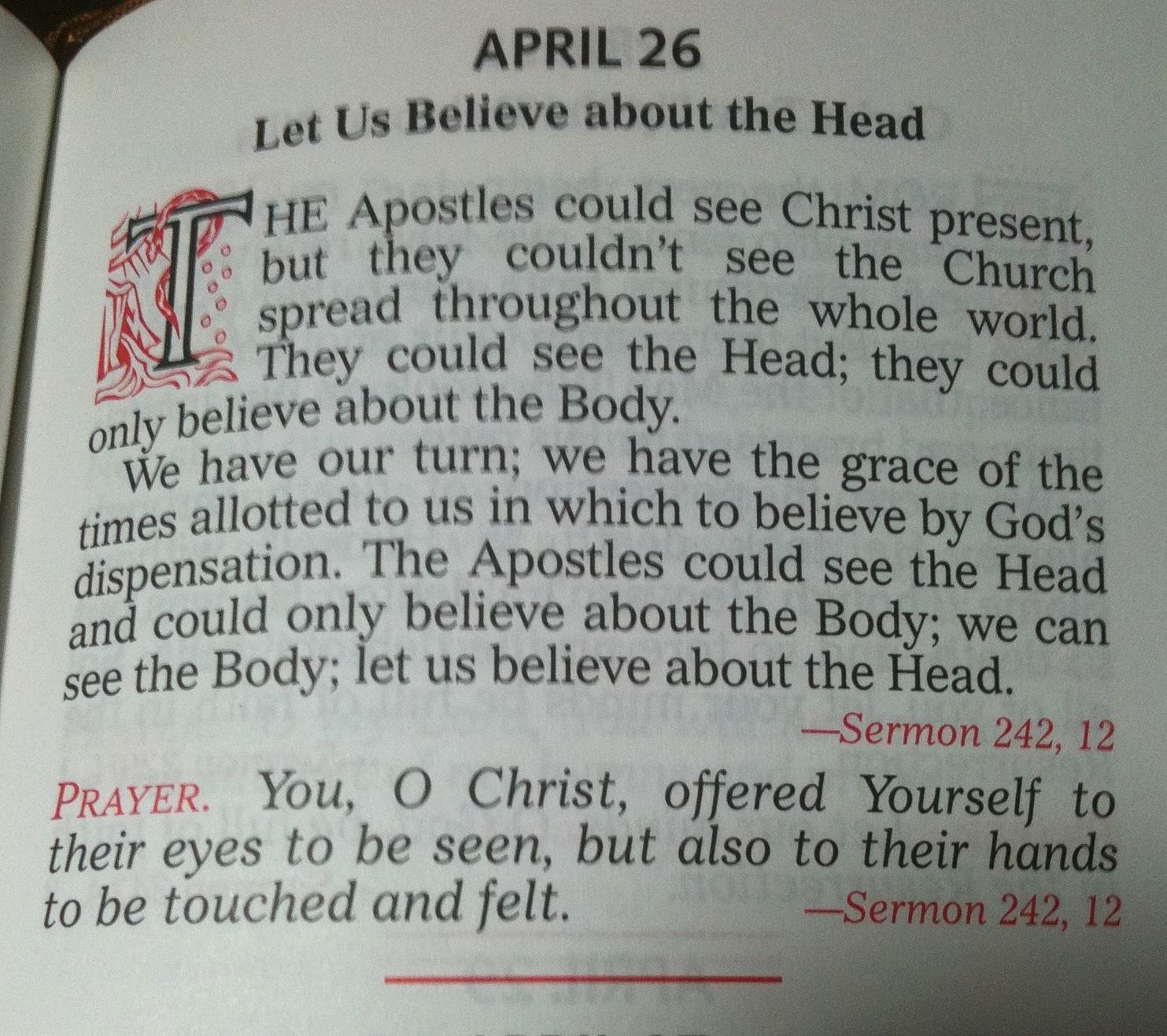
Let Us Believe About The Head

Posted: April 26, 2011 by CatholicJules in Life's Journeys

20110426-075230.jpg


Have you ever reflected on why you say Amen prior to receiving the Body of Christ?  Do you even know why you do? Has it become  routine to do so?


We Catholics should all be saying a loud resounding AMEN! A conviction on our part…as for me personally I do so because..

I am saying……

  • I believe wholeheartedly in the Creed I profess.
  • I believe that I am truly receiving the body, blood, soul and divinity of Christ my saviour.
  • I am proud to be a catholic.
  • I am in communion with the Church, i.e. part of the body of Christ my saviour.  I am one with my sisters and brothers in Christ.
  • I am receiving Jesus in a state of grace, free from mortal sin and hope to have eternal life.
there are more I could lists but these few are the most important to me.
Here is what  Rev. Jerome A Magat said in a homily I believe or a Gospel reflection…

Jesus said to the crowds: “I am the living bread that came down from heaven; whoever eats this bread will live forever; and the bread that I will give is my flesh for the life of the world.”

The Jews quarreled among themselves, saying, “How can this man give us his flesh to eat?” Jesus said to them, “Amen, amen, I say to you , unless you eat the flesh of the Son of Man and drink his blood, you do not have life within you. Whoever eats my flesh and drinks my blood has eternal life, and I will raise him on the last day. For my flesh is true food, and my blood is true drink. Whoever eats my flesh and drinks my blood remains in me and I in him. Just as the living Father sent me and I have life because of the Father, so also the one who feeds on me will have life because of me. This is the bread that came down from heaven. Unlike your ancestors who ate and still died, whoever eats this bread will live forever.”

In John 6:51-58, the Gospel provides us with another installment from John’s sixth chapter.- the Bread of Life discourse. In order to solemnize His claims, Jesus would often preface His statements by saying, “Amen, amen, I say to you.” The Catechism of the Catholic Church (CCC) reminds us that our Lord would use the phrase “Amen, amen” in order “to emphasize the trustworthiness of his teaching. His authority founded on God’s truth” (CCC, 1063). Similarly, we use the term “Amen” after we recite the Our Father at Mass during what is known as the “Great Amen” as well as when we receive Holy Communion.

What does the term “Amen” mean, and what does our saying “Amen” mean when we respond to the statement “The Body of Christ” when we receive Holy Communion?

What does the term “Amen” mean, and what does our saying “Amen” mean when we respond to the statement “The Body of Christ” when we receive Holy Communion? Again, the catechism reminds us: “In Hebrew, amen comes from the same root as the word ‘believe.’ This root expresses solidity, trustworthiness, faithfulness. And so we can understand why ‘Amen’ may express both God’s faithfulness towards us and our trust in Him.” (CCC, 1062) And so, more than simply “I believe,” the word “Amen” means that I place my life forward for the truth of a particular claim. It is more than an idea that resides in the mind. It is also an act of the will expressing God’s trustworthiness and my desire to believe, trust and love Him.

When a communicant says, “Amen,” to the words “The Body of Christ” when he receives the Eucharist at Mass, he is saying “Amen” to several realities. First, he is saying “Amen” to the reality of the real presence of Christ in the Eucharist. Next, he is saying “Amen” to the priesthood which confects this Eucharist, the authority of the bishop who ordained the priest and the pope that holds them in full communion with the See of Peter. Finally, he is saying “Amen” to all that the Church proposes as being true and definitively taught as worth of our belief. So, in order to make a genuine communion, a person receiving the Eucharist must be in full communion with the Church – that is, he accepts everything that the Church teaches. To believe in anything less makes that person’s “Amen” a disingenuous act. A true “Amen” links us to Jesus and nourishes us into everlasting life.

This precisely is the reason why Catholics don’t offer Holy Communion to non-Catholics (with the exception of the Orthodox). The reasoning is really quite simple. If, for example, a Protestant or a Jew was to come up to the Communion line and the priest said, “The Body of Christ,” the only response would be “Amen.” However, since neither Protestants nor Jews believe in the Eucharist in the same way that Catholics do, the priest would be asking the Protestant or Jew to violate their conscience in saying “Amen” to realities they do not accept.

Thus, the Church reminds us that the sacraments are not intended to engender unity. Rather, they are intended to express the unity that already exists among believers. Catholics are, therefore, not to receive communion in Protestant ecclesial communities because Catholics are not in communion with Protestants. That is why Jesus’ words in our Gospel are so chilling. “Unless you eat the flesh of the Son of Man and drink his blood, you do not have life within you.”

So, receiving Holy Communion with a resounding “Amen” expresses the unity of believers in the Catholic Church under the headship of the Roman Pontiff and his collaborators, the bishops. May the “Amen” that we say at Holy Communion be authentic – reflective of our unity of belief in all that our Lord has deemed necessary for our salvation and made known through His Bride, the Church.

~~~~~~~~

It is a statement of belief that the gathered Church makes in Christ’s presence in the Eucharist. It is further an acknowledgement of the presence of Christ in the faithful and union with Christ in his Body, the Church.

See how St. Augustine framed both of these aspects of the mystery of the Body of Christ in the early 5th
century:

“If you wish to understand the body of Christ, listen to the Apostle as he says to the faithful, ‘You are the body of Christ and His members.’ (1Cor 12:27) If therefore, you are the body of Christ and His members, your mystery has been placed on the Lord’s table, you receive your mystery. You reply “Amen” to that which you are, and by replying, you consent. For you hear, “The Body of Christ,” and you reply, “Amen.” Be a member of the body of Christ so that your “Amen” may be true.” But, why in bread? … Let us listen to the Apostle who said, ‘We though many, are one bread, one body.’”

(1Cor 10:17) [Augustine, IIA6.1 Sermon 272 (dated 405-411) Ed PL 38.1246-1248]

How is “Amen” an Act of Reverence?


Saying “Amen,” means we assent to our faith with our head and heart and will. Not only do we believe in the real presence but we also commit ourselves to living and acting as Jesus did and does. Tertullian, a 3rd century North African theologian, applied the Latin term sacramentum to the rites of baptism and Eucharist. Sacramentum referred to the oath of allegiance that soldiers made to the Roman emperor to serve him, even with their life. At this time in
the Church’s history, persecutions were common enough to make baptism into Christ a commitment that could mean dying for the faith. Thus, saying “Amen” to the sacrament of the Body and Blood of Christ serves as a Catholic pledge of allegiance to follow Christ.

How is Receiving Communion Itself an Act of Reverence?


The act of receiving is itself another powerful and meaningful gesture. “To receive” means to get, to obtain, to admit, to let in, and to accept. It implies a certain openness in the person receiving. It points to a hoped-for capacity in the person to be nourished by what one receives and to be nourished by the generosity of the Giver. Receiving, therefore, is an act that renders one vulnerable to what is given and to the one giving. Will the gift meet all my needs? Will the gift
be truly what I desire? Will I ever be hungry again? The procession of the faithful, the Body of Christ in the world is a procession of the hungry, the needy, and the hopeful. We may not always recognize each other in this manner, but all of God’s people (except possibly the very youngest) approach the minister of Communion with some experience of these things. What then do we see? We see members of our worshiping assembly engaging in a dialogic act of proclamation and response as well as a reciprocal act of giving and receiving. The minister of Communion, who herself has just been nourished by the Body and Blood of Christ, now serves the assembled Body by giving them food and drink. Even with her own vulnerability, demonstrated in needing to receive Communion, she and other ministers welcome fellow
sinners and nourish these same members of the Body with food and drink from heaven.

FOR REFLECTION


“What you see is transitory, but the invisible reality signified does not pass away, but abides. Behold, it is received, eaten, and consumed. Is the body of Christ consumed? Not at all! Here, on earth, His members are purified, there they are crowned. Thus, what is signified will endure eternally, even though what signifies it seems to pass away. Receive,
then, in such a way that you may take thought for yourselves, that you may have unity in your hearts, that you may fix your hearts always on high.” St. Augustine, IIA6.2 Sermon 227 (dated 412-413, 416-417)

April 24th, 2011 – Easter Sunday

Posted: April 24, 2011 by CatholicJules in Sunday Reflections

Sunday Bible Reflections with Dr. Scott Hahn

They Saw and Believed

Readings:
Acts 10:34, 37-43
Psalm 118:1-2, 16-17, 22-23
Colossians 3:1-4
John 20:1-9

Jesus is nowhere visible. Yet today’s Gospel tells us that Peter and John “saw and believed.”

What did they see? Burial shrouds lying on the floor of an empty tomb. Maybe that convinced them that He hadn’t been carted off by grave robbers, who usually stole the expensive burial linens and left the corpses behind.

But notice the repetition of the word “tomb” – seven times in nine verses. They saw the empty tomb and they believed what He had promised: that God would raise Him on the third day.

Chosen to be His “witnesses,” today’s First Reading tells us, the Apostles were “commissioned…to preach…and testify” to all that they had seen – from His anointing with the Holy Spirit at the Jordan to the empty tomb.

More than their own experience, they were instructed in the mysteries of the divine economy, God’s saving plan – to know how “all the prophets bear witness” to Him (see Luke 24:27,44).

Now they could “understand the Scripture,” could teach us what He had told them – that He was “the Stone which the builders rejected,” which today’s Psalm prophesies His Resurrection and exaltation (see Luke 20:17; Matthew 21:42; Acts 4:11).

We are the children of the apostolic witnesses. That is why we still gather early in the morning on the first day of every week to celebrate this feast of the empty tomb, give thanks for “Christ our life,” as today’s Epistle calls Him.

Baptized into His death and Resurrection, we live the heavenly life of the risen Christ, our lives “hidden with Christ in God.” We are now His witnesses, too. But we testify to things we cannot see but only believe; we seek in earthly things what is above.

We live in memory of the Apostles’ witness, like them eating and drinking with the risen Lord at the altar. And we wait in hope for what the Apostles told us would come – the day when we too “will appear with Him in glory.”

HOMILY OF HIS HOLINESS BENEDICT XVI – Easter Vigil

Posted: April 24, 2011 by CatholicJules in Memory Book

Dear Brothers and Sisters,

The liturgical celebration of the Easter Vigil makes use of two eloquent signs. First there is the fire that becomes light. As the procession makes its way through the church, shrouded in the darkness of the night, the light of the Paschal Candle becomes a wave of lights, and it speaks to us of Christ as the true morning star that never sets – the Risen Lord in whom light has conquered darkness. The second sign is water. On the one hand, it recalls the waters of the Red Sea, decline and death, the mystery of the Cross. But now it is presented to us as spring water, a life-giving element amid the dryness. Thus it becomes the image of the sacrament of baptism, through which we become sharers in the death and resurrection of Jesus Christ.

Yet these great signs of creation, light and water, are not the only constituent elements of the liturgy of the Easter Vigil. Another essential feature is the ample encounter with the words of sacred Scripture that it provides. Before the liturgical reform there were twelve Old Testament readings and two from the New Testament. The New Testament readings have been retained. The number of Old Testament readings has been fixed at seven, but depending upon the local situation, they may be reduced to three. The Church wishes to offer us a panoramic view of whole trajectory of salvation history, starting with creation, passing through the election and the liberation of Israel to the testimony of the prophets by which this entire history is directed ever more clearly towards Jesus Christ. In the liturgical tradition all these readings were called prophecies. Even when they are not directly foretelling future events, they have a prophetic character, they show us the inner foundation and orientation of history. They cause creation and history to become transparent to what is essential. In this way they take us by the hand and lead us towards Christ, they show us the true Light.

At the Easter Vigil, the journey along the paths of sacred Scripture begins with the account of creation. This is the liturgy’s way of telling us that the creation story is itself a prophecy. It is not information about the external processes by which the cosmos and man himself came into being. The Fathers of the Church were well aware of this. They did not interpret the story as an account of the process of the origins of things, but rather as a pointer towards the essential, towards the true beginning and end of our being. Now, one might ask: is it really important to speak also of creation during the Easter Vigil? Could we not begin with the events in which God calls man, forms a people for himself and creates his history with men upon the earth? The answer has to be: no. To omit the creation would be to misunderstand the very history of God with men, to diminish it, to lose sight of its true order of greatness. The sweep of history established by God reaches back to the origins, back to creation. Our profession of faith begins with the words: “We believe in God, the Father Almighty, Creator of heaven and earth”. If we omit the beginning of the Credo, the whole history of salvation becomes too limited and too small. The Church is not some kind of association that concerns itself with man’s religious needs but is limited to that objective. No, she brings man into contact with God and thus with the source of all things. Therefore we relate to God as Creator, and so we have a responsibility for creation. Our responsibility extends as far as creation because it comes from the Creator. Only because God created everything can he give us life and direct our lives. Life in the Church’s faith involves more than a set of feelings and sentiments and perhaps moral obligations. It embraces man in his entirety, from his origins to his eternal destiny. Only because creation belongs to God can we place ourselves completely in his hands. And only because he is the Creator can he give us life for ever. Joy over creation, thanksgiving for creation and responsibility for it all belong together.

The central message of the creation account can be defined more precisely still. In the opening words of his Gospel, Saint John sums up the essential meaning of that account in this single statement: “In the beginning was the Word”. In effect, the creation account that we listened to earlier is characterized by the regularly recurring phrase: “And God said …” The world is a product of the Word, of the Logos, as Saint John expresses it, using a key term from the Greek language. “Logos” means “reason”, “sense”, “word”. It is not reason pure and simple, but creative Reason, that speaks and communicates itself. It is Reason that both is and creates sense. The creation account tells us, then, that the world is a product of creative Reason. Hence it tells us that, far from there being an absence of reason and freedom at the origin of all things, the source of everything is creative Reason, love, and freedom. Here we are faced with the ultimate alternative that is at stake in the dispute between faith and unbelief: are irrationality, lack of freedom and pure chance the origin of everything, or are reason, freedom and love at the origin of being? Does the primacy belong to unreason or to reason? This is what everything hinges upon in the final analysis. As believers we answer, with the creation account and with John, that in the beginning is reason. In the beginning is freedom. Hence it is good to be a human person. It is not the case that in the expanding universe, at a late stage, in some tiny corner of the cosmos, there evolved randomly some species of living being capable of reasoning and of trying to find rationality within creation, or to bring rationality into it. If man were merely a random product of evolution in some place on the margins of the universe, then his life would make no sense or might even be a chance of nature. But no, Reason is there at the beginning: creative, divine Reason. And because it is Reason, it also created freedom; and because freedom can be abused, there also exist forces harmful to creation. Hence a thick black line, so to speak, has been drawn across the structure of the universe and across the nature of man. But despite this contradiction, creation itself remains good, life remains good, because at the beginning is good Reason, God’s creative love. Hence the world can be saved. Hence we can and must place ourselves on the side of reason, freedom and love – on the side of God who loves us so much that he suffered for us, that from his death there might emerge a new, definitive and healed life.

The Old Testament account of creation that we listened to clearly indicates this order of realities. But it leads us a further step forward. It has structured the process of creation within the framework of a week leading up to the Sabbath, in which it finds its completion. For Israel, the Sabbath was the day on which all could participate in God’s rest, in which man and animal, master and slave, great and small were united in God’s freedom. Thus the Sabbath was an expression of the Covenant between God and man and creation. In this way, communion between God and man does not appear as something extra, something added later to a world already fully created. The Covenant, communion between God and man, is inbuilt at the deepest level of creation. Yes, the Covenant is the inner ground of creation, just as creation is the external presupposition of the Covenant. God made the world so that there could be a space where he might communicate his love, and from which the response of love might come back to him. From God’s perspective, the heart of the man who responds to him is greater and more important than the whole immense material cosmos, for all that the latter allows us to glimpse something of God’s grandeur.

Easter and the paschal experience of Christians, however, now require us to take a further step. The Sabbath is the seventh day of the week. After six days in which man in some sense participates in God’s work of creation, the Sabbath is the day of rest. But something quite unprecedented happened in the nascent Church: the place of the Sabbath, the seventh day, was taken by the first day. As the day of the liturgical assembly, it is the day for encounter with God through Jesus Christ who as the Risen Lord encountered his followers on the first day, Sunday, after they had found the tomb empty. The structure of the week is overturned. No longer does it point towards the seventh day, as the time to participate in God’s rest. It sets out from the first day as the day of encounter with the Risen Lord. This encounter happens afresh at every celebration of the Eucharist, when the Lord enters anew into the midst of his disciples and gives himself to them, allows himself, so to speak, to be touched by them, sits down at table with them. This change is utterly extraordinary, considering that the Sabbath, the seventh day seen as the day of encounter with God, is so profoundly rooted in the Old Testament. If we also bear in mind how much the movement from work towards the rest-day corresponds to a natural rhythm, the dramatic nature of this change is even more striking. This revolutionary development that occurred at the very the beginning of the Church’s history can be explained only by the fact that something utterly new happened that day. The first day of the week was the third day after Jesus’ death. It was the day when he showed himself to his disciples as the Risen Lord. In truth, this encounter had something unsettling about it. The world had changed. This man who had died was now living with a life that was no longer threatened by any death. A new form of life had been inaugurated, a new dimension of creation. The first day, according to the Genesis account, is the day on which creation begins. Now it was the day of creation in a new way, it had become the day of the new creation. We celebrate the first day. And in so doing we celebrate God the Creator and his creation. Yes, we believe in God, the Creator of heaven and earth. And we celebrate the God who was made man, who suffered, died, was buried and rose again. We celebrate the definitive victory of the Creator and of his creation. We celebrate this day as the origin and the goal of our existence. We celebrate it because now, thanks to the risen Lord, it is definitively established that reason is stronger than unreason, truth stronger than lies, love stronger than death. We celebrate the first day because we know that the black line drawn across creation does not last for ever. We celebrate it because we know that those words from the end of the creation account have now been definitively fulfilled: “God saw everything that he had made, and behold, it was very good” (Gen 1:31). Amen.

Source

Glimpse Into A Seder Meal 2011

Posted: April 23, 2011 by CatholicJules in Photos

This slideshow requires JavaScript.

Palm Sunday Film – Get Your Kids To Watch This….

Posted: April 22, 2011 by CatholicJules in Videos/Audio

On The Easter Triduum

Posted: April 21, 2011 by CatholicJules in Memory Book

As the Lenten journey — begun with Ash Wednesday — comes to an end, yesterday’s liturgy of Holy Wednesday already introduces us into the dramatic atmosphere of the coming days, filled with the remembrance of the passion and death of Christ.

In fact, in the liturgy, the Evangelist Matthew presents for our meditation the brief dialogue that occurred in the Upper Room between Jesus and Judas. “Surely it is not I, Rabbi?” the traitor says to the Divine Teacher, who had prophesied: “Amen, I say to you, one of you will betray me.”

The Lord’s answer was incisive: “You have said so” (cf. Matthew 26:14-25).

St. John concludes narrating the prophecy of the betrayal with a short, meaningful phrase: “It was night” (John 13:30).

When the traitor exits the Upper Room, darkness penetrates his heart — it is an internal night — discouragement grows in the spirits of the other disciples — they too go toward the night — while the shadows of abandonment and hate grow darker around the Son of Man, who prepares himself for the consummation of his sacrifice on the cross.

In the coming days, we will commemorate the supreme battle between Light and Darkness, between Life and Death.

We also have to place ourselves within this context — aware of our own “night,” of our sins and responsibilities — if we want to spiritually benefit again from the paschal mystery, if we want to bring light to our hearts, by way of this mystery, which is the center point of our faith.

The beginning of the Easter triduum is Holy Thursday, today. During the Chrism Mass, which can be considered a prelude to the triduum, bishops of dioceses and their closest collaborators, the priests, surrounded by the people of God, renew the promises they made on the day of their priestly ordination.

Year after year, it is an intense moment of ecclesial communion, which highlights the gift of the ministerial priesthood which Christ left to his Church on the night before he died on the cross. And for each priest, it is a moving moment in the midst of the vigil of the passion, in which the Lord gave himself to us, gave us the sacrament of the Eucharist, and gave us the priesthood.

It is a day that moves our hearts. Later, the holy oils used for the sacraments are blessed: oil of catechumens, oil of the sick, and holy chrism. In the afternoon, entering into the Easter triduum, the community relives in the Mass “in Cena Domini” all that took place in the Last Supper. In the Upper Room, the Redeemer wanted to anticipate, with the sacrament of blood and wine made his body and his blood, the sacrifice of his life: He anticipated his death, the free gift of his life, offered as the definitive gift of himself to humanity.

With the washing of the feet, the gesture is repeated with which he, having loved his own in this world, loved them to the end (cf. John 13:1), and left his disciples, as a sort of trademark, this act of humility, love unto death.

After the Mass “in Cena Domini,” the liturgy invites the faithful to remain in adoration of the Blessed Sacrament, reliving Jesus’ agony in Gethsemane. And we see how the disciples slept, leaving the Lord alone.

Today as well — frequently — we sleep — we, his disciples. In this holy night of Gethsemane, we want to stay on guard; we do not want to leave the Lord alone in this hour. And in doing this, we can better understand the mystery of Holy Thursday, which encompasses the threefold, most-high gifts of the ministerial priesthood, the Eucharist and the new commandment of love, “agape.”

Good Friday, which commemorates the happenings between Christ’s condemnation to death and his crucifixion, is a day of penance, of fasting, of prayer, of participation in the passion of the Lord. At the prescribed hour, the Christian assembly retraces, with the help of the Word of God and liturgical actions, the history of human infidelity to the divine plan, which nevertheless is fulfilled precisely in this way. And we listen again to the moving narration of the sorrowful passion of the Lord.

Later, a long “prayer of the faithful” is directed to the heavenly Father, which includes all of the needs of the Church and the world. Then, the community adores the cross, and approaches the Eucharist, consuming the sacred species, reserved since the Mass “in Cena Domini” from the day before.

Commenting on Good Friday, St. John Chrysostom said: “Before, the cross meant disdain, but today it is venerated. Before, it was a symbol of condemnation, today it is the hope of salvation. It has truly been converted into a fount of infinite goods; it has liberated us from error, it has scattered our darkness, it has reconciled us with God. From being enemies of God, it has made us his family, from foreigners it has converted us to his neighbors: This cross is the destruction of enmity, the fount of peace, the coffer of our treasure” (“De cruce et latrone,” I, 1, 4).

To live the passion of the Redeemer more intensely, Christian tradition has given rise to numerous manifestations of popular piety, among them, the well-known Good Friday processions, with the evocative rites which are repeated year after year. But there is one expression of piety, the Way of the Cross, that offers us year-round the opportunity to impress in our spirits ever more deeply the mystery of the cross, advancing with Christ along this path and thus, interiorly conforming ourselves to him.

We could say that the Way of the Cross teaches us, using an expression from St. Leo the Great, to “fix the eyes of our heart on Christ crucified and recognize in him our own humanity” (Sermon 15 on the Passion of the Lord). In this consists the true wisdom of Christianity, that we wish to learn with the Way of the Cross on Good Friday in the Colosseum.

Holy Saturday is a day in which the liturgy is hushed, the day of great silence, which invites Christians to foster an interior recollection, often difficult to maintain in our day, so as to prepare us for the Easter Vigil. In many communities, spiritual retreats and Marian prayer meetings are organized on this day, in union with the Mother of the Redeemer, who awaits the resurrection of the crucified Son with anxious confidence.

Finally, in the Easter Vigil, the veil of sadness, which surrounds the Church during the death and burial of the Lord, will be torn in two by the victorious cry: Christ has risen and has overcome death forever! Then we can truly understand the mystery of the cross and, as an ancient author writes: “As God creates wonders even from the impossible, so that we will know that only he can do as he wishes: From his death proceeds our life; from his wounds, our healing; from his fall, our resurrection, from his descent, our rising up” (Anonymous 14th).

Animated by a stronger faith, at the heart of the Easter Vigil, we welcome the newly baptized and renew our own baptismal promises. Thus, we will experience that the Church is always alive, always renewing itself, always beautiful and holy, because its foundation is Christ, who, having risen, will never die again.

Dear brothers and sisters, the paschal mystery, which the holy triduum allows us to relive, is not only a memory of a past reality. It is a current reality: Today, too, Christ overcomes sin and death with his love. Evil, in all of its forms, does not have the final word. The final triumph belongs to Christ, to truth, to love!

If we, with him, are willing to suffer and die, as St. Paul reminds us in the Easter Vigil, his life will become our life (cf. Romans 6:9). Our Christian existence is based on and grows from this certainty.

Invoking the intercession of Holy Mary, who followed Jesus on the path of the passion and the cross, and who embraced him when he was taken down from the cross, I hope that all of you will participate fervently in the Easter triduum, and will experience the joy of Easter with all of your loved ones.

As we approach the end of Lent and the commemoration of Christ’s passion, death and resurrection, the Church’s liturgy invites us to contemplate the mystery of the Cross, to acknowledge our sinfulness and, in faith, to unite ourselves with Jesus in his saving passover from death to life. Holy Thursday, with its celebration of the Chrism Mass and the Mass of the Lord’s Supper, evokes gratitude for Christ’s institution of the sacraments of the Eucharist and Holy Orders, and for his new commandment of love. Good Friday is centred on the Gospel of the Lord’s Passion and the adoration of his Holy Cross, the source of our salvation. The somber silence of Holy Saturday is a prelude to the joy of the Easter Vigil, with its proclamation of Christ’s victory over sin and death, the gift of his grace in the sacrament of Baptism and the renewal of our baptismal promises. These liturgical celebrations are not mere commemorations of past events; they introduce us to the ever-present reality of God’s saving power. Today too, Christ’s love triumphs over evil, sin and death. Truly, as Saint Paul says, “if we have died with Christ, we believe that we shall also live with him” (Rom 6:8).

Good Easter To All….

From an address by Pope Benedict XVI

The Perfection Of Love

Posted: April 21, 2011 by CatholicJules in Memory Book

From a treatise on John by Saint Augustine, bishop

Dear brethren, the Lord has marked out for us the fullness of love that we ought to have for each other. He tells us: No one has greater love than the man who lays down his life for his friends. In these words, the Lord tells us what the perfect love we should have for one another involves. John, the evangelist who recorded them, draws the conclusion in one of his letters: As Christ laid down his life for us, so we too ought to lay down our lives for our brothers. We should indeed love one another as he loved us, he who laid down his life for us.

This is surely what we read in the Proverbs of Solomon: If you sit down to eat at the table of a ruler, observe carefully what is set before you; then stretch out your hand, knowing that you must provide the same kind of meal yourself. What is this ruler’s table if not the one at which we receive the body and blood of him who laid down his life for us? What does it mean to sit at this table if not to approach it with humility? What does it mean to observe carefully what is set before you if not to meditate devoutly on so great a gift? What does it mean to stretch out one’s hand, knowing that one must provide the same kind of meal oneself, if not what I have just said: as Christ laid down his life for us, so we in our turn ought to lay down our lives for our brothers? This is what the apostle Paul said:Christ suffered for us, leaving us an example, that we might follow in his footsteps.

This is what is meant by providing “the same kind of meal.” This is what the blessed martyrs did with such burning love. If we are to give true meaning to our celebration of their memorials, to our approaching the Lord’s table in the very banquet at which they were fed, we must, like them, provide “the same kind of meal.”

At this table of the Lord we do not commemorate the martyrs in the same way as we commemorate others who rest in peace. We do not pray for the martyrs as we pray for those others, rather, they pray for us, that we may follow in his footsteps. They practiced the perfect love of which the Lord said there could be none greater. They provided “the same kind of meal” as they had themselves received at the Lord’s table. This must not be understood as saying that we can be the Lord’s equals by bearing witness to him to the extent of shedding our blood. He had the power of laying down his life; we by contrast cannot choose the length of our lives, and we die even if it is against our will. He, by dying, destroyed death in himself; we are freed from death only in his death. His body did not see corruption; our body will see corruption and only then be clothed through him in incorruption at the end of the world. He needed no help from us in saving us; without him we can do nothing. He gave himself to us as the vine to the branches; apart from him we cannot have life.

Finally, even if brothers die for brothers, yet no martyr by shedding his blood brings forgiveness for the sins of his brothers, as Christ brought forgiveness to us. In this he gave us, not an example to imitate but a reason for rejoicing. Inasmuch, then, as they shed their blood for their brothers, the martyrs provided “the same kind of meal” as they had received at the Lord’s table. Let us then love one another as Christ also loved us and gave himself up for us.

An Overview Of The Bible By A Nine Year Old

Posted: April 20, 2011 by CatholicJules in Videos/Audio

This little boy Davis Burton does a fantastic job, hopefully one day on his journey he will discover the fullness of faith which he will only find in the Catholic Church.

God bless him….

Wellsprings BookSale

Posted: April 19, 2011 by CatholicJules in Upcoming Events


Let Us Too Glory In The Cross Of The Lord

Posted: April 18, 2011 by CatholicJules in Memory Book

From a sermon by Saint Augustine, bishop

The passion of our Lord and Savior Jesus Christ is the hope of glory and a lesson in patience.

What may not the hearts of believers promise themselves as the gift of God’s grace, when for their sake God’s only Son, co-eternal with the Father, was not content only to be born as man from human stock but even died at the hands of the men he had created?

It is a great thing that we are promised by the Lord, but far greater is what has already been done for us, and which we now commemorate. Where were the sinners, what were they, when Christ died for them? When Christ has already given us the gift of his death, who is to doubt that he will give the saints the gift of his own life? Why does our human frailty hesitate to believe that mankind will one day live with God?

Who is Christ if not the Word of God: in the beginning was the Word, and the Word was with God, and the Word was God? This Word of God was made flesh and dwelt among us. He had no power of himself to die for us: he had to take from us our mortal flesh. This was the way in which, though immortal, he was able to die; the way in which he chose to give life to mortal men: he would first share with us, and then enable us to share with him. Of ourselves we had no power to live, nor did he of himself have the power to die.

Accordingly, he effected a wonderful exchange with us, through mutual sharing: we gave him the power to die, he will give us the power to live.

The death of the Lord our God should not be a cause of shame for us; rather, it should be our greatest hope, our greatest glory. In taking upon himself the death that he found in us, he has most faithfully promised to give us life in him, such as we cannot have of ourselves.

He loved us so much that, sinless himself, he suffered for us sinners the punishment we deserved for our sins. How then can he fail to give us the reward we deserve for our righteousness, for he is the source of righteousness? How can he, whose promises are true, fail to reward the saints when he bore the punishment of sinners, though without sin himself?

Brethren, let us then fearlessly acknowledge, and even openly proclaim, that Christ was crucified for us; let us confess it, not in fear but in joy, not in shame but in glory.

The apostle Paul saw Christ, and extolled his claim to glory. He had many great and inspired things to say about Christ, but he did not say that he boasted in Christ’s wonderful works: in creating the world, since he was God with the Father, or in ruling the world, though he was also a man like us. Rather, he said: Let me not boast except in the cross of our Lord Jesus Christ.

Have A Blessed Palm Sunday

Posted: April 17, 2011 by CatholicJules in Life's Journeys

Sent from Julian’s Mobility Pad….

“In the same way, faith by itself, if it is not accompanied by action, is dead.” James 2:17

April 17th, 2011 – Passion Sunday

Posted: April 15, 2011 by CatholicJules in Sunday Reflections

Sunday Bible Reflections with Dr. Scott Hahn 

All Is Fulfilled

Readings:
Isaiah 50:4-7
Psalm 22:8-9, 17-20, 23-24
Philippians 2:6-11
Matthew 26:14-27:66
________________________________________

“All this has come to pass that the writings of the prophets may be fulfilled,” Jesus says in today’s Gospel (see Matthew 26:56).

Indeed, we have reached the climax of the liturgical year, the highest peak of salvation history, when all that has been anticipated and promised is to be fulfilled.

By the close of today’s long Gospel, the work of our redemption will have been accomplished, the new covenant will be written in the blood of His broken body hanging on the cross at the place called the Skull.

In His Passion, Jesus is “counted among the wicked,” as Isaiah had foretold (see Isaiah 53:12). He is revealed definitively as the Suffering Servant the prophet announced, the long-awaited Messiah whose words of obedience and faith ring out in today’s First Reading and Psalm.

The taunts and torments we hear in these two readings punctuate the Gospel as Jesus is beaten and mocked (see Matthew 27:31), as His hands and feet are pierced, as enemies gamble for His clothes (see Matthew 27:35), and as his enemies dare Him to prove His divinity by saving Himself from suffering (see Matthew 27:39-44).

He remains faithful to God’s will to the end, does not turn back in His trial. He gives Himself freely to His torturers, confident that, as He speaks in today’s First Reading: “The Lord God is My help…I shall not be put to shame.”

Destined to sin and death as children of Adam’s disobedience, we have been set free for holiness and life by Christ’s perfect obedience to the Father’s will (see Romans 5:12-14,17-19; Ephesians 2:2; 5:6).

This is why God greatly exalted Him. This is why we have salvation in His Name. Following His example of humble obedience in the trials and crosses of our lives, we know we will never be forsaken. We know, as the centurion today, that truly this is the Son of God (see Matthew 27:54).


The Paschal Sacrament Brings Together In Unity Of Faith

Posted: April 11, 2011 by CatholicJules in Memory Book

The paschal sacrament brings together in unity of faith those physically separated from each other.

From an Easter letter by Saint Athanasius, bishop

Brethren, how fine a thing it is to move from festival to festival, from prayer to prayer, from holy day to holy day. The time is now at hand when we enter on a new beginning: the proclamation of the blessed Passover, in which the Lord was sacrificed. We feed as on the food of life, we constantly refresh our souls with his precious blood, as from a fountain. Yet we are always thirsting, burning to be satisfied. But he himself is present for those who thirst and in his goodness invites them to the feast day. Our Savior repeats his words: If anyone thirsts, let him come to me and drink.

He quenched the thirst not only of those who came to him then. Whenever anyone seeks him he is freely admitted to the presence of the Savior. The grace of the feast is not restricted to one occasion. Its rays of glory never set. It is always at hand to enlighten the mind of those who desire it. Its power is always there for those whose minds have been enlightened and who meditate day and night on the holy Scriptures, like the one who is called blessed in the holy psalm: Blessed is the man who has not followed the counsel of the wicked, or stood where sinners stand, or sat in the seat of the scornful, but whose delight is in the law of the Lord, and who meditates on his law day and night.

Moreover, my friends, the God who first established this feast for us allows us to celebrate it each year. He who gave up his Son to death for our salvation, from the same motive gives us this feast, which is commemorated every year. This feast guides us through the trials that meet us in this world. God now gives us the joy of salvation that shines out from this feast, as he brings us together to form one assembly, uniting us all in spirit in every place, allowing us to pray together and to offer common thanksgiving, as is our duty on the feast. Such is the wonder of his love: he gathers to this feast those who are far apart, and brings together in unity of faith those who may be physically separated from each other.


April 10, 2011 – 5th Sunday of Lent

Posted: April 8, 2011 by CatholicJules in Sunday Reflections

Sunday Bible Reflections with Dr. Scott Hahn

At Lazarus’ Tomb

Readings:

Ezekiel 37:12-14
Psalm 130:1-8
Romans 8:8-11
John 11:1-45

________________________________________

As we draw near to the end of Lent, today’s Gospel clearly has Jesus’ passion and death in view.

That’s why John gives us the detail about Lazarus’ sister, Mary – that she is the one who anointed the Lord for burial (see John 12:3,7). His disciples warn against returning to Judea; Thomas even predicts they will “die with Him” if they go back.

When Lazarus is raised, John notices the tombstone being taken away, as well as Lazarus’ burial cloths and head covering – all details he later notices with Jesus’ empty tomb (see John 20:1,6,7).

Like the blind man in last week’s readings, Lazarus represents all humanity. He stands for “dead man” – for all those Jesus loves and wants to liberate from the bands of sin and death.

John even recalls the blind man in his account today (see John 11:37). Like the man’s birth in blindness, Lazarus’ death is used by Jesus to reveal “the glory of God” (see John 9:3). And again like last week, Jesus’ words and deeds give sight to those who believe (see John 11:40).

If we believe, we will see – that Jesus loves each of us as He loved Lazarus, that He calls us out of death and into new life.

By His Resurrection Jesus has fulfilled Ezekiel’s promise in today’s First Reading. He has opened the graves that we may rise, put His Spirit in us that we may live. This is the Spirit that Paul writes of in today’s Epistle. The same Spirit that raised Jesus from the dead will give life to we who were once dead in sin.

Faith is the key. If we believe as Martha does in today’s Gospel – that Jesus is the resurrection and the life – even if we die, we will live.

“I have promised and I will do it,” the Father assures us in the First Reading. We must trust in His word, as we sing in today’s Psalm – that with Him is forgiveness and salvation.

Contemplating The Lord’s Passion

Posted: April 8, 2011 by CatholicJules in Memory Book

From a sermon by Saint Leo the Great, pope

True reverence for the Lord’s passion means fixing the eyes of our heart on Jesus crucified and recognizing in him our own humanity.

The earth—our earthly nature—should tremble at the suffering of its Redeemer. The rocks—the hearts of unbelievers—should burst asunder. The dead, imprisoned in the tombs of their mortality, should come forth, the massive stones now ripped apart. Foreshadowings of the future resurrection should appear in the holy city, the Church of God: what is to happen to our bodies should now take place in our hearts.

No one, however weak, is denied a share in the victory of the cross. No one is beyond the help of the prayer of Christ. His prayer brought benefit to the multitude that raged against him. How much more does it bring to those who turn to him in repentance. Ignorance has been destroyed, obstinacy has been overcome. The sacred blood of Christ has quenched the flaming sword that barred access to the tree of life. The age-old night of sin has given place to the true light.

The Christian people are invited to share the riches of paradise. All who have been reborn have the way open before them to return to their native land, from which they had been exiled. Unless indeed they close off for themselves the path that could be opened before the faith of a thief.

The business of this life should not preoccupy us with its anxiety and pride, so that we no longer strive with all the love of our heart to be like our Redeemer, and to follow his example. Everything that he did or suffered was for our salvation: he wanted his body to share the goodness of its head.

First of all, in taking our human nature while remaining God, so that the Word became man, he left no member of the human race, the unbeliever excepted, without a share in his mercy. Who does not share a common nature with Christ if he has welcomed Christ, who took our nature, and is reborn in the Spirit through whom Christ was conceived?

Again, who cannot recognize in Christ his own infirmities? Who would not recognize that Christ’s eating and sleeping, his sadness and his shedding of tears of love are marks of the nature of a slave?

It was this nature of a slave that had to be healed of its ancient wounds and cleansed of the defilement of sin. For that reason the only-begotten Son of God became also the son of man. He was to have both the reality of a human nature and the fullness of the godhead.

The body that lay lifeless in the tomb is ours. The body that rose again on the third day is ours. The body that ascended above all the heights of heaven to the right hand of the Father’s glory is ours. If then we walk in the way of his commandments, and are not ashamed to acknowledge the price he paid for our salvation in a lowly body, we too are to rise to share his glory. The promise he made will be fulfilled in the sight of all:Whoever acknowledges me before men, I too will acknowledge him before my Father who is in heaven.


Catholic Q & As

Posted: April 5, 2011 by CatholicJules in Questions & Answers

Can God Take A Joke?
Q: Is it a sin to tell jokes? From time to time in old Christian writings I find statements such as “Christians should not indulge in jesting, laugh or tolerate buffoons” (St. Basil) and the like. I often rely on humor to get along with people and with myself. I’ll try to be less zany in the future, but I still feel frightened at the thought that I shouldn’t try to make people laugh. What should I do?

A: Did you hear the one about the man who . . . Well, okay, I’ll hold off on that for now. Perhaps an adequate answer is provided by some recent newspaper reports on the approaching beatification of Pope John XXIII. They recalled his humor and, in particular, his response to an American visitor who — honoring the interest in statistics that most Americans have inherited in their genes — asked the Pope, “How many people work in the Vatican?” Pope John is reputed to have looked at him and answered (with a pontifical grin, one imagines), “Oh, about half.”

The present successor of St. Peter, especially in situations where he is most at home — in Poland or with young people — loves bantering and joking. It’s possible that St. Basil didn’t have a great sense of humor. More likely, however, he was quite right in the context he was referring to. There are situations where jesting and laughing are clearly out of place. But mirth and humor also have a legitimate, even important, place in life. The key here is balance. If you don’t have that balance, when it comes to joking and humor, you have to find that balance.

As for buffoons, if the dictionary is right in its description of such a blighter (that’s Irish lingo) as someone who is “a low, vulgar or indecent jester, one without self-respect,” I couldn’t have more sympathy with St. Basil. In fact, I’d be tempted to utter a loud British “Hear, hear, old chap!” and vote for the buffoon to be sent off to a special purgatory where he would have to listen to replays of himself for about two millennia. On second thought, that might qualify as “cruel and unusual punishment.” Two days of some people’s “humor” would be excruciating.

Anyway, whatever you think of the above arguments, here’s the clincher: If jesting and laughing were unacceptable
for Christians, we would long since have died under an avalanche of anathemas. And while there are a few people out there who wish that such a thing had happened, so far not a single prelate has chimed in to accuse us of “execrable and perfidious levity unbecoming of Christians,” or of any similarly impressive crime. So there.

Q: We have a serious problem in our parish with a particular lay “liturgist.” One of our parish priests, Fr. N., is from another country. He’s a wonderful man and an excellent priest, but he’s been told by our bishop that he’s “here to learn, not to change anything.” (Apparently this translates to mean that the priest is not allowed to (re)introduce any of the traditional devotions that have fallen by the way in our parish.) The problem stems from the “liturgist” who says: “RCIA is my ministry, and Father N. has nothing to do with it.” She also claims that it’s mandated by the National Conference of Catholic Bishops to use the RCIA program, as opposed to allowing people to receive individual instructions in the Faith, something which Father N. has said he would be happy to provide, if it was requested of him (which it has). The parish “Liturgist” seems determined to thwart any effort by Father N. to do an “end run” around her RCIA position of power. Is there some reliable and authoritative ecclesiastical source I could turn to that would either support her claims or prove them false?

A: You’ve probably heard the standard line about liturgists. Question: “What’s the difference between a liturgist and a terrorist?” Answer: “You can negotiate with a terrorist.”

Ahem. Well, to be fair, I do know some excellent liturgists, people who are orthodox theologically, and blessed with great humility and a genuine spirit of cooperation. Unfortunately, there are also liturgists who are not theologically orthodox, who don’t evince the virtue of humility (something crucial for all Christians, of course, but especially for those who serve the Church with Her sacred ministry of the Sacraments and the Liturgy), and who are intransigent in their opposition to traditional forms of Catholic piety. Some of these liturgists have staked out their own liturgical fiefdom and will defend it with the territorial élan of a terrier.

For the benefit of those who are unfamiliar with the acronym (though it’s invoked with such fervor everywhere these days that it’s hard to imagine anyone who frequents a Catholic parish could possibly have avoided running into it), RCIA stands for the Rite of Christian Initiation of Adults. What does the Church have to say about adults who will be initiated into Christian life?

According to Canon 851 of the Code of Canon Law (Church law, that is universally binding in the Latin Rite), “An adult who intends to receive baptism is to be admitted to the catechumenate and, as far as possible, brought through the various stages to sacramental initiation, in accordance with the rite of initiation as adapted by the Episcopal Conference and with the particular norms issued by it.” We’re also told (Can. 788 §3): “It is the responsibility of the Episcopal Conference to establish norms concerning the arrangement of the catechumenate, determining what should be done by catechumens and what should be their prerogatives.” In the United States, the National Conference of Catholic Bishops (NCCB) effectively determined “what should be done by catechumens” by establishing the Rite of Christian Initiation of Adults.

Nevertheless, judging by what those nationally responsible for it say about it, your local liturgist is laboring under some fairly serious misconceptions about what “RCIA” is. With modesty, flexibility and reason (which goes to prove that the liturgist joke is unfair as a generalization!), what they say is the following (emphases are mine): “The Rite of Christian Initiation is not a program. It is the Church’s way of ministering sensitively to those who seek membership. For that reason some people will need more time than others to prepare for the lifetime commitment that comes with membership in the Catholic Church. The usual length of preparation is from one to two years. For those already baptized and who seek full communion in the Catholic Church, the time may also vary. It seems reasonable that catechumens or candidates experience the yearly calendar of Catholic practice at least one time around in order to make an informed decision.”
I think it’s fairly obvious that there’s a great deal of flexibility and adjustment to the situation of each candidate. And most importantly, it’s “not a program”; individual instruction can be “ministering sensitively” to candidates, and therefore part of RCIA.

The second part of the question is, can the priest intervene? Well, assuming he’s the pastor of the parish, he’s obliged to do so. At the very least, he should evaluate what the liturgists or catechists are proposing to do in order to decide whether to endorse and approve it.
According to Canon 519, “The parish priest is the proper pastor of the parish entrusted to him. He exercises the pastoral care of the community entrusted to him under the authority of the diocesan Bishop, whose ministry of Christ he is called to share, so that for this community he may carry out the offices of teaching, sanctifying and ruling with the cooperation of other priests or deacons and with the assistance of lay members of Christ’s faithful, in accordance with the law.” Moreover (Canon 528 §1), he “has the obligation of ensuring that the word of God is proclaimed in its entirety to those living in the parish. He is therefore to see to it that the lay members of Christ’s faithful are instructed in the truths of faith . . . . ”

That, too, seems clear enough. The pastor is the one who is primarily responsible before God for the spiritual well-being of his parish (i.e. all his parishioners, the souls of the men, women, and children entrusted to his care). He can exercise his responsibility with the assistance of others, but they aren’t somehow independent operators.

The bishop can remove him as pastor if he so wishes, but as long as he leaves him there as pastor, he can’t redefine the role entrusted to the parish priest by canon law. And if he removes him, he must name another priest in his place (no, the lay liturgist can’t become the pastor). That new priest, in turn, must take upon himself the pastoral care of the faithful of his parish. That’s why he’s the pastor!

Certainly, the pastor is “under the authority of the diocesan bishop,” and the bishop can instruct him to follow a particular process in preparing adults for initiation into the Sacraments. But you can take it as certain that nowhere is it said that the pastor is “under the authority of the parish liturgist.” Father, then, has plenty to do with it, since RCIA is most certainly a ministry of “teaching and sanctifying.”
That said, it’s not clear why there should necessarily be a preference for “individual instruction” by the priest over whatever the liturgist is proposing to do. If he or she understands and communicates that faith well, perhaps this person will do it better than the priest. There’s plenty of room and need for those lay collaborators; the priest is not a one-man orchestra.


Answers By Fr. Brian Wilson, L.C.

Book Review : A Life Of Our Lord For Children

Posted: April 2, 2011 by CatholicJules in Book Review

Product Description

Marigold Hunt begins with Adam and Eve and goes quickly through the Old Testament to Jesus, whom she presents simply but not trivially, so children encounter Him in His goodness, His suffering, and His majesty.Hunt speaks in words and phrases that young children understand and explains terms they may not know. She includes devotions from the Bible (such as the Magnificat, the Beatitudes, and the Canticle of Zachary) along with many of Christ’s parables (which she explains).

A Life of Our Lord for Children will make sense of Scripture for your children and help them be more attentive during Mass when they hear the same tales directly from the Gospels.

About the Author

Marigold Hunt was a speaker for the Catholic Evidence Guild and served for many years as advertising manager of Sheed and Ward publishing company. In addition to this book, she wrote St. Patrick’s Summer, A Book of Angels, and The First Christians: The Acts of the Apostles for Children.
  • Reading level: Young Adult
  • Paperback: 200 pages
  • Publisher: Sophia Institute Press (December 1, 2003)
  • Language: English
  • ISBN-10: 1928832644
  • ISBN-13: 978-1928832645
  • Product Dimensions: 8.5 x 5.5 x 0.5 inches

Dear Children:

“The Gospels are four very short books that tell you about our Lord’s life. You can read them quite fast. The reason the same story takes so much longer to tell in this book is that the men who wrote the Gospels just went straight on and hardly even stopped to explain anything. They couldn’t be expected to know how we would live, and that we would have forgotten how people dressed and spoke and built houses, and the other customs they had in those days. So in this book, I have to stop and explain all the time, but after you’ve read it, the explaining will have been done, and you can start reading the Gospels yourself any time you want.”

So says the author of this rich retelling of the life of Christ, a tale that possesses the interest, lucidity, and dignity that marks the best of books for children.

Marigold Hunt begins with Adam and Eve and goes quickly through the Old Testament to Jesus, whom she presents simply but not trivially, so children encounter Him in His goodness, His suffering, and His majesty.

Hunt speaks in words and phrases that young children understand and explains terms they may not know. She includes devotions from the Bible (such as the Magnificat, the Beatitudes, and the Canticle of Zachary) along with many of Christ’s parables (which she explains).

A Life of Our Lord for Children will make sense of Scripture for your children and help them be more attentive during Mass when they hear the same tales directly from the Gospels.

Personal Review’


I highly recommend this book for children! *psst shhhh see hidden text by highlighting between the arrows* -> Adults can learn lots from this book, bet she wrote this for us too i.e. children at heart <-

Marigold writing style is straight forward clear and concise and my children are always eager for me to read it to them.  In fact I got both my sons to read out loud passages from time to time.  What I like most about this book apart from the easy to grasp explanations, is that she even takes the time to explain the period, the way the people lived, dressed and their customs.  This makes the Gospels come to life for both children and parents.

April 3rd, 2011 – 4th Sunday of Lent

Posted: April 2, 2011 by CatholicJules in Sunday Reflections

Sunday Bible Reflections with Dr. Scott Hahn


Eyesight to the Blind

Readings:

1 Samuel 16:1, 6-7, 10-13

Psalm 23:1-6

Ephesians 5:8-14

John 9:1-41

________________________________________

God’s ways of seeing are not our ways, we hear in today’s First Reading. Jesus illustrates this in the Gospel – as the blind man comes to see and the Pharisees are made blind.

The blind man stands for all humanity. “Born totally in sin” he is made a new creation by the saving power of Christ.

As God fashioned the first man from the clay of the earth (see Genesis 2:7), Jesus gives the blind man new life by anointing his eyes with clay (see John 9:11). As God breathed the spirit of life into the first man, the blind man is not healed until he washes in the waters of Siloam, a name that means “Sent.”

Jesus is the One “sent” by the Father to do the Father’s will (see John 9:4; 12:44). He is the new source of life-giving water – the Holy Spirit who rushes upon us in Baptism (see John 4:10; 7:38-39).

This is the Spirit that rushes upon God’s chosen king David in today’s First Reading. A shepherd like Moses before him (see Exodus 3:1; Psalm 78:70-71), David is also a sign pointing to the good shepherd and king to come – Jesus (see John 10:11).

The Lord is our shepherd, as we sing in today’s Psalm. By his death and Resurrection He has made a path for us through the dark valley of sin and death, leading us to the verdant pastures of the kingdom of life, the Church.

In the restful waters of Baptism He has refreshed our souls. He has anointed our heads with the oil of Confirmation and spread the Eucharistic table before us, filling our cups to overflowing.

With the once-blind man we enter His house to give God the praise, to renew our vow: “I do believe, Lord.”

“The Lord looks into the heart,” we hear today. Let Him find us, as Paul advises in today’s Epistle, living as “children of light” – trying always to learn what is pleasing to our Father.


Let’s Us Pray This Psalm Together….

Posted: March 31, 2011 by CatholicJules in Life's Journeys

Dearest Sisters & Brothers In Christ,

God is our Hope and he is always present when we reach out to him.  Pray this Psalm together with me as we draw closer to Celebration of life at the end of his Lenten journey.

Psalm 63

Comfort and Assurance in God’s Presence A Psalm of David, when he was in the Wilderness of Judah.

2 O God, you are my God– for you I long! For you my body yearns; for you my soul thirsts, Like a land parched, lifeless, and without water.

3 So I look to you in the sanctuary to see your power and glory.

4 For your love is better than life; my lips offer you worship!

5 I will bless you as long as I live; I will lift up my hands, calling on your name.

6 My soul shall savor the rich banquet of praise, with joyous lips my mouth shall honor you!

7 When I think of you upon my bed, through the night watches I will recall

8 That you indeed are my help, and in the shadow of your wings I shout for joy.

9 My soul clings fast to you; your right hand upholds me.

10 But those who seek my life will come to ruin; they shall go down to the depths of the earth!

11 They shall be handed over to the sword and become the prey of jackals!

12 But the king shall rejoice in God; all who swear by the Lord shall exult, for the mouths of liars will be shut!


The Spiritual Offering Of Prayer

Posted: March 31, 2011 by CatholicJules in Memory Book

From the treatise On Prayer by Tertullian, priest

Prayer is the offering in spirit that has done away with the sacrifices of old. What good do I receive from the multiplicity of your sacrifices? asks God. I have had enough of burnt offerings of rams, and I do not want the fat of lambs and the blood of bulls and goats. Who has asked for these from your hands?

What God has asked for we learn from the Gospel. The hour will come,he says, when true worshipers will worship the Father in spirit and in truth. God is a spirit, and so he looks for worshipers who are like himself.

We are true worshipers and true priests. We pray in spirit, and so offer in spirit the sacrifice of prayer. Prayer is an offering that belongs to God and is acceptable to him: it is the offering he has asked for, the offering he planned as his own.

We must dedicate this offering with our whole heart, we must fatten it on faith, tend it by truth, keep it unblemished through innocence and clean through chastity, and crown it with love. We must escort it to the altar of God in a procession of good works to the sound of psalms and hymns. Then it will gain for us all that we ask of God.

Since God asks for prayer offered in spirit and in truth, how can he deny anything to this kind of prayer? How great is the evidence of its power, as we read and hear and believe.

Of old, prayer was able to rescue from fire and beasts and hunger, even before it received its perfection from Christ. How much greater then is the power of Christian prayer. No longer does prayer bring an angel of comfort to the heart of a fiery furnace, or close up the mouths of lions, or transport to the hungry food from the fields. No longer does it remove all sense of pain by the grace it wins for others. But it gives the armor of patience to those who suffer, who feel pain, who are distressed. It strengthens the power of grace, so that faith may know what it is gaining from the Lord, and understand what it is suffering for the name of God.

In the past prayer was able to bring down punishment, rout armies, withhold the blessing of rain. Now, however, the prayer of the just turns aside the whole anger of God, keeps vigil for its enemies, pleads for persecutors. Is it any wonder that it can call down water from heaven when it could obtain fire from heaven as well? Prayer is the one thing that can conquer God. But Christ has willed that it should work no evil, and has given it all power over good.

Its only art is to call back the souls of the dead from the very journey into death, to give strength to the weak, to heal the sick, to exorcise the possessed, to open prison cells, to free the innocent from their chains. Prayer cleanses from sin, drives away temptations, stamps out persecutions, comforts the fainthearted, gives new strength to the courageous, brings travelers safely home, calms the waves, confounds robbers, feeds the poor, overrules the rich, lifts up the fallen, supports those who are falling, sustains those who stand firm.

All the angels pray. Every creature prays. Cattle and wild beasts pray and bend the knee. As they come from their barns and caves they look out to heaven and call out, lifting up their spirit in their own fashion. The birds too rise and lift themselves up to heaven: they open out their wings, instead of hands, in the form of a cross, and give voice to what seems to be a prayer.

What more need be said on the duty of prayer? Even the Lord himself prayed. To him be honor and power for ever and ever. Amen.


March 27th, 2011 – 3rd Sunday of Lent

Posted: March 25, 2011 by CatholicJules in Sunday Reflections

Sunday Bible Reflections with Dr. Scott Hahn

Striking the Rock

Readings:

Exodus 17:3-7
Psalm 95:1-2, 6-9
Romans 5:1-2, 5-8
John 4:5-15,19-26,39-42


The Israelites’ hearts were hardened by their hardships in the desert.

Though they saw His mighty deeds, in their thirst they grumble and put God to the test in today’s First Reading – a crisis point recalled also in today’s Psalm.

Jesus is thirsty too in today’s Gospel. He thirsts for souls (see John 19:28). He longs to give the Samaritan woman the living waters that well up to eternal life.

These waters couldn’t be drawn from the well of Jacob, father of the Israelites and the Samaritans. But Jesus was something greater than Jacob (see Luke 11:31-32).

The Samaritans were Israelites who escaped exile when Assyria conquered the Northern Kingdom eight centuries before Christ (see 2 Kings 17:6,24-41). They were despised for intermarrying with non-Israelites and worshipping at Mount Gerazim, not Jerusalem.

But Jesus tells the woman that the “hour” of true worship is coming, when all will worship God in Spirit and truth.

Jesus’ “hour” is the “appointed time” that Paul speaks of in today’s Epistle. It is the hour when the Rock of our salvation was struck on the Cross. Struck by the soldier’s lance, living waters flowed out from our Rock (see John 19:34-37).

These waters are the Holy Spirit (see John 7:38-39), the gift of God (see Hebrews 6:4).

By the living waters the ancient enmities of Samaritans and Jews have been washed away, the dividing wall between Israel and the nations is broken down (see Ephesians 2:12-14,18). Since His hour, all may drink of the Spirit in Baptism (see 1 Corinthians 12:13).

In this Eucharist, the Lord now is in our midst – as He was at the Rock of Horeb and at the well of Jacob.

In the “today” of our Liturgy, He calls us to believe: “I am He,” come to pour out the love of God into our hearts through the Holy Spirit. How can we continue to worship as if we don’t understand? How can our hearts remain hardened?

Photos : EMC 2010 & 2011

Posted: March 24, 2011 by CatholicJules in Photos

This slideshow requires JavaScript.

DVD St Anthony – The Miracle Worker Of Padua

Posted: March 21, 2011 by CatholicJules in DVD Review


DVD Details

Actors: Daniele Liotti, Enrico Brignano, Jose Sancho

Directors: Umberto Marino

Format: Full Screen, Closed-captioned,

NTSCLanguage: ItalianSubtitles: English

Region: Region 1 (U.S. and Canada only. Read more about DVD formats.)

Number of discs: 1Rated: NR (Not Rated)

Studio: Ignatius PressDVD

Release Date: January 1, 2005

Run Time: 95 minutes

Product Description

The first major feature length drama on the life of St. Anthony of Padua, one of the most popular saints in Christian history. Made in Italy with top-notch acting talent, and superb cinematography, this is an outstanding film on the inspiring life of St. Anthony. It presents Anthony as a strong and appealing person who sacrificed wealth, popularity and looks for the Kingdom of God. It beautifully portrays the power of his preaching, the holiness of his life, his love for the poor and oppressed, and the wonders of his miracles. Sure to be a very popular film!

Personal Review

I love this movie for the actors, storyline and cinematography, though I cannot comment on the historical accuracy of the film.   Still the life and the Scripture knowledge of this remarkable Saint is inspiring and I have developed a deep fondness for St Anthony.  I definitely recommend watching it!

Perhaps this extract of a review done by Madeline P Nugent will help with the historical accuracy bit in this movie.

Here are just some of the things that the movie portrayed that are not in any of the histories:

1. That Anthony killed a man in knightly combat.
2. That Anthony had a girl friend by any name (she is called Teresa in the movie)
3. That Anthony was depressed

Here are some wonderful, true incidents in the life of St. Anthony that were not in the movie but, in my opinion, should have been:

1. The power of his preaching. The preaching he is shown giving is sappy, in my opinion, when we actually have volumes of his stirring sermon notes and lofty and beautiful theology. I could have preached better than he did in the movie.
2. The confrontation with heretics (he was called the Hammer of Heretics) yet his love for them. We have hints of this in the movie but don’t get a good sense of why he had enemies (the religious and political controversy involving Catharism is not explained well enough).
3. His miracles such as the poor woman’s broken wine glass restored or the maid that ran through the rain with vegetables for the friars and didn’t get wet or the band of robbers that went to hear him and were all converted.

A great deal of the movie concerned fiction that is not in any of the biographies of the saint while leaving out some of the major and powerful aspects of his life. The movie is worth seeing, but it falls short of the saint. I hope someone remakes a movie of St. Anthony and sticks close to his life as we have it historically because such a movie would be stirring indeed.

March 20, 2011 – 2nd Sunday of Lent

Posted: March 19, 2011 by CatholicJules in Sunday Reflections

Sunday Bible Reflections by Dr. Scott Hahn

Listen to Him

Readings:

Genesis 12:1-4
Psalm 33:4-5,18-20, 22
2 Timothy 1:8-10
Matthew 17:1-9

Today’s Gospel portrays Jesus as a new and greater Moses.

Moses also took three companions up a mountain and on the seventh day was overshadowed by the shining cloud of God’s presence. He too spoke with God and his face and clothing were made radiant in the encounter (see Exodus 24,34).

But in today’s Lenten Liturgy, the Church wants us to look back past Moses. Indeed, we are asked to contemplate what today’s Epistle calls God’s “design…from before time began.”

With his promises to Abram in today’s First Reading, God formed the people through whom He would reveal himself and bestow His blessings on all humanity.

He later elevated these promises to eternal covenants and changed Abram’s name to Abraham, promising that he would be father of a host nations (see Genesis 17:5). In remembrance of His covenant with Abraham he raised up Moses (see Exodus 2:24; 3:8), and later swore an everlasting kingdom to David ‘s sons (see Jeremiah 33:26).

In Jesus’ transfiguration today, He is revealed as the One through whom God fulfills his divine plan from of old.

Not only a new Moses, Jesus is also the “beloved son” promised to Abraham and again to David (see Genesis 22:15-18; Psalm 2:7; Matthew 1:1).

Moses foretold a prophet like him to whom Israel would listen (see Deuteronomy 18:15,18) and Isaiah foretold an anointed servant in whom God would be well-pleased (see Isaiah 42:1). Jesus is this prophet and this servant, as the Voice on the mountain tells us today.

By faith we have been made children of the covenant with Abraham (see Galatians 3:7-9; Acts 3:25). He calls us, too, to a holy life, to follow His Son to the heavenly homeland He has promised. We know, as we sing in today’s Psalm, that we who hope in Him will be delivered from death.

So like our father in faith, we go forth as the Lord directs us: “Listen to Him!”


I had a strong desire a few years ago to serve in our Church in whatever Ministry that allowed me some form of flexibility in managing my time.  The reason for this, is because I am doing shift work at my employ and so it is almost impossible to commit to a fixed weekly schedule.   To my limited knowledge at that time, I knew a few ministries and almost all of them would require a rather fixed schedule.  So I shelved the idea, thinking it best that I wait till either I find an office hour job or serve when I retire.   Deep in my heart I wanted to serve as an Extraordinary Minister Of Communion, but felt that I was not worthy as I led a rather sinful life.  So in my mind I was considering an alternative, and that it would likely be to serve  in the capacity of a warden.

After a few years had passed and as my elder son was preparing that year to receive his first Holy Communion.  Parents had to meet regularly with the Parish Priest so that all of us could equip ourselves with the knowledge necessary to share our faith with our kids.  While this was going on, our Parish Priest was also started a basic bible knowledge course of which both my wife and I made a commitment to attend, as we were learning so much from him.  That was how I received my calling to the EMC.

I desperately needed to change my lifestyle and my life! But how?  So I prayed earnestly to God to for help and His guidance and was led to join the LISS seminars.  Needless to say that it was life changing, thereafter I developed a deeper and closer relationship with the one triune God.

Close to a year now since I started this journey, I am now serving as EMC.  On the first two occasions that I served during Mass, it was slightly overwhelming because not only was I elated to serve, but had to observe and remember quite a fair bit all while being reverent.  I have pondered and prayed and still pray everyday on how I can serve our Lord to the best of my ability.  The other day as I prayed on how to always remain focussed on Jesus especially when I am serving Mass as EMC, the Holy Spirit led me with this thought, “You are holding Jesus in your hand” then I had a vision of St Anthony holding the child Jesus.  I teared with joy in my heart…….and uttered a resounding AMEN.

~~~~~~~~~~~~~~~~~~~~~~~~~~~~~~~~~~~~~~~~~~~~~~~~~~~~~~~~~~~~~~~~~~~~~~~~~~~

I extracted this from a book which I think is wonderful and does an incredible job in describing what it truly means to be a Eucharistic Minister of Holy Communion….

For special ministers of Holy Communion, there is another dignity and responsibility: you must become what you give.  You must become and live as the Body of Christ that you give to your brothers and sisters.  In you as in the bread and wine of the Eucharist, God the Father starts with the human and brings out the beyond-the-human.  God the Father gives you a share in a ministry that humans could not deserve and would not dare ask for their own! Your call to serve is as unexpected and as undeserved as the young boy’s at the multiplication of the loaves and fishes out of thin air. (John 6:1-15) He could have, but didn’t.  When Jesus wanted to feed the large, hungry crowd of his hearers, he didn’t ask the Father to create loaves and fishes out of thin air.  He could have, but he didn’t.  Jesus began this great miracle with loaves and fishes provided by a young boy.  How happy and surprised that boy must have felt in knowing that Jesus had chosen to use his loaves and fishes in so great a miracle!  The boy and the crowd that shared his lunch realized that God likes to start with the human when he is acting for and with human beings,  God starts with the human-with-us to lead us beyond human possibilities.  That is what Jesus did for the hungry crowd on the hillside in Galilee; that is what Jesus does for us who accept God’s call to ministry and for those we serve.

Through your humble service as minister of Communion, God unites you to your fellow members of the Body of Christ and actually forms all of you into that Body.  But God doesn’t do this without the human: God loves the human too much to ignore it! A special minister’s human, personal, interior qualities will either build up or tear down the Body of Christ, that temple for God in the Spirit made up of brothers and sisters in Christ.  The “Rite of Commissioning Special Ministers of Holy Communion” contains words that are worth recalling often: “In this ministry, you must be examples of Christian living in faith and conduct; you must strive to grow in holiness through this sacrament of unity and love.  Remember that, through many, we are one body because we share the one bread and one cup.”

There must be an essential unity between your life inside and outside the liturgy, as the liturgical scholar Aidan Kavanagh states: “The common end for which the diverse liturgical ministries work is not a ceremony but a corporate life in faithful communion with all God’s holy people and holy things.  For this reason liturgical ministers should never be seen to do in the liturgy what they are regularly seen to do outside the liturgy.”  To put his another way: your service as ministers inside the liturgy should only make visible the faith and love you are seen to manifest outside the liturgy.  Generous self-giving, conformed to the pattern of Chris’s self giving unto death, must mark both your interior and exterior life both inside and outside the liturgy.

St Augustine exhorted his hearers to such self-giving while praising St Lawrence , deacon and martyr , who had ministered the chalice of the Lord’s Blood:”Just as he had partaken of a gift of self at the table of the Lord, so he prepared to offer such a gift. In his life he loved Christ; in his death he followed his footsteps.”  Similarly, your love for Christ present in the Eucharist and in his people will make the bread and wine you minister to others genuine signs of Christ’s self-sacrifice and your own.  The bread and wine that you minister to others will be outward signs of the love that flows from the heart of Christ and from your own heart.

“If then, you want to understand the body of Christ,” says Saint Augustine, “remember what the Apostle says: ‘You are the body of Christ and members thereof’(1Cor 12:27).  If, then, you are the body of Christ and his members, it is your mystery which is set forth on the Lord’s table; it is your own mystery that you receive.  You say ‘Amen’ to what you are, and in saying ‘Amen’ you subscribe to it.  For you hear the words ‘The body of Christ,” and you answer ‘Amen.’ Be members of the body of Christ then, so that your ‘Amen’ may be authentic.”  As special ministers of Holy Communion, you join with your brothers and sisters to say “Amen” to Christ as you receive him in the Eucharist; you also lead your brothers and sisters, through their “Amen,” to make a personal act of faith in the Christ who is present in the Eucharist and in themselves. Let your “Amen” to being a member of the Body of Christ be true, so that you can help make others’ “Amen” to being members of the Body of Christ also be true.  This true “Amen” is a Christian Commitment: the liturgical ministries, ”As special ways of living out the baptismal life of faith….demand a renewal of faith in view of the new charge given by the community to the individual.  These moments of personal dedication demand reflection, prayer, and discernment so that the decisions to be made may be truly responsive to God’s call.

Such reflection, prayer, and discernment are not one-time only nourishment, but a necessary diet for sustaining a life of generous service to God’s people, both inside and outside the liturgy.  Your life as a special minister of Holy Communion must be one of both being and giving the Body of Christ .  Let your “Amen” to that life of service be real and complete.  Then you will find great joy in the Lord who chooses to be present in you, in those your serve, and in the Eucharist that forms you into his Body.

SGCatholics Iphone App

Posted: March 17, 2011 by CatholicJules in Life's Journeys, Memory Book
Tags:

This is a great, easy to use, easy to update IPhone App for both Catholic Tourists and locals who want to attend the Eucharistic celebration here in Singapore.

It has a list of all the churches here and maps which can be launched manually or by location service. It also not only provides timings for mass but devotions as well.

Now if only their next update will include how to get there i.e. Bus nos nearest MRT stations. Hmmmm

The friendship of God

Posted: March 15, 2011 by CatholicJules in Memory Book

From the treatise Against Heresies by Saint Irenaeus, bishop


Our Lord, the Word of God, first drew men to God as servants, but later he freed those made subject to him. He himself testified to this: I do not call you servants any longer, for a servant does not know what his master is doing. Instead I call you friends, since I have made known to you everything that I have learned from my Father. Friendship with God brings the gift of immortality to those who accept it.

In the beginning God created Adam, not because he needed man, but because he wanted to have someone on whom to bestow his blessings. Not only before Adam but also before all creation, the Word was glorifying the Father in whom he dwelt, and was himself being glorified by the Father. The Word himself said: Father, glorify me with that glory I had with you before the world was.

Nor did the Lord need our service. He commanded us to follow him, but his was the gift of salvation. To follow the Savior is to share in salvation; to follow the light is to enjoy the light. Those who are in the light do not illuminate the light but are themselves illuminated and enlightened by the light. They add nothing to the light; rather, they are beneficiaries, for they are enlightened by the light.

The same is true of service to God: it adds nothing to God, nor does God need the service of man. Rather, he gives life and immortality and eternal glory to those who follow and serve him. He confers a benefit on his servants in return for their service and on his followers in return for their loyalty, but he receives no benefit from them. He is rich, perfect and in need of nothing.

The reason why God requires service from man is this: because he is good and merciful he desires to confer benefits on those who persevere in his service. In proportion to God’s need of nothing is man’s need for communion with God.

This is the glory of man: to persevere and remain in the service of God. For this reason the Lord told his disciples: You did not choose me but I chose you. He meant that his disciples did not glorify him by following him, but in following the Son of God they were glorified by him. As he said: I wish that where I am they also may be, that they may see my glory.


March 13, 2011 – 1st Sunday of Lent

Posted: March 12, 2011 by CatholicJules in Sunday Reflections

Sunday Bible Reflections by Dr. Scott Hahn

Tale of Two Adams

Readings:
Genesis 2:7-9; 3:1-7
Psalm 51:3-6; 12-14,17
Romans 5:12-19
Matthew 4:1-11

 In today’s Liturgy, the destiny of the human race is told as the tale of two “types” of men – the first man, Adam, and the new Adam, Jesus (see 1 Corinthians 15:21-22; 45-59).

Paul’s argument in the Epistle is built on a series of contrasts between “one” or “one person” and “the many” or “all.” By one person’s disobedience, sin and condemnation entered the world, and death came to reign over all. By the obedience of another one, grace abounded, all were justified, and life came to reign for all.

This is the drama that unfolds in today’s First Reading and Gospel.

Formed from the clay of the ground and filled with the breath of God’s own Spirit, Adam was a son of God (see Luke 3:38), created in his image (see Genesis 5:1-3). Crowned with glory, he was given dominion over the world and the protection of His angels (see Psalms 8:6-8; 91:11-13). He was made to worship God – to live not by bread alone but in obedience to every word that comes from the mouth of the Father.

Adam, however, put the Lord his God to the test. He gave in to the serpent’s temptation, trying to seize for himself all that God had already promised him. But in his hour of temptation, Jesus prevailed where Adam failed – and drove the devil away.

Still we sin after the pattern of Adam’s transgression. Like Adam, we let sin in the door (see Genesis 4:7) when we entertain doubts about God’s promises, when we forget to call on Him in our hours of temptation.

But the grace won for us by Christ’s obedience means that sin is no longer our master.

As we begin this season of repentance, we can be confident in His compassion, that He will create in us a new heart (see Romans 5:5; Hebrews 8:10). As we do in today’s Psalm, we can sing joyfully of our salvation, renewed in His presence

Prayer Is The Light Of The Spirit

Posted: March 12, 2011 by CatholicJules in Memory Book

From A Homily By Saint John Chrysostom, Bishop


Prayer and converse with God is a supreme good: it is a partnership and union with God. As the eyes of the body are enlightened when they see light, so our spirit, when it is intent on God, is illumined by his infinite light. I do not mean the prayer of outward observance but prayer from the heart, not confined to fixed times or periods but continuous throughout the day and night.

Our spirit should be quick to reach out toward God, not only when it is engaged in meditation; at other times also, when it is carrying out its duties, caring for the needy, performing works of charity, giving generously in the service of others, our spirit should long for God and call him to mind, so that these works may be seasoned with the salt of God’s love, and so make a palatable offering to the Lord of the universe. Throughout the whole of our lives we may enjoy the benefit that comes from prayer if we devote a great deal of time to it.

Prayer is the light of the spirit, true knowledge of God, mediating between God and man. The spirit, raised up to heaven by prayer, clings to God with the utmost tenderness; like a child crying tearfully for its mother, it craves the milk that God provides. It seeks the satisfaction of its own desires, and receives gifts outweighing the whole world of nature.

Prayer stands before God as an honored ambassador. It gives joy to the spirit, peace to the heart. I speak of prayer, not words. It is the longing for God, love too deep for words, a gift not given by man but by God’s grace. The apostle Paul says: We do not know how we are to pray but the Spirit himself pleads for us with inexpressible longings.

When the Lord gives this kind of prayer to a man, he gives him riches that cannot be taken away, heavenly food that satisfies the spirit. One who tastes this food is set on fire with an eternal longing for the Lord: his spirit burns as in a fire of utmost intensity.

Practice prayer from the beginning. Paint your house with the colors of modesty and humility. Make it radiant with the light of justice. Decorate it with the finest gold leaf of good deeds. Adorn it with the walls and stones of faith and generosity. Crown it with the pinnacle of prayer. In this way you will make it a perfect dwelling place for the Lord. You will be able to receive him as in a splendid palace, and through his grace you will already possess him, his image enthroned in the temple of your spirit.

Rachel’s Vineyard Retreat 21 Mar 11 – 23 Mar 11

Posted: March 11, 2011 by CatholicJules in Upcoming Events

Rachel’s Vineyard Retreats are a beautiful opportunity for any person struggling with the emotional or spiritual pain of an abortion. The retreat helps a person to find healing and courage in their life journey.

Date: Monday, 21 Mar 2011 to Wednesday, 23 Mar 2011
Venue: Kingsmead Hall
(behind church of St Ignatius),
8 Victoria Park Road

Event Date : 21 Mar 11 – 23 Mar 11
Location : Kingsmead Hall (behind church of St Ignatius), 8 Victoria Park Road
Organised By : Rachel’s Vineyard
Booking information : For more information, please contact Rose Boon at 98185102 or drop her an email at rachelvineyard@familylife.sg
Contact Email : rachelvineyard@familylife.sg
Website : http://www.rachelsvineyard.sg

Miracles Are Real Today…

Posted: March 11, 2011 by CatholicJules in Videos/Audio

My Lenten Prayer For You..

Posted: March 10, 2011 by CatholicJules in Personal Thoughts & Reflections

I pray for you my dear brothers and sisters in Christ, as I hope you’d pray for me….
That as we have embarked on this Lenten journey, we never lose focus on Jesus our Lord and Saviour who is leading us closer and deeper into our Father’s bosom.
That we remain humble, prayerful and steadfast in relinquishing all bonds we have that is of our kingdom, for it is His kingdom we seek to rest in. Let us be beacons of light for one another instead of candle snuffers. May the Grace of God be upon us and may He unite all of us in His love.
Amen.

ash-wednesday11

Ask most Catholics and they will tell you that Ash Wednesday marks the start of Lent and that it is a day of abstinence and fasting.  And if they have gone to mass before work on Ash Wednesday then you would notice a cross like mark made with ash on their foreheads, but not all of them know the history behind the symbolic ritual.

Why smudge ash on our foreheads? Why is it a symbol of Lenten repentance?  In search of answers to this questions, we need to look to our past, but before we do that  here is a little excerpt I found, which may bring greater clarity as we journey back….

In Jewish and Christian history, ashes are a sign of mortality and repentance. Mortality, because when we die, our bodies eventually decompose and we become dust/ dirt/ash/whatever. Repentance:, because long ago, when people felt remorse for something they did, they would put ashes on their head and wear “sackcloth” to remind them that sin is pretty uncomfortable and leads to a sort of death of the spirit. This was their way of confessing their sins and asking for forgiveness.

*In the period of the Old Testament, the prophets of Israel often speak of ashes as a symbol of repentance. Jeremiah for example, calls for repentance as the enemy threatens Jerusalem: “O daugther of my people, gird on sackcloth, roll in the ashes” (Jeremiah 6:26). Daniel when he prayed for Israel’s deliverance used ashes too: “I turned to the Lord God pleading in earnest prayer, with fasting, sackcloth and ashes” The preaching of Jonah in Nineveh was so effective in bringing about the conversion of that city that the text says, “When the news reached the king of Nineveh, he rose from his throne, laid aside his robe, covered himself with sackcloth, and sat in the ashes” (Jonah 3:6).

The prophet Isaiah challenges the sincerity of wearing sackcloth and ashes, but in doing so he indicates that it was a recognized  custom in Israel:” Is this the manner of fasting I wish, of keeping a day of penance: that a man bow his head like a reed, and lie in sackcloth and ashes? Do you call this a fast, a day acceptable to the Lord?” (Isaiah 58:5)

In the New Testament , Jesus attests to this practice, too: “Woe to you, Chorazin! Woe to you, Bethsaida! For if the mighty deeds done in your midst had been done in Tyre and Sidon, they would long ago have repented in sackcloth and ashes” (Matthew 11:21, Luke 10:13)

Once we move beyond biblical times, the use of ashes does not appear clearly in Church documents until about the sixth century after Christ.  We discover then that it first used as part of a ritual of admitting people into the Order of Penitents.  This Order in the church was modeled on the catechumenate as a process of conversion.  As the catechumenate sought the initial conversion of those seeking Baptism, the Order of Penitents sought a renewed conversion of those who had fallen into serious sin after Baptism.  Penitents would confess their sins to the bishop or his representative and then be assigned a penance to be done over a period of weeks or months.  The penance was intended to foster a true conversion and a change of heart and behavior.  After the penance was completed, the penitents would be formally reconciled by the bishop in the presence of the community, often in Holy Thursday.

Though the confesstion was private, the rest of the process was a communal one.  The whole community prayed for the penitents and then welcomed them back to Communion when they were reconciled.  One of the symbols used in enrolling people in this Order was the imposition of ashes.

By the 11th century, it had become customary for all the faithful to receive ashes at the beginning of Lent, cleary imitating the penitents and expressing their own need for forgiveness and renewal.  At the end of the century, Pope Urban II called for the general use of ashes on the Wednesday before the First Sunday of Lent, and later the day came to be known as Ash Wednesday.

Though we do not have formal penitents in most of our communities today, our reception of ashes commits us to a ‘conversion’ journey similar to theirs.  We acknowledge our sinfulness and our need of forgiveness.  We admit that we had not fully lived up to the commitments of our Baptisms, so we seek healing and renewal.  We must always remember that Lent is a baptismal time.  Some Church documents speak of it as both baptismal and penitential, but the penitential dimension is based on the baptismal.  We do penance and we celebrate the sacrament of Reconciliation because we need to renew our baptismal commitment.

It is appropriate then, for those who are already baptized to include the celebration of the sacrament of Reconciliation as part of their journey through Lent.  This may be part of a parish penance service or it might be a time for individual Confession.  If the celebration is to be truly fruitful, it is important to prepare for it well.*

The Ashes
The ashes are made from the blessed palms used in the Palm Sunday celebration of the previous year. The ashes are christened with Holy Water and are scented by exposure to incense. While the ashes symbolize penance and contrition, they are also a reminder that God is gracious and merciful to those who call on Him with repentant hearts. His Divine mercy is of utmost importance during the season of Lent, and the Church calls on us to seek that mercy during the entire Lenten season with reflection, prayer and penance.

*Main Source* from an article by Father Lawrence E. Mick Archdiocese of Cincinnati

Additional Notes *

Abstinence is not about NOT Watching TV or NOT GOING to the PUB, it is about doing more this Lentern period as we journey towards forgiveness and moving closer to God.  That means not just saying/doing I will Not Watch TV but it is because I want to read the bible or saying I will NOT go to the pub this lentern period because I want to reflect and pray.

Fasting is not about losing weight, it is about emptying ourselves of worldly pleasures etc. so that we can meditate and reflect in prayer as we ask for forgiveness for our sins.

Alms Giving is not just about Money, there is more to it than that.  Making time for a friend in need is alms giving, taking care and consoling the sick is alms giving etc..