March 6, 2011 – 9th Sunday in Ordinary Time

Posted: March 5, 2011 by CatholicJules in Sunday Reflections

Sunday Bible Reflections with Dr. Scott Hahn

Solid Rock

Readings:
Deuteronomy 11:18, 26–28
Psalm 31:2–4, 17, 25
Romans 3:21–25, 28
Matthew 7:21–27


This Sunday’s Gospel takes us to the end of Jesus’ Sermon on the Mount. Like Moses in this week’s First Reading, Jesus climbed a mountain to deliver the Word of God’s covenant to His people (Ex 24:12–18). This covenant Word requires a great deal from us. Far more than our simple hearing and acceptance of Jesus’ “message.”

That’s because the Gospel is not a philosophy, a set of good ideas for living. It is God’s fatherly will for history. It is the good news of His kingdom, of the divine family He has come to create on earth in His Church.

The Word of God comes to us as a call to the obedience of faith (Rm 16:26). We must take this Word to heart, letting it dwell richly within our souls (Col 3:16). We must allow ourselves to be led, to be guided by the Word that comes to us in His name.

That’s what we mean in this week’s Psalm—when we sing of the Lord as our rock of refuge. Jesus also gives us this image of the solid rock. He promises that if we live by His Word we will have an eternal foundation to withstand the storms and trials of our lives.

Jesus is the new Solomon, bringing us the Wisdom of God (1Kings 3:10–12). And like Solomon, he builds a house of God, a Temple, on a rock of foundation (1Kings 5:17; 8:27). Jesus is the Wisdom of God made flesh. The Church is the new household and Temple of God, built on the cornerstone of Christ (Lk 7:35; Eph 2:19–22).

We will be judged by his Word. But this is not a matter of external works, as Jesus makes clear. That is Paul’s point too in this week’s Epistle. We must do the Father’s will, which is our sanctification—knowing we’ve been justified, made right before God, by Christ’s saving death (1Thes 4:3). It’s this redemption, our expiation by His blood, that we celebrate and participate in this Eucharist.

Whenever There Is Silence

Posted: March 2, 2011 by CatholicJules in Memory Book, Personal Thoughts & Reflections

Whenever there is silence around me,
by day or night,
I am startled by a cry.
The first time I heard it,
I went out and searched
and found a man in the throes of crucifixion.

I went to him and said,
“I will take you down.”
And I began to take the nails
out of his hands and his feet.
But he stopped me and said,
“You cannot take me down.
For I cannot come down
until every man, every woman, and every child in the world
shall come together to take me down.

“But sir,” I said, “your cry: I cannot bear your cry.”

“This cry,” he told me,
“It is the anguish of those with no food,
of those who thirst,
the ones huddled naked against the cold,
the cry of those who are lonely and in prisons.
This is the cry of the homeless,
of the ones rejected and hated by society.
It is the cry of those whose lives are snuffed out
by anger, hate or fear.
This is the cry of those living on the edge of war,
those made to wander from their homes in search of peace.”

“Then what am I to do?” I asked him.

“Go about the world,” he said,
“Tell everyone you meet: It is a shared cross on which we all do hang.”


For A nice PDF copy Download it here


Adapted by Bill Huebsch from an unknown source.

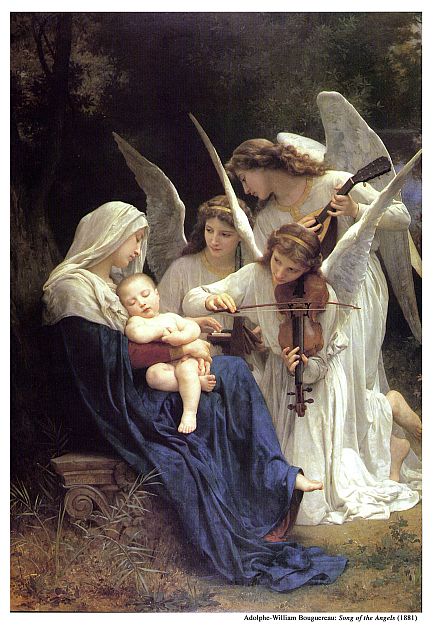
Song Of Angels – Bouguereau

Posted: March 2, 2011 by CatholicJules in Holy Pictures


A lovely and tender depiction of angels serenading the Infant Jesus by famed artist William Bouguereau.

Adolphe-William Bouguereau was a famous portrait artist born in La Rochelle, France on November 30, 1825. He followed the classical style of 16th century painters such as Raphael. Bouguereau painted for a number of Catholic Churches throughout the late 1800’s. He died in 1905.

Because We Belong To Christ

Posted: March 1, 2011 by CatholicJules in Memory Book

Everyday ask God to pour love for your brothers into your heart and to put love for you into theirs.  God can deny nothing to a community that prays this way, because it is His will that we love one another as he has loved us.

Where there is no love, put love and you will harvest love.  Susceptibility is charity’s worst enemy, humilty its best ally.  You should be intelligent and holy enough to be the first to give way in a quarrel; and never let squabbles over trifles harm your deep union with your brothers.  You may be in the right, but your duty is not to let the sun go down on your anger.  Resolve each day anew to pray for your brothers.  Pray that you may love, and love while you pray, and the grace of His love will find a way in.

Look on the call to brotherly love as the entry into an immense mystery, since it is your gateway into God Himself.  Where love is, there is God.  You, with your brethren, give God a body, express his presence, and signify His action.  Let your whole community become in this way a theophany of His love.

To express this love in authentic action, you must love sharing.  Share your time, table, roof,salaries and belongings.  Possess nothing so that one day you may, like Christ, be enriched by all you have given away.  Likewise, you should be able to say to each community member; all that is mine is yours.

THE JERUSALEM COMMUNITY RULE OF LIFE


Emmanuel Praise/Worship Session With Talk

Posted: February 27, 2011 by CatholicJules in Upcoming Events

Emmanuel

Date : 02 Mar 2011

Time : 8:00 pm

Topic : “Fasting & Almsgiving.” By Joseph Fernandez Of Gloria Patri Ministry.

Join us for the session followed by a potluck session at the end

Venue

Church of St Anthony
25 Woodlands Avenue 1
Singapore 739064
Thomas Aquinas Room

For Directions Click Here

February 27, 2011 – 8th Sunday in Ordinary Time

Posted: February 26, 2011 by CatholicJules in Sunday Reflections

Sunday Bible Reflections with Dr. Scott Hahn

Do Not Be Anxious

Readings:
Isaiah 49:14–15
Psalm 62:2–3, 6–9
1 Corinthians 4:1–5
Matthew 6:24–24

We are by nature prone to be anxious and troubled about many things.
In Sunday’s Gospel, Jesus confronts us with our most common fears. We are anxious mostly about how we will meet our material needs—for food and drink; for clothing; for security for tomorrow.
Yet in seeking security and comfort, we may unwittingly be handing ourselves over to servitude to “mammon,” Jesus warns. “Mammon” is an Aramaic word that refers to money or possessions.
Jesus is not condemning wealth. Nor is he saying that we shouldn’t work to earn our daily bread or to make provisions for our future.

It is a question of priorities and goals. What are we living for? Where is God in our lives?
Jesus insists that we need only to have faith in God and to trust in his Providence.
The readings this Sunday pose a challenge to us. Do we really believe that God cares for us, that he alone can provide for all our needs?

Do we believe that he loves us more than a mother loves the infant at her breast, as God himself promises in this week’s beautiful First Reading? Do we really trust that he is our rock and salvation, as we sing in the Psalm?
Jesus calls us to an intense realism about our lives. For all our worrying, none of us change the span of our days. None of us has anything that we have not received as a gift from God (see 1 Cor. 4:7).
St. Paul reminds us in the Epistle that when the Lord comes he will disclose the purposes of every heart.
We cannot serve both God and mammon. We must choose one or the other. Our faith cannot be partial. We must put our confidence in him and not be shaken by anxiety.

Let us resolve today to seek his Kingdom and his holiness before all else—confident that we are beloved sons and daughters, and that our Father in heaven will never forsake us.

The unfathomable depths of God

Posted: February 26, 2011 by CatholicJules in Memory Book

From an instruction by Saint Columban, abbot

God is everywhere in his immensity, and everywhere close at hand. As he says of himself: I am a God close at hand, not a God far off. The God we seek is not one who dwells at a distance from us, for we have him present with us, if only we are worthy. He dwells in us as the soul in the body, if only we are sound members of his, if we are dead to sin. Then in very truth he dwells in us, the one who said: I will dwell in them and walk among them. If we are worthy of his presence with us, then in truth we are made alive by him as his living members. As the Apostle says: In him we live and move and have our being.

Who, I ask, will search out the Most High in his own being, for he is beyond words or understanding? Who will penetrate the secrets of God? Who will boast that he knows the infinite God, who fills all things, yet encompasses all things, who pervades all things, yet reaches beyond all things, who holds all things in his hand, yet escapes the grasp of all things? No one has ever seen him as he is. No one must then presume to search for the unsearchable things of God: his nature, the manner of his existence, his selfhood. These are beyond telling, beyond scrutiny, beyond investigation. With simplicity, but also with fortitude, only believe that this is how God is and this is how he will be, for God is incapable of change.

Who then is God? He is Father, Son and Holy Spirit, one God. Do not look for any further answers concerning God. Those who want to understand the unfathomable depths of God must first consider the world of nature. Knowledge of the Trinity is rightly compared with the depth of the sea. Wisdom asks: Who will find out what is so very deep? As the depths of the sea are invisible to human sight, so the Godhead of the Trinity is found to be beyond the grasp of human understanding. If any one, I say, wants to know what he should believe he must not imagine that he understands better through speech than through belief; the knowledge of God that he seeks will be all the further off than it was before.

Seek then the highest wisdom, not by arguments in words but by the perfection of your life, not by speech but by the faith that comes from simplicity of heart, not from the learned speculations of the unrighteous. If you search by means of discussions for the God who cannot be defined in words, He will depart further from you than he was before. If you search for him by faith, wisdom will stand where wisdom lives, at the gates.Where wisdom is, wisdom will be seen, at least in part. But wisdom is also to some extent truly attained when the invisible God is the object of faith, in a way beyond our understanding, for we must believe in God, invisible as he is, though he is partially seen by a heart that is pure.


Meditation – The Foundation of Mental Prayer

Posted: February 24, 2011 by CatholicJules in Great Catholic Articles

Fr Andrew Apostoli, C.F.R.

If your spiritual life is to develop properly, you must learn how to meditate — the foundation of mental prayer. A great deal can be said about meditation, but we’ll have to limit ourselves to some basic points. I’d like to approach it by sharing something of my own experience.

When I first entered the seminary, I was already used to saying formal prayers, such as my morning and night prayers and some devotional prayers out of a little prayer booklet. But somehow, the idea of meditation seemed complicated. There was talk of different methods and steps in the meditation process. Even the meditation book from which a reflection was read daily to the community in the chapel listed “meditation points” to consider. I felt a bit apprehensive!

Nevertheless, after going to a few organized meditation periods, I realized that this basic form of mental prayer came quite naturally. There was nothing to be afraid of! I began by simply thinking about Jesus in the Gospels, about His words and actions, or about some important part of my Catholic faith, such as the Mass or God’s mercy. Then I found I wanted to talk to the Lord about what I was reflecting on.

In this way I came to realize that my thinking or reflecting (that’s the actual meditation) was leading me to new awareness and insights about Jesus and the truths of my Catholic faith. These insights, in turn, were stirring up various feelings within me (such feelings are called sentiments or affections). The more I meditated and came to new insights, the more I was led to speak with the Lord in my own words, having a loving conversation heart-to-Heart (mine with His). And that, quite simply, was mental prayer.

The Rosary and Stations of the Cross
In fact, I came to realize that I’d actually known for a long time what it is to meditate. For example, I’d done it for years whenever I prayed the Rosary. When reciting each of the fifteen decades, we meditate on one of the joyful, sorrowful, or glorious mysteries or significant events in the life of Jesus and His Blessed Mother.

As I constantly meditated on these mysteries, they became more meaningful for me. I began to see Jesus’ and Mary’s love in each mystery, and gradually realized they have that same love for me, too. By meditating, I was growing to know and love them more personally.

A similar thing was happening when I made the Stations of the Cross. Meditating on fourteen scenes from the passion and death of Our Lord, I experienced feelings (those sentiments or affections) of deeper gratitude to Jesus for all He suffered for me. There were feelings of deeper sorrow for my sins as well, since they caused Jesus to suffer so much. This, in turn, moved me to be more resolved, with the help of His grace, not to commit these sins again in the future.

Judging, then, from my own experience, I would say that many of us Catholics first learn to meditate by simply reciting the Rosary or making the Stations. As we seek to deepen this part of our mental prayer life, a few practical points about meditation and mental prayer may be helpful.

Formal Prayer vs. Mental Prayer
First, mental prayer (also called the prayer of the mind) usually develops naturally from formal prayer (or the prayer of the lips), as my own experience shows. A comparison between these two types of prayer can be useful. Recall St. John Damascene’s famous definition of prayer as “the raising of the mind and the heart to God.” In formal prayer, when we focus on the words of the prayer with our minds, the heart is then moved to love God with the sentiments contained in those words.

For example, if we recite an “Act of Faith,” the words prayed would logically stir up feelings or sentiments of faith in our hearts as we say something such as this: “God, You are all-knowing, and You reveal to us what we need to know and do to get to heaven. I believe in all that You have revealed to us! Please grant me a strong faith so that I will always believe what You teach us through Your Church.”

In mental prayer, however, the focus is not restricted by the words of a prayer formula. Rather, the focus of meditation is usually on a story, such as an event from the life of Jesus; or a teaching He gave, such as a parable; or something from the life of a saint, such as St. Thérèse; or something contained in a good spiritual book. My mind isn’t limited to the words, but moves through various details of the story or ideas contained in the teaching.

The mind, by reflecting on these details, can produce a far wider range of insights, which then stir more sentiments in the heart. The mind is freer to roam through this spiritual landscape. Thus the difference between formal prayer and the meditation of mental prayer is like the difference between reciting a poem, where each specific word is already given, and telling a story freely in your own words.

The Benefits of Meditation
Meditation as form of mental prayer has many benefits. One is a greater understanding and clarity regarding the teachings of our Catholic faith. By meditating, we go deeper into these realities and discover many valuable new insights that weren’t obvious at first sight.

St. John of the Cross used the image of mining for precious metals to describe this spiritual activity. If “there’s gold in them thar hills,” then the more you mine, the more you’ll find! The treasures of the Sacred Scriptures and other truths of our faith aren’t always obvious on the surface, but they’re limitless for those who bother to search for them.

Another benefit, as we’ve seen, is that our reflections stir up the vital sentiments of the heart so needed for loving and serving the Lord faithfully. These sentiments are really the most important fruit of mental prayer. They lead us to talk to God!

In fact, without these sentiments, we’d end up with a purely intellectual exercise, a mere reasoning process. Prayer requires talking with God, and that requires the sentiments.

In this regard, we should mention that beginners practicing mental prayer typically do much more reasoning or reflecting in the mind than speaking from the heart. But as time goes on, less reflection is needed to produce more sentiments. It’s like the growth of a human friendship.

When friends first meet, they need to ask lots of questions and share lots of facts about themselves to get to know each other better. After the friendship has grown, however, there are fewer questions but a deeper knowledge and more intense love for each other. In fact, when the reasoning in prayer becomes significantly less and the sentiments in the heart begin to predominate, it’s usually a sign that we’ve come to the third state or kind or prayer, called affective prayer (or the prayer of the heart).

Finally, the meditation of mental prayer helps us form the resolutions we need to grow in the love of God and our neighbor by a more conscious and consistent practice of the Christian virtues. Our meditations, in the light of the Holy Spirit and with the assistance of His grace, give us insights into how to apply the values of the Gospel, Church teachings, and the wisdom of the saints to our own daily lives. For all these reasons, the meditation that provides a foundation for mental prayer is a must for growth in Christian holiness!

Fr. Andrew Apostoli, C.F.R., is a priest of the Franciscan Friars of the Renewal, St. Felix Friary, 15 Trinity Plaza, Yonkers, NY 10701; 914-476-7279

Emmanuel Praise/Worship Session With Talk

Posted: February 20, 2011 by CatholicJules in Upcoming Events

Emmanuel

Date : 23rd Feb 2011

Time : 8:00 pm

Topic : “Setting The Right Frequency- God is communicating with you.” By Christian Chua from Church Of Christ The King Charismatic Group.  Christian is noted speaker in the Commercial Sector, he has used his oratorical gift to serve God and has much to share.

Join us for the session followed by a potluck session at the end

Venue

Church of St Anthony
25 Woodlands Avenue 1
Singapore 739064
Thomas Aquinas Room

For Directions Click Here

February 20, 2011 – Seventh Sunday in Ordinary Time

Posted: February 18, 2011 by CatholicJules in Sunday Reflections

SUNDAY BIBLE REFLECTIONS BY DR. SCOTT HAHN

February 20, 2011 – Seventh Sunday in Ordinary Time

Holy as God

Readings:
Leviticus 19:1–2, 17–18
Psalm 103:1–4, 8, 10, 12–13
1 Corinthians 3:16–23
Matthew 5:38–48

We are called to the holiness of God. That is the extraordinary claim made in both the First Reading and Gospel this Sunday.

Yet how is possible that we can be perfect as our Father in heaven is perfect?

Jesus explains that we must be imitators of God as his beloved children (Eph. 5:1–2).

As God does, we must love without limit—with a love that does not distinguish between friend and foe, overcoming evil with good (see Rom. 12:21).

Jesus himself, in his Passion and death, gave us the perfect example of the love that we are called to.

He offered no resistance to the evil—even though he could have commanded twelve legions of angels to fight alongside him. He offered his face to be struck and spit upon. He allowed his garments to be stripped from him. He marched as his enemies compelled him to the Place of the Skull. On the cross he prayed for those who persecuted him (see Matt. 26:53–54, 67; 27:28, 32; Luke 23:34).

In all this he showed himself to be the perfect Son of God. By his grace, and through our imitation of him, he promises that we too can become children of our heavenly Father.

God does not deal with us as we deserve, as we sing in this week’s Psalm. He loves us with a Father’s love. He saves us from ruin. He forgives our transgressions.

He loved us even when we had made ourselves his enemies through our sinfulness. While we were yet sinners, Christ died for us (see Rom. 5:8).

We have been bought with the price of the blood of God’s only Son (see 1 Cor. 6:20). We belong to Christ now, as St. Paul says in this week’s Epistle. By our baptism, we have been made temples of his Holy Spirit.

And we have been saved to share in his holiness and perfection. So let us glorify him by our lives lived in his service, loving as he loves.


A Catholic on National Talk Radio

Posted: February 16, 2011 by CatholicJules in Great Catholic Articles

A Catholic on National Talk Radio | Daily News | NCRegister.com.

A scan on the radio dial at just about any time of the day will surface a handful of radio talk shows with hosts clamoring to be the voice of reason and to have the answers to solving problems of all types.

One host, however, is very confident that he truly does have something to offer as he unabashedly gives his Catholic take on today’s headline issues. His name is Allen Hunt, and his show, the Allen Hunt Show can be heard each weeknight on 150 stations across the nation.

His viewpoint wasn’t always Catholic, however. He recently sat down to talk about his conversion to the Catholic faith and how it has shaped his radio platform.
Tell me about your journey from Methodist pastor for 20 years to entering the Catholic Church.

I grew up in a culture of Methodist pastors. My uncle, grandfather and great-grandfather were all Methodist pastors. I didn’t know much about the Catholic Church when I was growing up. After I finished seminary at Emory University in Atlanta, I went on to do some graduate-level work at Yale University on early Christian history and the New Testament.

My first exposure to the Catholic Church came while I was there in New England. Much of it came from my friendship with a Dominican friar who was also in the graduate program. That was in the 1990s, and many seeds were planted then. In the next decade or so, God used a number of experiences to bring me home to the Church. I became Catholic on Jan. 6, 2008, on the feast of the Epiphany.
What finally brought you home?

There were three big things that led to me entering the Church. First was a growing sense of Christ’s real presence in the Eucharist. Secondly is what I call doctrine by democracy. In general, in the Protestant church, everything is up to a vote every few years. For instance, in the Methodist church, every four years we would get together to vote whether or not homosexual behavior is acceptable or not and whether it was time to ordain openly gay pastors.

The third area of reflection was Jesus’ prayer in John 17. There, Jesus pleads for unity in the body of Christ. The Protestant church has split into 33,000 different strands. What message does that fractioning send to the world? As well, how much this division must grieve God’s heart.

I am only one person, but am trying to repair some of that damage by coming home to the mother Church.
At the time of your decision to pursue the Catholic Church you were leading a megachurch in Atlanta. How did your congregation react to your decision?

I had stepped down from my role as senior pastor July 1, 2007, to go into full-time radio ministry. Once I had left the role of pastor, it gave me the freedom to explore and discover the faith.

By and large, most people were supportive of my decision. As is typical of many megachurches, a lot of the members are ex-Catholics. I got a lot of e-mails and phone calls from people who were asking, “What do you see that I don’t see?” There were only a handful of people who were hostile towards me. But after years of being a pastor, I was used to people being hostile towards me.

Tell me about the Allen Hunt Show.

We started the show in 2006 with just a few hours on Sunday afternoon. We didn’t plan on being on Christian or Catholic radio. The show began as a way to engage the mainstream on all the issues of life through the lens of faith.

We want to come at things with a moral compass and engage people of all walks of life. I am unapologetic and non-defensive on who I am, what I stand for and where I’m coming from. It is mainstream radio done for you by a very Catholic guy.
Is there an evangelization element to your program?

I share my Catholic faith, but I don’t promote it — and I think that is at the heart of the show. I am who I am, and I am comfortable with who I am. I want to engage people who agree or disagree with me in a grace-filled way, as opposed to bomb throwing, which seems to be the standard these days. 

I think a lot of people find it very heartening that there is someone like them on mainstream radio. Then there is another group of people who find this fact strange to them. And then there is a small, vocal group who can’t stand my faith, but they keep listening. As long as they are listening, I’m content with that. Let’s talk and have a civil conversation.
What’s the future for you and the program?

We need to continue to do what God wants us to do. I think what that means is to continue to engage the culture with a reasonable voice of faith. Our long-term goal is to be on over 300 stations each week, Monday through Friday.
What is your take on the debate on whether or not conservative talk radio was to blame for the Tuscon shooting, the assassination attempt on Rep. Gabrielle Giffords?
Neither talk radio nor inflamed political rhetoric caused a mentally deranged young man to indiscriminately shoot people in Tucson any more than they caused the Virginia Tech massacre or even the silly Dunkin Donuts drive-through tirade last month regarding the lack of sprinkled donuts.
As you talk to America, day in and day out, what are two or three issues or themes that come up again and again? What is the temperament or the mood of the nation, so to speak?

In general, there is a self-confidence crisis in America. We have forgotten who we are. People are concerned and feel like we have lost something, even though they cannot always pinpoint what that is. Part of this is a natural response to a very long recession that has drained a lot of people’s passion and optimism. They worry we may never emerge from it. Part of this is a response to the lack of moral compass that we now routinely experience in our public life together, in our entertainment and even in our public schools.

Register correspondent Eddie O’Neill writes from Green Bay, Wisconsin.

February 13, 2011 – 6th Sunday in Ordinary Time

Posted: February 12, 2011 by CatholicJules in Sunday Reflections

Sunday Bible Reflections with Dr. Scott Hahn

Affair of the Heart

Readings:
Sirach 15:15–20
Psalm 119:1–2, 4–5, 17–18, 33–34
1 Corinthians 2:6–10
Matthew 5:17–37

Jesus tells us in the Gospel this week that he has come not to abolish but to “fulfill” the Law of Moses and the teachings of the prophets.

His Gospel reveals the deeper meaning and purpose of the Ten Commandments and the moral Law of the Old Testament. But his Gospel also transcends the Law. He demands a morality far greater than that accomplished by the most pious of Jews, the scribes and Pharisees.

Outward observance of the Law is not enough. It is not enough that we do not murder, commit adultery, divorce, or lie.

The law of the new covenant is a law that God writes on the heart (see Jer. 31:31–34). The heart is the seat of our motivations, the place from which our words and actions proceed (see Matt. 6:21; 15:18–20).

Jesus this week calls us to train our hearts, to master our passions and emotions. And Jesus demands the full obedience of our hearts (see Rom. 6:17). He calls us to love God with all our hearts, and to do his will from the heart (see Matt. 22:37; Eph. 6:6)

God never asks more of us than we are capable. That is the message of this week’s First Reading. It is up to us to choose life over death, to choose the waters of eternal life over the fires of ungodliness and sin.

By his life, death, and resurrection, Jesus has shown us that it is possible to keep his commandments. In baptism, he has given us his Spirit that his Law might be fulfilled in us (Rom. 8:4).

The wisdom of the Gospel surpasses all the wisdom of this age that is passing away, St. Paul tells us in the Epistle. The revelation of this wisdom fulfills God’s plan from before all ages.

Let us trust in this wisdom, and live by his Kingdom law.

As we do in this week’s Psalm, let us pray that we grow in being better able to live his Gospel, and to seek the Father with all our heart.

FTFF

Posted: February 10, 2011 by CatholicJules in Memory Book, Personal Thoughts & Reflections

Freely, Totally, Faithfully, Fruitfully


Christ gives us all the above, when he gives of himself in the Eucharist he instituted.

Use this easy to remember gauge or rather ‘A Love Standard’ when we give of ourselves whether in marriage, or in servitude of others.

I think this is a simple but wonderful prayer…..

In Search Of…

Posted: February 6, 2011 by CatholicJules in Great Catholic Articles

In Search Of The Full Gospel

By Deborah Danielski

Like many converts to the Catholic Church, Deborah Danielski wandered through a variety of back roads and cul-de-sacs on her way home. Her search for the full gospel was a frustrating one, filled with wrong turns and complicated by a drinking problem and two abusive marriages. But Christ calls His sheep by name, and Deborah heard His voice and followed Him home to the Catholic Church. She recounts for you the details of her conversion story and how she found the fullness of the Christian Faith where she least expected it.

As my husband Ed and I drove down a quiet rural Illinois highway one day, we passed a large wooden sign at the side of the road. The hand-painted lettering on the sign proclaimed, “Full Gospel Church —1/2 mile.” “What is a ‘full gospel’ church?” Ed asked. As I attempted to explain, a light came on in my mind, and suddenly I knew. The “full gospel” was what I had been searching for all of my adult life, at times actively, at other times without even being aware of what it was I sought. ”

Almost immediately, I sensed a brilliant light that seemed to move toward me. I felt immersed in God’s presence and love. I simultaneously laughed and cried and when I opened my mouth to speak, I was singing praises to God in a language I had never learned.” 

Apart from a brief encounter with Jesus at age 6, I grew up pretty much without religion. When I got to my teens, I took the route all-too-common in the ’60s, “looking for love in all the wrong places.” Just before my 17th birthday, I found myself pregnant and standing before a minister, vowing to “love, honor and obey” my 17-year-old boyfriend, while thinking about the red-checkered tablecloth I’d buy for our tiny new kitchen. 

By the time I reached my mid-20s, I was into my second abusive marriage and was the mother of three. I’d messed up my life just about as much as I possibly could. Near despair, I determined it was time to make some effort to change my miserable life. I began by seeking counseling. That was when a series of incredible “coincidences” began to occur through which the Spirit of the Lord led me to the gospel.

“How much do you drink?” the counselor asked only a short way into the first session. “What does that have to do with anything?” I wondered to myself. “Oh, not too much,” I responded. “Maybe about a six-pack a day.” He raised his eyebrows. ” ‘Not too much?’ Six beers a day is ‘not too much?’ ” Had I been completely honest, I would have told him that I often drank more than that. Much to my surprise, he referred me to an alcohol abuse counselor. I was pretty sure drinking wasn’t my problem, but knowing I had exhausted my own resources, I made the appointment.

“The first thing you have to do is admit the problem is beyond your control and submit it to God,” said the counselor. “Oh great,” I thought. “This will never work.” Sure, I could admit the problem was beyond my control, otherwise I wouldn’t have been there, but submit it to God? No way.

“I don’t believe in God,” I countered. “It doesn’t have to be any particular god,” she said, “but some form of ‘supreme being,’ however you understand Him.” I shook my head. “I don’t believe in any supreme being.” The counselor smiled. “You consider yourself a pretty open-minded person, don’t you?” It was exactly the right question. I felt I was the most open-minded person I knew. “Definitely,” I shot back. “But you’ve closed your mind to God,” she suggested. She was right. I had closed my mind and heart to God. Perhaps I could give it a try, I thought. I had nothing to lose. My stress goes down but my curiosity goes up. 

Out of hand, I rejected Christianity as too “traditional.” So, in search of a more palatable option, I went to the local library and checked out a couple of books on yoga and Hinduism and began my search for “God.” Soon I was practicing transcendental meditation at least 20 minutes a day. I was more relaxed, less stressed out about my problems, but I hadn’t found God. And I knew it.

At the same time, my husband Melvin was commuting to work with a man who was a Jehovah’s Witness. Every day Melvin would come home from work telling me something new John had said about God, Jesus, and the Bible. I had never read the Bible and we didn’t even own one, but I was sure what John was telling Melvin couldn’t possibly be true. Nonetheless, I found myself getting more and more curious. Then one day I was reading a book about yoga and came across the following claim, “Truly spiritual people are always vegetarians. Even in the Hebrew Bible, God gave man the fruits of the trees to be their food, not the animals of the field.” I was puzzled. I’d known many Christians over the years, and not one of them had been a vegetarian.

My curiosity got the best of me. I went out to the store and bought a Bible. I just had to know if what that author and the Jehovah’s Witness were saying was true. That night, I began to read the Gospel of Matthew, and immediately fell in love with Jesus. I knew without a doubt that no mere man could have invented the stories I read. If man were even capable of imagining God would become human, he would at least have Him born in a castle, I thought, but never in a manger. “Blessed are the poor in spirit, for theirs is the kingdom of heaven,” Jesus told me in Scripture. “Blessed are they who mourn, for they shall be comforted. Blessed are the meek, for they will inherit the earth.” 

These were definitely not the words of a mere man. In my experience, the meek never inherited anything but trouble. I lay there in bed, reading all night long, continuing into Mark, Luke and John. Just before daybreak, I rose, knelt by the side of my bed and began to pray. As I prayed, I experienced an overwhelming sense of Christ’s presence. It was as though He stood at my side with His hand resting on my shoulder, and I was nearly overcome with a feeling of love more powerful than any I had ever imagined. I knew without a doubt that Jesus loved me, and I knew my sinful past was forgiven as I surrendered my life to this incomprehensible God/Man Who captured my heart. St. Paul knew what he was talking about.

“Coincidentally,” my children were attending Bible school that week with our Baptist neighbors. That Sunday morning, I attended a worship service at their small, independent Baptist church and publicly professed my faith in Christ. The next week I was baptized by immersion. For the next year, I seldom missed a Sunday morning, Sunday evening or Wednesday night service. And I seldom allowed a day to pass without spending some time reading the Holy Scriptures and in prayer. I had tasted that the Lord was good, but I began to sense there was more to Christ than I had found. There was something missing. I sensed that I had not yet found the full gospel.

A friend and fellow Baptist, Marsha, began to tell me about the “baptism of the Holy Spirit” and the gifts of the Spirit. I searched the Scriptures and read every publication I could find on the subject. Marsha was involved in the “Women’s Aglow Fellowship,” an interdenominational women’s group associated with the “Full Gospel Businessmen’s Association.” I attended their next monthly meeting and was excited by the freedom with which this group praised God. 

Expecting to feel uneasy if any of the gifts of the Spirit were manifested, I was amazed when the group began to glorify God in a host of other languages and the only things I felt were joy, peace and fulfillment. “Yes, this is it,” I thought. This was what I had been missing. 

At the end of the service, I went forward for prayer. More than anything in the world I wanted this “full gospel.” As I knelt at the altar with my eyes closed in prayer, the leader laid her hands on my head. Almost immediately, I sensed a brilliant light in a far corner of the room that seemed to move toward me, and I soon felt immersed in God’s presence and love. I simultaneously laughed and cried and when I opened my mouth to speak, I was singing — singing praises to God in a language I had never learned.

Those were some of the best years of my life. I loved God, I loved my family, I loved everyone. Certainly there were trials, but I had the Spirit of God to uphold me through anything, or so I thought. Since my Baptist pastor did not believe in the gifts of the Spirit, I soon moved my membership to an Assembly of God. After a while, I came to believe that as a child of God, I had the “right” to walk always in divine health and material prosperity. With God as my Father, I believed nothing evil could touch me. I was satisfied that I had found the fullness of God and was convinced I was beyond reproach. I still avidly read Scripture, but I must have missed St. Paul’s warning: “Therefore let any one who thinks that he stands take heed lest he fall” (1 Cor. 10:12). Did God betray me? There was a major fall in store for me and when it hit, the entire structure of my new life was shattered.

For six years Melvin and I had prayed for a child. I had my two children from my first marriage with me only on weekends. When Melvin’s brother had been tragically killed two years before, we adopted his 3-year-old son. But Melvin desperately wanted a child of his own. One Wednesday evening as I stood praising God at the end of a worship service, I felt a sudden pain in my lower abdomen. I “rebuked” it, as I had been taught. But nothing happened. In fact, the pain grew worse. I went forward to the altar and asked two friends to help pray for my healing. We prayed and prayed. Still the pain worsened. The pastor was closing the church, so seven friends and I went to one of their homes, where we continued to pray and rebuke the pain in my abdomen. Still it did not yield. Finally I asked someone to take me to the hospital. I was experiencing my second tubal pregnancy. The tube burst and immediate surgery was required to save my life. Nothing that was tried could save my baby. I was devastated. Not only had my faith failed to heal my body, but it was now evident that I would never have another child, and my husband would never have one of his own — at least not with me.

As soon as I was released from the hospital, I was back in church, just in time to hear a sermon I will never forget. “Anyone who claims to be a Christian,” the preacher roared, “and would willingly go into a hospital and let someone cut on them with a knife is deluded!” I sat through the remainder of that sermon about “true faith,” but when it ended, I left that church, never to return. I wasn’t sure whether their theology was skewed or I had just utterly failed, but it put me into a tailspin. What had it all meant?, I wondered. Was what happened to me really due to a lack of faith? Was it my own fault? What could I have done differently? Or could all I had previously experienced — all the joy in praying, the warm feelings, the power I felt in “rebuking” sickness and evil, and speaking in “tongues” — could all that have been nothing more than wishful thinking?

I never spoke to that pastor again and my friends just didn’t seem to have the answers I needed. I soon stopped reading Scripture and stopped praying. I felt God had betrayed me, and I had no idea where to turn. I still believed in Him. I still believed in the gospel, but I no longer knew what it meant for me, and frankly, I was no longer inclined to find out.

I left my husband and found my mother. Melvin soon returned to his excessive drinking and abuse. My faith was shattered, but a spark of self-esteem remained. For the first time in my life, I felt I could make it on my own. Though I made far too little money to support myself in the manner to which I had grown accustomed, that no longer mattered. All I wanted was a little peace. I knew I would rather live in a hole in a wall in peace, than to continue the nearly constant battles with my husband. It was not easy to admit to another failure, but after 13 years in my second marriage, I left Melvin and obtained a second divorce.

Three years later, God gave me one of the greatest gifts I would ever receive from Him, my current husband, Ed. Though I had turned my back on Him, Christ had not abandoned me. Not long after my marriage to Ed, a series of “coincidences” began to occur in my life that made it impossible for me to ignore Christ and His full gospel any longer. My friend Judy, a Catholic with whom I had never discussed God or religion, unexpectedly gave me a book for my 43rd birthday. One glance at the cover of the book made me question her sanity. The book was about apparitions of the Virgin Mary, and the cover bore her picture. Though I knew nothing about apparitions, I had strong convictions about the Virgin Mary. I knew she had existed and I knew she’d given birth to our Lord, but apart from that, I’d rarely given her a second thought, except to condemn Catholics for “worshipping” her.

“I don’t know if you’ll like it,” Judy said as I held the book in my hand, looking incredulously at its cover. “It’s . . . spiritual.” I was polite. “Oh, I like spiritual books,” I said, all the while wondering what could ever have possessed anyone to give me a book about Mary. My being polite was a big mistake. It opened the door for Judy to spend the next hour-and-a-half telling me all about her new and wonderful relationship with the Virgin Mary. She told me Mary had become her dearest friend and closest confidante. I thought she’d gone over the edge. “Lord, help her,” I prayed. But I reluctantly accepted the book and out of curiosity, went home and began to read it.

Almost immediately, I felt the Holy Spirit move in my heart for the first time in years. I continued to read, and soon sensed Christ asking me to open my heart to His mother. My life was not such a mess as it had been when I first began to seek the Lord. Considering my past mistakes, I was relatively happy and successful. I hadn’t consciously felt a need for anything more. But God in His infinite wisdom and mercy stirred again in me that lifelong yearning to know Him in His fullness. In my hands that day was the answer. How better to learn the “full gospel” than from the very Mother of God? Who could more effectively lead me to the fullness of Christ than the human being who carried our Lord in her womb, nourished Him at her breast and lived physically and intimately with Him every moment of His life — the one who not only bore witness to the Word, but actually bore the Word? “And immediately something like scales fell…” 

I finished the book Judy gave me and proceeded to read everything I could get my hands on about apparitions and visions of the Blessed Mother. I devoured anything I could find regarding Fatima. I came to believe there was a profound message behind these Marian apparitions. “There will never be peace for individuals or mankind until you turn your hearts back to your Creator,” Mary seemed to be saying. “God loves you. Repent and pray for your own conversion, and for the conversion of the world.” I began to do just that, and many of my misconceptions about Catholicism were soon unmasked. Catholics didn’t worship Mary, I realized. They were devoted to her as the Mother of Christ. They reverenced Mary as the first Christian. They embraced Christ’s precious gift from the Cross — the gift of His mother to His body, the Church (cf. John 19:25-27). Statues of Mary in Catholic churches were no more “false idols” than were the pictures of my beloved husband and children in my home. 

I fell in love with my spiritual mother. I studied the Roman Catholic Faith. I read books by Scott Hahn, Alan Schreck, Karl Keating, Mark Shea, Patrick Madrid and Thomas Howard. I reread chapter six of the Gospel of John. “Unless you eat the flesh of the Son of Man and drink his blood, you do not have life in you,” Christ said to the skeptical Jews. I realized Holy Communion could be much more than symbolic of the Last Supper. By the power of the Holy Spirit in the Catholic Mass, Christ is truly present and imparts His life through the bread and wine. 

While wrestling with the Catholic meaning of the communion of saints, Christ’s words to the Sadducees in Matthew 22:31-32 came to life. “Have you not read what was said to you by God, ‘I am the God of Abraham, the God of Isaac, and the God of Jacob’? He is not God of the dead, but of the living.” It excited me to learn that the saints who lived before us had not been cut off from the Body of Christ just because they had died. I was as free to ask any of them to pray for me as I was to ask anyone here on earth. As I learned more about our covenant relationship with God, infant baptism took on a whole new meaning. Why wouldn’t our Father provide a means for our newborn children to enter that relationship, just as He had for the Jews in circumcision? In direct contrast to what I’d previously believed, I found Catholics had an objective faith totally absent from any other church I’d attended. I learned God always imparts His grace through the sacraments, regardless of the recipient’s faith. Sure, faith was necessary for the sacramental grace to flourish, but it was God Who acted first, not man.

“Catholics don’t believe in reading the Bible,” I’d been taught. But when I began to attend Mass, I heard far more Scripture read at every service than I had ever heard at any Protestant church.

“No priest can forgive sin,” I’d previously believed. But if Christ were present on earth, would I choose to sit in my own home and confess mentally to Him, hoping and praying I’d been forgiven? Or would I go to Him in person and hear the words of forgiveness directly from His mouth? That is exactly the reassurance the sacrament of reconciliation offers, I realized. Christ is indeed present and available to forgive sin, in His Body the Church, and in His representatives, the priests. It all began to make sense, and it was all found in the Catholic Church, the one Church on earth I had believed I would never enter. Much to my surprise, everything I learned about the Catholic Church expanded and enriched my faith, but I continued to have one major concern. Would I have to give up my belief in the baptism and gifts of the Holy Spirit in order to become Catholic? One final obstacle to the fullness of truth and grace.

I was still struggling with that dilemma when Ed and I attended a Marriage Encounter weekend (I’m currently going through the process prescribed by the Church of having my marriage situation regularized). At the closing Mass, the couples formed a circle as Father Tom Griffith distributed Holy Communion. Having not yet committed to or been accepted into the Catholic Church, I gently shook my head when Father Tom came to me. Rather than passing on to the next person, he stopped, laid hands on Ed and me, and prayed. When Father Tom prayed, I felt so overwhelmed by the power of the Holy Spirit that my knees grew weak and I nearly fell over. I was astonished. I had never believed a Catholic priest could pray with such power. I was delighted to discover the Holy Spirit was indeed alive and well in at least some members of the Catholic Church.

Having come this far in my journey toward Catholicism, I had to know immediately what my own parish priest believed about the baptism and gifts of the Spirit. “Is it okay for a Catholic to believe in the baptism and gifts of the Holy Spirit?” I nervously asked Father Tony Nugent. “Of course!” he responded. “Though we receive the Holy Spirit at baptism, we don’t always experience a full release of the power of the Spirit until much later,” he continued, relating his own experience of “the full release of the Spirit” as an adult priest. “Praise God,” I gasped. Relieved and encouraged by his incredible response, I poured out my soul. I told Father Tony all about my previous spiritual experiences, including the one that had led me to abandon my faith in God. “Do you believe it is always God’s will to heal?” I asked. “Yes,” he responded. “But He may not always heal in the way we want or expect. If God had granted you the physical healing you sought that day, you would not be here with me today,” he said, assuring me I was on the right path. “He healed you spiritually instead.”

In that moment, I recalled Romans 8:28: “We know that in everything God works for good with those who love him, who are called according to his purpose.” What had seemed to be the worst experience of my life, God had worked for my ultimate good. Another enormous burden was lifted from my soul. Finally, I knew I had it all. I had a loving Heavenly Father Who called me out of darkness and offered me life through the Body and Blood of His only begotten Son, nearly 2,000 years ago in the crucifixion, and today in the Holy Eucharist. I had the Son, Who humbled Himself, became man and was obedient unto death to give the power of the Holy Spirit to His Body, the Church. I had the Holy Spirit, Who enlightens, cleanses and empowers. I had His spouse, my spiritual mother, the Blessed Virgin Mary, to show me the way. I had Christ’s Church, built upon the rock, led by the Holy Spirit into all truth and against which the gates of hell will never prevail. And within that Church, I had priests and the fellowship of a group of believers who embraced both the gifts of the Holy Spirit and devotion to our Blessed Mother. At last, the full gospel was mine.

February 6, 2011 – 5th Sunday in Ordinary Time

Posted: February 5, 2011 by CatholicJules in Sunday Reflections

Sunday Bible Reflections by Dr. Scott Hahn

Light Breaking Forth

Readings:
Isaiah 58:7-10
Psalm 112:4-9
1 Corinthians 2:1-5
Matthew 5:13-16

Jesus came among us as light to scatter the darkness of a fallen world.

As his disciples, we too are called to be “the light of the world,” he tells us in the Gospel this Sunday (see John 1:4–4, 9; 8:12; 9:5).

All three images that Jesus uses to describe the Church are associated with the identity and vocation of Israel.

God forever aligned his Kingdom with the Kingdom of David and his sons by a “covenant of salt,” salt being a sign of permanence and purity (see 2 Chron. 13:5, 8; Lev. 2:13; Ezek. 43:24).

Jerusalem was to be a city set on a hill, high above all others, drawing all nations towards the glorious light streaming from her Temple (see Isa. 2:2; 60:1–3).

And Israel was given the mission of being a light to the nations, that God’s salvation would reach to the ends of the earth (see Isa. 42:6; 49:6).

The liturgy shows us this week that the Church, and every Christian, is called to fulfill Israel’s mission.

By our faith and good works we are to make the light of God’s life break forth in the darkness, as we sing in this week’s Psalm.

This week’s readings remind us that our faith can never be a private affair, something we can hide as if under a basket.

We are to pour ourselves out for the afflicted, as Isaiah tells us in the First Reading. Our light must shine as a ray of God’s mercy for all who are poor, hungry, naked, and enslaved.

There must be a transparent quality to our lives. Our friends and family, our neighbors and fellow citizens, should see reflected in us the light of Christ and through us be attracted to the saving truths of the Gospel.

So let us pray that we, like St. Paul in the Epistle, might proclaim with our whole lives, “Christ and him crucified.”

(Apologetics) John Vs Mike – 10

Posted: February 4, 2011 by CatholicJules in Apologetics


Mike Gendron 

John,

Your rebuke of God’s word is not backed up by any official references from the Catholic religion. In my article I state the source of my information but you appear to give your opinions instead of backing up your claims with the laughable “infallible” teachings of the magesterium.

You say Catholics are in purgatory because “they are not yet free from imperfections.” They ought to convert to Christ because born again Christians are made perfect forever at the moment of justification by the one offering of Jesus 2000 years ago (Heb. 10:14).

Where do you get the statement “grace earned for us by Jesus with His death on the Cross.” Did Jesus really have to earn grace?

Where do you get the idea that the fire of Purgatory is “the burning fire of God’s love for us.”
You said, “And how is it that we are able to be purified by God’s love?  By the merits and grace earned for us by Jesus with His death on the Cross.  In other words, the purging of imperfections that souls experience in Purgatory is as a result of the merits and grace earned for us by Jesus with His death on the Cross.  It is by the blood of Christ that souls in Purgatory are perfected.  There is no other means of perfection available to us.”
According to paragraph-1475 it has nothing to do with God’s love or Jesus but instead the merits of other Catholics. “In the communion of saints, “a perennial link of charity exists between the faithful who have already reached their heavenly home, those who are expiating their sins in purgatory and those who are still pilgrims on earth. between them there is, too, an abundant exchange of all good things.” In this wonderful exchange, the holiness of one profits others, well beyond the harm that the sin of one could cause others. Thus recourse to the communion of saints lets the contrite sinner be more promptly and efficaciously purified of the punishments for sin.”


You say “Catholic teaching that the Mass is the re–presentation of the sacrifice of Christ on the Cross and that the Mass is all about the Body and Blood of Jesus.  Therefore, if Masses are being offered for those in Purgatory, then it means that any sins and inclination to sin and punishment due to sin that are purged  So, to represent the Catholic Faith as teaching that the purgations of Purgatory have absolutely nothing to do with the blood of Christ, after what he said earlier about Masses being said for those in Purgatory, seems to me to be a deliberate misrepresentation of Catholic teaching.”

It is you who appears not know what the Mass is?  It is, according to your Catechism 1367 The sacrifice of Christ and the sacrifice of the Eucharist are one single sacrifice: “The victim is one and the same: the same now offers through the ministry of priests, who then offered himself on the cross; only the manner of offering is different.” “And since in this divine sacrifice which is celebrated in the Mass, the same Christ who offered himself once in a bloody manner on the altar of the cross is contained and is offered in an unbloody manner. Let me ask you this – how can say the purging in Purgatory is “by the blood of Christ” when the Mass is offered in an unbloody manner. Catholic teaching is not only false it is without logic or consistency.


John, I have compassion for you and all those who are being deceived in the name of Christ. Come out of your false religion and worship God in Spirit and truth before it is too late.

Mike Gendron

————————————————————————————

Mike Gendron

John,

Your rebuke of God’s word is not backed up by any official references from the Catholic religion. In my article I state the source of my information but you appear to give your opinions instead of backing up your claims with the laughable “infallible” teachings of the magesterium. You say Catholics are in purgatory because “they are not yet free from imperfections.” They ought to convert to Christ because born again Christians are made perfect forever at the moment of justification by the one offering of Jesus 2000 years ago (Heb. 10:14).

John Martignoni

Mike,

Gee, good thing you don’t like condescending emails, right?  Anyway, I am not rebuking God’s Word, I am rebuking man’s word and, in particular, I am rebuking your word.  Your fallible, man-made, non-authoritative, biased and bigoted word.

You speak of the “laughable infallible teachings of the [M]agisterium,” yet you tend to also speak as if you yourself are infallible.  Do you believe your private interpretations of Scripture to indeed be infallible?  And, if not, will you then admit that your private, fallible interpretations of Scripture, in regard to Purgatory and other such Catholic teachings, could be wrong?  You won’t admit that, though, will you?  You know why?  Pride, Mike…pride.  You are too proud to admit that you could be wrong.  That your interpretations are indeed fallible and, therefore, prone to error.

Heb 10:14, “For by a single offering He has perfected for all time those who are sanctified.”  Absolutely. But, you seem to be claiming to be perfect, Mike, is that right?  So, you are without sin?  You never commit any sin, whatsoever?  You never have a bad thought or do a bad deed?  Really?!

Well, Mike, Catholic teaching is in perfect unison with Heb 10:14, as it is with each and every passage of Scripture. But, contrary to your fallible private interpretation of this passage, it is not saying that those who are perfected are automatically perfected for all time and can never again sin, if so, then why does Paul so often remind the Christians he writes to about avoiding sin?  If you look at the context, this verse is comparing the sacrifice of Christ to the sacrifices of the Old Covenant.  Those had to be offered over and over again and did not take away sins.  The sacrifice of Christ, however, was once for all time.  This one sacrifice was indeed sufficient to sanctify and perfect all men for all of time, but this verse is not saying that a man cannot lose his sanctification if he later turns away from the Lord and sins.

Look at Heb 10:38, “…but my righteous one shall live by faith and if he shrinks back, my soul has no pleasure in him.” Why would God talk about His righteous one shrinking back, if his righteous one has been perfected for all time?  And, in Heb 6:4-6, it talks about those who have repented, and who have “tasted the heavenly gift” and who have “become partakers of the Holy Spirit” and who have “tasted the goodness of the Word of God.”  Those are Christians, right?  I mean, non-believers can’t be said to have become partakers of the Holy Spirit, can they?  Of course not.  So, what does this passage then say about these Christians?  It says that they can commit apostasy.  What does that do to your fallible interpretation of Heb 10:14?  Kind of messes it up, doesn’t it?

Regarding giving you my opinion, I do no such thing.  All throughout my dissection of your article on Purgatory and your article on false teachers, I have cited Scripture and the teachings of the Church.  Now, you may not agree with what the Church teaches, but that is not justification to knowingly misrepresent what the Church teaches.  Which you have done throughout your articles.  By the way, what sources did you give?  You cited the Catechism, out of context, and you give your private, fallible interpretation of Scripture.  Is that what you consider your sources?

Mike Gendron

Where do you get the statement “grace earned for us by Jesus with His death on the Cross.” Did Jesus really have to earn grace?  Where do you get the idea that the fire of Purgatory is “the burning fire of God’s love for us.” You said, “And how is it that we are able to be purified by God’s love?  By the merits and grace earned for us by Jesus with His death on the Cross.  In other words, the purging of imperfections that souls experience in Purgatory is as a result of the merits and grace earned for us by Jesus with His death on the Cross.  It is by the blood of Christ that souls in Purgatory are perfected.  There is no other means of perfection available to us.” According to paragraph-1475 it has nothing to do with God’s love or Jesus but instead the merits of other Catholics. “In the communion of saints, “a perennial link of charity exists between the faithful who have already reached their heavenly home, those who are expiating their sins in purgatory and those who are still pilgrims on earth. between them there is, too, an abundant exchange of all good things.” In this wonderful exchange, the holiness of one profits others, well beyond the harm that the sin of one could cause others. Thus recourse to the communion of saints lets the contrite sinner be more promptly and efficaciously purified of the punishments for sin.

John Martignoni

Jesus did not have to earn anything for himself – once again you twist someone’s words to suit your purposes.  Jesus’ death on the Cross opened up for us the floodgates of God’s mercy and grace.  He didn’t earn it for Himself, He did it for us.  Do you believe we could merit God’s grace all on our own without Jesus’ death on the Cross?  That’s what you seem to be implying here.

Where did I get the idea that the fire of Purgatory is “the burning fire of God’s love for us?”  Well, how about from the Bible?  Heb 12:29, “For our God is a consuming fire.”  1 Cor 3:14, “If the work which any man has built on the foundation (Jesus Christ) survives, he will receive a reward.  If any man’s work is burned up (consumed), he will suffer loss, though he himself will be saved, but only as through fire.”  Let’s see, our God is a consuming fire and anyone who is in Purgatory has their works of wood, hay, or stubble consumed by fire…hmmm.  What fire could that be?  By the way, Mike, you said that men have their “spurious works” burned up by fire.  Please be more specific as to what kind of “spurious works,” what is the nature of the fire that burns them up (is it related to God or not), and where exactly is it this burning up of a man’s spurious works takes place?

Regarding your assertion that the burning fires of Purgatory have nothing to do with God’s love, you once again quote the Catechism (#1475) out of context.  What does paragraph #1474 of the Catechism say?  “The life of each of God’s children is joined in Christ and through Christ in a wonderful way to the life of all the other Christian brethren in the supernatural unity of the Mystical Body of Christ, as in a single mystical person.”  And, Who is that single person to whom all Christians are joined?  Jesus Christ.  So, the merits shared in the Communion of Saints have nothing to do with Jesus and with God’s love?

#1476 of the Catechism, “On the contrary the ‘treasury of the church is the infinite value, which can never be exhausted, which Christ’s merits have before God.  They were offered so that the whole of mankind could be set free from sin and attain communion with the Father.  In Christ, the Redeemer Himself, the satisfactions and merits of His Redemption exist and find their efficacy.”  You still want to say that it has nothing to do with Jesus?

In other words, Mike, you failed to note that the link that binds together the Communion of Saints is Jesus Christ Himself.  It is only in Him, with Him, and through Him that the holiness of one is able to benefit another, because it is all ultimately the holiness of Christ Himself that the members of His Body share.  Does not what benefits one member of the Body benefit all members of the Body?  So for you to say that the burning fires of Purgatory have nothing at all to do with the love of God or with Jesus seems to be, quite simply, a lie.  And I say it is a lie because you have obviously read the Catechism, so what you’re saying is not out of ignorance but seems to be rather a deliberate misrepresentation of what the Catholic Faith teaches.

Mike Gendron

You say “Catholic teaching that the Mass is the re–presentation of the sacrifice of Christ on the Cross and that the Mass is all about the Body and Blood of Jesus.  Therefore, if Masses are being offered for those in Purgatory, then it means that any sins and inclination to sin and punishment due to sin that are purged  So, to represent the Catholic Faith as teaching that the purgations of Purgatory have absolutely nothing to do with the blood of Christ, after what he said earlier about Masses being said for those in Purgatory, seems to me to be a deliberate misrepresentation of Catholic teaching.”

It is you who appears not know what the Mass is?  It is, according to your Catechism 1367 The sacrifice of Christ and the sacrifice of the Eucharist are one single sacrifice: “The victim is one and the same: the same now offers through the ministry of priests, who then offered himself on the cross; only the manner of offering is different.” “And since in this divine sacrifice which is celebrated in the Mass, the same Christ who offered himself once in a bloody manner on the altar of the cross is contained and is offered in an unbloody manner. Let me ask you this – how can say the purging in Purgatory is “by the blood of Christ” when the Mass is offered in an unbloody manner. Catholic teaching is not only false it is without logic or consistency.

John Martignoni

Regarding how I can say the “purging in Purgatory” is by the blood of Christ when the Mass is offered in an unbloody manner…is that really the best you can do?  Mike, do you not claim to have been saved by the blood of Christ?  Of course you do.  Yet, how can this be since Christ stopped bleeding two thousand years ago and you weren’t “saved” until what, the 1980’s?  Did Christ have to be crucified again in order for you to be saved and His blood literally poured on you or some such thing? Was not Christ’s blood applied to you in an unbloody manner?  If so, how can you say that you were saved by the blood of Jesus?  He isn’t bleeding anymore is He, Mike?!  Just as you can be perfected by the blood of Christ without having it literally poured over you, so, too, can the souls in Purgatory be perfected by the blood of Christ without having it literally poured over them.

The sacrifice of the Mass, as you well know, Mike, is the re-presentation of the sacrifice of Christ on the Cross to the Father.  It is our participation in Christ’s spilling of blood on the Cross, in response to Jesus’ command to “do this” in remembrance of Him.  It is our participation in the cup of the “blood of the covenant.”  The cup in which we participate at Mass, the cup which is “poured out” for us, is the new covenant in Jesus’ blood.  No, Mike, we are not bled on at the Mass, just as you were not bled on when you were supposedly “saved” by the blood of Christ.  The Mass is the offering to God of Jesus’ sacrifice on the cross.  It is not a re-crucifixion, it is a re-presentation of that offering.  Is not Christ in Heaven as our High Priest and does He not continually intercede for us with the Father?  What does He do when He intercedes for us with the Father, Mike?  Does He say, “C’mon, Father, Mike’s a good guy, it’s okay to save him?”  No.  He points to the blood He spilled on the Cross, He re-presents His sacrifice to the Father, and says, “See, Father.  See what I did for Mike.”  And that is how you are able to be saved, Mike.  Not because Jesus was re-sacrificed for you, but because His sacrifice was put before the Father on your behalf.   Just so the souls in Purgatory are perfected, because of the grace and the merits which are available to them because of Christ shedding His blood on the Cross.  The grace and merits which Christ makes available to us through the Mass.  The blood of Christ, offered through the Mass, for the souls in Purgatory.  Is that really the best you can do?

Mike Gendron

John, I have compassion for you and all those who are being deceived in the name of Christ. Come out of your false religion and worship God in Spirit and truth before it is too late.

John Martignoni

Save your compassion for yourself, Mike.  I pray that the Holy Spirit will grant you the grace for you to see through the darkness which has enveloped you and that the scales will one day fall from your eyes.  Your soul is in serious jeopardy, Mike Gendron, and you need to be praying to God to send you the Spirit of Truth.

(Meditation) God Present In The Mustard Seed

Posted: January 29, 2011 by CatholicJules in Memory Book

  It is often said that God is in everything by his essence, presence, and power.  To understand this, we must grasp that someone is said to be in everything which is subject to him by his power, just as the king is said to be in the whole kingdom which is subject to him, without really being there in his presence and essence.  Through his presence, someone is said to be in all realities that are under his gaze, as the king is said to be through his presence in his palace.  But someone is said to be in realities through his essence, which is his substance, as the king is [in his own individuality] in a single, determined place.

  We say that God is everywhere in the world by his power, because everything is subject to him – “If I ascend to the heavens, you are there…if I take the wings of the dawn and dwell in the utmost ends of the sea, there too your hand guide me and your right hand shall hold me fast (Ps 139:8). God is also everywhere by his presence, for “everything in the world is naked and open to his sight” (Heb 4:13).  Finally, God is everywhere by his essence, for its essence is what it most intimate in every reality…Now God created and preserves all things according to the act of being in each reality.  And since the act of being is what is most intimate in each reality, it is manifest that God is in all realities by his essence, through which he creates them.

Saint Thomas Acquinas


January 30, 2011 – 4th Sunday in Ordinary Time

Posted: January 29, 2011 by CatholicJules in Sunday Reflections

Sunday Bible Reflections with Dr. Scott Hahn

The Blessed Path

Readings:
Zephaniah 2:3; 3:12-13
Psalm 146:6-10
1 Corinthians 1:26-31
Matthew 5:1-12

In the readings since Christmas, Jesus has been revealed as the new royal son of David and Son of God. He is sent to lead a new exodus that brings Israel out of captivity to the nations and brings all the nations to God.

As Moses led Israel from Egypt through the sea to give them God’s law on Mount Sinai, Jesus too has passed through the waters in baptism. Now, in today’s Gospel, He goes to the mountain to proclaim a new law – the law of His Kingdom.

The Beatitudes mark the fulfillment of God’s covenant promise to Abraham – that through his descendants all the nations of the world would receive God’s blessings (see Genesis 12:3; 22:18).

Jesus is the son of Abraham (see Matthew 1:1). And through the wisdom He speaks today, He bestows the Father’s blessings upon “the poor in spirit.”

God has chosen to bless the weak and lowly, those foolish and despised in the eyes of the world, Paul says in today’s Epistle. The poor in spirit are those who know that nothing they do can merit God’s mercy and grace. These are the humble remnant in today’s First Reading – taught to seek refuge in the name of the Lord.

The Beatitudes reveal the divine path and purpose for our lives. All our striving should be for these virtues – to be poor in spirit; meek and clean of heart; merciful and makers of peace; seekers of the righteousness that comes from living by the law of Kingdom.

The path the Lord sets before us today is one of trials and persecution. But He promises comfort in our mourning and a great reward.

The Kingdom we have inherited is no earthly territory, but the promised land of heaven. It is Zion where the Lord reigns forever. And, as we sing in today’s Psalm, its blessings are for those whose hope is in the Lord.


Emmanuel Praise & Worship Session

Posted: January 25, 2011 by CatholicJules in Upcoming Events

Emmanuel PW Ministry invites you and your family to a Praise & Worship Session, followed by a talk entitled “Here I Am Lord” by Gerard Francisco from Singapore Archdiocesan Catholic Charismatic Renewal (SACCRE).

Church of St Anthony
25 Woodlands Avenue 1
Singapore 739064

Date : 26 Jan 2011
Time : 8pm in St Thomas Aquinas Room

January 23, 2011 – 3rd Sunday in Ordinary Time

Posted: January 22, 2011 by CatholicJules in Sunday Reflections

History Redeemed

Readings:
Isaiah 8:23-9:3
Psalm 27:1,4,13-14
1 Corinthians 1:10-13,17
Matthew 4:12-23


Today’s Liturgy gives us a lesson in ancient Israelite geography and history.

Isaiah’s prophecy in today’s First Reading is quoted by Matthew in today’s Gospel. Both intend to recall the apparent fall of the everlasting kingdom promised to David (see 2 Samuel 7:12-13; Psalm 89; Psalm 132:11-12).

Eight centuries before Christ, that part of the kingdom where the tribes of Zebulun and Naphtali lived was attacked by the Assyrians and the tribes were hauled off into captivity (see 2 Kings 15:29; 1 Chronicles 5:26).

It marked the beginning of the kingdom’s end. It finally crumbled in the sixth century B.C., when Jerusalem was seized by Babylon and the remaining tribes were driven into exile (see 2 Kings 24:14).

Isaiah prophesied that Zebulun and Naphtali, the lands first to be degraded, would be the first to see the light of God’s salvation. Jesus today fulfills that prophecy – announcing the restoration of David’s kingdom at precisely the spot where the kingdom began to fall.

His gospel of the Kingdom includes not only the twelve tribes of Israel but all the nations – symbolized by the “Galilee of the Nations.” Calling His first disciples, two fishermen on the Sea of Galilee, He appoints them to be “fishers of men” – gathering people from the ends of the earth.

They are to preach the gospel, Paul says in today’s Epistle, to unite all peoples in the same mind and in the same purpose – in a worldwide kingdom of God.

By their preaching, Isaiah’s promise has been delivered. A world in darkness has seen the light. The yoke of slavery and sin, borne by humanity since time began, has been smashed.

And we are able now, as we sing in today’s Psalm, to dwell in the house of the Lord, to worship Him in the land of the living.


The Truth About Mary Through Scripture

Posted: January 21, 2011 by CatholicJules in Videos/Audio


  • Hardcover: 256 pages
  • Publisher: Ignatius Press; 1St Edition edition (November 24, 2010)
  • Language: English
  • ISBN-10: 1586176064
  • ISBN-13: 978-1586176068
  • Product Dimensions: 8.1 x 5.4 x 1.1 inches
  • Product Description

    Foreword by George Weigel

    Never has a Pope, in a book-length interview, dealt so directly with such wide-ranging and controversial issues as Pope Benedict XVI does in Light of the World. Taken from a recent week-long series of interviews with veteran journalist Peter Seewald, this book tackles head-on some of the greatest issues facing the world of our time. Seewald poses such forthright questions to Pope Benedict as:

    What caused the clergy sexual abuse in the Catholic Church?
    Was there a “cover up”?
    Have you considered resigning?
    Does affirming the goodness of the human body mean a plea for “better sex”?
    Can there be a genuine dialogue with Islam?
    Should the Church rethink Catholic teaching on priestly celibacy, women priests, contraception, and same-sex relationships?
    Holy Communion for divorced-and-remarried Catholics?
    Is there a schism in the Catholic Church?
    Should there be a Third Vatican Council?
    Is there any hope for Christian unity?
    Is Christianity the only truth?
    Can the Pope really speak for Jesus Christ?
    How can the Pope claim to be “infallible”?
    Is there a “dictatorship of relativism” today?

    Twice before these two men held wide-ranging discussions, which became the best-selling books Salt of the Earth and God and the World. Then, Seewald’s discussion partner was Joseph Ratzinger, head of the Vatican’s chief doctrinal office. Now, Joseph Ratzinger is Pope Benedict XVI, the spiritual leader of the world’s over one billion Catholics. Though Seewald now interviews the Pope himself, the journalist “pulls no punches”, posing some of the thorniest questions any Pope has had to address. Believers and unbelievers will be fascinated to hear Benedict’s thoughtful, straightforward and thought-provoking replies. This is no stern preachment or ponderous theological tract, but a lively, fast-paced, challenging, even entertaining exchange.

    Personal Book Review

    Brilliant! Calling all Catholics….here is y0ur chance to own a piece of history! Never before has such a lengthly interview been conducted with any of our Popes and on such a wide range of topics!

    His Holiness Pope Benedict XVI is truly an amazing, humble servant of God.  Gifted with a brilliant mind that is so far reaching in depth that some might have difficulty resurfacing when engaged in his line of thought.  His answers to most of the thought provoking questions on our Catholic faith as well as those on humanity are perennial while others will last decades to come.

    We are truly blessed to have him as our Holy Father immediately after the Great Pope John Paul II.

    January 16, 2011 – 2nd Sunday in Ordinary Time

    Posted: January 15, 2011 by CatholicJules in Sunday Reflections

    SUNDAY BIBLE REFLECTIONS BY DR. SCOTT HAHN

    Perfect Offering

    Readings:Isaiah 49:3,5-6
    Psalm 40:2,4,7-101
    Corinthians 1:1-3
    John 1:29-34

    Jesus speaks through the prophet Isaiah in today’s First Reading.

    He tells us of the mission given to Him by the Father from the womb: “‘You are My servant,’ He said to Me.”

    Servant and Son, our Lord was sent to lead a new exodus – to raise up the exiled tribes of Israel, to gather and restore them to God. More than that, He was to be a light to the nations, that God’s salvation may reach to the ends of the earth (see Acts 13:46-47).

    Before the first exodus, a lamb was offered in sacrifice and its blood painted on the Israelites’ door posts. The blood of the lamb identified their homes and the Lord “passed over” these in executing judgment on the Egyptians (see Exodus 12:1-23,27).

    In the new exodus, Jesus is the “Lamb of God,” as John beholds Him in the Gospel today (see 1 Corinthians 5:7; 1 Peter 1:18-19). Our Lord sings of this in today’s Psalm. He has come, He says, to offer His body to do the will of God (see Hebrews 10:3-13).

    The sacrifices, oblations, holocausts, and sin-offerings given after the first exodus had no power to take away sins (see Hebrews 10:4). They were meant not to save but to teach (see Galatians 3:24). In offering these sacrifices, the people were to learn self-sacrifice – that they were made for worship, to offer themselves freely to God and to delight in His will.

    Only Jesus could make that perfect offering of himself. And through His sacrifice, He has given us ears open to obedience, made it possible for us to hear the Father’s call to holiness, as Paul says in today’s Epistle.

    He has made us children of God, baptized in the blood of the Lamb (see Revelation 7:14). And we are to join our sacrifice to His, to offer our bodies – our lives – as living sacrifices in the spiritual worship of the Mass (see Romans 12:1).


    Description

    The TRUTH and LIFE DRAMATIZED AUDIO BIBLE NEW TESTAMENT elegantly blends voices, sound effects and an original music score to create an aural environment that will totally immerse you in the Scriptures. The literal English RSV-CE New Testament is ‘performed’ for you in radio drama style by more than 70 actors including international stars: Neal McDonough as ‘Jesus,’ Julia Ormond as ‘Mary, Mother of God,’ Blair Underwood as ‘Mark,’ Stacy Keach as ‘John,’ Michael York as ‘Luke,’ Brian Cox as ‘The Voice of God,’ Sean Astin as ‘Matthew,’ Kristen Bell as ‘Mary Magdalene, ‘ Malcolm McDowell as ‘Caiaphas,’ and John Rhys-Davies as the Narrator.

    Product Details

    • Audio CD
    • Publisher: Zondervan (November 14, 2010)
    • Language: English
    • ISBN-10: 1591713250
    • ISBN-13: 978-1591713258


    **CatholicJules Personal Thoughts**

    This huge undertaking seems to have paid off for all those involved in this project.  In fact the reviews for this product speaks volumes!  I can hardly wait to get my own personal copy! In fact I’ve just placed an order….

    Can you imagine an audio Bible that has a full cast of very talented actors, a powerful music score, realistic sound effects? From what I’ve heard and read it is 23 hours long on 18 CD’s which comes in 3 cross-shaped CD holders.

    Can you see from the label who did the foreword on this? Wow!

    (Apologetics) John Vs Mike – 9

    Posted: January 11, 2011 by CatholicJules in Apologetics

    From the website: http://www.pro-gospel.org, by Mike Gendron. 

    The Biblical Rebuke of Purgatory

    God’s Word leaves absolutely no possibility for sin to be purged away by anything other than the blood of Jesus Christ. The beloved apostle John penned these words with irrefutable clarity. He wrote, “The blood of Jesus His Son cleanses us from all sin” and “all unrighteousness” (1 John 1:7, 9). John did not say “some” sins or “most” sins, but all sin! This soundly rebukes the need for a sin-purging fire. God’s Word also declares, “All things are cleansed with blood, and without shedding of blood there is no forgiveness” (Heb. 9:22). When Jesus “made purification of sins, He sat down at the right hand of the Majesty on high” (Heb. 1:3). Those who desire to have their sins purged need to trust a person, not a place. The blood of Christ is the only cleansing agent for sin! Those who come to the cross of Christ must come with empty hands of faith, bringing nothing but their sins.
    Every blood bought believer is instantly present with their Redeemer at the moment of death. To be “absent from the body” is to be “at home with the Lord” (2 Cor. 5:6-8). This good news was affirmed by the Lord Jesus with the promise He gave to the repentant thief at Calvary. He said to him, “Truly I say to you, today you shall be with Me in Paradise” (Luke 23:43). This habitual sinner did not need a fire to purge his sins.
    Catholics who believe in Purgatory need to be asked: “Who is in charge of releasing souls from the purging fire?” It cannot be God because of His promise to believers. “Their sins and iniquities I will remember no more” (Heb. 10:17). After conversion, God no longer counts sins against His children (2 Cor. 5:19).
    Purgatory is a travesty on the justice of God and a disgraceful fabrication that robs Christ Jesus of His glory and honor. He alone satisfied divine justice, once and for all, by the perfect and finished sacrifice of Himself. The fatal deception of Purgatory blinds Catholics from the glorious Gospel of grace. It is one of Satan’s many lies which keep his captives from knowing and trusting the sufficiency of Jesus Christ. It is Christ alone that will present us “faultless before the presence of his glory” (Jude 24).

    ——————————————————————————–

    Mike Gendron

    The Biblical Rebuke of Purgatory

    God’s Word leaves absolutely no possibility for sin to be purged away by anything other than the blood of Jesus Christ. The beloved apostle John penned these words with irrefutable clarity. He wrote, “The blood of Jesus His Son cleanses us from all sin” and “all unrighteousness” (1 John 1:7,9). John did not say “some” sins or “most” sins, but all sin! This soundly rebukes the need for a sin-purging fire. God’s Word also declares, “All things are cleansed with blood, and without shedding of blood there is no forgiveness” (Heb. 9:22). When Jesus “made purification of sins, He sat down at the right hand of the Majesty on high” (Heb. 1:3). Those who desire to have their sins purged need to trust a person, not a place. The blood of Christ is the only cleansing agent for sin! Those who come to the cross of Christ must come with empty hands of faith, bringing nothing but their sins.

    John Martignoni

    To make the claim, as he does here, that Purgatory and Jesus’ death on the Cross are completely unrelated is due, quite frankly, to either ignorance or malice.  How is it that anyone ends up in Purgatory?  They are in Purgatory because they have died in a state of grace, but they are not yet free from imperfections.  How is it they are able to be in a state of grace?  By the merits and grace earned for us by Jesus with His death on the Cross.  And what exactly is the burning fire of Purgatory?  It is, in essence, the burning fire of God’s love for us.  And how is it that we are able to be purified by God’s love?  By the merits and grace earned for us by Jesus with His death on the Cross.  In other words, the purging of imperfections that souls experience in Purgatory is as a result of the merits and grace earned for us by Jesus with His death on the Cross.  It is by the blood of Christ that souls in Purgatory are perfected.  There is no other means of perfection available to us.

    The thing is, Mr. Gendron is perfectly aware that this is Catholic belief.  We know this because of what he himself stated earlier in this very same article.  Did not Mr. Gendron complain that Catholic priests “extract” untold riches from poor frightened and fearful Catholics by telling them they need to offer Masses for the souls of their loved ones in order to get them out of Purgatory?  What is the Mass?  It is, according to Catholic belief – which Mr. Gendron well knows – the re-presentation before God of Jesus’ death on the Cross.  So, in one part of his article, Gendron complains that Purgatory is used by the Church to gain riches from people by saying Masses for those in Purgatory, and in another part of his article he says that Catholics believe that those in Purgatory are purged of their imperfections by something other than the blood of Christ!

    Now, Mr. Gendron obviously does not agree that the Mass is a re-presentation of Jesus’ death on the Cross, but he has to admit that it is Catholic teaching that the Mass is the re-presentation of the sacrifice of Christ on the Cross and that the Mass is all about the Body and Blood of Jesus.  Therefore, if Masses are being offered for those in Purgatory, then it means that any sins and inclination to sin and punishment due to sin that are purged in Purgatory are purged by the blood of Christ.  So, to represent the Catholic Faith as teaching that the purgations of Purgatory have absolutely nothing to do with the blood of Christ, after what he said earlier about Masses being said for those in Purgatory, seems to me to be a deliberate misrepresentation of Catholic teaching.  So, once again, Mr. Gendron, I adjure you to retract these falsehoods.  You claim to be a Christian, well, let us see your faith by your works.

    Mike Gendron

    Every blood bought believer is instantly present with their Redeemer at the moment of death. To be “absent from the body” is to be “at home with the Lord” (2 Cor. 5:6-8). This good news was affirmed by the Lord Jesus with the promise He gave to the repentant thief at Calvary. He said to him, “Truly I say to you, today you shall be with Me in Paradise” (Luke 23:43). This habitual sinner did not need a fire to purge his sins.

    John Martignoni
    Gendron claims: “Every blood-bought believer is instantly present with their Redeemer at the moment of their death.” Where in Scripture does it say this?  Oh, I know, he quotes 2 Cor 5:6-8 to “prove” his assertion, but those verses do nothing of the sort.  He actually splits up the main segment of the verses he quotes in order to make it say something it doesn’t actually say.  The verse he quotes from above is 2 Cor 5:8, which states, “We are of good courage, and we would rather be away from the body and at home with the Lord.”  It does not say, as Gendron tries to make it say, “to be absent from the body [is to be instantly at home] with the Lord.” There is nothing in this verse, when properly quoted, that rules out the existence of Purgatory.  Paul is not saying it’s either Heaven or Earth with no in-between, he’s saying he prefers Heaven to Earth, and that is the extent of what he said. 

    Regarding the repentant thief at Calvary being told that he would be with Jesus “today” in Paradise, well, exactly what does that mean?  There is only one day in Paradise, and that day is “today.” How do you count time outside of time?  “Today” is forever in Paradise. Plus, 3 days after Jesus’ resurrection, Jesus tells Mary not to touch Him because He has “not yet ascended to the Father.”  Which seems to contradict Gendron’s private, fallible intepretation of what Jesus said to the good thief.  After all, if Jesus, 3 days after His crucifixion, had not yet ascended to the Father, then how could the good thief have been with Jesus “today” in Paradise, when “today” was 3 days ago and Jesus apparently has not made it there yet?

    Plus, Gendron again seems to be ignorant that Catholic teaching does not say everyone has to go to Purgatory before they enter Paradise.  If the temporal punishment due to sin has been remitted in this lifetime, and one has been freed of their attachment to sin, then when they die they go straight to Heaven.  Is it possible that being crucified might suffice to requite the temporal punishment due to sin?  Which means that if the Good Thief did indeed go straight to Heaven, it does absolutely nothing to disprove Catholic teaching on Purgatory.

    All of which is to say that Gendron’s Scripture citations here do not prove his point, rather they prove that his private, fallible interpretation of any and all Scripture verses should be held as being highly suspect.

    One last point to make on this.  Earlier in this article, when trying to argue that 1 Cor 3:15 – “If any man’s work is burned up, he will suffer loss; but he himself will be saved, but only as through fire” – does not teach anything about purging of one’s sins, Mr. Gendron nonetheless admits that there is a purging of a man’s “spurious works,” as through fire, before he gets into Heaven.  His exact words were: “Clearly, the context of this verse is the testing of a man’s works by fire. The works that survive are the ones done for the glory of Christ and are called gold, silver and precious stones (Eph. 2:10). All the other superfluous works are burned in fire and are called wood, hay and stubble. It is not man’s sins that are being purged, it is man’s spurious works that are being burned and destroyed.
    So, in one part of his article, Gendron admits that there can be a purging, as through fire, that a man goes through before he enters Heaven, yet in another part of your article he claims that there can be no such purging because a man is “instantly present with their Redeemer at the moment of death.” Could you please explain, Mr. Gendron, that contradiction?  By the way, Mr. Gendron, where does this purging you claim takes place, at least in one part of your article, actually take place?
    Apparently Mr. Gendron believes that a man having his spurious works “burned and destroyed” in fire does not run contrary to his claim that a person is “instantly present with their Redeemer at the moment of death,” but a man having his sins or his punishment due to sin “burned and destroyed” in fire, does.  Seems we’ve found yet another inconsistency in his argumentation.  Why does having your spurious works burned in fire not slow you down on your way to being with Jesus, but having your sins or punishment due to sin burned in fire does slow you down on your way to Jesus?  After all, in both cases a man is being purged “as through fire,” so what’s the timing difference between the two, Mr. Gendron?
    Mike Gendron

    Catholics who believe in Purgatory need to be asked: “Who is in charge of releasing souls from the purging fire?” It cannot be God because of His promise to believers. “Their sins and iniquities I will remember no more” (Heb. 10:17). After conversion, God no longer counts sins against His children (2 Cor. 5:19).

    John Martignoni

    Here we get a little of Gendron’s once saved always saved theology which leads him, as it does many others, into taking absolutely ridiculous positions based upon their private, fallible interpretations of Scripture.  A soul is released from Purgatory once they have been purged of their imperfections.  Hebrews 12:22-23, “But you have come to Mount Zion and to the city of the living God, the heavenly Jerusalem…and to the spirits of just men made perfect.”  How were the spirits of the just in Heaven “made” perfect?  Hmmm.

    To answer Gendron’s question, God is “in charge” of releasing souls from Purgatory.  God is “in charge” of all things. But let’s look at Gendron’s logic, or lack thereof.  Let’s go, for the moment, with Gendron’s private, fallible interpretation of Heb 10:17 and 2 Cor 5:19.  When does someone get released from Purgatory?  When all their sins and imperfections are gone.  Or, to say it another way, when their sins have been “remembered no more.”  So, why does Gendron think God cannot be in charge of releasing a soul from Purgatory after they’ve been cleansed of all imperfections…after their sins have been remembered no more?

    Now, regarding the Scripture verses he is twisting, let’s take a look at them.  Heb 10:17 does indeed tell us that God will “remember their sins and their misdeeds no more.”  But does that mean, as Mr. Gendron apparently contends, that after you’re “saved” God will just give you a free pass on sin whether you confess your sins and repent of them or not?  That is a ridiculous thing to contend.  1 John 1:9, which Mr. Gendron cited a few paragraphs earlier, states that God will indeed forgive our sins “if” we confess them.  And Jesus states several times in the Gospels the need for repentance of sin.  So, even if someone is “saved” according to Mr. Gendron’s theological system, in order to have their sins forgiven, the Bible tells us they still have to confess those sins and repent of their sins.

    So, my question for you, Mr. Gendron, is this: If someone is saved, and they commit a venial sin after being saved, and they do not repent or confess that sin, do you contend that if they died immediately after committing that sin, they would not need to be cleansed of that sin before entering Heaven?  Does God “remember their sins and their deeds no more” even if they do not repent and confess their sins, as you seem to be contending?  Or, does God remember their sins up until the point they repent and confess their sins and their sins are purged?

    In addition to Gendron’s scriptural consistency problems with how and when God forgives sin, let’s look just a few verses down from Heb 10:17.  Heb 10:29 states, “How much worse punishment do you think will be deserved by the man who has spurned the Son of God, and profaned the blood of the covenant by which he was sanctified, and outraged the Spirit of grace.” Who is the man described here?  He is a man who was sanctified by the blood of Jesus Christ.  Is that someone, according to Gendron’s theological system who has been saved?  You bet it is.  I don’t know how he could say otherwise.  Yet, what happens to this man who has been saved, whose sins, according to Gendron’s private, fallible interpretation will no longer be held against him, when he then spurns the Son of God and profanes the blood of the covenant and outraged the Spirit of grace?  Are none of those sins held against him?  According to Gendron, they are not.  According to Scripture, this man receives a “fearful prospect of judgment” (Heb 10:27).  Once saved always saved?  I don’t think so!  Once again Gendron’s private, fallible interpretations of Scripture get him into scriptural hot water.

    Mike Gendron

    Purgatory is a travesty on the justice of God and a disgraceful fabrication that robs Christ Jesus of His glory and honor. He alone satisfied divine justice, once and for all, by the perfect and finished sacrifice of Himself. The fatal deception of Purgatory blinds Catholics from the glorious Gospel of grace. It is one of Satan’s many lies which keep his captives from knowing and trusting the sufficiency of Jesus Christ. It is Christ alone that will present us “faultless before the presence of his glory” (Jude 24).

    John Martignoni

    The only travesty of justice here is Gendron’s spreading of misconceptions, half-truths, and outright lies about Catholic teaching on Purgatory.  There is nothing in the Catholic teaching of Purgatory that “robs Jesus Christ of His glory and honor.” The Catholic teaching on Purgatory is perfectly consistent with Sacred Scripture and does nothing but glorify Jesus Christ through Whom and with Whom and in Whom we are saved.  I am Catholic and I believe in Purgatory and I believe in the “glorious Gospel of grace.”  And I believe, as do all Catholics, that it is indeed Christ alone that will present us “faultless before the presence of His glory.”  Mike Gendron’s claims to the contrary are without merit.


    7 Secrets of the Eucharist

    Posted: January 9, 2011 by CatholicJules in Book Review

    Book Description

    Pope John Paul II referred to the Holy Eucharist as the greatest treasure of the Church, and yet even many devoted Catholics have a very limited understanding of this powerful sacrament. This book will change all that. The reader will come away with a completely new awareness that the Eucharist is not just about receiving Communion; it’s about transforming your daily life.Deeply based on the Scriptures, the writings of the Saints, and the teachings of our two most recent Popes, this profound and remarkably readable book will introduce you to some of the hidden truths of the Eucharist truths that have always been embraced by theologians, saints, and mystics, but have rarely been passed on to the average person in a meaningful way. In 7 Secrets of the Eucharist, these truths are finally made accessible to all, as author Vinny Flynn shows how each reception of Holy Communion can be a life-changing experience.No matter how much or how little you already know about the Eucharist, the secrets revealed here will bring you to a new, personal Emmaus experience, again and again. Perfect for personal devotion, catechesis, study groups, book clubs, and theological studies, 7 Secrets of the Eucharist will rekindle the Eucharistic amazement called for by Pope John Paul II.

    Book Details
  • Paperback: 130 pages
  • Publisher: MercySong / Ignatius Press (December 18, 2006)
  • Language: English
  • ISBN-10: 1884479316
  • ISBN-13: 978-1884479311
  • Product Dimensions: 7.4 x 4.7 x 0.7 inches
  • Personal Book Review

    This is a book I recommend that every catholic should own.  After reading this very quick and easy to read book I find myself not only more truly committed and in union with Christ after receiving the Eucharist.  But I have experienced an overpowering grace of love and joy!

    January 9, 2011 – Baptism of the Lord

    Posted: January 8, 2011 by CatholicJules in Sunday Reflections

    Anointed Ones

    Readings:Isaiah 42:1-4, 6-7
    Psalm 29:1-4, 9-10
    Acts 10:34-38
    Matthew 3:13-17

    Jesus presents himself for John’s baptism in today’s Gospel, not because He is a sinner, but to fulfill the word of God proclaimed by His prophets. He must be baptized to reveal that He is the Christ (“anointed one”) – the Spirit-endowed Servant promised by Isaiah in today’s First Reading.

    His baptism marks the start of a new world, a new creation. As Isaiah prophesied, the Spirit descends upon Jesus like a dove – as the Spirit hovered over the face of the deep in the beginning (see Genesis 1:2).

    As it was in the beginning, at the Jordan also the majestic voice of the Lord thunders above the waters. The Father opens the heavens and declares Jesus to be His “beloved son.”

    God had long prepared the Israelites for His coming, as Peter preaches in today’s Second Reading. Jesus was anticipated in the “beloved son” given to Abraham (see Genesis 22:2,12,26), and in the calling of Israel as His “first-born son” (see Exodus 4:22-23). Jesus is the divine son begotten by God, the everlasting heir promised to King David (see Psalm 2:7; 2 Samuel 7:14).

    He is “a covenant of the people [Israel]” and “a light to the nations,” Isaiah says. By the new covenant made in His blood (see 1 Corinthians 11:25), God has gathered the lost sheep of Israel together with whoever fears Him in every nation.

    Christ has become the source from which God pours out his Spirit on Israelites and Gentiles alike (see Acts 10:45). In Baptism, all are anointed with that same Spirit, made beloved sons and daughters of God. Indeed, we are Christians – literally “anointed ones.”

    We are the “sons of God” in today’s Psalm – called to give glory to His name in His temple. Let us pray that we remain faithful to our calling as His children, that our Father might call us what he calls His Son – “my beloved. . . in whom I am well pleased.”


    Virtual Tour Of The Sistine Chapel

    Posted: January 5, 2011 by CatholicJules in Holy Pictures, Memory Book

    Click On The Picture To Begin The Tour

    Some Nice Catholic Art

    Posted: January 3, 2011 by CatholicJules in Holy Pictures

    Mary And Baby Jesus


    Holy Alliance Against Sin

    January 2, 2011 – Feast of Epiphany

    Posted: January 1, 2011 by CatholicJules in Sunday Reflections

    SUNDAY BIBLE REFLECTIONS BY DR. SCOTT HAHN

    A King to Behold

    Readings:
    Isaiah 60:1-6
    Psalm 72:-12,7-8, 10-13
    Ephesians 3:2-3,5-6
    Matthew 2:1-12

    An “epiphany” is an appearance. In today’s readings, with their rising stars, splendorous lights and mysteries revealed, the face of the child born on Christmas day appears.
    Herod, in today’s Gospel, asks the chief priests and scribes where the Messiah is to be born. The answer Matthew puts on their lips says much more, combining two strands of Old Testament promise – one revealing the Messiah to be from the line of David (see 2 Samuel 2:5), the other predicting “a ruler of Israel” who will “shepherd his flock” and whose “greatness shall reach to the ends of the earth” (see Micah 5:1-3).
    Those promises of Israel’s king ruling the nations resound also in today’s Psalm. The psalm celebrates David’s son, Solomon. His kingdom, we sing, will stretch “to the ends of the earth,” and the world’s kings will pay Him homage. That’s the scene too in today’s First Reading, as nations stream from the East, bearing “gold and frankincense” for Israel’s king.

    The Magi’s pilgrimage in today’s Gospel marks the fulfillment of God’s promises. The Magi, probably Persian astrologers, are following the star that Balaam predicted would rise along with the ruler’s staff over the house of Jacob (see Numbers 24:17).
    Laden with gold and spices, their journey evokes those made to Solomon by the Queen of Sheba and the “kings of the earth” (see 1 Kings 10:2,25; 2 Chronicles 9:24). Interestingly, the only other places where frankincense and myrrh are mentioned together are in songs about Solomon (see Song of Songs 3:6, 4:6,14).

    One greater than Solomon is here (see Luke 11:31). He has come to reveal that all peoples are “co-heirs” of the royal family of Israel, as today’s Epistle teaches.
    His manifestation forces us to choose: Will we follow the signs that lead to Him as the wise Magi did? Or will we be like those priests and the scribes who let God’s words of promise become dead letters on an ancient page?

    The Word Took Our Nature From Mary

    Posted: January 1, 2011 by CatholicJules in Memory Book

    From a letter by Saint Athanasius, bishop

    The Apostle tells us: The Word took to himself the sons of Abraham, and so had to be like his brothers in all things. He had then to take a body like ours. This explains the fact of Mary’s presence: she is to provide him with a body of his own, to be offered for our sake. Scripture records her giving birth, and says: She wrapped him in swaddling clothes. Her breasts, which fed him, were called blessed. Sacrifice was offered because the child was her firstborn. Gabriel used careful and prudent language when he announced his birth. He did not speak of “what will be born in you” to avoid the impression that a body would be introduced into her womb from outside; he spoke of “what will be born from you” so that we might know by faith that her child originated within her and from her.

    By taking our nature and offering it in sacrifice, the Word was to destroy it completely and then invest it with his own nature, and so prompt the Apostle to say: This corruptible body must put on incorruption; this mortal body must put on immortality. This was not done in outward show only, as some have imagined. This is not so. Our Savior truly became man, and from this has followed the salvation of man as a whole. Our salvation is in no way fictitious, nor does it apply only to the body. The salvation of the whole man, that is, of soul and body, has really been achieved in the Word himself.

    What was born of Mary was therefore human by nature, in accordance with the inspired Scriptures, and the body of the Lord was a true body: It was a true body because it was the same as ours. Mary, you see, is our sister, for we are all born from Adam.

    The words of Saint John: the Word was made flesh, bear the same meaning, as we may see from a similar turn of phrase in Saint Paul: Christ was made a curse for our sake. Man’s body has acquired something great through its communion and union with the Word. From being mortal it has been made immortal; though it was a living body it has become a spiritual one; though it was made from the earth it has passed through the gates of heaven.

    Even when the Word takes a body from Mary, the Trinity remains a Trinity, with neither increase nor decrease. It is for ever perfect. In the Trinity we acknowledge one Godhead, and thus one God, the Father of the Word, is proclaimed in the Church.

    (Apologetics) John Vs Mike – 8

    Posted: January 1, 2011 by CatholicJules in Apologetics

    From the website: http://www.pro-gospel.org, by Mike Gendron.

    Biblical Support for Purgatory
    There is absolutely none! In fact, neither the word nor the concept of sin-purifying fire is found in Scripture. The Vatican was confronted with this in the 16th century when the Reformers protested its practice of buying and selling of God’s grace through indulgences. Backed into a corner, the  Council of Trent added the apocryphal books to its canon of Scripture. Rome now declares there is scriptural support for purgatory in the apocryphal book of Second Maccabees. The council ignored the fact that the Jewish scribes never recognized the apocryphal books as inspired or part of the Hebrew Scriptures. They were never included because of their many historical, theological and geographical errors. Since God is not the author of error, He obviously did not inspire the writers of the Apocrypha. This is why the Apocrypha was never included in the original canon of 66 books.

    The apocryphal verses Rome uses to defend its doctrine of Purgatory refer to Jewish soldiers who died wearing pagan amulets around their necks. Judas Maccabees “sent twelve thousand drachmas of silver to Jerusalem for sacrifice to be offered for the sins of the dead…Judas hoped that these men who died fighting for the cause of God and religion, might find mercy: either because they might be excused from mortal sin by ignorance; or might have repented of their sin, at least at their death. It is therefore a holy and wholesome thought to pray for the dead, that they may be loosed from sins” (2 Maccabees 12:43-46). Rome argues that since Judas Maccabees prayed for the dead, there must be hope for those who die in sin. This of course, goes directly against God’s Word which declares, “It is appointed for men to die once and after this comes judgment” (Heb. 9:22). Rome’s attempt to give credence to Purgatory by using this ungodly practice of the Jews, who had a history of disobeying God, is pathetic.

    In another attempt to find support for Purgatory, many Catholics point to this verse: “If any man’s work is burned up, he will suffer loss; but he himself will be saved, yet so as through fire” (1 Cor. 3:15). Clearly, the context of this verse is the testing of a man’s works by fire. The works that survive are the ones done for the glory of Christ and are called gold, silver and precious stones (Eph. 2:10). All the other superfluous works are burned in fire and are called wood, hay and stubble. It is not man’s sins that are being purged, it is man’s spurious works that are being burned and destroyed.

    ———————————————————————————————————–

    Mike Gendron:

    Biblical Support for Purgatory
    There is absolutely none! In fact, neither the word nor the concept of sin-purifying fire is found in Scripture. The Vatican was confronted with this in the 16th century when the Reformers protested its practice of buying and selling of God’s grace through indulgences. Backed into a corner, the  Council of Trent added the apocryphal books to its canon of Scripture. Rome now declares there is scriptural support for purgatory in the apocryphal book of Second Maccabees. The council ignored the fact that the Jewish scribes never recognized the apocryphal books as inspired or part of the Hebrew Scriptures. They were never included because of their many historical, theological and geographical errors. Since God is not the author of error, He obviously did not inspire the writers of the Apocrypha. This is why the Apocrypha was never included in the original canon of 66 books.

    John Martignoni:

    First, he states that there is “absolutely” no biblical support for Purgatory, but then in the next two paragraphs he goes on to give a couple of biblical passages that support Purgatory.  How can he say there is no biblical support for Purgatory when he himself cites biblical passages that Catholics believe support the teaching on Purgatory?  Would it not be more honest to say that there are a number of biblical passages that Catholics cite in support of the teaching on Purgatory, but that his biased fallible interpretation of those passages disagrees with the Catholic interpretation of those passages?  That is the more accurate and honest way to describe the situation.

    We’ll look at some of those passages below, including the ones cited by Mr. Gendron, and see if there is indeed “absolutely” no biblical support for Purgatory whatsoever.  But, before we get to that, let’s look at Gendron’s claim that Rome “added” the “apocryphal books” (the deuterocanon – Tobit, Judith, Wisdom, Sirach, Baruch, 1st & 2nd Maccabees) to the Bible at the Council of Trent, in order to be able to claim biblical support for Purgatory (2nd Macc 12:42-45).  Gendron claimed: “This is why the Apocrypha was never included in the original canon of 66 books.” His revisionist view of history is that the Catholic Church added those 7 books of the Old Testament to the Catholic bible only after Martin Luther confronted Rome with its lack of biblical evidence for indulgences (Purgatory).  Well, let’s look at the historical documents and see if that is indeed the case.

    From the “Faith of the Early Fathers, Vol I,” edited by Jurgens, we see the “Decree of Damasus” (Pope St. Damasus I) from the Council of Rome, in 382 A.D. (1200 years before the Council of Trent supposedly added the deuterocanon to the Catholic bible).  In the Decree of Damasus, the 7 books of the Old Testament that Gendron claimed were not “added” until the Council of Trent, are listed as part of the canon (note: Baruch was initially included as part of Jeremias, as Baruch was Jeremiah’s scribe).  Hmmm.  And, if Gendron had bothered to look, he would have found, without too much trouble, that the Latin Vulgate – the official bible of the Catholic Church – which was translated by St. Jerome in the late 4th century, included those 7 books as part of its canon.  And, the Bible Martin Luther used while still a Catholic priest, had those 7 books in it as part of the canon.  And, Martin Luther admitted to throwing out those books from the bible as part of his rebellion against the Church.  So, Gendron’s claim that, “This is why the Apocrypha was never included in the original canon of 66 books,” is absolutely false.  And he is absolutely wrong in his claim that the Council of Trent added those books to the Bible.  I call on him to correct this falsehood on his website.  But, he won’t, because he doesn’t seem to be interested in the truth, he is only interested in making the Catholic Church look bad, and if it means having to not be as honest as he could be, well, so be it….

    Furthermore, he states that the “Jewish scribes never recognized the apocryphal books as inspired or part of the Hebrew Scriptures.”  This, again, is a false claim.  How does he explain, for example, the Septuagint – the Greek language version of the Old Testament – which was put together by “Jewish scribes” and which contains the deuterocanonical books, and from which two-thirds of the Old Testament quotes in the New Testament come?  Plus, the Septuagint was indeed accepted by most of the Jews of the Diaspora (outside of Israel) as their Scriptures.  Besides, the fact that the deuterocanon was not accepted by “Jewish scribes,” according to Mr. Gendron, is not a very good argument for a Christian to make.  After all, the “Jewish scribes” did not accept any of the books of the New Testament as part of their Scripture either.  Does Mr. Gendron, to be consistent in his reasoning, then reject the New Testament books?

    So, since 2 Maccabees was indeed part of the “original canon” of 73 books of the bible, we can indeed claim that it provides biblical support for the Catholic doctrine of Purgatory. After all, if there is only Heaven or Hell, then it is completely useless to pray for the dead.  Prayer is not needed for those in Heaven.  Prayer does nothing for those in Hell. Prayers for the dead imply that there is a place, or state of being, other than Heaven or Hell.

    Mike Gendron:

    The apocryphal verses Rome uses to defend its doctrine of Purgatory refer to Jewish soldiers who died wearing pagan amulets around their necks. Judas Maccabees “sent twelve thousand drachmas of silver to Jerusalem for sacrifice to be offered for the sins of the dead…Judas hoped that these men who died fighting for the cause of God and religion, might find mercy: either because they might be excused from mortal sin by ignorance; or might have repented of their sin, at least at their death. It is therefore a holy and wholesome thought to pray for the dead, that they may be loosed from sins” (2 Maccabees 12:43-46). Rome argues that since Judas Maccabees prayed for the dead, there must be hope for those who die in sin. This of course, goes directly against God’s Word which declares, “It is appointed for men to die once and after this comes judgment” (Heb. 9:22). Rome’s attempt to give credence to Purgatory by using this ungodly practice of the Jews, who had a history of disobeying God, is pathetic.

    John Martignoni:

    This is a perfect example of either Mike Gendron’s complete and total ignorance of Catholic teaching on Purgatory or his deliberate and willful distortion of Catholic teaching on Purgatory.  Do you see what he says in this paragraph that betrays him?  He uses Heb 9:22 to try and say the practice of praying for the dead is contrary to Scripture.  But, what exactly is it in Heb 9:22 that actually contradicts the doctrine of Purgatory or the practice of praying for the dead?  Answer: NOTHING!  Hebrews 9:22 states that after death, comes judgment.  Catholics believe and teach that.  When a person dies, they receive their particular judgment – either they are headed to Heaven or to Hell.  Purgatory has absolutely nothing to do with judgment, however.  Purgatory has to do with the final purification of a soul AFTER it has already been judged as being just.  So, Heb 9:22 in no way, shape, or form contradicts the doctrine of Purgatory.  Mike Gendron’s use of this verse to deny Purgatory is ignorant at best, malicious at worst.

    Let’s re-visit the doctrine of Purgatory as taught by the Catholic Church: 1) “All who die in God’s grace [the just] and friendship, but still imperfectly purified, are indeed assured of their eternal salvation; but after death they undergo purification, so as to achieve the holiness necessary to enter the joy of heaven.”  (Catechism of the Catholic Church, #1030.)  2) Purgatory (Lat., “purgare”, to make clean, to purify) in accordance with Catholic teaching is a place or condition of temporal punishment for those who, departing this life in God’s grace are, not entirely free from venial faults, or have not fully paid the satisfaction due to their transgressions.  (Catholic Encyclopedia, article on Purgatory, http://www.newadvent.org.)  In other words, Purgatory has nothing to do with judgment, it pertains to a final purification of a just soul after it has received judgment.

    Mike Gendron has read the Catechism and he has read the article on Purgatory found in the Catholic Encyclopedia, yet he still apparently does not “get it.”  Or, rather, he “gets it,” but accurately portraying Catholic teaching on Purgatory does not suit his purposes, so he chooses not to do it.

    And, addressing 2 Maccabees 12 again, we see that it does, with its teaching on prayer for the dead, in fact provide biblical support for the doctrine of Purgatory.

    Mike Gendron:

    In another attempt to find support for Purgatory, many Catholics point to this verse: “If any man’s work is burned up, he will suffer loss; but he himself will be saved, yet so as through fire” (1 Cor. 3:15). Clearly, the context of this verse is the testing of a man’s works by fire. The works that survive are the ones done for the glory of Christ and are called gold, silver and precious stones (Eph. 2:10). All the other superfluous works are burned in fire and are called wood, hay and stubble. It is not man’s sins that are being purged, it is man’s spurious works that are being burned and destroyed.

    John Martignoni:

    First of all, let’s note that Mike Gendron is apparently making an infallible pronouncement on what the passage from 1 Cor 3:10-15 means.  A fallible man making an infallible pronouncement.  Sorry, Mike, but not only do you not have the authority to make an infallible pronouncement as to what any particular passage of Scripture means, but your interpretation is: 1) fairly ridiculous upon examination; and, 2) doesn’t actually respond to the Catholic argument regarding this verse.

    1) Ridiculous interpretation: According to Gendron, “It is not man’s sins that are being purged, it is man’s spurious works that are being burned and destroyed.”  What does “spurious” mean?  It means false, or bogus.  Well, what else could we call a spurious or false or bogus work?  I think the word “sin” would fit most appropriately, don’t you?  After all, I think we could all agree that a “spurious” work is definitely not a good work, right?  So, if it’s not a good work, then it must be a bad work – it must be a morally bad work.  Why else is it being burned up and why else does man “suffer” because of it?

    Does man suffer for morally good works?  No.  Does he suffer for morally neutral works?  No.  Does he suffer for morally bad works?  Indeed he does.  What is another name for a morally bad work?  Sin.  So, Gendron’s classification of these works as being “spurious” works vs. being sins, is a distinction without a difference.  It’s a distraction from the fact that he has no real answer to this passage, so he makes up “spurious” distinctions.  Can Gendron give us some examples of these “spurious” works that are “burned in fire?”

    Plus, isn’t Gendron himself essentially admitting that this “burning in fire” of man’s spurious works is purifying man from his “spurious” works?  What else would you call the process described here if not a purification?  What is going on in Purgatory?  Purification.  Which leads to my second point…

    2) Not answering the Catholic argument: So, Mr. Gendron, exactly where is it that man’s work is “burned in fire” and they suffer loss, yet are still saved?  Where exactly does this purification take place?  Heaven?  No, no purification is necessary once you reach Heaven.  Hell?  No, no purification is possible once you enter Hell.  Where then is this purification of man taking place, Mr. Gendron?

    Furthermore, if Gendron’s once saved always saved sola fide theology is true, then where exactly does what is happening in 1 Cor 3:10-15, fit into that theology?  He admits that this purification is taking place, but he doesn’t tell us why it is taking place.  Why does there need to be this purification at all?  Isn’t the atoning death of Jesus Christ on the cross enough?  What is this purification by fire of a man’s “spurious” works all about?  I mean, if a man has accepted Jesus Christ as his personal Lord and Savior, thus entering the rank of the “saved,” and he’s going to Heaven no matter what, then why does he have to later be purified of his spurious works?  I’m really confused…

    Okay, now let’s look at some of the “Catholic” verses of Scripture that support the Church’s teaching on Purgatory:

    2 Sam 12:13-18, “David said to Nathan, ‘I have sinned against the Lord.’  And Nathan said to David, ‘the Lord also has put away your sin; you shall not die.  Nevertheless, because by this deed you have utterly scorned the Lord, the child that is born to you shall die.’  And the Lord struck the child that Uriah’s wife bore to David, and it became sick…On the seventh day the child died.”  Principle #1 – there is punishment for sin even after one has received forgiveness. See also Numbers 20:12 (Moses and Aaron being denied entrance into the Promised Land); Gen 3:16-19 (woman has increased pain in childbirth; man eats by the sweat of his brow)

    Rev 21:27, “But nothing unclean shall enter it…”  The New Jerusalem – Heaven.  Principle #2 – nothing unclean, nothing with the stain of sin, will enter Heaven.  Mt 5:48, “You, therefore, must be perfect as your heavenly Father is perfect.”  That’s because of Principle #2 – nothing unclean will get into Heaven.

    Heb 12:22-23, “But you have come to Mount Zion and to the city of the living god, the heavenly Jerusalem…and to the spirits of just men made perfect.”  The spirits of just men, made perfect.  Principle #3 – there is a way, a process, through which the spirits of the “just” are “made perfect”.

    1 Cor 3:13-15, “…each man’s work will become manifest; for the Day [judgment day] will disclose it, because it will be revealed with fire, and the fire will test what sort of work each one has done.  If the work which any man has built on the foundation survives, he will receive a reward.  If any man’s work is burned up, he will suffer loss, though he himself will be saved, but only as through fire.”  Where is this place that a man, after he dies, suffers loss, as through fire, but is still saved.  Hell – once you’re in Hell, you don’t get out.  Heaven – you don’t suffer loss in Heaven.  Hmmm…must be somewhere else.  Principle #4 – there is a place other than Heaven or Hell.

    Mt 12:32, “And whoever says a word against the Son of man will be forgiven; but whoever speaks against the Holy Spirit will not be forgiven, either in this age or in the age to come.”  Implies forgiveness in the age to come.  Where can you go to be forgiven in the age to come?  Heaven?  You don’t need forgiveness.  Hell?  There is no forgivenss.

    Mt 18:32-35, “Then his lord summoned him and said to him, ‘You wicked servant!  I forgave you all that debt because you besought me; and should not you have had mercy on your fellow servant, as I had mercy on you?’  And in anger his lord delivered him to the jailers, till he should pay all his debt.  So also my heavenly Father will do to every one of you, if you do not forgive your brother from your heart.”  Where can you go, that is like jail, until you have paid your debt?  Heaven?  Hell?

    Rev 20:13-14, “And the sea gave up the dead in it, Death and Hades gave up the dead in them…[Hades? We know Hades isn’t Hell because of the next verse]…Then Death and Hades were thrown into the lake of fire.”  The lake of fire is Hell.  So, Hades is some place besides Heaven and Hell.  Again, Principle #4 – there is a place besides Heaven and Hell.

    So, let’s summarize these four principles: There is punishment for sin even after one has received forgiveness.  We have to be perfect as the Father is perfect, because nothing unclean will enter Heaven.  There is some way, or process, by which the spirits of the just are made perfect.  There is a place besides Heaven or Hell where you can suffer loss, yet be saved, but only as through fire; and where you can be forgiven of sins from a previous age; and where you will not get out until you have paid your entire debt.  Hmmm.

    Principle #5 – there are several Scripture passages that simply make no sense in a Heaven and Hell only theology.  For instance, James 5:20, “Let him know that whoever brings back a sinner from the error of his way will save his soul from death and will cover a multitude of sins.”  Cover a multitude of sins?   1 Ptr 4:8, “Above all hold unfailing your love for one another, since love covers a multitude of sins.”  There it is again.  Something that we do, that covers a multitude of sins.  Wait a minute.  If Jesus did all there is to do in terms of payment for sin, then how can we do something that covers a multitude of sins?  Unless…unless, there is a penalty for sin, even after we have been forgiven, as we saw with King David, and if we cooperate with Jesus in our redemption, we can “cover” the penalty for our sins by bringing sinners back to the truth and by loving others.

    Col 1:24, “I rejoice in my sufferings for your sake, and in my flesh I complete what is lacking in Christ’s afflictions for the sake of His body, that is, the Church…”  How can Paul suffer for our sake?  And, how in the world can he complete what is lacking in Christ’s afflictions?  Is there something lacking in Christ’s afflictions?  Like the previous two verses, this verse makes no sense in a Heaven and Hell only theological system.

    Finally, Heb 12:14, “Strive for peace with all men and for the holiness without which no one will see the Lord.”  We have to be holy in order to see the Lord (be ye perfect as your heavenly Father is perfect), and if we are not perfectly holy at the moment we die – and most people will admit that they are not perfectly holy at the present moment – then there must be some way that those who are in a state of grace (saved), but not yet perfected, can be perfected.  As Catholics, we call that process of being perfected after death – Purgatory.

    Our Joint Musical Entitled ‘The Log Cabin’

    Posted: December 31, 2010 by CatholicJules in Life's Journeys, Memory Book

    Held On 27th Dec 7:30pm

    This slideshow requires JavaScript.

    Samson and Delilah (The Bible Collection) (1996)

    Posted: December 30, 2010 by CatholicJules in DVD Review

    Actors: Dennis Hopper, Elizabeth Hurley, Eric Thal, Michael Gambon, Diana Rigg
    Directors: Nicolas Roeg
    Writers: Allan Scott
    Producers: Eleonora Andreatta, Gerald Rafshoon, Heinrich Krauss, Lorenzo Minoli, Luca Bernabei
    Format: Closed-captioned, Color, DVD, Subtitled, NTSC
    Language: English
    Subtitles: English, French, Spanish
    Aspect Ratio: 1.33:1
    Number of discs: 1
    Rated: NR (Not Rated)
    Studio: Turner Home Ent
    DVD Release Date: September 6, 2005
    Run Time: 180 minutes

    Product Description

    Samson is a simple shepherd with the strength of a titan and the destiny to fight the Philistines and General Tariq. Delilah is a Philistine beauty, torn between her love for the shepherd and loyalty to her people. As told in the Old Testament, Samson’s betrayal by Delilah left him in slavery. But Samson’s epic revenge vanquished his Philistine foes and made him one of the greatest heroes of the Bible. Samson and Delilah is the powerful tale of a deception that brought down an empire… and sealed their names in eternity.
    Review :

    Visually stunning with lots of liberties taken in the retelling of this famous bible tale.  However the essence of the story is intact.  Some may find certain scenes offensive in that they can be quite brutal while others may find the sex scene between Samson and Delilah distasteful. ( NO it did not border on porn in any way)  I on the other hand applaud them for trying to make this as accurate as possible how else would you be able to see just what a temptress Delilah really was!

    I did however have problem with the casting of Dennis Hopper as the fictional Philistine General Tariq, I reckon they spent too much time developing his fictional character as a result and this indeed was not one of his better performances.  Diana Rigg was exceptional as Mara while Eric Thal did a very convincing portrayal of Samson.  Liz Hurley is as usual visually stunning on film.


    Christian, Remember Your Dignity

    Posted: December 28, 2010 by CatholicJules in Memory Book

    From a sermon by Saint Leo the Great, pope

    Dearly beloved, today our Savior is born; let us rejoice. Sadness should have no place on the birthday of life. The fear of death has been swallowed up; life brings us joy with the promise of eternal happiness.

    No one is shut out from this joy; all share the same reason for rejoicing. Our Lord, victor over sin and death, finding no man free from sin, came to free us all. Let the saint rejoice as he sees the palm of victory at hand. Let the sinner be glad as he receives the offer of forgiveness. Let the pagan take courage as he is summoned to life.

    In the fullness of time, chosen in the unfathomable depths of God’s wisdom, the Son of God took for himself our common humanity in order to reconcile it with its creator. He came to overthrow the devil, the origin of death, in that very nature by which he had overthrown mankind.

    And so at the birth of our Lord the angels sing in joy: Glory to God in the highest, and they proclaim peace to his people on earth as they see the heavenly Jerusalem being built from all the nations of the world. When the angels on high are so exultant at this marvellous work of God’s goodness, what joy should it not bring to the lowly hearts of men?

    Beloved, let us give thanks to God the Father, through his Son, in the Holy Spirit, because in his great love for us he took pity on us, and when we were dead in our sins he brought us to life with Christ, so that in him we might be a new creation. Let us throw off our old nature and all its ways and, as we have come to birth in Christ, let us renounce the works of the flesh.

    Christian, remember your dignity, and now that you share in God’s own nature, do not return by sin to your former base condition. Bear in mind who is your head and of whose body you are a member. Do not forget that you have been rescued from the power of darkness and brought into the light of God’s kingdom.

    Through the sacrament of baptism you have become a temple of the Holy Spirit. Do not drive away so great a guest by evil conduct and become again a slave to the devil, for your liberty was bought by the blood of Christ.


    December 26, 2010 – Feast of the Holy Family

    Posted: December 26, 2010 by CatholicJules in Sunday Reflections

    SUNDAY BIBLE REFLECTIONS BY DR. SCOTT HAHN

    Saving Family

    Readings:
    Sirach 3:2-6,12-14
    Psalm 128:1-2, 3, 4-5
    Colossians 3:12-21
    Matthew 2:13-15, 19-23
    Underlying the wisdom offered in today’s Liturgy is the mystery of the family in God’s divine plan.

    The Lord has set father in honor over his children and mother in authority over her sons, we hear in today’s First Reading. As we sing in today’s Psalm, the blessings of the family flow from Zion, the heavenly mother of the royal people of God (see Isaiah 66:7,10-13; Galatians 4:26).

    And in the drama of today’s Gospel, we see the nucleus of the new people of God – the Holy Family – facing persecution from those who would seek to destroy the child and His Kingdom.
    Moses, called to save God’s first born son, the people of Israel (see Exodus 4:22; Sirach 36:11), was also threatened at birth by a mad and jealous tyrant (see Exodus 1:15-16). And as Moses was saved by his mother and sister (see Exodus 2:1-10; 4:19), in God’s plan Jesus too is rescued by His family.

    As once God took the family of Jacob down to Egypt to make them the great nation Israel (see Genesis 46:2-4), God leads the Holy Family to Egypt to prepare the coming of the new Israel of God – the Church (see Galatians 6:16).

    At the beginning of the world, God established the family in the “marriage” of Adam and Eve, the two becoming one body (see Genesis 2:22-24). Now in the new creation, Christ is made “one body” with His bride, the Church, as today’s Epistle indicates (see Ephesians 5:21-32).

    By this union we are made God’s chosen ones, holy and beloved. And our families are to radiate the perfect love that binds us to Christ in the Church.
    As we approach the altar on this feast, let us renew our commitment to our God-given duties as spouses, children and parents. Mindful of the promises of today’s First Reading, let us offer our quiet performance of these duties for the atonement of our sins


    From a sermon by Saint Augustine, bishop
    Truth has arisen from the earth, and justice looked down from heaven

    Awake, mankind! For your sake God has become man. Awake, you who sleep, rise up from the dead, and Christ will enlighten you. I tell you again: for your sake, God became man.

    You would have suffered eternal death, had he not been born in time. Never would you have been freed from sinful flesh, had he not taken on himself the likeness of sinful flesh. You would have suffered everlasting unhappiness, had it not been for this mercy. You would never have returned to life, had he not shared your death. You would have been lost if he had not hastened to your aid. You would have perished, had he not come.

    Let us then joyfully celebrate the coming of our salvation and redemption. Let us celebrate the festive day on which he who is the great and eternal day came from the great and endless day of eternity into our own short day of time.

    He has become our justice, our sanctification, our redemption, so that, as it is written: Let him who glories glory in the Lord.

    Truth, then, has arisen from the earth: Christ who said, I am the Truth, was born of a virgin. And justice looked down from heaven: because believing in this new-born child, man is justified not by himself but by God.

    Truth has arisen from the earth: because the Word was made flesh. And justice looked down from heaven: because every good gift and every perfect gift and every perfect gift is from above.

    Truth has arisen from the earth: flesh from Mary. And justice looked down from heaven: for man can receive nothing unless it has been given him from heaven.

    Justified by faith, let us be at peace with God: for justice and peace have embraced one another. Through out Lord Jesus Christ: for Truth has arisen from the earth. Through whom we have access to that grace in which we stand, and our boast is in our hope of God’s glory. He does not say: “of our glory,” but of God’s glory: for justice has not proceeded form us but has looked down from heaven. Therefore he who glories, let him glory, not in himself, but in the Lord.

    For this reason, when our Lord was born of the Virgin, the message of the angelic voices was: Glory to God in the highest, and peace to his people on earth.

    For how could there be peace on earth unless Truth has arisen from the earth, that is, unless Christ, were born of our flesh? And he is our peace who made the two into one: that we might be men of good will, sweetly linked by the bond of unity.

    Let us then rejoice in this grace, so that our glorying may bear witness to our good conscience by which we glory, not in ourselves, but in the Lord. That is why Scripture says: He is my glory, the one who lifts up my head. For what greater grace could God have made to dawn on us than to make his only Son become the son of man, so that a son of man might in his turn become the son of God?

    Ask if this were merited; ask for its reason, for its justification, and see whether you will find any other answer but sheer grace.

    Nazareth, A Model

    Posted: December 24, 2010 by CatholicJules in Memory Book

    From an address by Pope Paul VI
    (Nazareth, January 5, 1964)
    Nazareth, a model

    Nazareth is a kind of school where we may begin to discover what Christ’s life was like and even to understand his Gospel. Here we can observe and ponder the simple appeal of the way God’s Son came to be known, profound yet full of hidden meaning. And gradually we may even learn to imitate him.

    Here we can learn to realize who Christ really is. And here we can sense and take account of the conditions and circumstances that surrounded and affected his life on earth: the places, the tenor of the times, the culture, the language, religious customs, in brief everything which Jesus used to make himself known to the world. Here everything speaks to us, everything has meaning. Here we can
    learn the importance of spiritual discipline for all who wish to follow Christ and to live by the teachings of his Gospel.

    How I would like to return to my childhood and attend the simple yet profound school that is Nazareth! How wonderful to be close to Mary, learning again the lesson of the true meaning of life, learning again God’s truths. But here we are only on pilgrimage. Time presses and I must set aside my desire to stay and carry on my education in the Gospel, for that education is never finished. But I cannot leave without recalling, briefly and in passing, some thoughts I take with me from Nazareth.

    First, we learn from its silence. If only we could once again appreciate its great value. We need this wonderful state of mind, beset as we are by the cacophony of strident protests and conflicting claims so characteristic of these turbulent times. The silence of Nazareth should teach us how to meditate in peace and quiet, to reflect on the deeply spiritual, and to be open to the voice of God’s inner wisdom and the counsel of his true teachers. Nazareth can teach us the value of study and preparation, of meditation, of a well- ordered personal spiritual life, and of silent prayer that is known only to God.

    Second, we learn about family life. May Nazareth serve as a model of what the family should be. May it show us the family’s holy and enduring character and exemplifying its basic function in society: a community of love and sharing, beautiful for the problems it poses and the rewards it brings; in sum, the perfect setting for rearing children – and for this there is no substitute.

    Finally, in Nazareth, the home of a craftsman’s son, we learn about work and the discipline it entails. I would especially like to recognize its value – demanding yet redeeming – and to give it proper respect. I would remind everyone that work has its own dignity. On the other hand, it is not an end in itself. Its value and free character, however, derive not only from its place in the economic system, as they say, but rather from the purpose it serves.

    In closing, may I express my deep regard for people everywhere who work for a living. To them I would point out their great model,
    Christ their brother, our Lord and God, who is their prophet in every cause that promotes their well being.

    Some Q & A(s)

    Posted: December 23, 2010 by CatholicJules in Questions & Answers

    Answers By Fr. Hugh Barbour, O.Praem

    Q. In a previous answer, you said it’s permissible to confess sins already confessed and absolved, as long as it’s not done out of scrupulosity. I admit that it might be good to recall past sins in order to grow in gratitude for God’s forgiveness, but how is it appropriate to confess them again?

    A. In 1304, Pope Benedict XI, in the constitution Inter Cunctas Sollicitudines taught: “Even though it is not necessary to do so, we judge it spiritually helpful to confess the same sins over again on account of the contrition, which is a great part of this sacrament.” The “matter” of the sacrament of penance is contrition for sin, the sin is only the necessary motive for the sorrow. Thus any confession which increases contrition, as well as our purpose of amendment, is helpful to the fruitful reception of the sacrament. As we grow in the love of God, reflecting on our past sins, even though they are forgiven, strengthens our resolve to avoid sin, it deepens our sorrow for our sins, and it can make our reception of the sacrament more effective in rooting out the remaining sources of sin in us.


    Q. When I hear that the devil can tempt us, I am frightened. Is he able to get inside of us and make us sin? Can he force us to give in to his temptations?

    A. The only way that the devil can tempt us is, in principle, the way in which other human beings can tempt us. He can approach us only from the “outside,” through our senses and sense imagination and memory. The devil cannot force our spiritual will or our immaterial intellect. He can only work on the aspects of our soul which are completely dependent on physical sensation. The difference with the devil is that, being by nature an angel (although a fallen one) he is able to “see” into our imagination and memory, even though we may not be expressing their contents by words or actions. This gives him a slight advantage, more ammunition, to use against us. However, he never is able to be sure we have really given in, because he can only guess whether we have given full consent or completely understand, or have reflected sufficiently that what we have done or want to do is sinful. This is because he cannot see our intellect or will. This can only be seen by God. This is why the earliest teachers on Christian prayer and spiritual discipline, the Fathers of the Desert, emphasize how important control of our imagination is in fighting the devil. By constant prayer, by short aspirations prayed inwardly or out loud as we go about our daily work, short prayers like “My Jesus, Mercy” or “Mary, Help,” by thinking about the life of Our Lord, Our Lady, and the Saints, by avoiding useless words and images on TV and radio, we can clean up our imagination, and give the devil less to work on. We will recognize temptations more easily, and reject them more successfully, if we have a purer inner life. The best example of this is Our Lord and Our Lady. When the devil tempted Christ, he was not sure He was the Son of God and Messiah. This means that Our Lord had so complete a control of His imagination that nothing entered there which he did not want to, so the devil was perplexed at a man with an imagination and memory so pure and holy, so he was forced to come out into the open and ask. (What a humiliation for him, and a lesson for us!) In World War II, there were posters with sinking ships over the caption “somebody talked.” If we can quiet our imagination by prayer and silence, we can avoid many an attack of the evil one. Lets remember the words of St. Peter: “Be sober and vigilant. Your opponent the devil is prowling around like a roaring lion looking for someone to devour. Resist him, steadfast in faith, knowing that your fellow believers throughout the world undergo the same sufferings. The God of all grace who called you to His eternal glory through Christ will Himself restore, confirm, strengthen, and establish you after you have suffered a little” (1 Peter 5:8-10).


    Q. A nun recently told me its possible that we have more than one life on earth, through reincarnation. I showed her paragraph 1013 in the Catechism, which says there is no such thing as reincarnation. She shrugged and said that teaching is “non-infallible” and were free to hold other opinions. Is reincarnation compatible with the Catholic Faith?

    A. The problem with reincarnation isnt’ that a soul could be reunited with a body after death. After all, Christians believe in exactly that: the resurrection of the dead, in which our souls will be reunited with our bodies.
    The problem is that reincarnation entails the notion that the body is not an essential aspect of the human person, but only a shell, or an instrument of the spiritual soul. The Church solemnly defined at the Council of Vienna in 1312 that the human soul is not only a spirit, but is per se and essentially the form of a body. The council taught that the contrary view was heretical. The Catechism (CCC #365) quotes this definition of the fifteenth ecumenical council. Our Catholic Faith presents death as a tragic consequence of sin, not as a natural passage from one state to another. Christ’s death triumphs over the death brought about by sin by rising from the dead in His own identical body. So too our future resurrection will be the same body which we now are, materially reconstituted by the ministry of angels and reunited with the soul by the miraculous power of Christ. Resurrection in the same body means the re-uniting of body and soul (CCC #997), not the taking on of a new body not previously our own. Reincarnation has a tantalizing attraction for many since it satisfies their curiosity about themselves without coming to grips with the permanent, everlasting nature of our bodily individuality. Christianity believes so strongly that the body is an essential part of our makeup and happiness, that even God, to redeem us had to take on flesh, die, and rise again, and feed us with His own Body. The Fathers say “Christ did not redeem what He did not assume.” The Incarnation and Resurrection are the Catholic responses to the error of reincarnation. Archbishop Christoph Scho‘nborn of Vienna (the main architect of the Catechism) has written a book on reincarnation, available from Ignatius Press of San Francisco.

    ..

    Posted: December 21, 2010 by CatholicJules in Personal Thoughts & Reflections

    Lord Jesus I decrease myself and ask that you increase within me Oh Lord.

    From a letter to Diognetus….

    Posted: December 20, 2010 by CatholicJules in Memory Book

    God has revealed his love through the Son

    No man has ever seen God or known him, but God has revealed himself to us through faith, by which alone it is possible to see him. God, the Lord and maker of all things, who created the world and set it in order, not only loved man but was also patient with him. So he has always been, and is, and will be: kind, good, free from anger, truthful; indeed, he and he alone is good.

    He devised a plan, a great and wonderful plan, and shared it only with his Son. As long as he preserved this secrecy and kept his own wise counsel he seemed to be neglecting us, to have no concern for us. But when through his beloved Son he revealed and made public what he had prepared from the very beginning, he gave us all at once gifts such as we could never have dreamt of, even sight and knowledge of himself.

    When God had made all his plans in consultation with his Son, he waited until a later time, allowing us to follow our own whim, to be swept along by unruly passions, to be led astray by pleasure and desire. Not that he was pleased by our sins: he only tolerated them. Not that he approved of that time of sin: he was planning this era of holiness. When we had been shown to be undeserving of life, his goodness was to make us worthy of it. When we had made it clear that we could not enter God’s kingdom by our own power, we were to be enabled to do so by the power of God.

    When our wickedness had reached its culmination, it became clear that retribution was at hand in the shape of suffering and death. The time came then for God to make known his kindness and power (how immeasurable is God’s generosity and love!). He did not show hatred for us or reject us or take vengeance; instead, he was patient with us, bore with us, and in compassion took our sins upon himself; he gave his own Son as the price of our redemption, the holy one to redeem the wicked, the sinless one to redeem sinners, the just one to redeem the unjust, the incorruptible one to redeem the corruptible, the immortal one to redeem mortals. For what else could have covered our sins but his sinlessness? Where else could we—wicked and sinful as we were—have found the means of holiness except in the Son of God alone?

    How wonderful a transformation, how mysterious a design, how inconceivable a blessing! The wickedness of the many is covered up in the holy One, and the holiness of One sanctifies many sinners.

    December 19, 2010 – Fourth Sunday of Advent

    Posted: December 19, 2010 by CatholicJules in Sunday Reflections

    SUNDAY BIBLE REFLECTIONS BY DR. SCOTT HAHN

    God Is With Us

    Readings:Isaiah 7:10-14
    Psalm 24:1-6
    Romans 1:1-7
    Matthew 1:18-24


    The mystery kept secret for long ages, promised through His prophets in the holy Scriptures, is today revealed (see Romans 16:25-26).

    This is the “Gospel of God” that Paul celebrates in today’s Epistle – the good news that “God is with us” in Jesus Christ. The sign promised to the House of David in today’s First Reading is given in today’s Gospel. In the virgin found with child, God himself has brought to Israel a savior from David’s royal line (see Acts 13:22-23).

    Son of David according to the flesh, Jesus is the Son of God, born of the Spirit. He will be anointed with the Spirit (see Acts 10:38), and by the power of Spirit will be raised from the dead and established at God’s right hand in the heavens (see Acts 2:33-34; Ephesians 1:20-21).

    He is the “King of Glory” we sing of in today’s Psalm. The earth in its fullness has been given to Him. And as God swore long ago to David, His Kingdom will have no end (see Psalm 89:4-5).

    In Jesus Christ we have a new creation. Like the creation of the world, it is a work of the Spirit, a blessing from the Lord (see Genesis 1:2). In Him, we are saved from our sins, are called now “the beloved of God.”

    All nations now are called to belong to Jesus Christ, to enter into the House of David and Kingdom of God, the Church. Together, through the obedience of faith, we have been made a new race – a royal people that seeks for the face of the God of Jacob.

    He has made our hearts clean, made us worthy to enter His holy place, to stand in His presence and serve Him.

    In the Eucharist, the everlasting covenant is renewed, the Advent promise of virgin with child – God with us – continues until the end of the age (see Matthew 28:20; Ezekiel 37:24-28).


    Return To Rome…

    Posted: December 17, 2010 by CatholicJules in Great Catholic Articles

    All Information Highways lead to Rome


    By Diane Kamer


    A cradle Catholic, I’d spent my early years in an Irish-American ghetto in inner-city Boston. Here, during the pious ’50s, I’d developed an awed fascination with Catholic culture. I loved its mysterious milieu: the statues, votive candles and stained glass…the Latin hymns, May processions and novenas…the dimly-lit churches filled with incense during High Mass and Benediction. I eagerly read Lives of the Saints, borrowed from the public library’s bookmobile. And like many little girls of that era, I dreamed of becoming a nun.

    But after we moved to the suburbs when I was eight, the Catholic influence faded. My mom, who’d always inclined toward skepticism, gradually withdrew from parish involvement. By my teens, I too had become a skeptic. I stopped attending Mass and drifted into unreflecting agnosticism. Then, in my late teens, something happened. After a disastrous semester at an “experimental” college, I was living at home, listlessly looking for a job. On weekend nights, my hippie friends and I hung out at a “coffeehouse” sponsored by the local Congregational church. Soon several friends invited me to a Bible study at the home of a local lady who’d helped organize the coffeehouse. I had nothing better to do, so I tagged along. In the weeks that followed, as we plowed through the Synoptic Gospels, I found myself powerfully attracted to Jesus. I argued, balked, objected; but I kept coming back for more. Finally, our hostess took us for an overnight trip to a Christian coffeehouse in western Massachusetts. There, when the youth ministers asked if I was ready to receive Jesus, I surprised myself by saying yes. The next morning, on the trip back home, I felt elated, freed. I knew little about the faith I’d just embraced, but I did know I’d passed a turning point. Everything seemed fresh and new. A few months later, when I returned to college, I discovered that some of my classmates had also “accepted Jesus.” But after flirting with Pentecostalism, these friends had hankered for a richer, more liturgical tradition. Now they were attending a local “high church” Episcopal parish. Under their influence, I too journeyed from Fundamentalism to Anglicanism — and eventually back to Catholicism.

    Near the outset of my return to the Catholic Church, I received the “Baptism of the Holy Spirit” at a Full Gospel Businessmen’s Meeting. I began praying in tongues, and soon I was involved heavily in the local Catholic charismatic renewal. Unfortunately, my grasp of Catholic spirituality was weak. Although I was studying medieval history, I knew and cared little about prayer traditions that predated Vatican II. Caught up in the post-conciliar spirit, I neglected the Rosary and other age-old devotions in favor of more spontaneous worship. And, hungry for a deeper experience of God, I often focused on “feelings” — what the mystics call “consolations” — rather than on Jesus Himself. After college, back in big, impersonal Boston, I hung onto my faith for a while. But gradually, under the pressure of the sexual revolution, I abandoned both my beliefs and my chastity. I remember once sitting in the passenger seat as a colleague with whom I was carpooling raced helter-skelter down Route 128. “We’re going to crash,” I thought, “and I’m going to die in mortal sin.” The thought scared me — but not enough to drive me back to Confession.

    Ironically, I reached a low point during my mid-20s, while I was studying Church history at Harvard Divinity School. I suppose I must have still believed something — otherwise, why study Church history? — but I certainly didn’t live my faith. I spent only a year at Harvard before deciding to rejoin the real world. But the Lord was accomplishing His will in me even then, for at Harvard, I met the man who would eventually become my husband. Steve was working toward his doctorate in Byzantine history at Harvard’s Graduate School of Arts and Sciences. We took a class together, then lost touch. A year after I’d left school, we ran into each other outside the subway kiosk in the center of Harvard Square. We exchanged phone numbers, then launched a stormy dating relationship. Some months later, we moved in together and set up house. In fall 1980, while I was working at a well-known Boston publishing house, I became pregnant. At the time, Steve was earning scanty wages as a non-resident tutor at Harvard’s Leverett House. I was making nearly as little at my publishing job. Depressed and anxious about my career, I opted for abortion. Steve accompanied me to the feminist-run clinic and held my hand as I writhed in pain during the agonizing suction procedure. Afterward, I felt no remorse, only relief. It would be years before I would face the consequences of my “choice.”

    Still, the Lord refused to give up on me. Even as I persisted in terrible sin, He kept drawing me gently to Himself. A year or so later, I formally joined the Episcopal Church. Here, I thought, I’d find Catholic ritual and richness, without Catholicism’s “rigid” moral strictures. Translation: I could be an Episcopalian in good standing and still live with my boyfriend. In 1982, Steve and I were married in an Episcopalian ceremony at Harvard’s Memorial Church. The following summer, we headed down to rural northwest Louisiana, where Steve had taken a teaching job. Over the next six or seven years, we moved up and down the East Coast: first to north-central Vermont, then to southern Vermont, then back south to North Carolina. Early on, we’d agreed to remain “childless by choice,” and through the years, we consistently practiced birth control — a barrier method, the diaphragm, since I was afraid of the Pill. Off and on, we kept attending Episcopal churches. Sometimes, fed up with politically-correct Anglican theology, we’d wander into the local Catholic church. Yet we always felt like interlopers. Usually I would shuffle down the aisle at Communion time. But I’d make sure to receive the Sacred Host from the lay Eucharistic minister, not from the priest. Superstitiously, I feared that the priest could look into my soul and see my mortal sin — my past abortion and my present contraceptive practices. Despite my outward bravado, I felt inner shame. Even when I curtly told a Catholic friend that her objections to birth control were “hogwash,” deep down inside, I knew I was sinning. By the time we settled down near Winston-Salem, N.C., I knew I couldn’t return to Anglicanism. Steve and I both felt turned off by our Episcopal Church experiences. We were tired of watered-down, left-wing teaching. But where could we go from there?

    Steve started exploring Evangelicalism — an easy thing to do here in the Carolina Piedmont, a Southern Baptist stronghold. But while I too felt the lure of Baptist theology — get saved once, and you’re set — I couldn’t be comfortable in a stark, bare church, with no liturgy or tradition. During an illness, Steve experienced a profound conversion to Jesus. He began avidly reading the Bible and listening to Evangelical radio. One day he was struck by Christ’s words, “Whoever receives a little child for My sake, receives Me.” Soon afterward, on New Year’s Day, he announced that we could try to conceive. I was overjoyed. At age 40, I felt none of my earlier aversion to motherhood. Now I yearned for a baby. I was suffering from undiagnosed Graves’ Disease — overactive thyroid — so it took me awhile to get pregnant. But finally, that November, I noticed unmistakable symptoms. Then a home pregnancy test turned out positive. Memories of my abortion flooded my mind and heart. Deeply penitent, I felt unworthy of this precious new gift the Lord had graciously given me. I started longing to go back to Confession. At the time, we were attending a tiny Catholic mission church not too far from our backwoods home. Largely run by its lay members, it was extremely “laid back.” No stained glass, no kneelers. No rigorous moral demands. Just plenty of feel-good fellowship.

    During the Advent penance service, I made my first Confession in at least 15 years. Father listened sympathetically as I confessed the abortion. Then I hesitantly brought up the issue of artificial birth control. I knew Steve planned to return to contraception once I’d delivered the baby. How could I honestly confess something I fully intended to keep doing? Father let me off the hook. Natural Family Planning, he said, was the Church’s “ideal,” but we can’t always live up to ideals. Besides, my relationship with Steve was of prime importance. The Lord didn’t want us bickering over birth control. If we honestly couldn’t abstain during fertile times, so be it. Artificial contraception, he implied, was the lesser of two evils, preferable to marital discord. I left Confession convinced I could keep using the diaphragm. Even in retrospect, however, I can’t fully blame Father for this. He had told me what I wanted to hear, but it was my fault for wanting to hear it. Now I was “officially” back in the Catholic Church, but I still didn’t feel at home. My prayer life was a mess. I couldn’t connect with God. My faith seemed to make little or no difference in my life. Why couldn’t I live like a “new creature,” in the joy, peace and freedom of the Lord? This question haunted me. Yet it never occurred to me that the answer was my disobedience. Like so many others, I’d become a cafeteria Catholic. Deep inside, I knew better, but I just couldn’t bring myself to submit wholeheartedly to Church teaching. Unfortunately, Steve felt even more strongly than I that it was okay to pick and choose among Catholic beliefs. He pooh-poohed my suggestion that perhaps we should play by the rules — all the rules — rather than decide for ourselves which ones to obey.

    Again, though, I have only myself to blame. Steve’s views suited my own inclinations, so I took the path of least resistance. Our son John Michael was born in July 1992, on the Feast of Our Lady of Mount Carmel. As soon as my fertility returned, I went back to the diaphragm. But now I was a mother, and what a difference that made. When I rocked my baby in my arms and lost myself in his gaze, I gained a whole new perspective on birth control. Who was I to roadblock the miracle of life? How dare I thwart the Creator? Gradually, I began to believe contraception was wrong. Torn between Steve and God, I started taking secret chances. Sometimes I “forgot” to apply spermicide to the diaphragm. Occasionally, I just plain “forgot” the diaphragm. I figured at my age, the risk of conception was low. Yet 19 months later, I was pregnant again. Our son Paul Stephen was born in October 1994. Once more, I returned to the diaphragm, but this time with strong reluctance. I began to pray that Steve would agree to Natural Family Planning (NFP). Yet I had little hope of this. Every time I broached the subject, he flatly refused. And I do mean flatly!

    It was in this context that I began to explore cyberspace. At the time, I was still nursing Paul off and on, although I’d returned to my copywriting job at a local advertising agency. In the evenings, I’d sit at the computer, cradling Paul in one arm as he placidly nursed. With the other hand, I’d bang out e-mail notes and bulletin board messages. Still a Net novice, I started with the easy stuff: America Online’s message boards. Right away, I delved into the Religion and Culture forum, where I discovered Christianity Online. But after a few forays into cyber-Evangelicalism, I gravitated toward the Catholic boards. Even at the time, I felt the Holy Spirit’s powerful pull toward the true Faith. From the start, the Catholic message boards shocked me, for they were crowded with postings from Catholics half my age. Here were these hip Gen-Xers eagerly discussing theology and arguing doctrinal fine points. But that wasn’t the most startling part. No. What really shook me was their orthodoxy. At our little mission church, with its ’60s-redux atmosphere, orthodoxy was considered passe. Yet these youngsters took it for granted. For them, Catholicism was cool. They weren’t talking about cafeteria Catholicism, however, with its tendency to throw out the baby with the post-conciliar bathwater. They meant the genuine article, complete with total loyalty to the Magisterium and absolute submission to Church authority.

    Sick of their parents’ compromises, these kids were busy recovering the heritage they’d lost: the ancient devotions and prayers, the Eucharistic and Marian piety. Browsing among their messages, I could feel the Catholic atmosphere of my childhood and sense the awesome mystery of our Faith. Whatever these youngsters had, I wanted it. I craved a strong, sinewy alternative to theological mush. I longed to adore God totally and obey Him unreservedly. With a sense of exultant freedom, I realized I didn’t have to buy into the tepid liberal Catholicism favored by my Baby Boom peers. In fact, the liberal boomers were behind the curve. Orthodoxy was back in style. I began to post messages agreeing with the more orthodox postings. I found myself defending positions I didn’t even know I held — the necessity of both faith and works for salvation; the crucial role of Mary. Yet while I did so, I had a nagging sense that I was an impostor. After all, I myself was not an orthodox Catholic in good standing. What would my cyber-chums say, I wondered, if they knew I still practiced birth control? That’s when I ran smack into Blessed Faustina.

    I was browsing through AOL’s Catholic message boards one evening, when one subject line caught my eye: “Divine Mercy.” Well, I certainly needed that. I’d always had a hard time believing God truly loved me. I clicked on the subject line, and the message bloomed open. As I scanned it, I began to breathe faster. Here, allegedly, were the actual words of Jesus, spoken in private revelation to a little Polish nun more than 60 years ago. “I am Love and Mercy itself,” He had reportedly told Blessed Faustina. “Let the weak, sinful soul have no fear to approach Me, for even if it had more sins than there are grains of sand in the world, all would be drowned in the unmeasurable depths of My mercy.” Could it be true? Could Jesus love me so ardently? I knew the Gospel spoke of Our Lord’s endless mercy, but somehow I didn’t believe it. The words were so familiar, they hardly registered. Besides, it seemed different people could interpret them different ways. The local Evangelicals, for instance, often promoted the Calvinist view that God washes His hands of hardened sinners. After all, He has predestined the reprobates to wrath, right?

    On the conscious level, I rejected Calvinism, yet this fearful view of God still haunted me. What if it was correct? What if God wasn’t willing to lavish His grace on a persistent sinner like me? Now, suddenly, this fear evaporated. As I re-read the electronic message, I realized God is Love. He yearns to save every soul on earth, and He does everything in His power to draw each one to Himself. It is only we — with our free will — who frustrate Him. We choose hell. As Faustina noted, “God condemns no one.” What a liberating message! Awed, I zinged back an e-mail reply to the young man who’d posted the “Divine Mercy” excerpts: “Wow! Please tell me more!”

    Soon the young man and I were corresponding. At his suggestion, I purchased Divine Mercy in My Soul, Blessed Faustina’s diary, recording Our Lord’s words to her. I read it cover to cover and still hungered for more. So I began praying a novena consisting of the Chaplet of Divine Mercy. (Recited on ordinary Rosary beads, the Chaplet is comprised of two basic prayers: “Eternal Father, I offer You the Body and Blood, Soul and Divinity, of Your dearly beloved Son, Our Lord Jesus Christ, in atonement for our sins and those of the whole world,” and “For the sake of His Sorrowful Passion, have mercy on us and on the whole world.”) One of my novena intentions concerned birth control. As always, I figured my husband would never agree to NFP, yet I prayed for it anyway, just on the off chance he would. At the end of the novena, I once again asked Steve if we could switch to NFP. I fully expected another “No.” To my shock, he said “Yes.” Thrilled, I reported this unexpected response to my cyber-acquaintance. In passing, I mentioned that Steve and I had been practicing contraception, with my confessor’s apparent okay. In my own defense, I stressed that I’d merely been “obeying my husband.” It didn’t occur to me that I was not obliged to obey Steve when his demands contravened faith and morals.

    My cyber-acquaintance responded promptly. He was glad Steve and I were no longer contracepting. But he picked up on my stunning ignorance of Church teaching. Sin was sin, he said. We must honestly acknowledge our sin in order to receive Divine Mercy. God can’t forgive a sin we insist isn’t even there. Whew! Just a few months before, such a response would have offended and angered me. But now it convicted me. I realized that — despite my novena prayers — I still regarded NFP as an “option,” rather than something that was required. This was wrong. To experience the freedom I longed for, I must renounce mortal sin entirely. So I did. I even cut the diaphragm into ribbons. That was the beginning of my long spiritual journey back into the bosom of the Church — back to the Eucharist and frequent Confession, to the Rosary and Marian devotion. In the process, my prayer life has blossomed, and my relationship with Jesus has deepened. I feel closer than ever before to His Merciful Sacred Heart. And I feel closer to my neighbor, too, since I can finally see every person through the prism of Christ’s boundless love. I have also discovered the power of redemptive suffering — the joy of offering up hurts and annoyances for the salvation of souls. And I have only scratched the surface. Conversion is a continual process, involving frequent setbacks, spiritual warfare, daily repentance and renewal. But I cannot imagine life any other way. And I can never return to the cafeteria Catholicism that trapped me just a few years ago, before I encountered God’s marvelous mercy in cyberspace.


    Under the ancient law prophets and priests sought from God revelations and visions which indeed they needed, for faith had as yet no firm foundation and the gospel law had not yet been established. Their seeking and God’s responses were necessary. He spoke to them at one time through words and visions and revelations, at another in signs and symbols. But however he responded and what he said and revealed were mysteries of our holy faith, either partial glimpses of the whole or sure movements toward it.

    But now that faith is rooted in Christ, and the law of the gospel has been proclaimed in this time of grace, there is no need to seek him in the former manner, nor for him so to respond. By giving us, as he did, his Son, his only Word, he has in that one Word said everything. There is no need for any further revelation.

    This is the true meaning of Paul’s words to the Hebrews when he urged them to abandon their earlier ways of conversing with God, as laid down in the law of Moses, and to set their eyes on Christ alone: In the past God spoke to our fathers through the prophets in various ways and manners; but now in our times, the last days, he has spoken to us in his Son. In effect, Paul is saying that God has spoken so completely through his own Word that he chooses to add nothing. Although he had spoken but partially through the prophets he has now said everything in Christ. He has given us everything, his own Son.

    Therefore, anyone who wished to question God or to seek some new vision or revelation from him would commit an offense, for instead of focusing his eyes entirely on Christ he would be desiring something other than Christ, or beyond him.

    God could then answer: This is my beloved Son in whom I am well pleased; hear him. In my Word I have already said everything. Fix your eyes on him alone for in him I have revealed all and in him you will find more than you could ever ask for or desire.

    I, with my Holy Spirit, came down upon him on Mount Tabor and declared:This is my beloved Son in whom I am well pleased; hear him. You do not need new teachings or ways of learning from me, for when I spoke before it was of Christ who was to come, and when they sought anything of me they were but seeking and hoping for the Christ in whom is every good, as the whole teaching of the evangelists and apostles clearly testifies.

    Noel – The Priests

    Posted: December 12, 2010 by julesplife in Life's Journeys

    This is now the third album from the Priests and still a must buy! What can I say….I’m a holy fan!… 🙂

  • Audio CD (November 2, 2010)
  • Original Release Date: 2010
  • Number of Discs: 1
  • Label: RCA VICTOR
  • ASIN: B0041HSODI
  • Playlists

    1. Ding Dong Merrily On High
    2. The First Nowell
    3. Sussex Carol
    4. Little Drummer Boy/Peace On Earth
    5. The Holly And The Ivy
    6. Away In A Manger
    7. God Rest Ye Merry Gentlemen
    8. In The Bleak Midwinter
    9. In Dulci Jubilo
    10. Joy To The World
    11. Silent Night
    12. Come All Ye Faithful
    13. What Child Is This
    14. Hark The Herald Angels Sing
    15. Little Drummer Boy/Peace On Earth

    December 12, 2010 – Third Sunday of Advent

    Posted: December 11, 2010 by CatholicJules in Sunday Reflections

    Sunday Bible Reflections by Dr. Scott Hahn

    Here is Your God

    Readings:
    Isaiah 35:1-6,10
    Psalm 146:6-10
    James 5:7-10
    Matthew 11:2-11

    John questions Jesus from prison in today’s Gospel – for his disciples’ sake and for ours.

    He knows that Jesus is doing “the works of the Messiah,” foretold in today’s First Reading and Psalm. But John wants his disciples – and us – to know that the Judge is at the gate, that in Jesus our God has come to save us.

    The Liturgy of Advent takes us out into the desert to see and hear the marvelous works and words of God – the lame leaping like a stag, the dead raised, the good news preached to the poor (see Isaiah 29:18-20; 61:1-2).

    The Liturgy does this to give us courage, to strengthen our feeble hands and make firm our weak knees. Our hearts can easily become frightened and weighed down by the hardships we face. We can lose patience in our sufferings as we await the coming of the Lord.

    As James advises in today’s Epistle, we should take as our example the prophets who spoke in the name of the Lord.

    Jesus also points us to a prophet – holding up John as a model. John knew that life was more than food, the body more than clothing. He sought the kingdom of God first, confident that God would provide (see Matthew 6:25-34). John did not complain. He did not lose faith. Even in chains in his prison cell, he was still sending his disciples – and us – to our Savior.

    We come to Him again now in the Eucharist. Already He has caused the desert to bloom, the burning sands to become springs of living water. He has opened our ears to hear the words of the sacred book, freed our tongue to fill the air with songs of thanksgiving (see Isaiah 30:18).

    Once bowed down, captives to sin and death, we have been ransomed and returned to His Kingdom, crowned with everlasting joy. Raised up we now stand before His altar to meet the One who is to come: “Here is your God.”

    On A Recent Visit To St Bernadette Church..

    Posted: December 10, 2010 by CatholicJules in Life's Journeys

    12 Zion Road Singapore

    I attended a talk by Michelle Moran on the 7th Dec, however before I went in to the main hall I decided to pay a visit to the adoration room which was located on a 2nd floor.

    The adoration room was simply breathtakingly beautiful! I wonder if there are others like it in Singapore?  This interesting and informative plaque was placed outside the entrance :-

    The Upper Room

    Blessed and opened on the 6th November 2002

    During the time of Jesus, it was an important custom for a jewish family to show hospitality to any guest who showed up.  It was a practice that an upper room be always kept ready for guests at all time while the family resided in the lower room.  It was in one such upper room that Jesus and his disciples used for their “Passover meal”, or what we Christians call, the “Last Supper”.  It was in this “Last Supper” that the Eucharist and the Priesthood was instituted.  It was also here that Jesus washed the feet of this disciples when he commanded them to serve as he did.

    In this “Upper Room” Jesus appeared to the disciples for the first time after his Resurrection.  And after the Ascension the disciples together with Mary, the mother of Jesus, continued to see refuge and praying together in the “Upper Room” till the Pentecost event, the descent of the Holy Spirit, when Peter and the rest of the Apostles stood up bravely for the first time to preach the Lord Jesus Christ, an event which three thousand believed the Lord Jesus and were baptized. This marked the birth of the Church.

    The “Upper Room” having been the venue of so many significant events of the Church now symbolizes the integral part of our Church life, the Eucharist, the Priesthood, the coming of the Holy Spirit, the spirit of preaching the Word of God, conversion and praying together.

    The name “Upper Room” is chosen for this prayer room since it too is situated in the upper level with the presence of the Eucharist and the Word of God.  Our hope is that all who come here to pray imbibe the same spirit of the Apostles who spent much time witnessing the Lord, praying together asking for God’s guidance and strength to do his will.  And may this room be a source of strength and comfort for you in God’s presence. God Bless.

    Matthew 26:17-35
    Mark 14:12-25
    Luke 22:7-38

    (Apologetics) John Vs Mike – 7

    Posted: December 7, 2010 by CatholicJules in Apologetics

    From http://www.pro-gospel.org, by Mike Gendron 

    The Motivation for Purgatory

    Over the centuries billions of dollars have been paid to Roman Catholic priests to obtain relief from imaginary sufferings in Purgatory’s fire. The Catholic clergy has always taught that the period of suffering in Purgatory can be shortened by purchasing indulgences and novenas, buying Mass cards and providing gifts of money. When a Catholic dies, money is extracted from mourning loved ones to shorten the deceased’s punishment in Purgatory. When my dear old dad passed away as a devout Catholic of 79 years, I was amazed at the hundreds of Mass cards purchased for him by well-meaning friends. We have heard of other Catholics who have willed their entire estates to their religion so that perpetual masses could be offered for them after they die. It is no wonder that the Catholic religion has become the richest institution in the world. The buying and selling of God’s grace has been a very lucrative business for the Vatican.

    Another motivation for Rome to fabricate the heretical doctrine of Purgatory is its powerful effect on controlling people. Ultimately, the enslavement and subjugation of people is the goal of every false religion, and Purgatory does exactly that. The concept of a terrifying prison with a purging fire, governed by religious leaders, is a most brilliant invention. It holds people captive, not only in this life but also in the next life. Catholic clergy will not say how many years people have to suffer for their sins or how many Masses must be purchased before they can be released from the flames. This dreadful fear and uncertainty is the most ruthless form of religious bondage and deception!

    —————————————————————————————————–
    Mike Gendron:
    The Motivation for PurgatoryOver the centuries billions of dollars have been paid to Roman Catholic priests to obtain relief from imaginary sufferings in Purgatory’s fire. The Catholic clergy has always taught that the period of suffering in Purgatory can be shortened by purchasing indulgences and novenas, buying Mass cards and providing gifts of money. When a Catholic dies, money is extracted from mourning loved ones to shorten the deceased’s punishment in Purgatory. When my dear old dad passed away as a devout Catholic of 79 years, I was amazed at the hundreds of Mass cards purchased for him by well-meaning friends. We have heard of other Catholics who have willed their entire estates to their religion so that perpetual masses could be offered for them after they die. It is no wonder that the Catholic religion has become the richest institution in the world. The buying and selling of God’s grace has been a very lucrative business for the Vatican. 

    John Martignoni:

    Let’s take this sentence by sentence: “Over the centuries billions of dollars have been paid to Roman Catholic priests to obtain relief from imaginary sufferings in Purgatory’s fire.” Let’s re-phrase this sentence to make it more accurate: Over the centuries, potentially billions of dollars have been paid to Roman Catholic priests for Mass stipends as priests offered literally millions of Masses for the sanctification of the dead.  Just as Job offered sacrifice for the sanctification of his sons (Job 1:5) and Judas Maccabeus took up a collection and sent it to Jerusalem to provide a sin offering for the atonement of the dead (2 Macc 12:43-45), so we ask our priests to offer sacrifice for our dead.  Mr. Gendron is upset over a practice of the Catholic Church that is fully supported by Scripture.

    Has a lot of money, in total, come into the pockets of the priests over the centuries as a result of them saying Masses for the dead?  Absolutely.  But what is Mr. Gendron ignoring with his accusation?  Well, first, he is ignoring the fact that these “billions of dollars” went to literally millions and millions of priests.  In other words, no priest is getting rich, which is the underlying contention of Mr. Gendron’s statement, from Mass stipends.   Plus, money earned from stipends often goes not into the priest’s private bank account, it often goes to help pay for the cost to the parish of having a funeral – paying the cantor, the organist, paying for electricity, and so on.  But, compare what a priest makes from a Mass stipend (usual stipend that I’m aware of is $5 or so) to what Mr. Gendron charges for preaching salvation to people – it pales in comparison.  Also, when the stipends go to a religious order, they go straight to providing for the good works these orders are doing – providing food, shelter, clothing, medicine, education, and more for the poor, and quite often for the poorest of the poor.

    What else is Mr. Gendron ignoring?  The fact that if a priest does keep money from a Mass stipend for his personal use, it goes to support the priest’s physical well-being – to provide food, shelter, clothes, etc. for the priest.  Is that contrary to Scripture, Mr. Gendron?  Don’t think so.  Does not Scripture say, “For the laborer is worthy of his wage,” (Luke 10:7; 1 Tim 5:18) and, “You shall not muzzle an ox when it is treading out the grain,” (1 Cor 9:9; 1 Tim 5:18) and, “If we have sown spiritual good among you, is it too much if we reap your material benefits,” (1 Cor 9:11)?

    So, let me offer a parallel to Mr. Gendron’s statement: Over the past 5 centuries, tens of billions of dollars have been paid to Protestant ministers (and lay people such as Mike Gendron) to preach a false doctrine of salvation (sola fide), and to hold non-scriptural altar calls, and many Protestant ministers have gotten materially rich from preaching this false doctrine of salvation, and by giving millions upon millions of people a false sense of security in regard to their salvation.

    Next sentence from Mr. Gendron:  “The Catholic clergy has always taught that the period of suffering in Purgatory can be shortened by purchasing indulgences and novenas, buying Mass cards and providing gifts of money.”  This is a patently false and absurd statement.  There may have been a short time where some members of the clergy, contrary to Catholic teaching, “sold” indulgences, but it has never been a teaching of the Catholic Church that indulgences could be sold.  If it happened, it was an abuse of Catholic teaching.  One does not “buy” an indulgence.  Furthermore, I, personally, have never heard of “purchasing” a novena.  Regarding the buying of Mass cards – providing a stipend to a priest for saying a Mass on behalf of the dead – that was dealt with above.  As far as, “providing gifts of money,” to shorten the period of suffering in Purgatory, I ask Mr. Gendron to provide evidence that this has “always” been taught by the “Catholic clergy.”  Mr. Gendron, please give the papal encyclical, Council documents, or paragraph in the Catechism where this claim of yours can be found?  Have you noticed, folks, that in the other paragraphs he at least quoted Catholic sources – out of context, but at least he mentioned them – yet in these two paragraphs he doesn’t even try to quote a single Catholic source – even out of context!  He is taking a biblical principle – that those who provide spiritual services to people deserve to be compensated for those services – and basically saying it does not apply to the Catholic clergy, and he is, quite simply, just making a lot of this garbage up.

    Next sentence from Mr. Gendron: “When a Catholic dies, money is extracted from mourning loved ones to shorten the deceased’s punishment in Purgatory.” Notice his use of the word, “extracted,” as if it is an act of extortion or some such thing.  Again, Mr. Gendron shows his bias and bigotry towards the Catholic Church.  His comments can in no way be described as being fair and objective, which is what a self-professed Christian should strive for.  First of all, as far as I know, no priest comes to the family of the deceased and says, “For a Mass stipend of $xxx, I will say a Mass to get your loved one out of Purgatory early.”  I have never, ever, heard of such a thing.  The stipend for a Mass is offered voluntarily by the family, out of gratitude for the priest’s service to them and according to the scriptural principle mentioned above, “The laborer is worthy of his wage.”  It is never “extracted” from the “mourning loved ones.”

    Next Gendron sentence: “When my dear old dad passed away as a devout Catholic of 79 years, I was amazed at the hundreds of Mass cards purchased for him by well-meaning friends. Mr. Gendron, when your “dear old dad” died (may God rest his soul), did the priest come to you and tell you that he would not say a funeral Mass for your dad until you paid a certain amount of money?  Please let the world know how much money the priest “extracted” from you before he would say a funeral Mass for your dad.  Surely this happened to you since you say it is the common practice of the Catholic clergy.  You must have experienced it personally, right?  Well, let us know how much money they “extracted” from you before they said your dad’s funeral Mass.

    More from Gendron: “We have heard of other Catholics who have willed their entire estates to their religion so that perpetual masses could be offered for them after they die. As if giving all of your money to the Church is a horrible thing?  I guess it’s okay if Protestants do it, but not if Catholics do it.  And, I wonder if Mr. Gendron would turn down the money if someone willed their entire estate to him?  I seriously doubt it.

    More from Gendron: “It is no wonder that the Catholic religion has become the richest institution in the world. The buying and selling of God’s grace has been a very lucrative business for the Vatican.”  Here, again, we run into the myth of the wealth of the Vatican.  The Vatican is getting rich from all of these Mass stipends.  Really?!  I don’t know of a single penny that goes to the Vatican from the average Mass stipend.  Mr. Gendron, could you please trace the path of the money for us?  Can you give us your sources for this statement?  No, you can’t, can you?  Sorry, but that money pretty much stays at the local parish or in the particular religious congregation.  For more on the myth of the “wealth” of the Vatican, I would ask the reader to check out Issue #49 on the “Newsletter” page of our website (www.biblechristiansociety.com), where that particular topic is covered in more detail.

    Mike Gendron:

    Another motivation for Rome to fabricate the heretical doctrine of Purgatory is its powerful effect on controlling people. Ultimately, the enslavement and subjugation of people is the goal of every false religion, and Purgatory does exactly that. The concept of a terrifying prison with a purging fire, governed by religious leaders, is a most brilliant invention. It holds people captive, not only in this life but also in the next life. Catholic clergy will not say how many years people have to suffer for their sins or how many Masses must be purchased before they can be released from the flames. This dreadful fear and uncertainty is the most ruthless form of religious bondage and deception!

    John Martignoni:

    This paragraph is about as ridiculous as something can get.  One billion plus Catholics being “controlled” by the doctrine of Purgatory.  I ask Mr. Gendron, as I did before, if he felt “controlled” by the doctrine of Purgatory when he was Catholic?  Was it Purgatory and Purgatory alone that kept him Catholic…that caused him to be “enslaved” by the Catholic Church? Gendron makes it seem that Purgatory is the one thing that keeps Catholics Catholic, and it does so by fomenting fear among Catholics.  Yet, in the Catechism of the Catholic Church, with some 2865 paragraphs, the doctrine of Purgatory is contained in all of three (3) of those paragraphs.  I find it odd that the one doctrine which the Church uses to enslave its people gets such short shrift in the Catechism, don’t you?  I also find it odd that there is a complete lack of personal testimony from Mr. Gendron about how he felt “enslaved” by Purgatory and about how much money was extorted from him by the Catholic clergy in return for them saying a funeral Mass for his dad.  Come on, Mike, tell us your personal experiences in these regards.

    Finally, the statement: Catholic clergy will not say how many years people have to suffer for their sins or how many Masses must be purchased before they can be released from the flames. This dreadful fear and uncertainty is the most ruthless form of religious bondage and deception! My older brother died about 15 years ago.  My father died 8 years ago.  I do not have a “dreadful fear and uncertainty” regarding their ultimate fate that causes me to keep pouring money into the coffers of the Vatican, as Mr. Gendron claims.  I don’t know of any Catholics that do in regard to their deceased loved ones.  Oh, there is concern for the fate of the loved ones, especially when the loved ones did not appear to be living a very holy life, but “dreadful fear” that results in a ruthless “religious bondage?!”  Absolutely not.  The Church, on the contrary, teaches us that God is in control, and teaches us to turn any concern over the fate of our loved ones over to the mercy of God.  Besides, Mr. Gendron seems to be ignorant of the fact that the “Catholic clergy” cannot tell anyone the number of “years” someone has to suffer for their sins in Purgatory, because there is no time in Purgatory.  Purgatory is outside of time.  There are no “years” in Purgatory.  Furthermore, does Mr. Gendron not believe that it is God and God alone who can judge when someone is deserving of Heaven?  Why does he “blame” the Catholic clergy for not being able to judge what God alone can judge?


    Debate Between Robert Spencer And Peter Kreeft

    Posted: December 6, 2010 by CatholicJules in Videos/Audio

    This is a great debate and a must watch, however you’ll need to sit down totally focussed for over an hour.

    Good Muslim / Bad Muslim