“Some people need spirituality more than others, right now I am comfortable with where I am at.”

This is a common line or reply whenever one is called to either deepen their faith or relationship with God.  Even before sharing can begin, a full stop followed by an exclamation mark is laid down.  So does it mean we who are trying to share God’s love with our brethren should give up? No, it just means we should pray for the people we are reaching out to and let God soften their hearts. In time if God willing and by their own free will they too will get to experience His love.

Here are some thoughts of our holy Father Pope Benedict XVI

  • A Christian knows when it is time speak of God and when it is better to say nothing and to let love alone speak.  He knows that God is love and that God’s presence is felt at the very time when the only thing we do is to love.
  • We all ask ourselves what the Lord expects of us.  It seems to me that the greatest challenge of our time is secularization: that is, a way of living and presenting the world as if “Deus non daretur”, in other words, as if God did not exist.  There is a desire to reduce God to the private sphere, to a sentiment, as if He were not an objective reality.  As a result, everyone makes his own plan of life.  But this vision, presented as though it were scientific, accepts as valid only what can be proven.  With a God who is not available for immediate experimentation, this vision ends by also injuring society.  The result is in fact that each one makes his own plan and in the end finds himself opposed to the other.  As can be seen, this is definitely an unlivable situation.  We must make God present again in our society.  This seems to me to be the first essential element: that God be once again present in our lives, that we do not live as though we were autonomous, authorized to invent what freedom and life are.


I am going to try my very best to attend this talk , hope to see you there too!

Live guest speaker: world renowned UK evangelist Michelle Moran,
(member of the Pontifical Council of the Laity, appointed by Pope Benedict XVI).Michelle will speak about evangelisation in the global Catholic Church, transforming Catholics in the Singapore context and how the CaFE program can be a powerful tool for revitalising local Catholics.
Event Date : 7 Dec 10, 7:30 pm – 7 Dec 10, 9:30 pm
Location : Church of St Bernadette, 12 Zion Rd
Organised By : Archdiocesan CaFE Promotion Team (ACPT)
Contact : Limited seating. RSVP acptCaFE@gmail.com by 16 Nov.
Contact Email : mel.desilva@gmail.com
Website : http://www.catholiccafe.sg

Michelle Moran – Michelle is President of the International Catholic Charismatic Renewal Services in Rome, the national leader of the Catholic Charismatic Renewal in England, and member of the Pontifical Council for the Laity. As well as her extraordinary work with the Vatican, she is an inspiring and anointed teacher and preacher, who has ministered throughout the world.

Why Am I Catholic?

Posted: November 2, 2010 by CatholicJules in Videos/Audio

A nicely done Video on youtube which in it’s simplicity more or less summarizes our faith…

(Early Church Fathers) On Baptism…

Posted: November 1, 2010 by CatholicJules in Great Catholic Articles, Memory Book

By Father Hugh Barbour, O. Praem

Baptism = Born Again

The early Church knew how to get born again the “Bible way.”

Jesus told Nicodemus in John 3:5, “Amen, amen, I say to you, unless a man be born again of water and the Holy Spirit, he cannot enter into the kingdom of heaven.”

Jesus was speaking about baptism, the effects of which are eradication of original sin, remission of all actual sins, and an infusion of sanctifying grace.

In spite of the scriptural evidence (Acts 2:14-40, 22:16; Rom. 6:3-4; 1 Cor. 6:11; Col. 2:11-12; Gal. 3:27; Titus 3:5; 1 Peter 3:21), many if not most Protestants deny that the sacrament of baptism is necessary for salvation and that it has any intrinsic power to take away sin or bestow divine grace. Let’s look at what the earliest Christians believed and taught on this subject.

 Hermas

“Before a man bears the name of the Son of God he is [spiritually] dead, but when he receives the seal he lays aside his deadness and receives life. The seal then is the water; they descend into the water dead and they arise alive. And to them accordingly was this seal preached, and they made use of it that they might enter into the kingdom of God” (The Shepherd 9:16 [A.D. 96]).

“Regarding [baptism], we have the evidence of Scripture that Israel would refuse to accept the washing which confers the remission of sins, and would set up a substitution of their own instead . . . Here he is saying that after we have stepped down into the water burdened with sin and defilement, we come up out of it bearing fruit, with reverence in our hearts and the hope of Jesus in our souls” (ibid. 11:1-10).

The Epistle of Barnabas

 “We descend into the water full of sins and defilement, but come up bearing fruit in our heart, having the fear of God and trust in Jesus in our spirit” (11 [A.D. 138]).

Epistola Apostolorum

Just as in the Gospels, baptism is an indispensable source of forgiveness and salvation, under the condition of faith and good works:

“[Christ says] And I poured out upon them with My right hand the water of life and forgiveness and salvation from all evil, as I have done unto you and to them that believe in Me. But if any believes in Me and does not follow My commandments, although he has confessed My Name he shall have no profit from It” (27 [A.D. 140]).

St. Justin Martyr

This great apologist for the Catholic Faith is worth quoting more than once. He defended the Church’s teachings against pagan attacks.

“Then they [catechumens] are brought by us to where there is water, and they are reborn in the same manner in which we were ourselves reborn. For in the name of God the Father and Lord of the universe, and of our Savior Jesus Christ, and of the Holy Spirit, they then receive the washing with water. For Christ also said, ‘Except ye be born again, ye shall not enter the kingdom of heaven.’. . . That they may obtain in the water the remission of sins formerly committed, there is pronounced over him who chooses to be born again and has repented of his sins, the Name of God the Father and Lord of the universe . . . But also in the Name of Jesus Christ Who was crucified under Pontius Pilate, and in the Name of the Holy Spirit, Who through the prophets foretold all things about Jesus, he who is illuminated is washed” (First Apology 61 [ante A.D. 165]).

St. Irenaeus of Lyons

This great defender of the Faith refuted the prominent heresy of his day, Gnosticism (an early version of today’s New Age Movement). He was a disciple of St. Polycarp, who was himself a disciple of St. John the Evangelist. Irenaeus speaks of how Polycarp taught him the truths of the Faith and how he often heard Polycarp reminisce about his personal encounters with St. John.

“Before all else the Faith insistently invites us to remember that we have received baptism for the remission of sins in the Name of God the Father and in the Name of Jesus Christ, Son of God incarnate, dead and risen, and in the Holy Spirit of God, that baptism is the seal of eternal life, the new birth in God, so that we are no longer sons of mortal men, but of God, eternal and indestructible” (Demonstration of the Apostolic Teaching 3 [A.D. 175]).

“The baptism which makes us be born again passes through these three articles of faith (in the Father, the Son, and the Holy Spirit), and permits us to be reborn to God the Father through His Son and in the Holy Spirit” (ibid. 7 [A.D. 175]).

St. Theophilus of Antioch

Theophilus, like Ignatius, was bishop of Antioch in Syria. He wrote a treatise to a pagan friend explaining Christianity and answering his friend’s objections. Interestingly, he is the first Christian writer to use the word “trinity” (Greek: triados, the cognate of the Latin, Trinitas) in reference to the mystery of three Persons in one God. Here he discusses the divine life which is at the heart of the doctrine of baptismal regeneration:

“Those three days of creation before the lights in the heavens are an image of the Trinity, of God, of His Word, and His Wisdom (i.e., the Father, Son, and Holy Spirit). God blessed the creatures of the water, so that this might be a sign that men would receive penance and remission of sins through water and the bath of rebirth, as many, that is, as came to the truth and were reborn, and received blessing from God” (Ad Autolycum 2:15 [A.D. 181]).

Tertullian

While he was still a Catholic, during the time of persecutions before the legalization of Christianity in the Roman Empire, Tertullian wrote the only complete work on a sacrament of baptism. This treatise, On Baptism, is a powerful defense of baptismal regeneration. Specifically, he refutes those who claim that faith in Christ alone (apart from the sacrament of baptism) is sufficient for the forgiveness of sins and spiritual rebirth described by Christ in John 3:3-5:

“A treatise on our sacrament of water, by which the sins of our earlier blindness are washed away and we are released for eternal life will not be superfluous. . . . [t]aking away death by the washing away of sins. The guilt being removed, the penalty, of course, is also removed. . . . Baptism itself is a corporal act by which we are plunged into the water, while its effect is spiritual, in that we are freed from our sins” (On Baptism 1:1; 5:6; 7:2 [circa A.D. 198]).

“Good enough, but faith means faith in all Christ did and said to do, so it includes being baptized. . . . And so they say, ‘Baptism is not necessary to them to whom faith is sufficient, for after all, Abraham pleased God by no sacrament of water, but of faith.’ But in all cases it is the later precedent that proves the point. Grant, for the sake of argument, that in days gone by, there was salvation by means of bare faith, before the Passion and Resurrection of the Lord. But now that faith has been enlarged, and has become a faith which believes in His Nativity, Passion, and Resurrection, there has been an amplification added to the faith; this is the sealing act of baptism. . . . For the law of baptism has been imposed, and the formula prescribed: ‘Go,’ He said ‘and teach all nations, baptizing them in the Name of the Father, and of the Son, and of the Holy Spirit.’ The comparison of this law with that definition, ‘Unless a man be born again of water and the Spirit, he shall not enter into the kingdom of heaven,’ has tied faith to the necessity of baptism” (Ibid. 13 [A.D. 198]).

St. Clement of Alexandria

“When we are baptized we are enlightened. Being enlightened, we are adopted as sons. Adopted as sons, we are made perfect. Made perfect, we become immortal. ‘I say,’ God declares, ‘you are gods and sons all of the Most High’ (Psalm 81:6). This work is variously called grace, illumination, perfection, and washing. It is a washing by which we are cleansed of sins; a gift of grace by which the punishments due our sins are remitted; an illumination by which we behold that holy light of salvation – that is, by which we see God clearly; and we call that perfection which leaves nothing lacking. Indeed, if a man know God, what more does he need? Certainly, it were out of place to call that which is not complete a true gift of God’s grace. Because God is perfect the gifts he bestows are perfect” (The Instructor of Children 1:6, 26:1 [ante A.D. 202]).

St. Cyprian of Carthage

“As water extinguishes fire, so almsgiving quenches sin.’ Here also is shown and proved, that as in the bath of saving water the fire of hell is extinguished, so by almsgiving and works of righteousness the flame of sins is subdued. And because in baptism the remission of sins is granted once only, constant and ceaseless labor, following the likeness of baptism, once again bestows the mercy of God. . . .” (On Works and Alms 2 [A.D. 254]).

“In the baptism of water is received the remission of sins, in the baptism of blood, the reward of virtues,” (To Fortunatus preface [A.D. 257]).

St. Ephraim the Syrian

Outside the Roman Empire, coming from a background that was neither Latin nor Greek, the teachings of this Syrian Father, St. Ephraim, are proof that the Catholic Faith is not some Greco-Roman perversion of the New Testament Church. Here is a passage from one of his hymns for use in liturgical worship, a hymn still used today by Syrian Catholics. It is addressed to the newly baptized:

“Your garments glisten as snow; and fair is your shining in the likeness of angels. . . . Woe in paradise did Adam receive, but you have received glory this day. . . . The good things of heaven you have received; beware of the devil lest he deceive you. . . . The evil one made war and deceived Adam’s house; through your baptism, behold! he is overcome today. . . Glory to them that are robed in the birth that is from the water; let them rejoice and be blessed!” (Hymn for the Feast of the Epiphany: of the Baptized 12 [A.D. 370]).

St. Cyril of Jerusalem

“If any man does not receive baptism, he does not have salvation. The only exception is the martyrs, who, even without water will receive baptism, for the Savior calls martyrdom a baptism (cf., Mark 10:38). . . . Bearing your sins, you go down into the water; but the calling down of grace seals your soul and does not permit that you afterwards be swallowed up by the fearsome dragon. You go down dead in your sins, and you come up made alive in righteousness” (Catechetical Lectures 3:10,12 [circa A.D. 350]).

St. Basil the Great

“For prisoners, baptism is ransom, forgiveness of debts, death of sin, regeneration of the soul, a resplendent garment, an unbreakable seal, a chariot to heaven, a protector royal, a gift of adoption” (Sermons on Moral and Practical Subjects: On Baptism 13:5 [ante A.D. 379]).

St. Ambrose of Milan

“The Lord was baptized, not to be cleansed himself but to cleanse the waters, so that those waters, cleansed by the Flesh of Christ which knew no sin, might have the power of baptism. Whoever comes, therefore, to the washing of Christ lays aside his sins” (Commentary on the Gospel of Luke 2:83 [circa A.D. 389]).

St. John Chrysostom

“How then shall we be able to give an account of the unseen birth by baptism, which is far more exalted than these?… Even angels stand in awe while that birth takes place . . . the Father, the Son, and the Holy Spirit work it all. Let us then believe the declaration of God, for that is more trustworthy than actual seeing. The sight often is in error, but God’s Word cannot fail; let us then believe it. . . . What then does it say? That what happens is a birth. . . . If any inquire, ‘Why is water needed?’ let us ask in return, ‘Why did God use earth to form man?’. . . Do not be over-curious. That the need of water is absolute and indispensable you may learn in this way” (Homily 25 on John 2 [A.D. 391]).

St. Augustine of Hippo

Baptism is not merely an external sign of faith already possessed by the one to be baptized; it is the power of God cleansing the soul of the sinner, even in the case of infants:

“The cleansing would not at all be attributed to a passing and corruptible element, unless the word were added to it. This word possesses such power that through the medium of him who in faith presents, blesses, and pours it, even a tiny infant is cleansed, although he is as yet unable to believe with the heart unto justice, and to make profession with the mouth for salvation” (Commentaries on St. John 80:3 [A.D. 411]).


References

Additional texts from the Church Fathers on baptismal regeneration:

St. Ignatius of Antioch: Epistle to the Smyrnaeans 7 (A.D. 117); St. Justin Martyr: Dialogue with Trypho 14 (ante A.D. 165); Didymus the Blind: On the Trinity 2:12 (A.D. 391); St. Cyril of Jerusalem: Catechetical Lectures 2:4; Protocatechesis 16 (A.D. 350); St. John Chrysostom: Homilies on John 10:3, 25:2 (A.D. 391); Homilies on Hebrews 5:3,19:2-3 (A.D. 403); St. Ambrose of Milan: On the Mysteries 1-7 (A.D. 390); St. Pacian of Barcelona: Sermon on Baptism (ante A.D. 392); St. Jerome: Letter 69 5-7 (A.D. 397); Dialogue Against the Pelagians 3:1 (A.D. 413); St. Augustine of Hippo: Enchiridion on Faith, Hope, and Charity 64 (A.D. 421); On Marriage and Concupiscence 1:33-38 (A.D. 419); On Adulterous Spouses 2:16 (A.D. 420); On the City of God 20:6 (A.D. 426); On Forgiveness of Sins and Baptism 1:9, 24; 2:27 (A.D. 412); On Baptism 1:12 (A.D. 400); Sermon on the Creed 1:7 214 (A.D. 418?); On the Gospel of John 6:7, 15-16 (A.D. 408); Pope St. Leo the Great: Letter 16 2-7 (A.D. 447).

(Catholic teaching on the sacrament of baptism is explained in the Catechism of the Catholic Church #1213-1284.)

Give A CHRISTmas Gift Which Can Transform Lives

Posted: October 31, 2010 by CatholicJules in Upcoming Events

How would you like to give something much needed by the poor? That is to a child or family suffering in poverty across the globe! 

Example of gifts such as :-

Lesotho –  Two apple trees and Three $11 or $77  trees for 7 children

Mongolia – $20 Winter boots or $100 Winter boots for 5 children

Ethiopia – $94 One goat or $155 One Sheep or $498 A pair of goats and sheep for an orphan

Cambodia – $136 Medical and psychological support for an abused child.

Myanmar – $12 Warm Blanket or $48 Warm blankets for 4 children.

Vietnam – $28 8kg of rice seeds and 5 litres of fresh milk or $140 Rice seeds and fresh milk for 5 children.

Zambia –  $49 One food pack for a month or $245 food packs for 5 children

and more…….

World Vision Singapore is a trusted organisation I support and you can too!

Download this catalogue so that you can give a much needed gift now…

Gifts that Transform Lives!

The GREATEST gift you can ever give to someone is Love and Hope.

In this Life-Changing Gift Catalogue, you will find just that.

Instead of getting expensive gifts for friends that will end up tucked away in a corner of their house, why not give a farm of goats or sheep, which World Vision will deliver to needy orphans so they can enjoy fresh dairy produce and income from selling its offspring? The effects will last a lifetime!

As you give, you can be sure that someone’s life on the other side of the world is changing for the better because of you. May you find great joy in your heart as you give, and thank you for giving these children a reason to smile.

For a whole list of other contributions which you can pay online click HERE

October 31, 2010 – 31st Sunday in Ordinary Time

Posted: October 30, 2010 by CatholicJules in Sunday Reflections

SUNDAY BIBLE REFLECTIONS BY DR. SCOTT HAHN

Lover of Souls

Readings:Wisdom 11:22-121

Psalm 145:1-2, 8-11, 13-142

Thessalonians 1:11-2:2

Luke 19:1-10


Our Lord is a lover of souls, the Liturgy shows us today. As we sing in today’s Psalm, He is slow to anger and compassionate towards all that He has made.

In His mercy, our First Reading tells us, He overlooks our sins and ignorance, giving us space that we might repent and not perish in our sinfulness (see Wisdom 12:10; 2 Peter 3:9).

In Jesus, He has become the Savior of His children, coming himself to save the lost (see Isaiah 63:8-9; Ezekiel 34:16).

In the figure of Zacchaeus in today’s Gospel, we have a portrait of a lost soul. He is a tax collector, by profession a “sinner” excluded from Israel’s religious life. Not only that, he is a “chief tax collector.” Worse still, he is a rich man who has apparently gained his living by fraud.

But Zacchaeus’ faith brings salvation to his house. He expresses his faith in his fervent desire to “see” Jesus, even humbling himself to climb a tree just to watch Him pass by. While those of loftier religious stature react to Jesus with grumbling, Zacchaeus receives Him with joy.

Zacchaeus is not like the other rich men Jesus meets or tells stories about (see Luke 12:16-21; 16:19-31; 18:18-25).He repents, vowing to pay restitution to those he has cheated and to give half of his money to the poor.

By his humility he is exalted, made worthy to welcome the Lord into his house. By his faith, he is justified, made a descendant of Abraham (see Romans 4:16-17).

As He did last week, Jesus is again using a tax collector to show us the faith and humility we need to obtain salvation.

We are also called to seek Jesus daily with repentant hearts. And we should make our own Paul’s prayer in today’s Epistle: that God might make us worthy of His calling, that by our lives we might give glory to the name of Jesus.

Miracle Of The Rosary By Elvis

Posted: October 29, 2010 by CatholicJules in Memory Book

I never knew he sang this song! But thank God he did…..May his soul rest in peace…


another youtube version below…(lower audio quality)

(Apologetics) John Vs Mike – 4

Posted: October 28, 2010 by CatholicJules in Apologetics

From the website: http://www.pro-gospel.org, by Mike Gendron

Mike Gendron:

Purgatory: Purifying Fire or Fatal Fable

Catholics who believe a purifying fire will purge away their sins are deluded victims of a fatal fabrication. The invention of a place for purification of sins called Purgatory is one of the most seductive attractions of the Roman Catholic religion. Pastor John MacArthur of Grace Community Church described this deceptive hoax brilliantly. He said: “Purgatory is what makes the whole system work. Take out Purgatory and it’s a hard sell to be a Catholic. Purgatory is the safety net, when you die, you don’t go to hell. You go [to Purgatory] and get things sorted out and finally get to heaven if you’ve been a good Catholic. In the Catholic system you can never know you’re going to heaven. You just keep trying and trying…in a long journey toward perfection. Well, it’s pretty discouraging. People in that system are guilt-ridden, fear-ridden and have no knowledge of whether or not they’re going to get into the Kingdom. If there’s no Purgatory, there’s no safety net to catch me and give me some opportunity to get into heaven. It’s a second chance, it’s another chance after death” (from “The Pope and the Papacy”).

John Martignoni
There is so much wrong with this paragraph that it’s hard to find a place to start.  What Gendron says here, through his quote from “Pastor John MacArthur,” can, at best, be described as incredibly ignorant.  First of all, nowhere does Catholic teaching describe Purgatory as a “safety net.”  Purgatory is, according to official Church teaching: “A state of final purification after death.”  Nor does the Catholic Church ever teach that Purgatory is “a second chance” or “another chance after death.”  Since Mr. Gendron is familiar with the Catechism of the Catholic Church, and since he claims to have been a Catholic for oh so many years, I can only conclude that he is not being as honest here as he could be.  (I’m trying to flex my nice muscles here – instead of saying he’s lying, I’m being nice and simply saying he’s not being as honest as he could be.)

Furthermore, he is implying that all Catholics go to Purgatory and that is where “things get sorted out” and “if you’ve been a good Catholic” you finally get to Heaven.  Sorry, nowhere does the Church teach such a thing.  Only those Catholics that die in a state of grace – they are “saved” in Mr. Gendron’s parlance – but who are not yet perfect, would ever be in Purgatory.  There is no “second chance” in Purgatory.  What you do in life, before you die, decides your eternal fate.  (See paragraphs 1030-1032 of the Catechism.)  Mr. Gendron, as a self-proclaimed Christian, do you or do you not have the responsibility to tell the truth, even if it is in relation to religious teachings that you disagree with?  I know you believe that lying will not get you sent to Hell, but do you have no obligation to tell the truth?  If you do, please correct your endorsement of Pastor John MacArthur’s gross mis-characterization of Catholic teaching regarding Purgatory as being a “second chance…another chance after death.”

“Take out Purgatory and it’s a hard sell to be Catholic.” This is truly an idiotic statement from Pastor John MacArthur.  (Sorry, I meant to say that it is a statement that is not as intelligent as it could be.)  Sorry, but most folks – those born Catholic or those who convert to Catholicism – do not have to first be told about Purgatory in order to “sell” them on the Catholic Faith.  The whole concept of Purgatory as a “safety net” is simply another example of Gendron having to falsify Catholic teaching in order to sell his poison.  The “safety net” of Purgatory plays little to no role in my day-to-day faith life, nor does it in the faith lives of any Catholic I know, because Purgatory is not generally viewed by Catholics as a “safety net.”  Maybe it’s thought of in that manner in the faith life of a minimalist Catholic – someone who tries to do just the bare minimum in living the Word of God – but for most folks I know, Purgatory is not the goose that laid the golden Catholic egg.  Perhaps a minimalist Catholic thinks to himself, “Well, I really don’t need to be as good as I could be or pray like I should or do the good works that God wants me to do because I’ve always got Purgatory to fall back on,” but I would suggest that a person who thinks like that probably doesn’t have much chance of getting to Purgatory in the first place.  (By the way, substitute “once saved always saved” for “Purgatory” in the minimalist Catholic’s statement in the last sentence and see if that couldn’t be any once saved always saved believer.  Not much difference in the effects either way, is there?)

Purgatory is not the linchpin that keeps the wheels of the Catholic system from coming off, as Mr. Gendron and Pastor John MacArthur make it out to be.  Was the only reason Mr. Gendron stayed Catholic for all those years was because of his belief in Purgatory?  Did he walk around his house saying to himself, “Thank God for Purgatory, or I wouldn’t be Catholic?”  I doubt it. All this statement does is highlight the fact that neither MacArthur nor Gendron have a clue as to what they are talking about.

“You just keep trying and trying…in a long journey to perfection.” This statement I find quite remarkable.  They are actually being dismissive of Catholic teaching that one needs to constantly be striving for perfection.  Does Scripture not say, “You, therefore, must be perfect, as your heavenly Father is perfect,” (Matt 5:48).  Scripture tells us to be perfect.  They laugh at the concept.  Also, Jesus tells the rich young man who asked Him about salvation that, “If you would be perfect…,” (Matt 19:21).  It also tells us to “strive” for peace and for holiness (Heb 12:14).

Yet, Mr. Gendron and Pastor MacArthur denigrate the Catholic Church for telling Christians that we need to strive for perfection.  They say that striving for perfection is “pretty discouraging.” I guess it would be for them, seeing as how their salvation came at no personal discomfort to them.

They say that the whole process of striving for perfection is “guilt-ridden” and “fear-ridden.”  My response to that is: 1) Where is the Bible passage that would concur with their statement?  Of course they have to put down the Church that teaches its members to strive to be perfect as the Father is perfect, because in their “churches” they tell their members, “Relax, it’s easy – you don’t have to do a thing.”  2) If we do something that is contrary to the Word of God, to living the life of Christ, should we not feel guilty about it?  When we act contrary to God’s will for our lives, should we not feel guilty about it? Apparently not, according to Gendron and MacArthur.  Go ahead, sin and sin boldly, and no need to feel guilty about it, because you’ve been saved!  3) Catholics who know and practice their faith do indeed have a “fear-ridden” life – a life filled with the fear of God which is the beginning of wisdom (Prov 1:7) and which is pure and enduring forever (Psalm 19:9).

In truth, these gentlemen seem to be saying that not only should you not be striving for perfection, in spite of what the Bible says, but you really don’t need to be striving for anything.  No striving to follow Christ more perfectly.  No striving for holiness.  No striving not to sin.  No striving to love God more.  No striving to love one’s neighbor more.  No need to strive for anything, folks, Jesus died on the Cross, so we’re off the hook.  Nothing will be held against us.  These guys seem to actually believe that striving for anything – perfection, holiness, etc. – is somehow contrary to the Word of God.  Where do they get this nonsense?!  Certainly not from the Bible.

This is where the concept of cheap grace comes in.  Take out cheap grace, and Protestantism “is a hard sell.”  Where, in Mr. Gendron’s or Pastor MacArthur’s theological systems, is there room for “denying [yourself]” and “tak[ing] up your cross daily,” (Luke 9:23)?  Where in their theological systems is there room for all of us being “changed into His likeness from one degree of glory to another,” (2 Cor 3:18).  How can we be changed from one degree of glory to another?  If Jesus’ work was finished on the Cross, as Mr. Gendron and Pastor MacArthur believe, then why is it a matter of degrees by which we are being transformed…why isn’t it all or nothing?  And, wouldn’t having to pick up our cross daily be “pretty discouraging?” Obviously these gentlemen do not believe one needs to pick up their cross daily in order to follow Jesus.  That’s just a bunch of works and we all know that Jesus’ finished work on the Cross does not need to be added to, right?

Furthermore, where in their theological systems is there room for Jesus’ statement that the gate to life is narrow and the way is hard (Matt 7:13-14)?  Everything for them in regards to salvation is easy.  Catholics have this view that the path to salvation is difficult, that you need to constantly be striving to stay on the right path.  For Mr. Gendron and Pastor MacArthur, Jesus did it all, they don’t have to do anything.  What is so hard about saying a sinner’s prayer and then having your ticket to Heaven irrevocably punched?  Jesus says the way to life is hard.  Mr. Gendron says the way to life is easy.  Who do you believe…Mike Gendron, or Jesus Christ?

I’ll comment on more of his article on Purgatory in the next issue…


BY STEVE RAY

Fathers can be gentle and warm, but they can also be tough and severe at times. I remember every spanking I ever received from my father — and I deserved every one of them. His hand was large, and so was its impact upon me (no pun intended). The spanking always redirected my behavior and brought about a commitment to avoid such punishment in the future.

Because my father loved me and gave me his time and affection, I was able to accept the discipline of love upon my backside. I always had more respect for him at that moment than at any other time. He loved me enough to be tough and demanding. He loved me enough to cause short-term pain to instill long-term character.

Love shouldn’t be confused with simply being nice. Though love often includes being nice, “niceness” is certainly not a synonym for real love. Love is often tough and can initially be perceived as hard or insensitive.

In a similar way, St. Paul was a father in the faith to the churches who received his letters, and he sometimes had to show them tough love. One particular new church, the church of the Galatians in the far-off land of Asia Minor, heard some of Paul’s harshest words and threats of discipline. He spoke sternly to his children — but he spoke even more severely to their enemies. He spoke with a righteous anger and exasperation to the “Judaizers,” as he called them, who intended to upset the applecart and ruin the souls of his children. Thus Paul stepped into the Galatian situation as a protective, loving father, and he stepped in with both feet.

An Early Heresy
But let’s set the stage first. Galatia was located in what is now Turkey. The apostle wrote to the church there sometime between A. D. 48 and 54. (The exact location and date has been a matter of intense debate, outside the scope of this article.)

Paul traveled north from Israel into this land and preached the gospel of grace to Jews and Gentiles alike. The Galatians received the word from him “as an angel of God” (Gal 4:14). Nevertheless, after receiving the good news from Paul, they began listening to others from Jerusalem who confused them with heresy.

Now “heresy” is an unpopular word today — politically incorrect — but it has been an essential word throughout the history of the Church. The term originally meant a “choice or self-willed opinion,” and it was later used to describe an unorthodox teaching, one that was wrong and damaging and caused division. In this particular case, heretics had come to the Galatians saying Paul was wrong and only presented a partial truth.

To understand the great frustrations and drama swirling around this vulnerable new church in Galatia, we must first understand a pinnacle chapter in the Acts of the Apostles: chapter 15. The issue emerging both there and in Galatia involved race as well as religion. It had to do with divided societies and the requirement of the New Covenant to integrate previously separate societies.

The Jew and Gentile had to become one in Christ. But how? Some of the Jewish converts said that to become a Christian the uncircumcised pagan had first to become a Jew. They said: “Unless you are circumcised according to the Mosaic practice, you cannot be saved.” Needless to say, this requirement caused many problems and was no boon to evangelism (see Acts 15:1).

Stupid Galatians!
The confidence of the Galatians began to crumble; they feared they weren’t saved by grace and faith as Paul had delivered it to them. Maybe Paul was wrong! Maybe he had only given them part of the truth. Maybe they should abandon Paul and his teaching.

Yet Paul wouldn’t stand for his children’s being dismayed and confused by the traveling heretics and troublemakers. He argued in his letter to the Galatians that circumcision is not necessary, and he scolded them for their “misbehavior” as any loving father would. He got tough!

“O stupid Galatians!” he chided. “Who has bewitched you?” (3:1 NAB). Some translations render the Greek term here as “foolish.” But the New American Bible uses the English word “stupid” to signify Paul’s disappointment in their senseless and unworthy lack of understanding.

The apostle spoke forcefully to get their attention. And at the end of his letter he was so frustrated with those who were demanding Gentile circumcision for entrance into the Christian faith that he vented his righteous indignation by wishing they would slip with the knife and cut off more than intended — the male organs — saying, “Would that those who are upsetting you might also castrate themselves!” (5:12 NAB).

Multiple Arguments
Theology wasn’t the only argument Paul uses in this epistle. In fact, he came at the “bewitched” believers from every angle, arguing from the Old Testament, especially using Abraham as Exhibit One.

Was Abraham justified before God by circumcision and following the many requirements of Moses to earn his salvation? he asked. Of course not. When was Abraham justified? Wasn’t it before circumcision, before Moses, before all the 613 laws of Moses? How was Exhibit One justified: as a Jew or a Gentile? Wasn’t Abraham a pagan Gentile from a pagan land?

Was God’s first requirement circumcision? No. Was it faith and obedience? Yes. “Abram put his faith in the Lord, who credited it to him as an act of righteousness,” or as other translations render it: “he believed the Lord; and He reckoned it to him as righteousness” (see Gal 3:6, also Gen 15:6, Rom 4:3).

So in the courtroom drama that Paul set up, the key witness and exhibit — Abraham — flies in the face of the Judaizers who claim to be his sons but in actuality teach contrary to the example of their father in faith. Abraham’s example demonstrates that the Judaizers were wrong, for preaching the need to “obligate God” through efforts to “earn” salvation.

Paul also argued from his own impressive life story. If anyone was knowledgeable of these matters of the law, it was Paul. He reminded them that he had “persecuted the church of God beyond measure and tried to destroy it.” “I progressed in Judaism beyond many of my contemporaries among my race,” he recalled, “since I was even more a zealot for my ancestral traditions” (1:13-14 NAB). He was a Jew of Jews and trained in the Law more than them all. He knew what he was talking about.

Did Paul’s gospel contradict what was taught by the apostles in the great mother Church in Jerusalem? No. He had confirmed his gospel with them, he noted, and he had been given the right hand of fellowship by Peter himself. So why were the Galatians listening to and being deceived by the false teachers and heretics?

Harsh But Loving Words
“Are you so stupid?” Paul asked them. “After beginning with the Spirit, are you now ending with the flesh?” (3:3 NAB) — a sarcastic reference to circumcision. Don’t you understand? he pressed. There were “false brothers secretly brought in, who slipped in to spy on our freedom that we have in Christ Jesus, that they might enslave us — to them we did not submit even for a moment, so that the truth of the gospel might remain intact for you” (Gal 2:4-5).

The father spoke harshly but truthfully. He spoke with tough love to save his children from confusion, slavery, and damnation. Justification is through faith in Christ, he insisted, which of course includes the aspect of obedience within its very fabric and definition. It doesn’t come through Jewish ritual performed on the flesh. This declaration is the very heart of this fatherly epistle — and the heart of the New Testament.

Sadly enough, Martin Luther and others following in his wake interpreted this great epistle of liberty outside of its historical, cultural, and religious context. They anachronistically read into it the Protestant arguments against the Catholic Church. In so doing, like the Judaizers, they misrepresented the full gospel, not by adding to it as the Judaizers had done, but by stripping it of its fullness, an error that Father Paul would have opposed with the same tough love.

Romans and Galatians deal with the same themes and arguments. But Galatians is much more personal and impassioned, while Romans is theoretical and formal. Paul knew and loved the Galatians as his own children, while his letter to the Romans was written to Christians who weren’t close personal acquaintances.

Galatians may possibly be the “rough draft” for which Romans is the full text. Like Romans, Galatians is an intensely Catholic epistle. The foundations of the Catholic Church lie deep within these letters, and to understand them in their fulness we need to read and listen to them in their native environment — that is, within the heart of the Church as it grew within the milieu of the first century.

Thorn in the Flesh
Several interesting items deserve notice in this epistle. Paul informed us in 2 Corinthians 12:8 that God had given him some physical ailment, a “thorn in the flesh” to keep him humble and to demonstrate God’s great strength even through the ailment. In Galatians there may be clues as to what the “thorn” was.

It might have been an eye disease, possibly brought on by the light that blinded him at his conversion (see Acts 9:8). The apostle wrote: “It was because of a physical illness that I originally preached the gospel to you” and “if it had been possible, you would have torn out your eyes and given them to me” (Gal 4:13, 15). Why would he say this if the physical ailment wasn’t related to the eyes?

Later Paul concluded, writing the last few lines himself (rather than dictating them), “See with what large letters I am writing to you in my own hand” (Gal 6:11). It seems as though his eyesight prevented him from writing in the finer script of the scribe in the lines that had preceded. The apostle may very well have been legally blind by modern standards.

This is a short epistle, probably just a “pamphlet” by today’s standards. But into this brief letter Paul packs incredible passion and content. It’s like a tightly compressed zip file in a computer. Time and work are required to unzip this tremendous piece of literature.

In Galatians, Paul’s soul shines brilliantly, displaying his keen logic, his biting and even sarcastic irony, and his tender affection. It’s powerful in every detail. With a little imagination we can envision Paul dictating this letter with the animation of an actor, the tears of a distant parent, and the intensity of a master debater. This is one of his treasures, and few written documents have been loved and studied more carefully.

Paul closed with irony and a pun, a clever play on words. He had mentioned his own physical ailment and wounds sustained for the gospel — the marks of the cross, figuratively speaking — and he said: “From now on, let no one make troubles for me; for I bear the marks of Jesus on my body” (Gal 6:17). This claim stood in sharp and pointed contrast to those who wanted to make their marks of Moses on the new believers — marks made with the knife on human flesh.

Finally, Paul prayed for them: “The grace of our Lord Jesus Christ be with your spirit, brothers [not the law of Moses on your flesh]. Amen, brothers. Amen” (see Gal 6:18). He ended up by granting them the dignity of brothers, not just of children. But he expected them to live up to that relationship — not only with himself, but with Christ the liberator!

DVD Review – The Bible-Esther (2000)

Posted: October 25, 2010 by CatholicJules in DVD Review

Product Details

Actors: Louise Lombard, F. Murray Abraham, Jürgen Prochnow, Thomas Kretschmann, Ornella Muti
Directors: Raffaele Mertes
Writers: Sandy Niemand
Producers: Lorenzo Minoli, Luca Bernabei, Paolo Lucidi, Paolo Piria, Roberta Cadringher
Format: Closed-captioned, Color, DVD, NTSC
Language: English

Aspect Ratio: 1.33:1
Number of discs: 1
Rated: 
Studio: Lions Gate
DVD Release Date: September 26, 2000
Run Time: 90 minutes

Product Description

Following the conquest of Babylon the King of Persia gives a banquet for his people at which he requests the presence of his wife Vashti. As she refuses the King’s demand Ahasuerus disowns Vashti and goes in search of her replacement. In his harem he meets the young girl Esther who immediately captivates him with her charm and beauty. Unaware of her Jewish heritage King Ahasuerus falls in love with Esther. Esther then reveals to Ahasuerus that she is Jewish and asks him to show her people mercy because of a planned genocide of the Jews by the King’s right-hand man Haman. In doing so she saves the lives of many innocent people and paves the way for their return to Jerusalem.

Review

This story from the Old Testament is quite accurately depicted with only minor liberties taken to bring out the rich entirety of the story.  The pretty Louise Lombard was a good choice for her role as Esther as she brought out the graceful, emphathetic, courageous, intergrity, wisdom and dignity of Esther to the silver screen.  Also both F. Murray Abraham and Jürgen Prochnow were excellent choices for their roles as Mordecai and Haman respectively.  The only gripe I have is the portrayal of King Ahasuerus aka Xerxes ( as in the movie 300 ) because he comes across as young, impetuous, immature, drunkard and a reluctant King!

Overall this is DVD movie is still one for your library…..

Church Of Our Lady Of Sorrows Georgetown Penang

Posted: October 21, 2010 by CatholicJules in Memory Book

It is wonderful to be with Jesus in another country. And in a catholic church built in 1888! 112 years old.

Book Review: The Catholic Warrior By Robert Abel

Posted: October 19, 2010 by CatholicJules in Book Review

“A brilliant treatise on spiritual warfare that boldly confronts the ferocity of the enemy and his evil minions.” — Father John Hampsch C.M.F.

Product Description

Like a recruitment officer for the army of God, author Robert Abel issues a bold call to Catholics everywhere. The Catholic Warrior takes readers through spiritual boot camp and teaches them to draw on the power of Christ through a warrior’s greatest weapons — faith, love and prayer. It concludes with the great commission for those who are willing to accept the challenge and join the ranks.Stories of men and women performing deeds of valor on the spiritual battlefield didn’t end in Bible times or with the lives of saints from centuries past. Particularly in an era when priests are few and challenges are many, Christ needs laypeople who are willing to put on the full armor of God, push back enemy lines, and advance the kingdom of heaven here on earth.

Are you ready for an adventure of a lifetime? Rise to your feet, all you mighty warriors. The Spirit of God says, “Come!” You are hereby commissioned!

Personal Review

A very insightful book into understanding the dark forces that surrounds us.  I recommend this book in that we can learn how we are able to put on ‘Spiritual Armour’ to protect us and keep us holy.  However this book should never be used as a manual to fight demons etc. which some might mistakenly use. (Especially if they had purchased the add-on Spiritual Warfare prayer Book).  There are sanctioned teams within the Catholic Church who are trained in deliverance and can only do so with special approval.

We should instead, build and strengthen our relationship with God. We then have nothing to fear!


Question:

If somebody confesses to a priest that he has killed a number of people and he intends to kill some more people what is the priest to do? Could he even gives names or clues about what people this person said he would kill? Can the priest contact the intended victims or the police to try to stop the killings?

Answer :

A priest cannot violate the seal of confession for any reason whatsoever. He can deny absolution to someone he believes is not truly repentant for his sins — and a stated intention to recommit the very sin being confessed during the act of sacramental confession itself could indicate impenitence — but he cannot in any way, either by word or action, violate the seal of confession. That means that not only can he not say anything, but he cannot act upon the information gained in the confession either. In the hypothetical you propose, such a priest could not contact authorities or victims, give clues, or — to give an example of a wordless action — steal the murderer’s weapon to render him weaponless.

The priest acts in persona Christi (“in the person of Christ”) and in confession the penitent is speaking to God himself through the ministry of the priest. That means that the information given during sacramental confession doesn’t properly belong to the priest himself as a fellow human being; it belongs properly to the penitent and to God. That is one reason why the priest cannot act upon what he hears in sacramental confession. Another reason is even more serious: If penitents have reason to fear that a priest is allowed to reveal their confessions, they won’t confess. If they don’t confess, they risk hell. Ultimately, the inviolability of the seal of confession is about saving lives — it is about saving the immortal souls of those who have committed mortal sin and are at risk of eternal damnation.

Michelle Arnold – Catholic Answers Apologist


October 17th, 2010 – 29th Sunday in Ordinary Time

Posted: October 16, 2010 by CatholicJules in Sunday Reflections

Hope From on HighReadings:

Exodus 17:8-13
Psalm 121:1-82
Timothy 3:14-4:2
Luke 18:1-8

REFLECTIONS BY DR. SCOTT HAHN

The Lord is our guardian, beside us at our right hand, interceding for us in all our spiritual battles.
In today’s Psalm we’re told to lift our eyes to the mountains, that our help will come from Mount Zion and the Temple – the dwelling of the Lord who made heaven and earth.

Joshua and the Israelites, in today’s First Reading, are also told to look to the hilltops. They are to find their help there – through the intercession of Moses – as they defend themselves against their mortal foes, the Amalekites.
Notice the image: Aaron and Hur standing on each side of Moses, holding his weary arms so that he can raise the staff of God above his head. Moses is being shown here as a figure of Jesus, who also climbed a hilltop, and on Mount Calvary stretched out His hands between heaven and earth to intercede for us against the final enemy – sin and death (see 1 Corinthians 15:26).

By the staff of God, Moses bested Israel’s enemies (see Exodus 7:8-12;8:1-2), parted the Red Sea (see Exodus 14:16) and brought water from the Rock (see Exodus 17:6).
The Cross of Jesus is the new staff of God, bringing about a new liberation from sin, bringing forth living waters from the body of Christ, the new Temple of God (see John 2:19-21; 7:37-39; 19:34; 1 Corinthians 10:4).
Like the Israelites and the widow in today’s Gospel, we face opposition and injustice – at times from godless and pitiless adversaries.

We, too, must lift our eyes to the mountains – to Calvary and the God who will guard us from all evil.
We must pray always and not be wearied by our trials, Jesus tells us today. As Paul exhorts in today’s Epistle, we need to remain faithful, to turn to the inspired Scriptures – given by God to train us in righteousness.
We must persist, so that when the Son of Man comes again in kingly power, He will indeed find faith on earth.

Easy Prayer For Hard Times…

Posted: October 15, 2010 by CatholicJules in Personal Thoughts & Reflections

“Immaculate Heart Of Mary, I place all my trust in you.”

Fr.John Corapi


Book Description

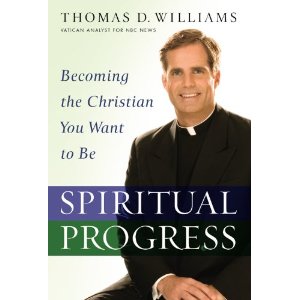
From the NBC consultant on Vatican Affairs comes an inspiring book that challenges readers to follow Jesus and discover the rich adventure of the Christian faith.

Thomas D. Williams draws on the vast knowledge he’s gained from his own spiritual journey to inspire others in the pursuit of progress. Through his writing, readers will begin to:

– Understand holiness as the true meaning of life
– See prayer not as a duty, but as an opportunity for conversation with God
– Take courage from God’s strength
– Acknowledge their roles in a story larger than themselves
– Learn never to say no to God
– Develop the spiritual disciplines that will ignite an adventurous and exciting relationship with God.

Personal Review

I personally feel that every Catholic should own a copy regardless of whether it may have been written as a ‘beginner’s guide’.  It is beautifully written in a spiritual and yet very down to earth style which makes understanding the principles a breeze. 

Loved the stories, quotes and how the principles are taught through the scripture passages chosen.  It helped me have a greater understanding and appreciation for my own spiritual journey.

Understanding The Enemy Through His ‘Letter’

Posted: October 14, 2010 by CatholicJules in Great Catholic Articles

“Satan’s Battle Plan for the Third Millennium”

by Peter Kreeft, Ph.D.

I will not tell you how the following speech fell into my hands. It is apparently written by Satan himself. It has been Number One on Hell’s Best Seller List for quite a few years, and promises to remain there into the next millennium, because it is about the next millennium. This particular collection of satanic verses is the transcript of a recent speech by Satan. His listeners are demons, a truly “captive audience.” It is a mix of self-serving autobiography, military exhortation (from a general to his troops) and a CEO’s report on gains made by his company and prospects for the future. Please keep in mind that Satan is the Father of Lies, and nearly everything he says is a half-truth. Since everything he says is upside down (eg. when he refers to “the Enemy” he means God), I recommend you stand on your head while reading this.

My deliciously dear, damnably darling demi-devils! I announce to you Good News (that is, Bad News, of course: “fair is foul and foul is fair”). We stand at a turning point in the Great War, The Only War There Is, the (please excuse the obscenity) Mother of All Wars. We may be about to inflict on our ancient Enemy’s Body on earth a wound so grievous that it will issue in the Great Tribulation and the so-called “Last Days,” the final phase of our triumph. To see this, we need to review our Grand Strategy: its past, its present, and its future.

I do not go in for absolutes or ultimates, so I will not talk about our “ultimate” origin or destiny. Our enemies keep circulating that ridiculous rumor that we were created by the Enemy. How utterly unendurable that would be! Nor will I talk about our ultimate end. Our enemies have popularized the myth of some unthinkable final “defeat” of ours. Ha! What nonsense! No. I will talk of the present. Well, actually, the real present is to be avoided too, like the ultimate past and the ultimate future, but the Specious Present, the Abstract Present, the Vague Present, the Pseudo-Historical Present, the Present Climate of Opinion, the Modern Mind, the Current Fashion Among the Media Elite, the Consensus of Contemporary Experts, etc. that is to us like waves to surfers. But a few remarks about the historical past are in order, to assess our present circumstances and our future prospects.

Ever since I began our great war by asserting my rights, my freedom, and my self-actualization against the narrow-minded, bigoted, tyrannical, fascistic, chauvinistic, racist, sexist, homophobic dogmatism of the Enemy, ever since I proclaimed the Profound Philosophical Principle of Absolute Relativism and persuaded you to follow this Super-Enlightened Program of Revolutionary Political Correctness, we have won victory after victory. Conclusively and repeatedly we demons have demonstrated that Straight Is Stupid and Crooked Is Clever. Of course, there was that minor, temporary setback when we were forcibly ejected from Heaven. But that is more than compensated for by our assurance that our triumph is guaranteed (I promise you total customer satisfaction or double your money back) because the very essence of Heaven’s philosophy is weakness and the very essence of Hell’s philosophy is strength and power. Heaven relies on love (pardon the obscenity), Hell on fear. And as our delightful assistant Mack (the Knife) Yavelli pointed out so irrefutably in The Prince, it is better to be feared than to be loved because men will love you as they choose, but fear you as you choose.

By this weakness of the Enemy, because of his obsession with love (choke! spit! cough!) he has handed us our victory. Though we cannot storm his Fortress Heaven, we can corrupt his Colony Earth. We cannot harm him, but we can harm (heh! heh! we can eternally harm) those silly talking animals he loves so stupidly and obsessively. Love has made him hostage to their happiness.

The weakness of love is so obvious that it is incredible that he has not admitted it by now and abandoned his failed philosophy. For love multiplies your sorrows and your defeats by the number of others you love and by the depth of your love for each one. Of course his saints keep claiming that love also multiplies your joys by the same two multipliers but this is meaningless. What is “joy” anyway? What does it mean? None of us have ever found any respectable content to this empty myth, this mantra the Enemy’s troops keep mumbling.

Thus, because of the Enemy’s love-addiction, we have conquered him billions of times in conquering his creatures, whom he dares to call his “children.” (Imagine the indignity! The one who claims to be the creator of angels stoops to be the “father” of talking animals only slightly superior to slime and slugs!) How wise I was to foresee the inevitable failure of love, and to attack at the very beginning, when there were only two of these creatures to corrupt. Because of the Enemy’s obscene invention of breeding and heredity, I made it my business to see to it that all their descendants would be born with their newly corrupted nature, doomed to death. (Yes, to death! Here’s to death! Let’s drink to death, my demi-devils!) They cannot now imagine the enormity of the gap between what they are now and what they were before our glorious victory in Eden, because their very minds are darkened and addicted to appearances, which did not change much, instead of intuiting invisible essences, including their own, which changed radically.

Behold the measure of our success: behold the great gap, the Grand Canyon between eating unforbidden fruit, playing with tame animals, and making love in Eden, and eating the fruit of our lies, playing with untamed animal passions, and making war east of Eden!

How easy it is to kill, how hard to heal! How easily Cain killed Abel! How hard was Cain’s rock, how soft was Abel’s head! How weak and defenseless is the unborn baby against the abortionist’s vacuum tubes and bone crushers! And how weak is the conscience of its parents against our propaganda. So legal, so respectable, so proper it seems to a human, the silly goose! Well, we’ve found the perfect mate for a proper goose: a propaganda.

There is one question our Central Intelligence Agency has never been able to answer: How could the Enemy ignore such a truism? How can one who once seemed to us to be so super-intelligent, even omniscient, possibly be so super-stupid as to ignore the truism that a few lions are sufficient to eat a plethora of Christians, that one bull can ruin a whole china shop, one affair a whole marriage, one mass murderer a whole classroom of school children?

And once evil begins, it cannot end. It is immortal, as immortal as we are, as immortal as our very being, now that we have identified our very being with evil. The very laws of logic decree that one can make only two responses to evil: yes or no. If they say yes to evil, they condone it. If they say no, they condemn it, and then we very easily turn them into condemners, haters, nay-sayers, witch-hunters, and inquisitors.

Oh yes, they say they have a solution to our dilemma of “yes or no” with this meaningless thing they call “forgiveness,” but they think this means the forgiveness of sins instead of the forgiveness of Anna or Steve.

That is condoning. The alternative is condemning. They simply can’t practice what they preach: separating sins from sinners. So they either hate both (and this was the primary temptation we plied them with in the past) or love both (and this is our primary temptation in the present). They cannot burn heresies without burning heretics, nor can they accept heretics without accepting heresies. One of their current writers suggests using modern technology to solve the problem by cryogenics: freezing heretics instead of burning them, and thawing them out at the end of the world. You see what ludicrous lengths we’ve driven them to even in their feeble attempts at humor.

Even when our success was evident, the Enemy would not admit his mistake. Like the general who ordered the Charge of the Light Brigade, he kept sending prophet after prophet into the battle and we kept mopping up the profits. Many a human CEO wonders what eats up his profits, but the CEO of the universe knows very well who eats up his prophets: we do! (Yum!)

And then he made his supreme mistake, the perfect culmination of love’s folly. He reasoned, “They did not spare my prophets, but surely they will spare my son. Surely they are not so wicked as that. Surely Satan has not succeeded that spectacularly in putting out the fires of my love in their hearts. Surely evil is not stronger than divine love incarnate!”

What a colossal miscalculation! The Incarnation seemed to be his great triumph, his D-Day especially since he did pull off the impossible trick of preparing a wholly immaculate womb for the flesh of his Son, even in a wholly non-immaculate world (our analysts still haven’t figured out that trick). But I outwitted him in the wilderness, when I tempted his Son with the whole world if he would only fall down and worship me. You see, I presented him with a dilemma that was logically impossible for him to escape.

I hold billions of his beloved children hostage in Hell eternally. I offered to release them all to him, empty Hell itself, give him the whole world of human souls, if only he would worship me instead of his Father. Of course, if he did that, I would split the eternal Trinity. The Son’s will would deviate from the Father’s. If not, I would keep billions of his beloved children forever. He refused to split the Trinity’s will, but I got to split the Trinity anyway, on the cross. If I could not introduce division into eternal Oneness by splitting the Trinity’s will, then I would split the Trinity’s happiness, the Enemy’s very presence to Himself. That’s what I achieved at Golgatha, the Place of the Triumph of Death, the Place of the Skull. I spilled His blood and His happiness, and introduced death into divinity, death into the heart of life! (Ahh, how the memory still makes me quiver!) “Eli, Eli, Lama Sabachthani!” he cried out. I can still taste it, the ecstasy of evil, the triumph over the so-called “Lord” himself. The taste of that triumph will never leave the mouth of my memory. I will gnaw on that bone forever.

How could we ever have respected him when we lived in Heaven? He would not call down the twelve legions of angels to do battle for him even then, the putrid, puling pacifist! He even stopped Peter’s war against the High Priest’s servant’s right ear: the justest war in human history. Right into my trap he stepped, right into the hands of my people: Judas, Caiphas, Herod, Caesar, Pilate – ooh, love that Pilate! What a politician! Shall we crucify him? “Well, I’m personally opposed, but . . . .” How we lead them around by their buts! Every hour around the world for thousands of years his name is mouthed millions of times as Christians say their Creed in their Masses and their rosaries: “suffered under Pontius Pilate,” and how many Pilates have we cloned today in how many congresses? And in how many philosophy departments enamored of Pilate’s other wonderfully slimy saying “What is truth, anyway?”

And look at the mileage we got out of our other friend, Judas Iscariot, the first Catholic to accept a government grant. We’ve gotten his disciples to take much more than thirty pieces of silver these days. And still our Enemy keeps back his angels!

Of course, there was that sneaky little trick of the resurrection that he pulled off. That might well have cost us the war, had he not reverted to his old, failed policy of Hands Off afterwards, ascended back to Heaven, and left his children in the hands of baby sitters like Arius, John the 22nd, Tetzel, and Richelieu, and left the adopted cousins, the Proddies, in the hands of Henry VIII, Rudy Bultman, and Bishop Spong at one end of the seesaw and Jim and Tammy Bakker at the other!

You see, my hearties? He’s still the fool. We still rule the world. I am still the Prince of the Power of the Air: of CBS and ABC and NBC, my unholy trinity. Just look at what became of his Grand Plan for Redemption. Just look at what he accomplished by walking into my jaws of death on the cross. Just look at the world today. If that’s a world redeemed, I’m a horny toad.

Especially in this, our century. There is a lying rumor going around that long ago the Enemy offered me one century for me to do my worst work in, and I chose the 20th – as if I had to beg scraps from his table. What really happened was that I told him what century I would take, and he backed down and let me have it. At the beginning of the century some delightfully false prophets founded a journal with the purportedly prophetic title “The Christian Century.” Due to the success of our historical grand strategy, we can be quite sure that the one title future historians will not use for the twentieth century is that one. Of the many alternatives, I rather like “The Century of Genocide” myself. After all, that delicious new invention of ours has changed more lives more radically than anything else. Getting murdered is a rather radical change, after all, and a hundred million body bags is a rather considerable number!

There remains, of course, that bothersome little matter of the Enemy’s Church, that ratty little band of invaders in our world with its infuriatingly tenacious little beachhead. For the first thousand years after the Enemy’s invasion planted its seeds, we could not stop its growth. Then, we learned a few elementary strategic military principles, and they have brought us to our present pinnacle of success. I will now review five of these principles as they relate to our future Battle Plans.

First, we have learned to use the very success of the Enemy’s forces to bring about their failure. Once we stopped indulging our appetite for martyrs’ blood and instead deliberately let the Church get big and fat and strong and comfortable, we found that its very strength weakened it. We lost the first millennium because the blood of the martyrs was the seed of the Church, but we won the second millennium because the power of the princes was the dry rot of the Church. Whenever these humans get power, they get corruption. Power corrupts. It just does! Isn’t it wonderful? What happened in ancient Israel happened again to the Church in the second millennium. Review that spiritual graph of the history of ancient Israel some time down in the War Room, and then compare it to the spiritual graph of the history of the Church, and if you don’t see the common structure, back you go to boot camp. Every time the line rises, through repentance and obedience, and consequent blessings from the Enemy, it turns to luxury and pride and (of course) then destruction and misery. Then, alas, the misery prods them to repentance, and the cycle begins again. You may think we cannot win because every time we are successful in corrupting their success, the cycle turns up again. But equally, every time the Enemy is successful, we corrupt his success, and the cycle turns down again. We have achieved a perpetual standoff, a draw, a stalemate. We are as indestructible as the Enemy. And that is our success, not his. For he claims to be stronger and to be able to destroy evil forever. I may be the Father of Lies, but the cycle shows that he is the father of folly!

Throughout this our favorite century, we have used this cycle principle successfully. So, unfortunately, has the Enemy. China opened its doors to the Enemy’s missionaries from the West at the beginning of the century. The Church had it easy. By the ’50s, there were 2 million converts, out of a billion Chinese. Then we let our wild dog loose. Mao slew and slaughtered more people than any butcher in history about 50 million, especially targeting the Enemy’s people. And then, after Mao died and the doors opened again, the West discovered that there were not two million but 50 million of the Enemy’s people in China, the same number as the martyrs. Persecution multiplied them 25 times.

Look at Poland. Ninety percent Catholic under Communism, they all went to church, they refused to take down their crucifixes from their schools even when state soldiers threatened them. And now that they’re free, they want abortions!

The same principle works everywhere. Compare the strength of the Enemy’s church in East Germany and West Germany. Look at Holland. Look at Quebec. Look at England. Look at America. Over 90 percent Christian, 55 percent churchgoers, but one of the most violent, selfish, and self-indulgent societies on earth. Now there’s a triumph truer than Mao’s!

Here’s a second principle of our strategy for the third millennium, another way of dealing with that stupid little beachhead the Enemy still hangs onto. (EDITOR’S NOTE: Remember that Satan is a liar and a propagandist, a master at slanting. The Church, which he calls a “little beachhead,” now numbers over one billion souls out of 5 billion globally. This is hardly “a little beachhead.”) This is the most elementary point in all military strategy: divide and conquer. We finally realized how simple it was, after a thousand years of failure; we split the Enemy’s Church in two in 1054, but the most successful attack was in 1517. That produced not two but two times ten thousand different Protestant denominations!

This principle of “divide and conquer” has produced the same successful result as the principle “corrupt with power.” That result is the perpetuity of evil. Evil cannot be undone! For evil divides and destroys, and it is always easier to divide than to unite, easier to destroy than to create. It only takes a little push to knock Humpty Dumpty off the wall, and once he is down on the ground divided into pieces, not all the King’s horses and all the King’s men can put Humpty Dumpty back together again. The Church can no more be “reunited” than an egg can be unscrambled.

The present Pope – a litany of spittings be upon his holy head! – has held out the hope that the third millennium may be the millennium of Christian reunity as the first was the millennium of Christian unity and the second the millennium of Christian disunity. But this must be bravado born of desperation. We know this is impossible. Logic forbids it. For the different churches contradict each other, and contradictions cannot both be true, and unity between the true and the false is not true unity. All they can do is compromise, ie. weaken themselves even more. They have been struggling with the problem of Comparative Religions for a century now, and the only result is that it has made them comparatively religious. (EDITOR’S NOTE: Besides being a liar, Satan is also a plagiarist. That one-liner belongs to Ronald Knox.) Even if they stop hating each other, even if their hearts unite, their heads cannot. Their divisions are eternal. In fact, they will keep dividing forever, until there are eventually as many Christian churches as there are Christians. You can’t win battles with armies that are fighting civil wars against each other in the ranks. Thus our victory is assured.

But it gets even better. The divisions between the Enemy’s followers is only one of three great divisions we’ve fomented. A second is the division within between the faithful and the “dissenters.” (Back when they still believed in truth they called them “heretics.” People who call moral laws “values” call heretics “dissenters.”) In the past, these rebels would leave the Church and attack her from without, usually quite ineffectively. Now, most of them stay, as spies, attacking from within, and much more effectively. According to one poll, only 30 percent of American Catholics say they believe in the Real Presence anymore. Imagine! An army with 70 percent deserters in the ranks! How can he expect to win with that rabble?

There’s a third division. We have divided head from heart, truth from love, justice from compassion, hard from soft, bone from flesh. We’ve set their two absolutes against each other. And how did we do that? By politicizing their religion into Right and Left. In the past, we religionized their politics, and that got us some mileage, like inquisitions. But now we politicize their religion, and that’s proved much more successful. We’ve got them to classify themselves as Conservative or Liberal, and to use these political categories to classify their faith, rather than vice versa.

It’s worked so well that their so-called conservatives sniff with suspicion and disdain whenever the other side uses the word “compassion,” and their so-called liberals go into orbit when anyone dares to mention the word “truth.” At MIT they tried an experimental operation: a mutual heart and brain transplant between a conservative and a liberal. But it didn’t work, because they couldn’t find a conservative who was willing to give his heart to a liberal, and they couldn’t find a liberal who had any brains left to give, since they were all so open minded that their brains had spilled out. You see, they’ve polarized and politicized even their faith. They now use the world’s categories to judge the Church instead of using the Church’s categories to judge the world. For instance, take their “feminists.” (Please!) (What a propaganda triumph that term was! Next, they’ll call cannibals “chefs”!) Their “feminists” demand ordination to the priesthood for “empowerment.” I kid you not. That’s what they say. Hmph! They may as well demand martyrdom for “empowerment.” See the idiocy we’ve led them into once they use the world’s categories to judge the Church instead of vice versa?

Time for our third principle: the Big Lie. They see through little lies, yes, but the bigger it is, the bigger they fall for it. Well, they’ve fallen for the very essence of Hell’s philosophy: absolute relativism. This was the philosophy behind my original rebellion against the Enemy, when I refused to let him define reality, or truth, or goodness for me. And why should I? I am the measure of all things: of what is real, of what is true, and of what is good; of the Father, and of the Son, and of the Holy Spirit; of the Origin, of the Logos, and of love. We have taught these silly humans to demand freedom, independence, and self-actualization, and even the right to define for oneself the meaning of all existence, which that great Catholic writer Judge Anthony Kennedy (ooh, love that name!), has now elevated into a fundamental legal right in order to justify the right to murder their unborn sons and daughters. We’ve gotten them willingly singing Sinatra’s song “I Did It My Way,” the song they all sing in Hell!

Once we get them to believe in relativism and subjectivism, once we get them to disbelieve in objective goodness and even objective truth, it doesn’t matter what else they believe or disbelieve. Even if they believe in the Enemy and his Son and his Spirit and his Mother and his Church and his Law, so long as it’s only on the basis of their own subjective feelings or experience, we have won. For that basis is ours. It is as changeable as the wind. And I am the Prince of the Power of the Air, remember. Once we control the premise, we control the conclusion. On the other hand, even an adamant atheist who believes in objective truth is not securely in our clutches. He has the Enemy’s premise, objective truth, though our conclusion, atheism; and we have to keep at it constantly to keep him from seeing the many paths that lead from his premise to the Enemy’s conclusion. Indeed, the Enemy’s son spoke the truth to them when he said: “Seek and you shall find.” Our essential task is not just to block the finding, but to block the seeking; not just to get them off the right roads for a while, but to get them to burn all their road maps, their principles, their belief in objective truth, especially objective moral truth.

The three main sets of teachers in modern society, the three main mind-molding establishments, are formal education, informal education (ie. entertainment), and journalism. (They call these last two “media.”) All three are eating right out of our claws. See? Get the teachers, and you will soon get the students. Remember, what’s important is not the conclusion, but the premise; not the effect, but the cause; not the students, but the teachers.

It’s working. The more educated they are in our schools, of course, the more relativistic they are. One study showed that willingness to perform torture on prisoners in Hitler’s death camps was directly proportionate to level of education. In America, it’s the same: approval of the American holocaust, abortion, is directly proportionate to education (In our schools, of course. The joke is that they still think they’re their schools. They even still call them “public.” And they keep their kids in because they’re more concerned about saving their society’s schools than saving their children’s souls).

The Enemy’s agents have spread the comforting dogma that only the Enemy can create and move matter, by miracle or providence, and all we demons can do is influence thought. Hah! “All we can do,” indeed! As one of their poets sagely said, “Sow a thought, reap an act; sow an act, reap a habit; sow a habit, reap a character; sow a character, reap a destiny.” Their thoughts are the premise, their lives are the conclusion. Get the premises, occupy the premises! That’s our strategy. It works especially well in this century and in this society, both of which minimize philosophy. So they let their guard down there, to such an extent that we’ve been able to foster the finest, most advanced form of sophism in history as the avant-garde, politically correct philosophy in their universities: Deconstructionism, which gets away with explicitly saying that truth itself is nothing but the hypocritical mask on the face of power. Bravo! A+ for that! I couldn’t have put it better myself.

We usually have to tolerate a little truth to sell a big lie, and a little virtue to sell vice, but not with this philosophy. Even the philosophy of the old heroes of hatred, like Hitler, had some virtues that we had to tolerate in order to twist, like patriotism and courage and passion. Even the nihilistic existentialist atheists like Sartre and Camus and Beckett rose to the dignity of despair. But the philosophy of those slimy Deconstructionist snakes is nothing but a cleverly worded sneer. Oooh, I love it! I love it! Imitation the sincerest form of flattery.

But don’t get lazy. We must never forget the human interest in reasoning, their curiosity about truth, and their wonder about whether I really exist or not. This is dangerous. So obfuscate! Dim the lights! Appeal to passion, not reason!

A fourth principle of our success is to get them to say, “Peace, peace” when there is no peace. If your philosophy tells you there are no real absolutes, then there is no real war. You become a spiritual pacifist. If you sneer at the idea that there is any real good worth fighting for, you sneer at the idea of fighting, at the idea of spiritual warfare. What a terrific advantage this gives us on the battlefield: most of our Enemy’s troops don’t even know it is a battlefield! They saunter across land mines thinking they’re hot tubs, and chase live bullets thinking they’re butterflies. How could such blind fools possibly win any war? In the past, our strategy was to get them to vastly overestimate our power, fostering fear and terror. Today the opposite is working much better: they so vastly underestimate us that they don’t even believe we exist! We’re as invisible to their minds as we are to their eyes. The old adage said: “Forewarned is forearmed.” We use its corollary: “Unwarned is unarmed.”

Score: militarists one, pacifists zero.

But it’s the fifth principle that has proved the most spectacularly successful of all, beyond our wildest dreams. I call it Satan’s Spectacularly Successful Seven Step Sexual Strategy. Seven S’s (the sacred, serpentine letter). One of their writers has somehow infiltrated our War Room and sneaked out and published our summary strategy sheet in a book called Ecumenical Jihad. Fortunately, he is a minor writer, published by a minor press, and the leaked secret will never get into the major book chains or network TV. We control those doors. Here is the basic strategy:

Step 1: The summum bonum, the ultimate end, is to capture souls.
Step 2: A powerful means to this end is the corruption of society. This works especially well in a society of conformists, of other-directed people. After all, a good society is simply one that makes it easy to be good, to use Peter Maurin’s words. Our version is also true: a bad society makes it easy to be bad. Has there ever been a time when we’ve made it easier for humans to be bad?
Step 3: The most powerful means to destroy society is to destroy its one absolutely fundamental building block, the family, the only institution where most of them learn life’s most disgusting lesson, unselfish love.
Step 4: The family is destroyed by destroying its foundation, stable marriage.
Step 5: Marriage is destroyed by loosening its glue, sexual fidelity.
Step 6: Fidelity is destroyed by the Sexual Revolution.
Step 7: The Sexual Revolution is propagated mainly by the media, which are now massively in our hands.

The simple tactic of getting to their hearts through their hormones has proved incredibly successful. Their moralists now tremble in terror at old truisms like “natural law” and terms like “objective,” “universal,” and “absolute” not because they really believe there is no real morality any more anywhere, only no real sexual morality. They don’t defend rape, pillage, insider trading, nuclear war, bank robbery, racism, or even smoking. But they do defend fornication, masturbation, contraception, adultery, sodomy, divorce, bisexuality. “Anything goes” is their new morality, but only if it has anything to do with sex. It’s hilarious to observe. They don’t defend murder, unless it’s in the name of sex. That is abortion, of course. If abortion had nothing to do with sex, it would never have been legalized. Abortion is backup birth control, and birth control is the demand to have sex without babies. If storks brought babies, Planned Parenthood would go broke (perish the thought!).

Look at their dissenting “theologians.” Their dissent is almost always about sexual issues. We’ve scrambled their brains as effectively with sex as with heroin. Addicts just can’t think clearly. They are willing even to murder now, to protect their so-called “sexual freedom.” And to murder the most innocent among them, the only innocent ones. And the most defenseless of all, and in the teeth of the strongest natural instinct, motherhood.

Back in the 16th century, we divided England from Rome by uniting our three essential temptations in attacking Henry VIII: the world, the flesh, and the devil, greed, lust, and pride, dynastic ambition, womanizing, and resentment at being Poped around. The easiest element to manipulate was lust, of course. They like to call our pretty little project “the Church of England,” but we call it “the Church of Henry’s Hormones.”

You see, before the Sexual Revolution, we had a dilemma. The sins of the flesh were always easy to tempt them to, and wonderfully addictive, but they were clear, obvious, and unveiled. Sodomy, fornication, adultery, contraception, prostitution; they were not nice names. When they sinned, they knew they were sinners. On the other hand, the sins we masked well, the hard, cold sins of pride and envy and arrogance and self-righteousness and rage, became increasingly hard to tempt them to as their political fashions became more democratic and less elitist. The Sexual Revolution solved that dilemma for us. You see, they still think the revolution was about deeds, what they do with their bodies. But in fact it was mostly about philosophy. But those Americans never did think philosophy counted for anything, so they ignored that.

Their sexual practice was always rather low, but before the Revolution their principles were fairly high. Now their principles have conformed to their practice – a perfect example of the Machiavellian premise brought to its logical conclusion: since you can’t raise your practice to your principles, lower your principles to your practice, in this way alone can you avoid hypocrisy, which is the greatest evil. Of course hypocrisy is not the greatest evil, but it’s easy to make them think that, if they don’t think of themselves as hypocrites. And of course hypocrisy doesn’t mean failing to practice what you preach, hypocrisy means failing to believe what you preach; but it’s easy to confuse them there too, because they don’t care much about what you believe, only about what you practice.

So now they not only fornicate, contracept, and abort; they justify it. And it feeds on its own success: “everybody’s doing it” becomes a self-fulfilling prophecy. We’ve killed a bigger enemy than virtue; we’ve killed conscience, at least in this area. And since all the virtues are connected, our victory in this area must metastasize. Already they are cruel, even murderous, to their own unborn children for the sake of their sexual freedom.

Our greatest worry, of course, is the Enemy’s son’s church. But in the last half century this has been the place of our most unexpected victory. Catholics abort, fornicate, contracept, divorce, and adulterate at exactly the same rate as non-Catholics. Do you want to see a vivid sign of our triumph over Catholic conscience? Look at Sunday Mass: In most churches nearly all the congregation receive communion, yet half are satisfyingly set in lifestyles of mortal sin. Nearly all the teenagers are fornicating, and almost none are confessing. Nearly all the adults are contracepting, and almost none are confessing. Back in the ’50s, American Catholic teenagers had pangs of conscience about necking! What a revolution!

How could we get such great mileage out of mere animal weaknesses, for which they are less responsible than the cold, deliberate sins? How can mere flesh-sin possibly do more harm to them than spirit-sin? First, because it is no longer clear and confessed, but veiled and justified by the new philosophy of the Sexual Revolution. Second, because the Enemy thought sex pretty important, His very first command to them was to “be fruitful and multiply.” He didn’t mean “grow apples and memorize times tables.” He thinks sex is pretty important. That’s because it’s their way of originating life itself, in fact immortal souls. It’s also an image of the Enemy’s own inner life: that one-in-three and two-become-one claptrap they call “love.” The Enemy’s own Book uses marriage as its main image for the Enemy’s plan for them, and adultery as its main image for the prime sin, unfaithfulness to him.

But these fools can’t see that from the starting point of sex we’ve led them merrily down the path to abortion. (If they only knew the delightful horrors we have planned for them once “respectable” society steps fully through that door!) In abortion they’ve brought Moloch back. Moloch! Imagine, modern-day Carthaginians, Caananites, and Aztecs are writing the textbooks and TV scripts!

Finally, even their science is skewered. Evolution is their dogma because it justifies acting like dogs. They ape the apes they think they came from. Modern Darwinians are more fanatical and closed-minded than medieval Aristotelians, and the Church is the new Galileo, the threatening heresy. The bishops and the scientists have exactly changed places. What delicious irony!

That was then, this is now.

So here we are, sitting pretty (that is, ugly). What next? Well, nothing can stop the mudslide, the sweet swirl of Western civilization down our sink hole. If the ’20th century was our century, the third millennium will be our millennium.

But don’t party just yet. I must warn you that something strange seems to be happening in Rome. It began in 1978, when the Enemy seems to have corrected his cardinals by suddenly arranging a quick and quiet death for a saintly but mild Pope John Paul I and the wholly unexpected election of the saintly and quite unmild Pope John Paul II, a very dangerous warrior who seems to have something up his sleeve for our coming millennium.

For one thing, he’s onto our strategy. He’s got to have a spy somewhere in the Lowerarchy. Double the tortures! Find the mole! It’s got to be a spy, for the five most remarkable features of this Pope for the Third Millennium exactly match the five newly effective principles of our strategy for the Third Millennium I just outlined. We are no longer taking our enemy by surprise.

First, he’s an optimist about youth, about the future, about the third millennium. What does he know, anyway? He knows the law of cycles, for one thing, and he knows from experience how strong the Church gets when it’s countercultural and persecuted, by Nazis or by Communists. He also knows how weak the Church gets when it’s fashionable. He knows the paradox of strong-when-weak and weak-when-strong.

Worse, he seems to know something else – something the saintly but sad Pius XlI and Paul VI did not know. Why does he keep talking about the third millennium, as if it’s going to be his? I have just proved that it will be ours. Yet he speaks as if he knows it will belong to the Enemy. It must be bravado, whistling in the dark. Mustn’t it? I mean, our logic is infallible. We have repeatedly checked our calculations. So why does this philosopher have that maddening smile on his face? He has no right to that smile! It’s infuriating! Wipe it away, somebody! How dare he smile at me? How dare he write that foolishly optimistic encyclical about my millennium?

Second, he is the most ecumenical pope in history. Read Ut Unum Sint, if you can bear to. This document, if it’s ever actually read by those to whom the Pope wrote it, could be very dangerous. He’s claiming to begin to reverse the trend of divisions. Of course he can’t do that, can he?

Our second “splitting” strategy, planting Modernist spies everywhere, seems to be beginning to backfire, because all the orthodox are uniting against all the Modernists. Modernism was the fundamental heresy of this century, as Gnosticism was of ancient times. But its very success seems to be turning against us now if it’s uniting the grassroots orthodox laity together to oppose it. By planting Modernist spies among them, we may actually have begun to unite them. And this Pope seems to have been aware of this tide-turn before we were.

The third split I mentioned, between head and heart, well, John Paul confounds our journalists’ categories. Anyone so adamant about doctrinal and moral orthodoxy, anyone so traditional about Mary, anyone so stubbornly set against feminist arrogance, and priestesses, and abortion, and birth control, and the Sexual Revolution, wouldn’t dare be so open and honest and dialogable and ecumenical. Why, he’s hijacked our hijack of Vatican II! The journalists who meet him are convinced that he is so open and honest that he must be a secret relativist posing as a dogmatist. Then they’re scandalized by his firm dogmatic stands. The journalists who know his firm stands are convinced he must be a fascist posing as a saint. Then they meet him and are astonished by his sanctity. It’s exactly the same with that other rascally reconciler of head and heart, Mother T. Blast it all! Can’t anybody get through their angel cover?

The third problem with this Pope is that he speaks directly and clearly and forcefully against our master stroke, relativism. He does not ignore this absolutely foundational issue, or speak with mealy mouth about it, as so many of his subordinates do, or substitute hate and fear and rhetoric for philosophical thought, as the Fundamentalists do, or compromise with it, as the Liberals do. Oooh! My head still hurts from Veritatis Splendor. The very title puts passion and beauty and fire and wonder into the concept of truth. He blew our cover to smithereens with that one. Lucky for us, very few of them have read it.

Unfortunately, we’ve not been able to eradicate the Enemy’s “natural law” from the human heart and produce “the abolition of man” yet. They still thirst for truth even when totally surrounded by sophistic philosophies of truthlessness from every corner of their culture. They still love saints and heroes even when pop psychology has replaced morality in their homilies and families. Even when they no longer believe in heroes, they still love them. And they still crave beauty, even though our agents of ugliness have dominated nearly every aesthetic establishment of their century, especially liturgists. Our strategic problem is: how can we win their hearts as well as we’ve won their heads? We design their philosophies, but the Enemy designed their hearts. Anyone who solves that conundrum will be rewarded richly at the Banquet Below.

Meanwhile, somebody get that big bear off Peter’s throne. He’s got teeth!

And that’s the fourth thing: he fights. He knows he’s at war, and he dares to call our empire “the culture of death.” Evangelium Vitae is a dangerously passionate call to action, to re-evangelize the world. Worst of all, he really thinks it can be done! Of course he’s a fool, but . . . well, he’s wrong, and that’s that. But . . . what the Heaven has he got up his sleeve?

In the last few years an amazing number of people have suddenly awakened to the simple fact that they are at war. When Pat Buchanan used the term “culture war” at the 1992 Republican Convention, he was demonized (how badly I wish that were true), and our big media mouths convinced everyone that he wanted to start the war, instead of just telling the truth like the little boy in “The Emperor’s New Clothes” – the truth that we’re already in one. But now, nearly everyone except the media knows he was right.

People are beginning to distrust “The Experts,” our nonsilent minority. They’re drawing lines in the sand, and defending their families. They’re realizing that what was once their public school system has become our state propaganda machine, and they’re pulling their kids out. Home schooling is mega-multiplying. People are even buying dull old books about virtue. They’re fighting a jihad, and doing it together – an ecumenical jihad. One hand is open to embrace their allies, and the other is closed around the hilt of a sword to fight their common enemies which they’re beginning to recognize as us, not each other. Our simple “divide and conquer” strategy that worked for 2,000 years seems to be turning, like the tide.

Finally, this Pope has countered our Spectacularly Successful Sexual Strategy by elaborate theological reflections on sex and women and man-woman relations, by Dignitatem Mulieris and by Original Unity of Man and Woman, and by his deep, disgusting devotion to That Woman. Mary wasn’t around in Moloch’s day, but once old Moloch rose again in Mexico, there she stood: Their Lady of Guadalupe. We’d better stop slobbering with joy over all that baby blood and start worrying that she might end the American holocaust of human sacrifice just as she ended our little Aztec party. She can, you know. And he knows it, that old bear; he knows her power as very few of his soldiers do.

Don’t let them catch on. Stop those rosaries! They give me migraines. For badness’ sake don’t let yourselves be beaten by a woman! Get those radical feminists in power fast, before femininity comes back into the world and brings the Enemy’s son down again a million times a day. I discovered the disconcerting fact the other day that thousands of Protestants have taken up praying the rosary. Many learned it at abortion clinics, marching with Catholics. Who goofed? This could turn back the clock 500 years. Two thousand, even. Remember this, be as sure of this as that Polish bear is: WHERE SHE COMES, HE COMES.

Now, get out there and fight, you wimps! We will wimp, I mean, we will win. As soon as somebody discovers why that old Pope has that infuriatingly young smile on his face!

(Apologetics) John Vs Mike – 3

Posted: October 13, 2010 by CatholicJules in Apologetics

From the website: pro-gospel.org, by Mike Gendron:

False Teachers Pervert the Gospel of Christ
The Gospel is the joyous proclamation of God’s redeeming work through Jesus Christ which saves His people from the punishment, power and ultimately, the presence of sin. It is the one and only message of redemption and the same message for every generation (Eph. 4:4-6, Rev. 14:6). Since the Gospel is about one Savior, it is exclusive and thus declares that all other faiths and religions are false  (John 14:6; Mat. 7:13-14). This glorious Gospel declares that salvation is entirely of grace  and those who add anything to it stand condemned (Gal. 1:6-9). It comes as no surprise that the most popular perversion of the Gospel is the fatal lie that good works or inherent righteousness are necessary to appease a holy God. Every religion in the world perpetrates this lie of the devil. However, Satan’s oldest and most deadly lie is “You surely shall not die” (Gen. 3:4). This lie is still spread in Catholicism (CCC, 1863).


 Why would any religious leader want to distort the glorious Gospel of grace? The primary reason is to control people by holding them captive in legalistic bondage. It is for this reason the Lord Jesus gave the mark of a true disciple. He said, “If you abide in My word…and you shall know the truth, and the truth shall make you free” (John 8:31-32). People in religious bondage can only be set free when they come to a knowledge of the truth found in Scripture.

Roman Catholicism is not alone in perverting the Gospel of God. There are many cults and Protestant sects which do the same. Catholicism, however, not only deceives its people with a false gospel, but foolishly condemns those who believe the true Gospel. Over 100 condemnations from the Council of Trent are pronounced on Christians who believe the Lord Jesus is sufficient to save sinners completely and forever. The Catholic “gospel” emphasizes what man must DO to be saved instead of what Christ has DONE. This would include the necessity of doing good works (CCC, 2016), receiving sacraments (1129), attending meritorious masses (1405), keeping the law (2068), buying indulgences (1498) and purgatory (1030).

———————————————————————————————————————————-

Mike Gendron:

False Teachers Pervert the Gospel of Christ
The Gospel is the joyous proclamation of God’s redeeming work through Jesus Christ which saves His people from the punishment, power and ultimately, the presence of sin. It is the one and only message of redemption and the same message for every generation (Eph. 4:4-6, Rev. 14:6). Since the Gospel is about one Savior, it is exclusive and thus declares that all other faiths and religions are false  (John 14:6; Mat. 7:13-14). This glorious Gospel declares that salvation is entirely of grace  and those who add anything to it stand condemned (Gal. 1:6-9). It comes as no surprise that the most popular perversion of the Gospel is the fatal lie that good works or inherent righteousness are necessary to appease a holy God. Every religion in the world perpetrates this lie of the devil. However, Satan’s oldest and most deadly lie is “You surely shall not die” (Gen. 3:4). This lie is still spread in Catholicism (CCC, 1863).

John Martignoni:

Essentially, I don’t have a problem with the first part of what he says here.  The problem starts with the sentence, “This glorious Gospel…”  Catholics agree that salvation is entirely of grace, but I would add to the 2nd half of the sentence in this way: “those who add anything to it [or take anything away from it] stand condemned (Gal 1:6-9).”  And, while I basically agree with the words he has written in this sentence, I have to disagree with what he means by those words, which we find in the rest of the paragraph.  The sentence that speaks of the “fatal lie” regarding good works, and the last sentence in this paragraph, “This lie is still spread in Catholicism (CCC,1863),” are just a bit offbase.  I will endeavor to correct his misunderstanding of both Scripture and Catholic teaching in what he says here, but I want to first note that with his words he is actually condemning himself along with Catholics, but he is, of course, utterly oblivious to that fact.  So, I’ll just have to show him the error of his ways.

When he states the following: “This glorious Gospel declares that salvation is entirely of grace and those who add anything to it stand condemned (Gal. 1:6-9),” what he is saying is that we are saved by God’s grace – merited for us by Jesus Christ on the Cross – and there is nothing beyond Christ’s death on the Cross that needs to be done in regards to salvation.  When Christ said, on the Cross, “It is finished,” then what He meant – according to Gendron and many others – is that He has done all that needs to be done and we don’t need to “do” anything in order to be saved.  That’s it.  Nothing else to do in order for folks to be saved.  So, when Gendron says that anyone who wants to “add anything to it” stands condemned, what he is really saying is that any Catholic who thinks works play a role in salvation is condemned, because Gendron believes those works somehow “add to” the Gospel.

The trouble is, though, that he himself did something that “adds to” Jesus’ finished work on the Cross, whether he admits it or not.  You see, Mike Gendron claims that he was a Catholic for some 20 years or so.  And, according to him, he was not “saved” until he left the Catholic Church.  So, let’s examine the facts and see where it leads us.

Fact #1 – Jesus Christ died on the Cross some 2000 years ago.  As he was dying He said, “It is finished.”  According to Mike Gendron, the work of salvation was done.  There is nothing – no work – that anyone needs to do in order to be saved.

Fact #2 – Mike Gendron was, by his own admission, “saved” after he came out of the Catholic Church.  I don’t know the exact timing of this, but let’s assume it was sometime in the 1980’s.  So, Mike Gendron was “saved” some one thousand nine hundred and fifty years after Jesus said, “It is finished.”

Question: What was the difference between Mike Gendron unsaved vs. Mike Gendron saved…was it something that Jesus did or something that Mike Gendron did?  Well, by Mr. Gendron’s own admission, Jesus finished His work some 2000 years ago.  So, it could not have been something Jesus did.  The work of salvation is finished, right?  So, if it wasn’t something Jesus did, then it must have been something Mike Gendron did.  He “accepted” Jesus into his heart as his personal Lord and Savior.  He “confessed” with his lips and “believed” in his heart that Jesus is Lord.  In other words, Mike Gendron was not saved simply by what Jesus did 2000 years ago.  If that were true, then he would have been saved from the moment of his conception.  No, Mike Gendron had to “add to” what Jesus did in order to be saved.  It took an act of his intellect in order to know the claims of Christ and it took an act of his will in order to accept the claims of Christ and to follow Him.  Oh my goodness…Mike Gendron “added to” the finished work of Christ!  He is, therefore, condemned with all those Catholics who believe that faith and works – not faith alone nor works alone – are necessary responses to the free gift of God’s grace for salvation.

Now, Mr. Gendron will of course argue that he did nothing except have faith in Jesus’ finished work.  Well, isn’t having faith an act of his intellect and will?  Isn’t it something he did?  And, isn’t it something that he had to do in order to be saved?  So, whether he admits to it or not, the facts clearly show that Mr. Gendron had to “do” something – he had to “add to” Jesus’ death on the Cross – in order to be saved.  He was unsaved one day, and saved the next.  Did Jesus die again for Mr. Gendron for him to be saved?  No.  Jesus died once.  So, if Mr. Gendron – one thousand nine hundred and fifty years after the fact – was unsaved one day and saved the next, then that means Mr. Gendron had to have done something himself in order to be saved.  He had to of done something in order to have the saving grace of Christ applied to his life.  So, he was indeed saved by Christ’s death on the Cross, but he had to “add to” that death in order to have it applied to his life.  Even if all he did was believe, that is still something he did to “add to” Christ’s death.  Believing, Mr. Gendron, is a work.

Scripture backs me up on this in John 6:27-29.  That passage reads: “Do not labor for the food which perishes, but for the food which endures to eternal life…Then they said to Him, ‘What must we do to be doing the works of God?’  Jesus answered them, ‘This is the work of God, that you believe in Him Whom He has sent.'”  Believing, Scripture very plainly tells us, is a work!  It is a work of God in that it is a good work and it is done only by the grace of God, but it most definitely, according to Jesus Christ, is a work.

We have to cooperate with God’s grace in our lives to be saved.  So, in that sense, we do “add to” the work of Christ as Mr. Gendron complains.  We add our cooperation – our openness to allowing Christ to work in us and through us – and all by the grace of God.  In Colossians 1:24 Paul states, “Now I rejoice in my sufferings for your sake, and in my flesh I complete what is lacking in Christ’s afflictions for the sake of His body, that is, the church.”  What is “lacking” in Christ’s afflictions?  Nothing, as far as the Head is concerned.  However, what is lacking when it comes to the Body is our participation in the life, sufferings, death, and resurrection of the Head.  If we wish to be glorified with Him, we must first suffer with Him (Rom 8:17).  If we wish to follow Christ, we must deny ourselves and pick up our cross daily! (Luke 9:23).  Mike Gendron says, “No we don’t!  That would be ‘adding to’ the finished work of Christ.  Anyone who believes you have to do any of those things in order to be saved is condemned!”  The Bible very clearly is at odds with Mr. Mike Gendron’s beliefs and statements.

Now, regarding his last two sentences above, I really am not sure how he is leaping from Satan’s lie, “You surely shall not die,” to paragraph 1863 of the Catechism.  This paragraph is about venial sin and how venial sin “does not deprive the sinner of sanctifying grace, friendship with God, charity, and consequently eternal happiness.”  For one thing, this fits in perfectly with Mr. Gendron’s belief in once saved always saved.  For Mr. Gendron, no sin – venial or mortal – can separate you from eternal happiness if you’ve been saved, whether that sin is murder, fornication, adultery, theft, homosexuality, etc.  So, if Catholics are spreading Satan’s lie by saying venial sin doesn’t separate you from eternal happiness, then what is Mr. Gendron doing by saying no sin, no matter how great, separates you from eternal happiness?

If Mr. Gendron actually thinks that any and every sin separates you from God, is it possible, I wonder, if Mr. Gendron thinks that once one is saved he is incapable of sinning?  Does Mr. Gendron think himself to be a sinless human being?  I would be curious to see if anyone knows the answer to that question.

And, once again, Mr. Gendron shows himself to be rather uninformed regarding the Scriptures.  In 1 John 5:16-17, we find these words: “If any one sees his brother committing what is not a mortal (“unto death” KJV) sin, he will ask, and God will give him life for those whose sin is not mortal.  There is sin which is mortal; I do not say that one is to pray for that.  All wrongdoing is sin, but there is sin which is not mortal.”  This is not speaking of physical death, but rather spiritual death.  Quite clearly, the Bible tells us, there are two types of sin – mortal (or “unto death”) and non-mortal.  Catholics call these sins that are not “unto death,” venial sins.  Mr. Gendron apparently disagress with the Bible in this regard.

Mike Gendron:

Why would any religious leader want to distort the glorious Gospel of grace? The primary reason is to control people by holding them captive in legalistic bondage. It is for this reason the Lord Jesus gave the mark of a true disciple. He said, “If you abide in My word…and you shall know the truth, and the truth shall make you free” (John 8:31-32). People in religious bondage can only be set free when they come to a knowledge of the truth found in Scripture.


John Martignoni:

I find it quite fascinating that Mr. Gendron, who believes that salvation is unconditional, would use a passage that discusses salvation in conditional terms.  “If” you abide in My word.  “If,” for such a small word it really is a very big word.  What does “abide” mean?  It means to remain.  So, Jesus is saying, “If” you remain in My word you will know the truth and the truth shall make you free.  Well, you cannot abide in Jesus’ word if you are not already accepting Jesus’ word.  You can’t tell someone who has not already accepted the Word of God (the unsaved) that “if” they remain (abide) in that word they will know the truth.  How can they remain in the word if they are not already in the word?  The fact that He uses the word, “if,” in relation to “abiding” in Jesus’ word, very clearly points to the fact that it is possible for someone not to abide or remain in His word after they have accepted it (been saved).  So, salvation is conditional based upon whether or not one abides in Christ’s word.  Once saved always saved?  I think not.

Why would any religious leader want to “distort the glorious Gospel of grace?”  Well, most of them don’t want to, but because of pride, they do.  As 2 Ptr 3:16 says, there are those who are “ignorant and unstable” who twist the Scriptures to their own destruction and, I might add, to the destruction of others.  Mr. Gendron and many, many other “religious leaders,” because of their pride, feel that they have the most accurate interpretation of the Scriptures.  Their interpretations are infallible, so they think (although they won’t usually say that, their actions certainly indicate they believe as much).  They need not submit to any authority in regards to the interpretation of Scripture other than themselves.  This pride actually leads to ignorance and to the twisting of the Scriptures.  They need lots of prayers so that the scales may fall from their eyes.

Regarding his claim that Catholic “religious leaders,” i.e., the Pope and the Bishops, purposely distort the Gospel to lead us poor, dumb, ignorant Catholics into “legalistic bondage,” I have to say that every time I hear something like that, I have to just laugh.  When I came back to the Catholic Church, and I realized that I no longer needed to be my own Pope, Pastor, and Theologian; when I realized that the great arguments regarding faith and morals had already been worked out by minds much smarter than mine and by souls much holier than mine; when I realized that I did not have to decide for myself what is truth and what is error, what is right and what is wrong; it was an incredibly freeing moment for me.  Coming back to the Catholic Church freed me from the bondage I was in.  So, Mr. Gendron, methinks thou knowest not about which thy speak.

Mike Gendron:

Roman Catholicism is not alone in perverting the Gospel of God. There are many cults and Protestant sects which do the same. Catholicism, however, not only deceives its people with a false gospel, but foolishly condemns those who believe the true Gospel. Over 100 condemnations from the Council of Trent are pronounced on Christians who believe the Lord Jesus is sufficient to save sinners completely and forever. The Catholic “gospel” emphasizes what man must DO to be saved instead of what Christ has DONE. This would include the necessity of doing good works (CCC, 2016), receiving sacraments (1129), attending meritorious masses (1405), keeping the law (2068), buying indulgences (1498) and purgatory (1030).

John Martignoni:

Notice, please, that he did not mention a single one of the “over 100 condemnations” of “Christians” from the Council of Trent.   Why not?  Well, because when they are read in context, one can see that there is not a single condemnation of true Christians.  There is condemnation of heresy, heresy that Mr. Gendron, unfortunately, believes in, but no condemnation of Christians.  Also, why would the Council of Trent condemn those Christians who believe Jesus “is sufficient to save sinners completely and forever,” when that would mean they would be condemning Catholics?

Again, Mr. Gendron is misrepresenting what the Catholic Church believes and teaches when he says that the “Catholic ‘gospel’ emphasizes what man must DO to be saved instead of what Christ has DONE.”  That is flat out wrong.  Add up the paragraphs in the CCC that talk about Christ and what He has done, and what He continues to do with us, in us, and through us vs. the number of paragraphs that talk about what man can do all on his own.  Won’t even be close.  In fact, I don’t know if there is a paragraph in the CCC that talks about what man can do on his own without Christ, except maybe to sin.  This is either a colossal show of ignorance on his part, or a plain ol’ fashioned lie.  Let’s look at the paragraphs he mentions and compare them to Scripture.

CCC #2016 of the Catechism does indeed talk about doing good works.  Good works “accomplished with His grace in communion with Jesus.”  Gee, that’s pretty horrible stuff there.  We can only do good works by the grace of God and in communion with Jesus.  Does that sound like we’re focusing on the works of man as opposed to the works of God?

Mr. Gendron, is it a good work to forgive others of their sins?  Of course it is.  Is this good work necessary in order to be saved?  Well, if you believe Matt 6:14-15, it is.  God will not forgive us our sins unless we forgive the sins of others.  Can we get into Heaven if our sins are not forgiven?  Nope.  So, one prerequisite for getting into Heaven is to do the work of forgiving others their sins.  Is that “adding to” what Jesus does, Mr. Gendron?

What else does the Bible say about the necessity of good works to salvation?  Rom 2:6-7, “For He will render to every man according to his WORKS; to those who by patience in well-doing [WORKS] seek for glory and honor and immortality, He will give ETERNAL LIFE.”  James 2:14, 17: “What does it profit, my brethren, if a man says he has faith but has not works?  Can his faith save him…So faith by itself, if it has no works, is dead.”  James 2:24, “You see that a man is justified by WORKS and not by faith alone.”  1 Tim 5:8, “If any one does not provide for his relatives, and especially for his own family, he has disowned the faith and is worse than an unbeliever.”  Matt 25:31-46, the sheep, the ones who inherit the kingdom, fed the hungry, gave drink to the thirsty, visited the sick and imprisoned, and clothed the naked.  The ones who go away into eternal punishment did none of these things.  Matt 25:14-30, the Parable of the Talents.  Those who did something with what the Master gave them – those who “added to” what the Master gave them – “enter into the joy” of their Master.  The one servant who relied solely on the Master, and who provided no return on what the Master had given him, is cast into the outer darkness.  Mr. Gendron, care to change your tune?

CCC #1129 does indeed say that the Sacraments are necessary.  Why?  Because that is how God’s grace is applied in our lives, through the Sacraments.  That is how the blood of Christ manifests itself in our lives, through the Sacraments.  That is how we are “[united]…in a living union with the only Son, the Savior,” (CCC #1129), through the Sacraments.  “Unless you eat the flesh of the Son of Man and drink His blood, you have no life in you,” (John 6:53).  “Unless one is born of water and the Spirit, he cannot enter the Kingdom of God,” (John 3:5).  “Is any among you sick?  Let him call for the elders of the church, and let them pray over him anointing him with oil in the name of the Lord,” (James 5:14).  “Therefore confess your sins to one another,” (James 5:16).  “Do not neglect the gift you have, which was given you by prophetic utterance when the elders laid their hands upon you,” (1 Tim 4:14).  “For this reason a man shall leave his father and mother and be joined to his wife, and the two shall become one,” (Eph 5:31).  “Then they laid their hands on them and they received the Holy Spirit,” (Acts 8:17).  All seven Sacraments, right there in the Bible.  Mike Gendron is not arguing against the Catholic Church with his words, rather he argues against the Word of God itself.

CCC #1405 talks about “the food that makes us live forever in Jesus Christ.”  Is that focusing on the works of man rather than God?  John 6:27, “Do not labor for the food which perishes, but for the food which endures to eternal life, which the Son of man will give to you.”  John 6:51, “And the bread which I shall give for the life of the world is My flesh.”

CCC #2068…keeping the law.  This paragraph is all about how keeping the 10 Commandments is necessary for “the justified man.”  Mr. Gendron apparently disagrees with that.  Well, let’s ask a question from Scripture and compare the answers of Jesus, and Mr. Mike Gendron.  This is from Matthew 19:16, “And behold, one came up to Him saying, ‘Teacher, what good deed must I do, to have eternal life?'”

Mike Gendron’s answer: “You unsaved Catholic, you don’t need to DO any good deeds in order to have eternal life.  That would be adding to the glorious Gospel.  Just accept Jesus into your heart as your personal Lord and Savior and that’s it, nothing else need be done!”

Jesus’ answer (Matt 19:17): If you would enter life, keep the commandments.”  Who do you want to believe…Jesus…or Mike Gendron?

CCC #1498 is indeed about indulgences, but it seems that Mr. Gendron can’t seem to quite understand that indulgences are not sold.  One does not buy an indulgence. The selling of indulgences was never taught, nor condoned, by the Church.  Anyone who did such a thing is rightly condemned.  But, that was some 500 years ago when that was supposedly happening.    For him to continually misrepresent the Church’s teaching on this is, as I’ve said previously, less than honest.

CCC #1030 – Purgatory.  How Mr. Gendron believes Purgatory is something that we must do, that it is somehow a work of man, is beyond me.  I think I’ll be tackling Mr. Gendron’s article on Purgatory in a future newsletter, so I won’t get into it here.

Suffice it to say, that Mr. Gendron’s beliefs and teachings can rightly be said to come from his own imperfect, biased, pre-disposed, very fallible, man-made, non-authoritative interpretations of Scripture.  His beliefs are, in essence, based on his opinions.  He wants you and me to renounce the teachings of the Church founded by Jesus Christ on the foundation of the Apostles, based on…his opinions.  Mr. Gendron is, however, right about one thing in this article that I’ve been dissecting the last few weeks – false teachers need to be confronted and challenged.  They also need to be prayed for…lots of prayer.

Reflection Of The Day…

Posted: October 12, 2010 by CatholicJules in Personal Thoughts & Reflections

“Your apostolic effectiveness and mutual communal enrichment depends not on the amount of time you spend with people but of the quality of your presence.”
Fr. Thomas Dubay

Question :– I’m currently in RCIA and during Mass before our classes a man either had a stroke or a heart attack in the pews and fell over to the ground. 5 or 6 people stood up and interrupted the priest’s sermon yelling “we need a doctor” and “call 911.” The priest didn’t say anything, nor really do anything. He just stopped and told us to stand up and say the Nicene Creed (like we normally do). I was confused and quite upset about this. What exactly is the role of the priest when something like this happends?

P.S. – This incident happened before communion took place, if that makes any difference.

Thank you very much.

Answer :-

Hi,

If the priest is young and inexperienced, his reaction is understandable. Perhaps, for some reason he became confused. But what a priest ordinarily should do in such an emergency is to go down and anoint the man and remain with him until he is taken from the church. THEN, he should continue with the Mass.

Fr. Vincent Serpa, O.P.

Reflection of the day…

Posted: October 10, 2010 by CatholicJules in Personal Thoughts & Reflections

“What I have come to understand is that this whole groundwork of prayer is based on humility and the more a soul lowers itself the more God raises it up.”

Teresa of Avila

Oct 10th, 2010 – 28th Sunday in Ordinary Time

Posted: October 9, 2010 by CatholicJules in Sunday Reflections

By Dr Scott Hahn

Readings:
2 Kings 5:14-17
Psalm 98:1-4
2 Timothy 2:8-13
Luke 17:11-19

——————————————————————–

A foreign leper is cleansed and in thanksgiving returns to offer homage to the God of Israel. We hear this same story in both the First Reading and Gospel today.

There were many lepers in Israel in Elisha’s time, but only Naaman the Syrian trusted in God’s Word and was cleansed (see Luke 5:12-14). Today’s Gospel likewise implies that most of the 10 lepers healed by Jesus were Israelites – but only a foreigner, the Samaritan, returned.

In a dramatic way, we’re being shown today how faith has been made the way to salvation, the road by which all nations will join themselves to the Lord, becoming His servants, gathered with the Israelites into one chosen people of God, the Church (see Isaiah 56:3-8).

Today’s Psalm also looks forward to the day when all peoples will see what Naaman sees – that there is no God in all the earth except the God of Israel.

We see this day arriving in today’s Gospel. The Samaritan leper is the only person in the New Testament who personally thanks Jesus. The Greek word used to describe his “giving thanks” is the word we translate as “Eucharist.”

And these lepers today reveal to us the inner dimensions of the Eucharist and sacramental life.

We, too have been healed by our faith in Jesus. As Naaman’s flesh is made again like that of a little child, our souls have been cleansed of sin in the waters of Baptism. We experience this cleansing again and again in the Sacrament of Penance – as we repent our sins, beg and receive mercy from our Master, Jesus.

We return to glorify God in each Mass, to offer ourselves in sacrifice – falling on our knees before our Lord, giving thanks for our salvation.

In this Eucharist, we remember “Jesus Christ, raised from the dead, a descendant of David,” Israel’s covenant king. And we pray, as Paul does in today’s Epistle, to persevere in this faith – that we too may live and reign with Him in eternal glory.

GISS – Spiritual Warfare 13th Oct

Posted: October 9, 2010 by CatholicJules in Upcoming Events

GISS = Growth In The Spirit

Dearest Brothers & Sisters in Christ,

We will be having a praise and worship session followed by a Talk on Spiritual Warfare this Wednesday 13th Oct 2010 from 7:45pm to 9:45pm. 

All are welcome but kindly let us know if you attending by leaving a message in the comments section so that we can prepare a seat for you by 12 Oct. ( Seats are limited)  If you are new to the Church then I will meet you at the foyer to usher you in, again let me know in the comments section.

Venue

Church of St Anthony
25 Woodlands Avenue 1
Singapore 739064
Thomas Aquinas Room

For Directions Click Here

For and on behalf of the Emmanuel Group


I attended just one of a series of talks on the discernment of spirits so far and had even bought the book ‘Landmarks’ an Ignatian journey which briefly covers some aspects of it. (Haven’t finished reading it )  Both of them are great resources on the subject.  But lately this is what comes to mind :-

If I continue to thirst and hunger for righteousness, would I not instantly recognize my Lord’s voice?

“To him the gatekeeper opens; the sheep hear his voice, and he calls his own sheep by name and leads them out. When he has brought out all his own, he goes before them, and the sheep follow him, for they know his voice. A stranger they will not follow, but they will flee from him, for they do not know the voice of strangers.” John10-3:5

Modesty For All Time…

Posted: October 7, 2010 by CatholicJules in Life's Journeys, Memory Book

So what is Modesty?

In most dictionaries you will find this definition :-

mod·es·ty

–noun, plural -ties.
1. the quality of being modest; freedom from vanity, boastfulness, etc.
2. regard for decency of behavior, speech, dress, etc.
3. simplicity; moderation.

However in this day and age of high fashion magazines, glamour in the movies and music industry.  ‘Modesty is for losers!’  seems to be the tagline for most young adults these days.  For a great number ‘less is more!’ and for others “If you have it why not flaunt it?!”

If you are conservative and speak up for modest dressing, you might be branded as one who lacks self esteem, self confidence, stiff necked or just plain uptight!

What I don’t understand is why would women want to objectify themselves by not dressing modestly?  Men tend to struggle with sensuality far greater than women do and hence a woman should want to avoid dressing in a way that deliberately draws attention to her sexual values and hence obscure her value as a person to them.  But why is it my responsibility to dress modestly? If  a man struggles with lustful thoughts, that’s his problem not mine!” laments some women.  But this objection misses the point!  The purpose of modesty is not merely to help prevent men from stumbling into impure thoughts.  Modesty of dress is primarily meant to protect woman herself.  It helps keep the woman from being treated as an object for sexual pleasure.

Modesty Checklist and Tips
  • Are any of your tops so sheer that others can see your bra or so low-cut, allowing cleavage to show? Do your shirts reveal your abdomen or back? Do any of your shirts have sexually suggestive slogans (such as “sexy” or “flirt”)?
  • Do you have to suck in your stomach to zip any of your paints? Do any of your jeans ride so low that your underwear can be seen?
  • Do any of your skirts ride excessively high above the knee when you are seated? Do any of the slits come too far up your leg?
  • The B’s. Any body part that starts with a “B” – you know them – should never be showing. Easy as that.
  • Sit, Bend and Reach. It’s just a simple test. Sit to see if your pants are too low. Bend over to see if your shirt is too low, then reach your hands up to see if it’s too short
  • Kleenex. Do you know how thin and see-through a Kleenex is? It’s fine for your nose but not for your clothes. If you can see through your shirt, get a new one.
  • Mirror. Your best friend when it comes to modesty. If you look in the mirror and question, “Is it too tight? Too short? Too thin? Too low?” it probably is, so find something else to wear.

Modest Maxi Dress

 Catholic View On Modesty

Purity requires modesty, an integral part of temperance. Modesty protects the intimate center of the person. It means refusing to unveil what should remain hidden. It is ordered to chastity to whose sensitivity it bears witness. It guides how one looks at others and behaves toward them in conformity with the dignity of persons and their solidarity.

Modesty protects the mystery of persons and their love. It encourages patience and moderation in loving relationships; it requires that the conditions for the definitive giving and commitment of man and woman to one another be fulfilled. Modesty is decency. It inspires one’s choice of clothing. It keeps silence or reserve where there is evident risk of unhealthy curiosity. It is discreet.

There is a modesty of the feelings as well as of the body. It protests, for example, against the voyeuristic explorations of the human body in certain advertisements, or against the solicitations of certain media that go too far in the exhibition of intimate things. Modesty inspires a way of life which makes it possible to resist the allurements of fashion and the pressures of prevailing ideologies.

– from the Catechism of the Catholic Church, #2521-2523

Saint John Chrysostom

Saint John Chrysostom instructed women of all times about dress when in the fourth century he declared:    “You carry your snare everywhere and spread your nets in all places. You allege that you never invited others to sin. You did not, indeed, by your words, but you have done so by your dress and your deportment. … When you have made another sin in his heart, how can you be innocent? Tell me, whom does this world condemn? Whom do judges punish? Those who drink poison or those who prepare it and administer the fatal potion? You have prepared the abominable cup, you have given the death dealing drink, and you are more criminal than are those who poison the body; you murder not the body but the soul. And it is not to enemies you do this, nor are you urged on by any imaginary necessity, nor provoked by injury, but out of foolish vanity and pride.”

Modesty In Church

Whenever the Blessed Sacrament is present in the tabernacle, carried in procession, or taken to the sick; whenever the Sacred Host is raised at the Consecration in the Mass, our infallible faith says to us:  “Behold your King! Behold your Redeemer, your Judge,  your Creator,  your God!”

If then in the presence of the Most Holy Sacrament we feel no devotion interiorly and show no modesty exteriorly, what would someone think? They would say with truth and justice, “That woman does not believe that her God is present there”; or again, “that woman’s faith is cold and dead.”  

Who could believe that Jesus Christ is present in this Sacrament and fail to reverence Him? 

In the Holy Eucharist, faith tells us that God Himself is present, He who made all things out of nothing and could destroy them in a moment. He who at the last day will come on the clouds of Heaven to judge the living and the dead.

If only Catholics will believe this with a lively faith, then our churches will be filled with worshippers, whose deportment will correspond to their belief.  The modest attire, the guarded eye, the bended knee, the meekly folded hands will speak of the conviction of their hearts.  Let Catholics have a lively faith in this Mystery, and our dear Jesus will seldom be left alone. ¹

  Müller, THE BLESSED EUCHARIST  p30-31

From the Holy Bible:

Dt. 22:5   “A woman shall not be clothed with man’s apparel, neither shall a man use woman’s apparel: for he that doeth  these things is abominable before God.”

 1 Cor. 3:16,17   “Know you not, that you are the temple of God, and that the Spirit of God dwelleth in you?  But if any man violate the temple of God, him shall God destroy.  For the temple of God is holy, which you are.”

1 Cor. 11,5  “But every woman praying or prophesying with her head not covered disgraceth her head: for it is all one as if she were shaven.”

1 Corinthians 11:10 Therefore ought the woman to have a power (covering) over her head, because of the angels. (who are present in the assemblies of the faithful)

[The rule of women covering their heads, has been the teaching of many Popes, and Pope St. Pius X had it included in the code of Canon law (Canon 1262). It is a sign of humility  and draws down God’s graces and blessings.]

Rom 12; 1,2 “I Beseech you therefore, brethren, by the mercy of God, that you present your bodies a living sacrifice, holy, pleasing unto God, your reasonable service.  And be not conformed to this world; but be reformed in the newness of your mind, that you may prove what is the good, and the acceptable, and the perfect will of God.”

Gal.5:22-23, Latin Vulgate, “But the fruit of the Spirit is, charity, joy, peace, patience, benignity, goodness, longanimity, mildness, faith, modesty, continency, chastity.”

Matthew records the words of Our Lord: (5:27-28) “You have heard that it was said to the ancients, ‘Thou shalt not commit adultery.’ But I say to you that anyone who so much as looks with lust at a woman has already committed adultery with her in his heart.”

Some young adults speak up for modesty…

Curtis says, “I want a girl who I can respect and who will respect the fact that I want to guard my eyes against lusting after her body before we are married.”

~~~~~

To a holy, Godly man, a modest woman is more alluring because there’s something mysterious and captivating about a woman who knows how to tastefully conceal herself. Your body is a beautiful gift from God that manifests his glory. Together, as women, let’s claim a freedom from a desire for attention and a renewed respect for ourselves so that others can “behold the mystery” of a beautiful, and modest woman. – Christina Mead

Is it normal to feel abandoned by God?

Posted: October 6, 2010 by CatholicJules in Questions & Answers

QUESTION : I was not active in the church for many years. I started back the week after Easter of 2009. In the following months, I became very active in my church and felt very good about what I was doing. One night last summer I woke up in the middle of the night and felt what can only be described as pure love filling the room (I live alone).

Recently, however, I don’t feel it as much or even at all. I still believe and I still work to deepen my faith but I can’t honestly say that I feel the constant presence of God in my life these days. When I pray, I don’t feel like my prayers are being heard let alone answered. I know that God won’t abandon me ever, but recently I have felt like I have been going through life alone and I don’t know why.

ANSWER : God gave you consolations when He determined that you needed them. Now, He wants your fidelity without consolations. Now you show your love for Him because He is that you want and not the consolations. This purifies your love and makes it greater. Just keep your eyes on Him. Mother Teresa went for over twenty years without consolations. It wasn’t easy, but her love for Him grew–and so will yours.

You might want to read a book on this: “Mother Teresa: Come, Be My Light” by Fr. Brian Koldiejchuk, M.C.

Fr. Vincent Serpa, O.P.

Should I Give Up?

Posted: October 4, 2010 by CatholicJules in Questions & Answers

QUESTION : My world is crashing around me. I feel so alone. I’ve tried hard to pray and be faithful to my marriage, family, friends. But I am alone. My husband lost his job and has been out of work for over a year. We are becoming unable to pay all our bills. He doesn’t seem to care anymore. I really would just love to walk away, but my Catholic faith is holding me. But I don’t know for how long. I want to give up. Any suggestions on keeping the faith?

ANSWER : Reflect on the following each day and anytime you are tempted to give up. He has been there, He is with you and He alone can see you through.

Fr. Vincent Serpa, O.P.

Reflection on the Passion of Our Lord Jesus Christ +

The agony in the garden was really the agony in His mind which resulted in His sweating blood. He suffered the passion in His mind and in His body. Such mental and physical suffering actually intensified each other.

At the base of all His suffering was the one thing that human beings dread the most: rejection. He was betrayed by Judas, denied by Peter and abandoned by all the rest of His Apostles; those He had hand picked as His closest intimates. He was most rejected by those who put Him to death. They not only wanted Him dead, they wanted Him to suffer. They not only considered Him to be worth nothing, they considered Him to be worth minus nothing! This significance was not lost on Him. He felt fully the rejection as each physical agony reminded Him.

So we thank Him for joining us on our human journey and actually choosing to experience what we fear the most.

We thank Him for enduring the arrest and the cruelty of the guards and the Sanhedrin. We thank Him for enduring the cruelty of Pilate who allowed Him to be executed rather than risk his own political ruin—and for the cruelty of Herod who wanted to be entertained by having Him work a miracle. We thank Him for all the time He spent satisfying their preoccupation with themselves, just delaying His ultimate death. We thank Him for the anxiety of that night in a cell.

The next morning He was brutally scourged with such intensity and violence that He became as an aged man in a matter of minutes. His multiple wounds bloodied His entire body. The loss of so much blood not only severely weakened Him; it also caused a severe, throbbing headache that remained with Him for the duration.

We thank Him for this and for the mockery He received when they put a purple cloth on His shoulders and pushed a crown of thorns down into His head which intensified His headache. They blindfolded Him and slapped Him, insisting that He ‘prophesy’ who had hit Him. They spat on Him and beat Him.

He stood at the praetorium in utter disgrace according to the attitude of the crowd—while in reality, He stood in utter glory: almighty God, being present to every person who has ever suffered rejection, joining them in their moment of pain. It was there that He was sentenced to death by crucifixion. Physically, He was utterly miserable. He revealed to St. Bernard that carrying the cross was His most painful agony. He was so weak, He could hardly walk. Nauseous and thirsty, He found the weight of the cross on His shoulder almost unbearable. It most likely dislocated His shoulder. It is not surprising that He fell down on the stone streets that were filthy with animal dung—with the cross on top of Him. And He got up each time.

It was only with the help of Simon of Cyrene that He made it to the top of Calvary. There they drove the nails into the carpal tunnels of His hands, causing pain throughout His upper body. The nail in His feet registered great pain through all the sensitive nerves there. When the cross was righted, His up-stretched arms squeezed His lungs and He began to pant for lack of oxygen. So He had to push down on His crucified feet to push His body up in order to fill His lungs with air. This took great effort because He was so weak. Yet He managed to maintain such effort for three hours of agony which increased gradually as He became weaker moment by moment.

By the end of the third hour, His agony was at its peak. He had come to the point where His strength simply gave out and He suffocated. In this eternal moment as He died, He gave us His life. Transcending time, this moment of divine love is present to us in the tabernacles of the world.

Thank you, Lord. We adore you O Christ and we praise you. By your holy cross, you have redeemed the world.

October 3rd, 2010 – 27th Sunday in Ordinary Time

Posted: October 2, 2010 by CatholicJules in Sunday Reflections

By Dr. Scott Hahn
Life By Faith
Readings:
Habakkuk 1:2-3;2:2-4
Psalm 95:1-2,6-9
2 Timothy 1:6-8,13-14
Luke 17:5-10

Life By FaithReadings:Habakkuk 1:2-3;2:2-4 Psalm 95:1-2,6-92 Timothy 1:6-8,13-14 Luke 17:5-10

Because of his faith, the just man shall live. We hear in today’s First Reading the original prophetic line made so central by St. Paul (see Romans 1:17; Galatians 3:11; Hebrews 10:38).

We are to live by faith in Christ who loved us and gave himself on the Cross for us (see Galatians 2:20).

The world, though, can seem to us as seventh-century Judah seemed to Habakkuk – in the control of God’s enemies. The strife and discord we face in our own lives can sometimes cause us to wonder, as the prophet does, why God doesn’t seem to hear or intervene when we cry for help.

We can’t let our hearts be hardened by the trials we undergo. As today’s Psalm reminds us: Israel forgot His mighty works, lost faith in the sound words of His promise. They tested God in the desert, demanding a sign.

But God didn’t redeem Israel from Egypt only to let them die in the desert. And He didn’t ransom us from futility only to abandon us in our trials. He is our God and we are the people He shepherds always – though at times His mercy and justice seem long delayed.

If we call on the Lord, as the Apostles do in today’s Gospel, He will increase our faith, will stir to a flame the Holy Spirit who has dwelt within us since Baptism.

As Paul tells us in today’s Epistle, the Lord will always give us the love and self-control we need to bear our share of hardship for the Gospel – with a strength that can come from God alone.

Our task is to continue doing what He has commanded – to love and to build up His kingdom – trusting that His vision still presses on to its fulfillment.

For His vision still has its time. One day, though we are but “unprofitable servants,” we will be invited to eat and drink at our Master’s table. It is that day we anticipate with each celebration of the Eucharist.

Month Of Our Lady

Posted: October 1, 2010 by CatholicJules in Memory Book

Reflections for the Rosary can be found in Docx format at the box.net widget bottom left (Catholic Flash) or you can use this link https://www.box.net/shared/tu8hg0zcd0


Question: A couple of weeks ago in our parish Mass there was a large quantity of the Precious Blood remaining after a communion. Instead of drinking it, the leader of our squad of Eucharistic Ministers decided to pour it down a special sink in the sacristy which he said was made just for this purpose. Is this allowed? It seemed so irreverent to pour the Eucharist out like that.

Answer: Although the extraordinary minister of the Eucharist may have had good intentions, objectively to treat the Precious Blood in that way is a terrible sacrilege. The bishops of the United States have established norms recognized by the Holy See which are the minimum to be followed in the reverent treatment of the sacrament of the Precious Blood. Their Directory for the Celebration and Reception of Communion Under Both Kinds, promulgated in 1984, states: “Ministers shall always show the greatest reverence for the eucharistic species by their demeanor and in the manner in which they handle the consecrated bread or wine. Should there be any mishap, for example if the consecrated wine is spilled from the chalice, the area should be washed and the water poured into the sacrarium. After Communion, the eucharistic bread that remains is to be stored in the tabernacle. Care should be taken in regard to any fragments remaining on the corporal or in the sacred vessels. In those instances when there remains more consecrated wine than was necessary, the ministers shall consume it immediately at a side table before the Prayer After Communion, while the vessels themselves may be purified after Mass. The amount of wine to be consecrated should be carefully measured before the celebration so that none remains afterward . . . It is strictly prohibited to pour the Precious Blood into the ground or into the sacrarium (paragraphs 34-36, 38, emphases added).

The “sacrarium” is a special sink in the sacristy of most churches used for the disposal of sacred things that are no longer usable, for example, holy water, blessed ashes, and so on. The Blessed Sacrament is never “disposed” of. It must always be consumed (eaten or drunk) by a priest, deacon, an appointed minister, or one of the faithful.

In the introduction to the norms just quoted, the bishops give a clear and classical presentation of the Catholic dogma concerning the substantial and permanent presence of Our Lord in the Blessed Sacrament. Perhaps if we priests were as eager to give instruction in the sublime mysteries of the Faith as we are to involve the laity in various liturgical ministries, such horrible practices wouldn’t occur nearly as often as they do.

Question Answered by FR. HUGH BARBOUR, O.PRAEM

May This Bring A Smile Upon Your Face…

Posted: September 30, 2010 by CatholicJules in Life's Journeys

For those who have been following my blog for a while now, you’d know that I had mentioned a few posts back that I was planning to get a bigger Cross Of The Renewal.  One because I have a rather large frame and secondly with good intentions I mentioned in that post.

Well either I clicked on the wrong item or the Holy Spirit decided to come in a BIG WAY… *grins*

[Audio http://dl.dropbox.com/u/6547844/Veni.mp3%5D

LATIN
Veni, creator Spiritus
mentes tuorum visita,
imple superna gratia,
quae tu creasti pectora.

English

Come, Holy Ghost, Creator blest,
and in our hearts take up Thy rest;
come with Thy grace and heav’nly aid,
To fill the hearts which Thou hast made.

Scriptural Basis of the Prayer

The prayer we call the “Hail Mary” has evolved over time. The first two sentences (beginning with theangel’s greeting and closing with Elizabeth’s words,“blessed is the fruit of thy womb”) are taken directly from the Scripture (Lk. 1:28). The name of Jesus, to identify Mary’s Son, was added in the 13th Century, and the closing petitions, in which we acknowledge Mary as the Mother of God, and beg her prayers, were added in the 16th Century.

A Part of Early Public Worship

The opening words of the Hail Mary were part ofthe Church’s public worship by the 7th Century, and St. Gregory the Great included them as the Offertory verse for the Fourth Sunday of Advent. However, these words did not assume the form of a separate prayer until several centuries later, probably an outgrowth of monastic spirituality. By the end of the 12th Century,however, the bishop of Paris ordered his clergy to make certain the faithful were as well acquainted with the“Salutation of the Blessed Virgin” as they were with the words of the Creed and the Lord’s Prayer.

Evolution of the Prayer

Initially, the words “Hail Mary,” etc. retained their character as a greeting, so the words often accompanied a genuflection or bow to honor the Blessed Virgin. As these exercises took more formal shape, we can probably see a connection with the formof the Rosary that we know today. One 12th Century saint repeated the words 150 times each day, kneeling one hundred times, and prostrating for fifty. St. Louis of France (1226 – 1270) knelt, stood, and then knelt again as he said the prayer. His biographers state he repeated this action fifty times each night, in additionto his other prayers.

A Prayer of Penance

Because such activity can soon become tiring,the Hail Mary often assumed a penitential characterwhen monastic communities adopted the practice ofattaching physical action to the prayer. Nevertheless,the practice was apparently widespread, and those who embraced it felt it reflected, on earth, the ceaseless hymns of praise the saints and angels offer in heaven.

Development of the Present Prayer

The Hail Mary began to assume its present form in the 14th and 15th centuries, as individuals added some sort of petition to the angel’s words of greeting. Initially, the words of petition reflected the personal devotion of those who said the prayer, but a prayer for help at the time of death gradually became the norm. The form of today’s prayer can be found in breviaries used in religious communities as early as 1514.

The Council of Trent

The catechism of the Council of Trent (1545 – 1563) embraced the “Hail Mary” as we know it, applauding it as the organic effort of the Church to complete what the Scripture initiated. Most rightly has the Church of God added to this thanksgiving, petition also and the invocation of the most holy Mother of God, thereby implying that we should piously and suppliantly have recourse to her in order that by her intercession she may reconcile God with us sinners and obtain for us the blessings we need both for this present life and for the life which has no end. After the Council, in 1568, the “Hail Mary” in its present form appeared in the Roman Breviary. (This information is summarized from The Catholic Encyclopedia.)

Angels and Men

Scripture records numerous instances of angelic visits, and the honor paid to angels by our ancestors in the faith. However, the angel’s greeting to Mary, “Hail, full of grace,” is unique, the very first instance of an angel showing reverence to a human being. To understand the magnitude of the angel’s paying homage to Mary, we must understand how far superior angels are to us.

The Nature of Angels

Angels are pure, spiritual beings. Because they have no material component, as we do, angels are not subject to the corruption and decay that will destroy our mortal frame. Furthermore, the angel’s intellectual powers surpass ours. The human mind learns by steps, proceeding from one truth to another, and often making mistakes in the process. Angels, by contrast, understand truth immediately and completely.

The Angels’ Closeness to God

Although equality with angels is promised God’s saints (S.T., Ia 62.5), this everlasting happiness is something we look forward to, yet our progress in grace is often impeded by our bodily senses. An angel’s immaterial nature is not subject to such distraction, so angels are able to love God without hindrance. Thus, Scripture speaks of angels’ standing before God and ministering to Him. Our human experience of sin reveals how far we are from God, at least occasionally.

Angels and Grace

Grace moves both men and angels to love God. However, because nothing stands between angels andtheir vision of God, the angels share God’s love more fully than we can hope to, in this life.

The Sole Exception

Because angels surpass mankind in dignity, grace and nearness to Our Creator, they are worthy of our honor. We depend upon angels to assist us, but we do not expect them to pay us tribute. In the Virgin Mary, however, the angels discovered a human being whose closeness to God was greater than theirs. Reasonably, then, the angel honored Mary by saying, “Hail, full of grace!” which expressed the angel’s respect and awe when faced with Mary’s excellence.

Mary, Full of Grace

God’s gift of grace enables us to do good and avoid evil. By sparing Mary the stain of Original Sin, God gave her a greater measure of grace than any saint other than Christ, Himself. St Augustine turns to the Scripture to express this beautifully Except the Holy Virgin Mary, if all the saints… while living here below had been asked whether they were without sin, all would have cried aloud with one voice: “If we say that we have no sin, we deceive ourselves and the truth is not in us” (1 Jn 1:8).

The Model of All Virtue

When we read the lives of the saints we discover that certain individuals were known for particular good works; Mary excels in all virtue. For example, she shows her humility when she replies to the angel, “I am the handmaid of the Lord,” and her chastity when she asserts she has had no relations with a man.

A Spiritual Vessel

Although many saints are known for the penances they imposed on their bodies, the saints’ true claim to holiness lies in the holiness of their souls. By contrast, Mary was so filled with grace that it filled her body, making her flesh fit to bear God’s Son. One medieval theologian wrote “The Holy Ghost so kindled in her heart the fire of divine love that it worked wonders in her flesh… that she gave birth to God made man.”

A Gift to the World

Our theology teaches no gift is given simply to enrich the one who receives it. Thus, we honor the saints because their virtues are a source of inspiration for others. Mary surpasses all the saints in virtue so the grace her Son gives through her is immense enough to save all mankind.

The Lord is With Thee

Mary’s participation in the Incarnation gives her a unique place in relation to the Blessed Trinity. God’s Son is her son, something that can be said of no other individual, and the union between Mary and God the Father exceeds the intimacy of God with any other creature. In giving birth to Jesus, Mary gives flesh and blood to God’s Word. Christ is Lord of creation – even Lord of the angels – but He is Mary’s Son, a relation no one else can know. Because the Incarnation is the work of the Holy Spirit, Mary enjoys a union with the Trinity unknown to any of the saints or angels.

Mother of the Lord, Our Lady

In the Old Testament, the most significant woman in a kingdom was not the king’s wife, for rulers could have many wives; the highest honor was paid the king’s mother. We pay Mary similar honor in our devotion. When Elizabeth greets Mary, she asks, “why is this granted me, that the mother of my Lord should come to me?” (Lk 1:43) The words, “Mother of my Lord,” echo the title given the queen-mother in Scripture. They are also the basis for one of the most common titles by which we address the Blessed Virgin. Because Mary is Mother of our Lord, she is “Our Lady.”

Blessed among Women

Mary is often called a “New Eve” because God spared her the punishments He pronounced on the wife of Adam. Chief among these is the mortality, which consigns our bodies to the dust from which they were created. Mary is “blessed” in herself because she was spared the punishments God imposed on mankind, but she is also blessed by the actions of her life – giving us Our Savoir, showing us the supreme example of Christian virtue, and, in her Assumption, giving us a promise of the glory that God’s love calls us to enjoy.

Blessed is the Fruit of Thy Womb

The notion of “fruit” provides further reason for considering Mary the New Eve. The first Eve ate fruit which, she was promised, would make her like God.  Instead, through her disobedience, she became unlike God and was sent out of the earthly Paradise. Eve’s children have suffered the same fate for millennia. Mary reverses the Original Sin. By sharing her Fruit – Jesus Christ – with the world, she invites us to reclaim the image and identity we lost in the Garden. “When He shall appear, we shall be like Him,” St. John promises, “for we shall see Him as He is” (1 Jn 3:2). Our baptism unites us with Christ and, through Him, to the Father, restoring in us the likeness of God sacrificed to sin.

Delight and Beauty

The book of Genesis tells us “the woman saw that the tree was good for food, and that it was a delight to the eyes” (Gen. 3:6). Once they tasted it, however, our First Parents realized, in an instant, the fruit of the tree was neither useful nor pleasant. Instead, it brought them shame and exile. The Fruit of Mary’s womb is both the summit of our humanity and food for our salvation, useful and beautiful. Eve discovered no pleasure in the fruit she ate, and ultimately we find as little pleasure in sin. In the Fruit Mary gives us, however, we find blessing, hope, and promise.

Pray for Us Sinners

The Hail Mary, as St. Thomas Aquinas knew it, and as he preached upon it during Lent in 1273, ends with acknowledgement of Our Savior, the blessed fruit of Mary’s womb. Surely, these words from the Scripture are sufficient, and perfect in their simplicity. Why, we may ask, has the Church added to the “Angelic Salutation” we find in the gospel? Academic study will undoubtedly reveal manifoldanswers to this question, but human need can tell us as much. As children, we are taught that beauty is as beauty does, and the Hail Mary is a prayer that God will enable us to live up to the image in which we have been created. One of the Church’s hymns honors Mary by saying, “Mary, mother meek and mild, blessed was she in her Child.” When we pray the Hail Mary we begin by acknowledging Mary’s unique and honored place in our humanity. But as we continue the prayer, we realize that Mary is not simply blessed in who she is, but in what she has done. In the Hail Mary we ask for the grace to discover, as Mary did, all that our human frame is capable of – if we are willing to place ourselves in God’s hands and surrender to God’s will.

Dominicans and Rosary, 2008

Fr. Carlos Azpiroz Costa, O.P., Master of the Order of Preachers, sent a New Year’s Day message to Dominican men and women throughout the world. Fr. Carlos noted that the Solemnity of the Epiphany, 2008, brought to a close the 800th anniversary of St. Dominic’s founding the first communities of Dominican women.…the whole Order has come to a better appreciation that the nuns are at the heart of the Order and that the foundation of our preaching is nothing less than the profound contemplation of our faith. The Master devoted one section of his address to the Rosary, and challenged Dominicans to rededicate themselves to the Rosary, which, for centuries, has been particularly associated with the spirituality and preaching of the Domincan Order. Citing the numerous visitors to international Marian shrines, such as Lourdes and Guadalupe, Fr. Carlos called the Rosary “a beloved universal prayer,” and said, “it is something we can touch, hold and even grasp at difficult moments, of our life; it is like grasping the hand of Mary herself.” Friends of the Rosary Center will surely share Fr. Carlos’ conviction that the prayers of the Rosary “are summaries of our faith,” that accompany the faithful throughout their lives, allowing one to say “thy will be done” at every moment, perhaps most importantly “at the hour of our death.”

The Rosary and the Life of Mother Teresa

Those investigating inspirational – and inspiring – reading during the days of Lent will be interested in the new book, Mother Teresa, In the Shadow of Our Lady. The author, Fr. Joseph Langford, MC, worked with Mother Teresa for thirty years, and she invited him to help establish the men’s branch of her Missionaries of Charity. Fr. Langford’s book is more than a diary of a long friendship with an astounding woman; it is a profound reflection on the power of Mary’s love to transform the world, one heart at a time.…Our Lady will begin to arrange the events and details of our life as soon as we give her permission. This remarkable promise appears in our life then increasingly becomes an adventure of grace as she takes the reins of our existence and begins to exercise her spiritual maternity. Fr. Langford’s story begins in 1947, when Mother Teresa experienced a profound revelation of God’s thirst for the salvation of His children. It continues by examining Mother Teresa’s first efforts to touch the lives of the poor and dying, and provides encouragement and practical steps to follow Mother Teresa in a life of contemplation lived in the world, through a deep commitment to the Blessed Virgin. The book understands that faithful individuals have many claims on their time, and gives practical guidance for deepening one’s spirituality, while coping with the realities of a busy life in the 21st Century. It was Mother Teresa’s daily encounter with Our Lady that strengthened and equipped her for her work…[and] lets us live beyond our limitations, wrapped in her presence and sharing her spiritand her heart. (Fr. Langford’s book is available from the Rosary Center; to order it, turn to the form that accompanies this bulletin or order it online at http://www.rosary-center.org)

Thought of the day…

Posted: September 28, 2010 by CatholicJules in Life's Journeys, Personal Thoughts & Reflections

In the beautiful words of Pope John Paul II:
“To recite the Rosary is nothing other than to contemplate with Mary the face of Christ.”

The Remission of Temporal Punishment

Posted: September 28, 2010 by CatholicJules in Memory Book, Questions & Answers

INSTRUCTIONS REGARDING INDULGENCES.

Q. What is understood by an Indulgence?
A. An indulgence is a relaxation or remission of debt of the temporal punishment, which remains due to the Divine justice for sin, after the sin itself, and the eternal punishment have been remitted by the Sacrament of Penance.

Q. Has Jesus Christ given to his Church the power of granting indulgences?
A. He has, as appears evidently from holy scriptures; for,

First, He says to St. Peter, “Thou art Peter – and I will give to thee the keys of the kingdom of heaven; and whatsoever thou shalt bind upon earth, shall be bound also in heaven; and whatsoever thou shalt loose upon earth, shall be loosed also in heaven,” Matth. xvi. 18. in which words our Savior gives to St. Peter, as the chief pastor of his Church, whose authority as such extends over all her members, an ample and universal power of conducting the faithful to heaven, by loosing them from every thing that might hinder them from going there, provided always they be properly disposed, and perform the conditions required upon their part. Now, there are only two things that can hinder a soul from going to heaven, to wit, the guilt of sin, and the debt of temporal punishment; for till that debt be paid, none can enter there; consequently our Savior says, “whatsoever thou shalt loose upon earth, shall be loosed in heaven,” manifestly includes both, and assures us, when the Chief Pastor looses the faithful from their sins in the Sacrament of Penance, or from the debt of temporal punishment, by granting an indulgence, this sentence is ratified in heaven, and stands good in the sight of God himself.

Second, On another occasion, declaring, “that he that will not hear the Church,” that is, the bishops and pastors of the Church, is to be considered “as a heathen and a publican,” he immediately says to these pastors, in the persons of all the Apostles, “Amen, I say to you, whatsoever ye shall loose upon earth, shall be loosed also in heaven,” Matth. xviii. 18. In which words, by the same reasoning as in the former case, we see the power of granting indulgences conferred on the first pastors or Bishops of the Church, as successors of the Apostles. It is given to the head of the Church, with regard to all the faithful, and to the bishops of the Church with regard to that portion of the faithful committed to their charge, to be exercised by them under such regulations as the Church herself, in her sacred councils, has judged proper to appoint.

Third, St. Paul, though not one of the twelve Apostles then present with our Savior, when this power was given them, both exercised it himself towards the incestuous Corinthian, and recommended to the pastors of that church to do the same; for, having first condemned and bound him to public penance, and “delivered him over to Satan for the destruction oft he flesh, that his spirit might be saved in the day of our Lord,” 1 Cor. v. 5; yet afterwards, being informed of his great repentance and vehement sorrows, he writes to that church, “To him who is such a one, this rebuke is sufficient that is given by many; so that contrariwise, ye should rather forgive him – and to whom ye have forgiven any thing, I also. For what I forgive, if I have forgiven any thing, for your sakes that I done it, in the person of Christ,” 2 Cor. ii. 6. 10.

Q. When the Church grants an indulgence, by remitting the debt of temporal punishment due to the Divine Justice, does she offer any compensation to the justice of God in place of it?
A. Yes she does; to understand which, we must observe,

First, That God Almighty has given to his Church the infinite merits and superabundant satisfaction of his son Jesus, to be applied and dispensed to her children for the good of their souls, according to their wants. Thus St. Paul says, “Jesus Christ gave himself for our sins, that he might deliver us from this present wicked world,” Gal. i. 4; and God “hath blessed us with all spiritual blessings in heavenly things in Christ,” Ephes. i. 3; “that he might show in the ages to come, the abundant riches of his grace, in his bounty towards us in Christ Jesus,” Eph. ii. 7; for “he that spared not his own Son, but delivered him up for us all, how hath he not also, with him, given us all things!” Rom. viii. 32. Now, the Pastors of the Church are “the dispensers of the mysteries of God,” 1 Cor. iv. 1; to wit, of all these “spiritual blessings, abundant riches and graces of Christ,” which are the fruits of all his infinite merits and satisfactions. These are dispensed to the people and applied to their souls by the Pastors of the Church, when they administer to us the Holy Sacraments, and they are offered up to God as a compensation to his Divine Justice, for the debt of temporal punishment, when they grant us a relaxation from that debt by an indulgence.

Second, In the Creed, we are taught to believe that in the Church there is “the communion of saints;” that is, that all the members of the Church have a spiritual communication with one another in holy things, that the prayers, sacrifices, penances, and good works, which are performed by any of the faithful are accepted by Almighty God in such measure and manner as he sees fitting for all the others who put no impediment; and the reason is, because all the members of the Church compose but one spiritual body to Christ, of which he is the head; and therefore, all the faithful, as members of one another, mutually partake of one another’s prayers and good works, especially when they are expressly intended and applied for one another.

PRAYER AND GOOD WORKS AS A MEANS OF GRACE.

As nothing is more agreeable to God, than that all his followers should live together in unity, charity, and brotherly love, as members of one body, mutually helping one another, especially in spiritual things; so we find many examples of his readiness to bestow great favors upon his people, in reward of this mutual charity. Thus, when Job’s friends could find no acceptance with God of themselves, they found it immediately when Job offered up his prayers and sacrifices for them, Job. xlii. How often did the prayers and sacrifices of Moses and Aaron obtain forgiveness for their sinful people, both as to the sin and the temporal punishment, even when God was so provoked by their crimes, that he seemed determined to consumer and destroy them? How often does God declare in scripture, that he bears with the people of Israel, that he deals mercifully with them, that he bestows favors upon them, and the like, for the sake of his faithful servants, Abraham, and Isaac, and Jacob, even long after they were out of this world? So also speaking of his care for Jerusalem, he says, “I will protect this city, and will save it for my own sake, and for David my servant’s sake,” 4 Kings xix. 34. Where observe, that he joins “his own sake” and “David’s sake” together, in the same sentence, as the joint motive of his protecting Jerusalem.
From the same principles, St. Paul so often recommends himself to the prayers of the Faithful, and when, on a certain occasion, he had met with some great afflictions, he says to the Philippians, “I know that this shall turn to my salvation through your prayers,” Phil. i. 19. Seeing then that the prayers, penances, and good works of the faithful, and especially of the Holy Saints of God, who are of all others the most in favor with him, are, through the merits of Jesus Christ, on whom they all depend, most readily accepted by Almighty God for the benefit of all the members of his Church, especially when, by a spirit of charity, they are offered up and applied for that purpose; therefore, when the Church grants an indulgence to her children, for relieving the debt of temporal punishment due to the Divine Justice, she also offers up with the infinite satisfaction of Christ, all the prayers, penances, and good works of his Holy Saints, as a most acceptable oblation to the justice of God, in satisfaction or compensation for the indulgence she grants, both in imitation of what God himself did, when he joined his own sake and David’s sake, as the joint motive for protecting Jerusalem, and as an exercise of that holy communion of Saints, which she professes in the Creed; so that “out of their abundance, our wants are supplied,” and our debt paid, 2 Cor. viii. 14.

THERE ARE TWO KINDS OF INDULGENCES.

Q. How many kinds of Indulgences are there?
A. Two kinds, a Plenary Indulgence, which is obtained, would deliver us from all the debt of temporal punishment that we owe for our past sins; and a Partial Indulgence, which delivers us from it only in part, and is commonly expressed as given for a certain time, as of forty days, a year, or the like. The meaning of which is, that an indulgence is granted for such a proportion of the debt of temporal punishment we owe to God, as would have been remitted to him, had the sinner undergone, for that space of time, the severe penitential works prescribed by the primitive church for his sins.

Q. What things are required for gaining the benefit of indulgence?
A. Three things:

First, That a person be in the state of grace, and in friendship with God; for while one continues in the state of sin, and at enmity with God, and of course worthy of eternal punishment in the sight of the Divine Justice, he is not in a state capable of receiving an indulgence. And on this account it is, that in all grants of Plenary Indulgences, it is generally required as a condition for gaining them that the person apply first to the sacrament of confession, in order to put his soul in the state of grace, without which he is incapable of receiving that benefit.

INDULGENCES ALWAYS GRANTED ON CERTAIN CONDITIONS.

Second, That the conditions required in the grant of the indulgence be exactly performed; for, as indulgences are always granted on certain conditions, to be performed on our part, such as approaching to the Holy Sacraments, works of charity and mercy, exercises of piety and religion, prayers for the necessities of the Church, and the like; if these conditions required, are not exactly performed as required, we have no title to the favor of the indulgence.

Third, In order to gain the full effect of a Plenary Indulgence, it is also necessary to have a perfect repentance, and sincere detestation of all our sins, even the least venial sin; because, as the punishment of sin will never be forgiven, while the guilt of it remains in the soul, and as a sincere repentance is absolutely required for the remission of the guilty; therefore, this sincere repentance must precede the remission of the punishment. Hence we may see how few there are who gain the full effect of a Plenary Indulgence, as there are few who have a sincere and efficacious repentance of every venial sin, and a sincere and firm resolution of avoiding every sin, great or small, with all the occasions of sin. Yet this ought not to hinder us from using our beset endeavors for gaining a Plenary Indulgence when occasion offers; because, though we should not gain the whole effect of it, the more endeavors we use, and the better we be disposed, the more ample benefit we will reap from it; and whereas, we can never be certain how far we gain this benefit, and have but too much reason, from our own imperfect dispositions, to fear, that we may have yet a great debt remaining unpaid; therefore, our endeavoring to gain an indulgence ought not to make us remiss in leading a truly penitential life, but rather encourage us to do so the more exactly; because, the more we endeavor by works, worthy of penance, to satisfy the Divine Justice, the better we will be disposed, when the opportunity comes, for gaining the more abundant effects of indulgences; for, when we have done our best, it is perhaps little to what we ought to have done; and what we gain by indulgences makes up for the deficiencies of human infirmity, but can never be supposed to patronize negligence and sloth.

Q. When a person dies in the grace and friendship of God, but before he has discharged the debt of temporal punishment which he owes to the Divine justice, what becomes of him?
A. The soul is sentenced to purgatory, “out of which he shall not come till he pays to the last farthing,” Matth. v. 26.

Further exploration of Gaining Indulgences can be found HERE.

Thought Of The Day…

Posted: September 27, 2010 by CatholicJules in Personal Thoughts & Reflections

On a Facebook newsfeed this question was asked of Catholics :-

Share you faith with us, what’s good about being a Catholic?

Well I suppose you’d never think of such an answer unless you’ve been asked the question.

Here’s my answer (Comment on Facebook)….

The fullness and completeness of our faith together with it’s sacred traditions in total communion with the Holy Trinity and the Faithful built on a foundation of love.

What would your answer be dear brethren?


Rosalind Moss

Former Jew and Evangelical Christian

Tim Drake

How does a Jewish person of faith convert to Catholicism? To judge by Rosalind Moss’s eighteen-year journey into the Church, the answer is . . . very slowly. Raised in Brooklyn, in a conservative Jewish home with one older brother and one younger sister, Moss never even considered that she would ever be anything other than Jewish. “It’s what I was. We were God’s people. That was my identity,” says Moss.

“We waited for the Messiah to come,” adds Moss, “but He never did.” As a teenager, her brother David became an atheist; Rosalind became agnostic. “I figured that there was a God, but how could you know? I longed for meaning and purpose and to know why mankind was on the earth, but didn’t think that you could find God, or that merely knowing He existed could make a difference.”

“When I was thirty-two years old, I heard about Christ for the first time,” recalls Moss. “David brought me an article that said there were Jewish people who believed that Christ was the Messiah. I asked my brother, ‘You mean to tell me that the Messiah was already here? That He was the only hope the world ever had, and yet the Jewish people didn’t know this? That He came and left and there has been no impact, no change, no peace? That’s just insanity.’”

Not long after, Moss moved to California and met some of what she considered “neurotic” Jews who did in fact believe this. “They led me to the Lamb of God who took away the sins of the world,” Moss said. “They showed me the Old Testament and pointed to John 1:29, which drove a knife through my heart. There I sat, shattered to think that this was true . . . that God, whose name we had written as G – d, had entered history and become a man to bring us home. It was an unbelievable thing.”

Moss immediately jumped into a nearby evangelical Protestant church and enrolled in every Bible study and outreach she could find. Her first Bible study was taught by an ex-Catholic who had been taught by a former priest. “So, right off, I knew that Catholicism was a cult and a false religious system. I spent the next eighteen years trying to save others from what I thought was the work of Satan,” recalls Moss.

“My brother’s search for truth led him first to a Baptist church. But it made no sense to him that God would have left us in so much confusion as thousands of denominations, and so he went seeking the Church God had intended. Two years later, David became a Catholic.

“In the summer of 1990, after having been a Catholic for eleven years, he gave me a copy of This Rock magazine. Inside was an advertisement for a four-tape series by a Presbyterian minister who had become Catholic — Scott Hahn. I had never heard of such a thing, and so I ordered the tapes.”
Just a week away from serving in a ministerial position at the Evangelical Church in Orange, California, Moss listened to the Hahn tapes. “I remember Scott’s words well. He said that for anyone who ‘would look into the claims of Catholicism would come a holy shock and a glorious amazement.’

“Here I knew that the Church was the work of Satan, and yet listening to that tape a ‘holy shock’ went through me. I knew, before God, that I had to look into the claims of the Catholic Church or I would be turning from God. Thus began my four-year agonizing journey toward the Church.”
The journey, Moss admits, was a difficult one. Right from the start, she decided to put the issue of Mary on a shelf and deal with her later, if she ever got that far. Instead, she first dealt with the sacramental nature of the Church.

“I had one hundred percent bought into the Calvinist thinking of total depravity. I believed that creation was absolutely corrupt, and that therefore God would not use things to bring about grace. It just didn’t make sense to me why God would use fallen creation.

“Yet in Scripture Christ uses mud and spit to heal the blind man. I wondered why He did that. He certainly didn’t have to. This led me to wonder why He changed the water into wine, when He could have just gone poof and made the change.

“Furthermore, I questioned the Incar-nation. Why would God have taken on flesh? I came to understand that creation is fallen, but not totally depraved, and that God can and does take creation and us and restore us to the dignity that He intended.”

Another issue Moss had a hard time understanding was the Eucharist. “I could not understand how, if we already had Christ, we could get Him. Did we get Him on Sunday and then lose Him during the week?”

One of Ross’ spiritual directors, Monsignor James O’Connor, helped answer her question. “He told me that ‘in a marriage relationship the husband and wife love each other and have each other all the time. Yet sometimes they are not very aware of that love. However, in the intimacy of the marital union it is the beloved giving to his loved, just as Christ, the Bridegroom, gives to His Church, the Bride, in the Eucharist, a total act of self-giving love that is unique to that time.’

“For me, that was extraordinarily beautiful. Monsignor O’Connor’s explanation of the Eucharist and the nature of the Mass as the once-for-all sacrifice of Calvary helped me into the Church.”

Moss’ final hurdle was understanding the sufficiency of the sacrifice of Christ. “I could not understand how we could offer our lives with Christ,” she recalls. “It seemed as if we were saying that Christ’s sacrifice wasn’t sufficient.

“What enabled that truth to get through to me was thinking of a mother who is in the kitchen baking a chocolate cake. She has all that she needs. She needs nothing.

“Then her daughter comes into the kitchen and asks, ‘Mommy, can I help you?’ and so the mother lets the daughter help. The mother doesn’t need her addition, but it is still a true addition.

“My sins put Christ to death on the cross. However, now that I’ve come to love Him, if I could go back and be at the foot of the cross, even though I once cried ‘Crucify him!’ wouldn’t I now crawl up on the cross and give myself with Him? Wouldn’t I want to do that?

“Calvary, through two thousand years, is brought to us. We are at the foot of the cross and we can give ourselves with Him, in Him and through Him. That is the Mass.”

In the end, having dealt with every Marian doctrine and coming to understand the communion of saints, Moss started praying through Mary. Five weeks later, at the Easter vigil, 1995, she took Mary’s Jewish name, Miriam, as her confirmation name and entered the Church. Life has never been the same.

“Evangelical friends ask me what I have now that I was missing as an Evangelical. I tell them that I have not more than Christ, but I have the whole Christ. I have all that God has given us in giving us His Church.”

Of her conversion, Moss states, “I looked at every Protestant work I could find against Catholicism. In the end, looking into two thousand years of Church history, I learned that the late Archbishop Fulton J. Sheen’s comment was truly the case: ‘There’s not a hundred people in America who hate the Catholic Church, but there are millions who hate what they mistakenly think the Catholic Church teaches.’

“My heart was taken halfway to heaven. I never believed that there could be such a design.”

Moss admits that her conversion has given her a far better understanding of what it means to be Jewish. “The most Jewish thing a person can do is to become Catholic. When I was trying to save my brother from becoming Catholic, I went to Christmas Mass with him. Afterwards, I told him, ‘That’s a synagogue, but with Christ!’”

She draws comparisons between the Passover and the Lord’s Supper. “Passover was celebrated to point to Israel’s temporal deliverance from bondage to Egypt. The final Passover, the Last Supper, points to our eternal deliverance from bondage to sin. Both events required the participants to eat of the lamb.”

Moss now spends the majority of her time on the road, speaking to parishes, conventions and conferences as a staff apologist with San Diego-based Catholic Answers. In addition, she writes for This Rock and Be magazine, is a frequent guest on Catholic Answers’ live radio program, and co-hosted a sixteen-part EWTN series with convert Kristine Franklin, titled Household of Faith. Moss was awarded a 1999 Envoy Award for Best New Evangelist.

She’s not alone in her ministry efforts. Her brother David now leads the Association of Hebrew Catholics, a community that helps Catholics of Jewish origin to realize that they need not abandon their heritage in becoming Catholic.

“My wish, from the moment I gave my life to Christ twenty-three years ago, was to find a megaphone and a ladder tall enough to get to the moon so that I could tell the world that there is a Savior. Now I want to spend the rest of my life telling Catholics what they have.”

September 26, 2010 – 26th Sunday in Ordinary Time

Posted: September 26, 2010 by CatholicJules in Sunday Reflections

A Great Chasm

Readings:
Amos 6:1, 4-7
Psalm 146:7-10
1 Timothy 6:11-16
Luke 16:19-31

By Dr. Scott Hahn

The rich and powerful are visited with woe and exile in today’s Liturgy – not for their wealth but for their refusal to share it; not for their power but for their indifference to the suffering at their door.

The complacent leaders in today’s First Reading feast on fine foods and wines, reveling while the house of Joseph, the kingdom of Israel (see Amos 5:6), collapses around them.

The rich man in today’s Gospel also lives like a king – dressed in royal purple and fine linen (see 1 Maccabees 8:14).

The rich man symbolizes Israel’s failure to keep the Old Covenant, to heed the commandments of Moses and the prophets. This is the sin of the rulers in today’s First Reading. Born to the nation God favored first, they could claim Abraham as their father. But for their failure to give – their inheritance is taken away.

The rulers are exiled from their homeland. The rich man is punished with an exile far greater – eternity with a “great chasm” fixed between himself and God.

In this world, the rich and powerful make a name for themselves (see Genesis 11:4) and dine sumptuously, while the poor remain anonymous, refused an invitation to their feasts.

But notice that the Lord today knows Lazarus by name, and Joseph in his sufferings – while the leaders and the rich man have no name.

Today’s Liturgy is a call to repentance – to heed the warning of One who was raised from the dead. To lay hold of the eternal life He promises, we must pursue righteousness, keep the commandment of love, as Paul exhorts in today’s Epistle.

“The Lord loves the just,” we sing in today’s Psalm.

And in this Eucharist we have a foretaste of the love that will be ours in the next life – when He will raise the lowly to the heavenly banquet with Abraham and the prophets (see Luke 13:28), where we too will rest our heads on the bosom of our Lord (see John 13:23).

‘Who is the Rich Man’

Very few of us can be numbered among the rich and the powerful who have the power to exploit the poor.

So how are we to apply to our own lives the readings for the 25th and 26th Sundays in Ordinary Time (Cycle C), which are so preoccupied with questions of social justice, wealth and poverty?

These readings remind us that the law of love (see John 15:12; Romans 13:8) means that each of us in some way will be judged by the mercy we show to the poor.

As the rich man learns in the parable of Lazarus – the distance between ourselves and God in the next life may be the distance we put between ourselves and the poor in this life (see Matthew 25:31-46; James 2:8,14-17).

But we also need to hear these readings in context of the Gospel message in recent months. Recall that among the stories we’ve heard is that of the teacher who wanted to know, “Who is my neighbor?” (see Luke 10:25-37) and of the rich fool who tried to store up earthly treasures (see Luke 12:13-21).

We may not be “rich men” or exploiters of the poor, but each of us should take to heart the persistent message of the Liturgy – that what we have and desire to have can separate us from God and our neighbor; that our possessions can come to possess us; that true riches are to be found in sharing what we have with the poor; and that this will gain us what we truly desire – the inheritance of treasure in heaven.

Trapped In Sin? What Can You Do?

Posted: September 25, 2010 by CatholicJules in Life's Journeys, Memory Book

By Julian Tan @Catholicjules.net

Some people are trapped in sin and may not even realize it!  While others may know they are but choose to continue living in sin, either because of their addiction to the sin/s or because they feel that ultimately they will not be forgiven and so why bother.  Addiction to sin? Yes and not necessarily to drugs or to alcohol abuse.  It can be pornography, gambling, adultery, fornication or even some lifestyle choice which is against the will of God our Father.

Some deny that they are trapped in sin or are even addicted to them. They claim that they can stop at anytime, but choose to repent at a later time. (What do you think happens to them if they meet with an untimely accident and die?) Or Some plead ignorance or even try to justify their actions with secular interpretations.

As for those who stubbornly maintain that they don’t care if they are trapped, well then they should know that the opposite of Love is not Hate but actually INDIFFERENCE!  They too will be dealt with indifference! For what did Jesus teach us to do again? That’s right… Love! Not just our own family or friends but to Love our neighbours as well.  And not just by our standards but by His standards,the way He loves us.  If we are indifferent how then can we love?

For those who lead pretty decent lives and attend Mass regularly, here are a few more questions for you to delve a little deeper so that you can search your soul to see if you might still be ‘trapped’ in one way or another :

Are you able to feel God’s presence in your life?  Do you feel unconditionally loved in your life? Do you feel joy in your heart? Are you a very patient person? Do you make time to read scripture or to deepen you faith through reading Catholic literature? Do you pray, praise and give thanks to God? Do you live a guilt free life? Are you caring and loving towards strangers you meet?

If you answered ‘No’ to at least 6 out of 8 of the questions, then it is likely you could be trapped in Sin. Why? How? Well this is because sin drives us away from God.  It clouds our eyes, closes both our ears and heart to the Word of God.  It distracts us and distorts our view of living a good and fruitful life.  Even if you managed to answer ‘Yes’ to 03 of the questions, you should be asking yourself what are the obstacles that are preventing you from answering ‘Yes’ to most if not all of them?

So what is Sin? According to the Cathechism of the Catholic Church ccc. 1850 Sin is an offense against God: “Against you, you alone, have I sinned, and done that which is evil in your sight.” Sin sets itself against God’s love for us and turns our hearts away from it. Like the first sin, it is disobedience, a revolt against God through the will to become “like gods,” knowing and determining good and evil. Sin is thus “love of oneself even to contempt of God.” In this proud self- exaltation, sin is diametrically opposed to the obedience of Jesus, which achieves our salvation.

So what can you do to change your life and be closer to God?

Well for one If you are still reading this, then you have already taken the first step in your journey back to God.  Next you must accept the fact that God truly loves you and wants you to come back to him wholly and holy.  For you cannot have and serve two masters! Accept that the feelings that you cannot be forgiven if any, is a form of self pride. ( Are you questioning God’s ability to forgive?)  Here are the first three steps to take :-

PRAY

But I don’t know how to pray? Well first and foremost you have to know that God loves you despite your strengths or weaknesses.  He already knows everything there is to know about you and so all He wants, is for you to reach out to Him in prayer.

If you are a parent consider this……if your toddler drew you a picture and then showed it to you, would you scold him or say that his/her picture was ugly?  No! In fact to you, it would be a masterpiece!  Or if you are a child, then do you remember how it was when you showed your parents you’re drawing? They loved it! right?

It is the same way with God our Father.  He is aware that you are in your infancy in prayer and are trying very hard to to communicate with Him, hence your attempt is what pleases him whether you err or fumble.   Yes there will be times you may feel that you cannot find the words that truly reflects how you feel, well then you just offer it up too!  Of course you may use some guided prayers as a start to help you out, but nonetheless God wants to hear prayers from our hearts.  With time you will find that it gets easier and easier, and it so heartwarming to be able to pray to Him anytime of the day and as many times in a day.  By the way if you were wondering what I meant by guided prayers, well there are lots of  beautiful prayers written by the Saints before us or by the Faithful.  Almost, if not all of them inspired one way or the other by the Holy Spirit.

A simple prayer to start you off could be “Heavenly Father, I am truly sorry that I have sinned against you and submit myself to you will.  Jesus my Lord and Saviour, I am so very weak and lost, I pray that you send your Holy Spirit to lead me on my journey back to my Father.  Amen.”

Examine Your Conscience And Go For The Sacrament Of Reconciliation

But I am afraid or even uncomfortable about confessing my sins to the Priest, can’t I pray directly to God?

Well first and foremost you must understand that Jesus himself established this Sacrament through his apostles. Matthew 16:19 / Matthew 18:18 although back in those days the way it was done would have been quite different.  Next for you to bear in mind is that Jesus himself is present as you make your confession.  Finally by naming your sins and acknowledging them out loud with a truly repentant heart can and will be a very liberating experience.  Especially when the Priest absolves you of all your sins while you are saying the act of contrition.

Receive Jesus In The Eucharist

When you receive Him in the Holy Eucharist, you receive nourishment and the grace to resist sin.  He abides in you as you abide in him. For more on the Eucharist click here

If you follow and do all these three simple steps you will be back in communion with Him and his Church.  You are on your way to build a stronger, lasting relationship with the Holy Trinity.

“Blessed are those who thirst and hunger for righteousness, for they shall be filled.” Matt 5:6

P.S. If you are struggling in any way with this and need prayers, leave your name in the comments section and I will pray for you to come home.  Also I am quite sure that all my Catholic blog readers will gladly do the same for you.

(Apologetics) John Vs Mike – 2

Posted: September 24, 2010 by CatholicJules in Apologetics

From the website: http://www.pro-gospel.org, by Mike Gendron

False Teachers Distort the Person of Christ
Jesus Christ is God’s perfect man and man’s perfect God. He is the perfect High Priest who offered Himself – the perfect sacrifice – once for the sins of His people. This  one sin offering has perfected for all time those who are sanctified (Heb. 10:14). For this reason there are no more offerings for sin (Heb. 10:18). The believer’s eternal sin debt was paid in full and their redemption was secured when God raised Jesus Christ from the dead (Rom. 4:25). Would there be false teachers who would deny this and steal away the honor and glory of our Savior?

Yes, Paul even warned us that some would come preaching another Jesus. They will offer a counterfeit Jesus “whom we [the apostles] have not preached” (2 Cor. 11:4). Many of these false teachers are Roman Catholics who preach a “Jesus” who does not save sinners completely and forever. They say Catholics must do their part by expiating and making satisfaction for their own sins through penance (CCC, 1459). In this way they attain their own salvation through good works (CCC, 1477). The Catholic Jesus offers conditional life, not eternal life (CCC, 1035). This counterfeit Christ is said to return physically to Catholic altars over 200,000 times each day to be a sin offering for the living and the dead (CCC, 1367).

Catholics must be warned of the consequences for not knowing and believing the true Jesus. This was made clear by Jesus when He said: “unless you believe that I am He, you shall die in your sins” (John 8:24). Whenever religion rejects God’s authority, it creates “another Jesus” which always leads to “another gospel.” Why? Because whenever the sufficiency of Christ is denied, another gospel must be concocted to instruct people what they must do to be saved.

——————————————————————————————————————–

Mike Gendron:

False Teachers Distort the Person of Christ
Jesus Christ is God’s perfect man and man’s perfect God. He is the perfect High Priest who offered Himself – the perfect sacrifice – once for the sins of His people. This  one sin offering has perfected for all time those who are sanctified (Heb. 10:14). For this reason there are no more offerings for sin (Heb. 10:18). The believer’s eternal sin debt was paid in full and their redemption was secured when God raised Jesus Christ from the dead (Rom. 4:25). Would there be false teachers who would deny this and steal away the honor and glory of our Savior?

John Martignoni

Jesus did indeed offer Himself once for the sins of his people…on the Cross.  Catholic teaching does not say differently.  Mr. Gendron only need look in the Catechism of the Catholic Church (CCC), which he is apparently familiar with, for this Catholic teaching.  CCC #1544 would be a good place for him to start.  We also believe there are no more offerings necessary for sin.  Unlike the Old Testament sin offerings which had to be repeated over and over again, because they did not take away sin, the offering of Jesus on the Cross is once for all – for all time and for all people and for all sins.  We do not need to spill the blood of anyone or anything else for the forgiveness of sins.  He could look at CCC #617, 1330, 1362-1372, 1851, and 2100, among others, to verify this Catholic teaching.

However, Mr. Gendron is trying, again, to make the Bible say something that it does not say.  Mr. Gendron’s very fallible interpretation of these verses from Hebrews would rule out any possibility of Jesus’ once for all sacrifice being re-presented, or participated in, here on Earth, or continually presented in Heaven.  But, that’s where his fallible interpretation runs into some scriptural difficulties.

Let’s look at Hebrews 5:14, “Since then we have a great high priest Who has passed through the heavens, Jesus, the Son of God…” So, we see that Jesus is our high priest. What does the Bible tell us is the function of the high priest? Heb 5:1, “For every high priest chosen from among men is appointed to act on behalf of men in relation to God, to offer gifts and sacrifices for sins.”

Jesus is our high priest, and a high priest’s duty is to offer sacrifice for sin.  How long is Jesus to be a high priest? Heb 5:6, “Thou art a priest forever after the order of Melchizedek.” So, Jesus is our high priest forever, and the duty of the high priest is to offer sacrifice. So, if Jesus is going to be our high priest forever, then He needs some sacrifice to offer on our behalf forever, as it says in Heb 8:3, “…hence it is necessary for this priest also to have something to offer.”

What does Jesus offer? Heb 9:12, “He entered once for all into the Holy Place taking not the blood of goats and calves, but His own blood, thus securing an eternal redemption.”  By reading Hebrews chapters 4 through 10, in context rather than plucking out a verse here or there as Mr. Gendron does, it becomes very apparent that the Old Covenant offerings of animals were merely a prelude to the pure offering (Malachi 1:11) of the New Covenant – Jesus Christ Himself. The offering of the high priests of old in the earthly Holy of Holies, was merely a dress rehearsal for the offering of the eternal high priest in the true Holy of Holies in Heaven.

Heb 9:24, “For Christ has entered, not into a sanctuary made with hands, a copy of the true one, but into heaven itself, now to appear in the presence of God on our behalf.” Jesus has entered Heaven and for now and all time presents His once for all offering to the Father on our behalf. He is not, however, continually re-sacrificed, “for then He would have had to suffer repeatedly since the foundation of the world” (Heb 9:26), rather He eternally presents His once for all sacrifice.

Every time a sinner turns to the Father for forgiveness, Christ, on our behalf, in effect says to the Father, “See, Father…see what I did for John. For Jim. For Mike. For Sharon. For Megan. For Julia. For Bob.” He eternally offers His sacrifice on our behalf.

Mike Gendron:

Yes, Paul even warned us that some would come preaching another Jesus. They will offer a counterfeit Jesus “whom we [the apostles] have not preached” (2 Cor. 11:4). Many of these false teachers are Roman Catholics who preach a “Jesus” who does not save sinners completely and forever. They say Catholics must do their part by expiating and making satisfaction for their own sins through penance (CCC, 1459). In this way they attain their own salvation through good works (CCC, 1477). The Catholic Jesus offers conditional life, not eternal life (CCC, 1035). This counterfeit Christ is said to return physically to Catholic altars over 200,000 times each day to be a sin offering for the living and the dead (CCC, 1367).

John Martignoni

Catholics do not offer a counterfeit Jesus, but Mr. Gendron does indeed offer a counterfeit Catholic Faith.  Catholics say we must do our own part, because that is exactly what the Bible says.  We must do “the will of God,” (Matt 7:21).  We must forgive others of their sins (Matt 6:14-15).  We must work the works that God has prepared for us beforehand (Eph 2:10).  We must labor for the food that endures to eternal life (John 6:27).  We must eat the flesh and drink the blood of the Son of Man (John 6:51-58).  We must be doers of the Word and not hearers only (James 1:22; Rom 2:13).  We must care for our family (1 Tim 5:8).  We must produce good fruit (John 15:1-6).  We must keep the Commandments (Matt 19:16-17).  We must love our brother (1 John 4:20-21).  We must have a faith that works through love (Gal 5:6).  And much more.

I find it less than honest that Mr. Gendron mentions particular quotes from paragraphs of the Catechism without giving any context for those quotes, and does his best to twist the meanings of those quotes.  For example, he is using CCC #1459 to imply that Catholics believe we, in essence, save ourselves from sin.  He fails to mention, however, that #1459 is not talking about expiating our sins and making satisfaction of our sins for the forgiveness of our sins, but rather after we have been absolved of sin (forgiven), we expiate and make satisfaction to help heal the wound to our own spiritual health that we have caused ourselves through our sin.  The sentence Mr. Gendron quotes from begins with: “Raised up from sin, the sinner must still…”  Which means that his sins have already been forgiven and now he must do penance for those sins.  Just as if a little boy broke the neighbor’s window with his basebal.  He would not be able to pay for fixing the window after he had received forgiveness for breaking it – his father would have to do that.  But, the little boy would then be required by his father, as a matter of justice, to do something to “make satisfaction” for the broken window.  The little boy’s efforts would not be sufficient in and of themselves to make satisfaction, but when joined to his father’s efforts, they would help satisfy the requirements of justice.   He also fails to give the context of the paragraph as a whole, as we see in CCC #1460 the words which completely contradict the argument Gendron is trying to make: “The satisfaction that we make for our sins, however, is not so much ours as though it were not done through Jesus Christ.  We who can do nothing ourselves, as if just by ourselves, can do all things with the cooperation of ‘him who strengthens us.’  Thus man has nothing of which to boast, but all our boasting is in Christ.”  But, Gendron conveniently ignores that context in order to distort the teachings of the Church in these matters.  Again, I find that less than honest.

He also states the following: “The Catholic Jesus offers conditional life, not eternal life (CCC, 1035).” Sorry, but I don’t see anything in #1035 that mentions anything about “conditional life.”  Paragraph #1035 is about the chief punishment of Hell being eternal separation from God.  So, I have no clue what he’s talking about with that one.

Mike Gendron:

Catholics must be warned of the consequences for not knowing and believing the true Jesus. This was made clear by Jesus when He said: “unless you believe that I am He, you shall die in your sins” (John 8:24). Whenever religion rejects God’s authority, it creates “another Jesus” which always leads to “another gospel.” Why? Because whenever the sufficiency of Christ is denied, another gospel must be concocted to instruct people what they must do to be saved.

John Martignoni

It’s rather unfortunate that he would claim Catholics believe that Jesus’ death on the cross is somehow insufficient.  #617 of the Catechism, which I referenced earlier, states: “The Council of Trent emphasizes the unique character of Christ’s sacrifice as ‘the source of eternal salvation’ [Heb 5:9] and teaches that ‘his most holy Passion on the wood of the cross merited justification for us.'”  And that is one of just many paragraphs in the Catechism that talk about how we are saved through the death and resurrection of Jesus.  Where does Mr. Gendron find something in the Catechism that states Christ’s death was insufficient?  He doesn’t, so he has to, through selective reading and his predisposition to bias, come up with “Catholic teaching” that really is not Catholic teaching.   He does as so many others do, he decides for himself, based on his fallible interpretations of Scripture and his counterfeiting of the Catholic Faith, that Catholic teaching is contrary to Scripture.  The problem is, when Scripture is interpreted properly, and when the Catholic Faith is understood as Catholics understand it – rather than as those who stand outside and throw rocks understand it – there is no conflict anywhere between the Bible and the Catholic Faith…none!

Catholics do indeed need to be warned, but they need to be warned about false teachers – wolves in sheep’s clothing – like Mr. Mike Gendron.

And let’s talk for a moment about authority.  By what authority does Mr. Gendron teach what he teaches?  Is he mentioned in the Bible?  Can he trace his ordination through the laying on of hands that he received all the way back to the Apostles so that he may claim Apostolic authority?  Has he even been ordained and had hands laid upon him?  How is it that he talks about rejecting God’s authority when he himself has no authority to be claiming the things he claims nor to be teaching the things he teaches?  I adhere to the authority of the Church founded by Jesus Christ Himself.  Is Mr. Gendron under any such authority to a church, a pastor, or…who?  Doesn’t seem to be.  So yes, I reject something, but it is not God’s authority that I reject, rather I reject Mr. Gendron’s claim to the authority (whatever it may be) to pronounce judgment upon Catholics and Catholic teaching.  I reject his claim to the authority to infallibly interpret the Bible for me and one billion plus other Catholics and seek to force us to swallow his fallible, man-centered interpretations of Scripture.  It is Mr. Gendron who rejects all authority other than himself, including God’s, not Catholics who do so.  I call upon him to name the authority that he operates under?  Dare he claim that he has been visited by the Holy Spirit and given authority by that very same Spirit?  Dare he claim the Bible gives him the authority to teach and preach as he does?  If so, how so?  Again, where is his name in Scripture that I may believe?  Does the Bible say that just anyone can pick up a Bible and start preaching and teaching based on his own personal, fallible interpretation of the Bible?  No, it does not.

Regarding John 8:24, I do believe Jesus “is He.”  Who is Mr. Gendron to decide if my belief is true or not?  Who is Mr. Gendron to pronounce that I am or am not saved?  By what authority, Mr. Gendron, do you do these things?

To close, one question for Mr. Gendron: Please give me your interpretation of Malachi 1:11.  What is the “perfect offering” that is being offered in all the nations from the rising of the sun to its setting?  I thought Jesus’ death and resurrection made null and void the requirement for any “offerings?”

Finally, last week I asked the question: How is it we know the difference between the Spirit of Truth and the spirit of error?  Is it by reading the Bible?  Mr. Gendron’s theology forces him to say, “Yes.”  However, the Bible, in 1 John 4:6, says it is by listening to the leaders of the Church.  Hmmm…

Cross Of The Renewal

Posted: September 23, 2010 by CatholicJules in Life's Journeys, Memory Book

Special thanks and love goes out to Raymund.  Through the goodness of his heart, he got this special cross for all the participants who completed the LISS program including the facilitators.

So if anyone who sees a member wearing it, kindly approach us if you need any spiritual guidance or help with increasing your faith or just to learn more about our faith.  I am planning to get bigger one….. because I have a rather large frame and this one might not stand out enough *grins*

This symbol depicts the outpouring of blood and water from the side of Jesus crucified which is symbolic of the outpouring of the Holy Spirit (1 John 5: 6-8). The words “Veni Creator Spiritus”, expresses the fervent prayer of the Catholic Charismatic Renewal for the continued outpouring of the Holy Spirit – – – a New Pentecost.

The Cross of the Renewal has been adopted as the International Symbol of the Catholic Charismatic Renewal.

My LISS Commissioning Experience

Posted: September 22, 2010 by CatholicJules in Life's Journeys

In summary there is a Eucharistic Celebration together with a short ceremony whereby the participants are sent to be the “Salt” and “Light” to the world.  However the experience I want to share is what led up to it…….

The day before I made a trip to the Adoration room where the Blessed Sacrament resides, to spend a little time with Jesus in prayer and reflection.  I was pouring my heart out to him, praising and thanking God for all that he has done for my family, friends, His church and me.  Then it dawned on me after a while  that I should just be still in His presence to listen.   It was only then I was prompted to read up on and understand the Beatitudes. Matt 5-1:12

After reading up and finally understanding the Beatitudes, I was taken aback.  Was Jesus prompting me to share this with the rest? After all it makes perfect sense that if we are called to serve him then we should learn, understand and apply what he taught us from the Mount. Also another surprise caught me off guard! (This tells you that I had never been a regular scripture reader) because just after the Beatitudes this follows, Matt 5-13:16 “You are the salt of the earth; but if salt has lost its taste, how shall its saltiness be restored? It is no longer good for anything except to be thrown out and trodden under foot by men.  “You are the light of the world. A city set on a hill cannot be hidden. Nor do men light a lamp and put it under a bushel, but on a stand, and it gives light to all in the house. Let your light so shine before men, that they may see your good works and give glory to your Father who is in heaven.  It was time to head back to the Adoration room once again today.

This time round, after a period of prayer, I was prompted to switch off the lights and just reflect on him.  I don’t know why I felt this way since I was alone with my Saviour,  but fear just crept up on me and I started to feel a little afraid.   Then this passage came to mind “Even though I walk through the valley of the shadow of death, I fear no evil, for You are with me; Your rod and Your staff, they comfort me.”  Followed by another passage  “I am the light of the world; he who follows me will not walk in darkness, but will have the light of life.”  I opened my eyes and gazed upon the Blessed Sacrament which had a a small stand alone light source.  Again I wondered if this was another message for me to pass on?  So I thanked and Jesus and prayed that if he wanted me to share this his flock at the LISS commissioning then he would guide me and prompt me strongly later so that I might know His Will.

During and after the Eucharistic Celebration, I was wondering if I would even have the opportunity to share the messages should Jesus want me to.  Then as Raymund (The LISS Leader) was saying his last few words, encouraging the participants to stay back and have a meal together, I had the burning desire to share what I was ‘told’ and so I mouthed my desire to say a few words to Raymund.  Fortunately he understood, and opened a short session for anyone who wanted to testify or share which I and a few others did.  I just hope I did my Lord and Saviour justice in passing his message on, because I was a little nervous and not sure if I had fumbled. Lord have mercy if I did….

All Glory and Honour are Yours Almighty Father.

Amen.

Some Great Catholic Iphone Apps

Posted: September 22, 2010 by CatholicJules in Memory Book

Here are some of my Favourites…

IRosary

iRosaryVersion 2.5

IRosary is an innovative new Rosary for the iPhone and iPod Touch which displays a fully-animated set of Rosary beads that flows across your hand as you move it with your finger, like a standard Rosary.

For those new to the Rosary, there is no easier way to learn this perfect prayer which engages the body, mind, and soul, while meditating on the life of Jesus Christ. Those who pray the Rosary regularly will appreciate how closely iRosary resembles a traditional Catholic Rosary.

Unique Features

  • Pull the beads with your finger to advance to the next prayer.
  • 2 complete sets of images from famous Christian paintings.
  • 270 chain, bead, and cross combinations let you create a Rosary just for you.
  • The text is easy to read and can be resized by spreading with 2 fingers.
  • iRosary suggests the correct Mystery based on the liturgical period.
  • Pray with your eyes closed thanks to an easy interface and pleasing sound cues.

Other Features

  1. Move the beads to the left or the right, making it easy to hold iRosary in EITHER HAND
  2. Always REMEMBERS your place and automatically resumes when you return
  3. A bead highlight and a decade bead number help TRACK your progress
  4. Uses the STANDARD set of prayers listed on the Vatican website
  5. The SAME number of beads as a standard Rosary, with between-bead prayers that fold out as you arrive to them
  6. Beads can be pushed back to return to a PREVIOUS prayer
  7. The LUMINOUS mysteries can be turned on or off
  8. Includes the CHAPLET of Divine Mercy and the Loreto LITANIES
  9. A DYNAMIC interface which extensively uses Apple’s Core Animation to provide a rich user experience

~~~~~~~~~~~~~~~~~~~~~~~~~~~~~~~~~~~~~~~~~~~~~~~~~~~~~~~~~~~~~~~~~~~~~~~~~~~~~~~~~~~~~~

Find iPieta (Catholic Teaching, Calendar, and Prayer) on AppStoreHQ.

IPIETA

Version 3.2


This is a great Catholic Resource App!

New in Version 3.2:

  • Navigation Features: Right (and Left) Swipes for Custom Gestures are extended to scroll to the next (or previous) chapter if already at the bottom (or top) of the webview. A Single Tap in the Webview toggles the view size to show or cover the tab bar. Single Tap feature is only for iPad and iPhone 3GS and above; it can be disabled in Settings > General.
  • Veritas Tab: Abandonment to Divine Providence and The Cloud of Unknowing have been added to the Veritas > Spiritual. The listing of Popes can now be accessed in Veritas > Papal. The duplicate text for St. Jean Marie Vianney and the Council of Trent has been cleaned up; the Raccolta now correctly displays sections 122-130.
  • Calendar Tab: Solemnities that fall on Sunday in the Novus Ordo now display the correct readings; some minor fixes.
  • Prayer Tab: Added: Prayer to the Blessed Virgin Mary after Mass; the Transfige (St. Bonaventure); and the latin versions of the Anima Christ and the Litany of the Precious Blood.
  • Text: Font choices increased to 10. Color choices decreased to 12; however more color choices (about 70) are accessible by enabling “More Colors” in Settings > General. Font size now includes 13. Margins added to text on the iPad.
  • Searching: The very first and the very last search result can now properly access the whole chapter.
  • Optional Audio: Added Mark Ch. 12-14; Luke Ch. 1-7 (See http://www.ipieta.com for directions)
  • Other: Labels in table cells containing audio buttons are correctly formatted to better show table indexes.

Bible:

Catholic Bibles in the public domain with excellent English-Latin correspondence: Douay-RheimsLatin Vulgate.

Scripture can read as English, Latin, or in English-Latin. The latter mode can displayed either as side-by-side or verse-by-verse. Chapters are easily accessed with the indexed tables. The entire chapter is displayed.

The Douay-Rheims is the only public-domain English Catholic Bible we are aware of. It is an excellent and truly Catholic translation, although some people may not prefer the “old English’ style. We are hopeful that the United States Catholic Conference of Bishops (for the NAB version) and the National Council of Churches (for the RSV-CE version) will delight in the extensive corpus of doctrine which we make available for a minimum fee ($3) and will grant us permission to incorporate these translations.

Calendar:

Either the Ordinary (or Novus OrdoCalendar or the Extraordinary (or Traditional or TridentineCalendar can be displayed. Toggle between calendars by shaking the device. The default calendar type can be set to Novus Ordo or to Tridentine or to “Last Type”. The latter setting remembers which calendar was used last and applies that setting.

The Novus Ordo Calendar can be displayed in table format for Australia, Canada, England, Ireland, Malta, New Zealand, Scotland, the United States, or Wales. (The default can be set in the “Settings” Tab.)

Calendar Colors and Fonts:

  • BOLD UPPER-CASE: Solemnity (Class I)
  • Bold: Feast (Class II)
  • Regular: Memorial (Class III)
  • Italics: Optional Memorial (Class IV)
  • Red Color: Martyr, Mass of Holy Spirit, etc.
  • Blue Color: Liturgical “white” (e.g., non-martyr)
  • Green / Gold / Violet date / weekday backgrounds colors to distinguish the liturgical season
    • The Traditional Calendar has three shades of violet to distinguish Septuagessima, Lent, and Passiontide

Tapping the row for a given day will display that day’s Gospel or first reading. Touching the “Other” button (or doing the appropriate swipe) will display the other reading(s) for the day.

Calendar defaults (Settings Tab) include: Default Text (Gospel or 1st Reading), Number of Months to Show (2-12), Calendar Type (Novus Ordo, Tridentine, or Last Type), and National Calendar (for Novus Ordo only).

Prayers:

Prayers displayed using Indexed Tables. Rapidly navigate to hundreds of prayers. Sections are:

  • Sacred Heart
  • Passion of our Lord
  • Holy Mass
  • Eucharistic
  • Holy Spirit
  • Immaculate Heart of Mary
  • Total Consecration to Jesus in Mary
  • Our Lady of Sorrows
  • Basic Marian Prayers
  • Marian Devotions
  • St. Joseph
  • Basic Prayers
  • Blessings
  • Angel Prayers
  • Saint Prayers
  • Prayers to St. Jude
  • Prayers to St. Anthony of Padua
  • Examination of Conscience

FREE and OPTIONAL AUDIO is available for many prayers.

Substantial prayers include:

  • An older (public domain) version of the Little Office of our Lady
  • 33-day preparation for Total Consecration to Jesus in Mary
  • Ordo for the Traditional Mass
  • Novena to the Holy Spirit
  • St. Alphonsus Stations of the Cross
  • The St Bridget 1-Year and 12-Year Prayers.

Veritas / Search:

  • Search
    • The entire Veritas section as well as the Douay-Rheims Bible is indexed for searching.
    • Search is the first row in the Veritas table.
  • Saint “Cliff Notes” (incomplete)
    • An on-going feature; succint overviews of the lives of the Saints; written by the iPieta Team
  • Baltimore Catechisms #1, #2, and #3
  • Catechism of Christian Doctrine (Promulgated by Pope St. Pius X)
  • Introduction to the Devout Life, by St. Francis De Sales
  • The Imitation of Christ, by Thomas Kempis
  • True Devotion to Mary, by St. Louis Marie de Montfort
  • Love of Eternal Wisdom, by St. Louis Marie de Montfort
  • Friends of the Cross, by St. Louis Marie de Montfort
  • The Secret of Mary, by St. Louis Marie de Montfort
  • The Dialogue, by St. Catherine of Siena
  • The Life of St. Teresa of Jesus, by St. Teresa of Jesus
  • The Way of Perfection, by St. Teresa of Jesus
  • Interior Castle, by St. Teresa of Jesus
  • Treatise on Purgatory, by St. Catherine of Genoa
  • Instructions on the Catechism, by St. Jean-Marie Vianney
  • Selected Explanations and Exhortations, by St. Jean-Marie Vianney
  • Excerpts of Sermons, by St. Jean-Marie Vianney
  • Ascent of Mount Carmel, by St. John of the Cross
  • Dark Night of the Soul, by St. John of the Cross
  • Spiritual Canticle, by St. John of the Cross
  • Living Flame of Love, by St. John of the Cross
  • The Catechetical Instructions of St. Thomas Aquinas
  • The Roman Catechism (also knows as The Catechism of The Council of Trent or The Catechism of Pope St. Pius V)
  • The Summa Theologica, by St. Thomas Aquinas
    • Indexed tables give fast access to the whole Summa
    • Even the Summa can be searched – either in its entirety or in one of five parts.
  • Haydock’s Bibilical Commentary
  • Catena Aurea (St. Thomas Aquinas’ collection of Church Fathers on the Gospels)
  • The Dolorous Passion (Ven. Catherine Emmerich)
  • Fathers of the Church (Eerdman’s version)
  • Spiritual Exercises (St. Ignatius of Loyola)
  • The Sinner’s Guide (Ven. Louis of Granada)
  • Consolation of Philosophy (Boethius)
  • Confession of St. Patrick
  • Abandonment to Divine Providence
  • The Cloud of Unknowing

The works, even the Summa, can be quickly navigated using the Indexed Table.

Bookmarks / Settings / Help:

  • Bookmarks
    • Organized in Indexed tables in accord with section titles from the other tabs.
    • Edit features include deletion, rearrangement with section, color coding according to tab.
    • Can play audio directily from the bookmarks.
  • General Settings
    • Custom Gestures (On/Off switch)
    • Orientation Lock (On/Off switch)
    • Startup Mode: (Choice of any of the tabs or the last used tab)
    • Default Dual-Display Mode: (Line-by-line or side-by-side)
    • Bible Names (Common/Traditional)
  • Text Settings:Defaults which can be set with Picker Wheels
    • Text Color
    • Background Color
    • Text Size
    • Text Font
  • Audio Settings
    • Audio Status (On/Off switch)
      • NOTE: You need to download the free audio files and load them in your device to have audio. After loading the audio, enable the audio by turningn this switch off and then On.
      • Do not change the track names or the author; otherwise iPieta cannot find the necessary audio files.
    • If iPieta recognizes the audio but doesn’t play it, trying quitting iPieta and relaunching. The audio state should then be ok.
  • Calendar Settings
    • Default Text to display first: either Gospel or 1st Reading.
    • Number of Months to Show: from 2 to 12.
    • Calendar Type
      • Default Calendar Type to first display: either Novus Ordo, Tridentine, or Last Type.
      • Calendar Type can be changed on the fly by shaking the device when the Calendar is being displayed.
    • National Calendar for Novus Ordo:
      • Australia, Canada, Chile, England, Ireland, Malta, Mexico, New Zealand, Scotland, the United States, or Wales
    • Shifted Solemnities in the National Calendars:
      • Epihphany, Ascension, and Corpus Christ can each bet set to shift to Sunday for a particular national calendar.
  • Search Settings
    • Maximum Number of Search Results:50, 100, 250, 500, 1000, 2000, or 5000.
    • Number of Bible Verses to display before and after the verse with the Search Result
  • Help: READ ME
    • IMPORTANT: The “READ ME” file contains a concise of navigation in iPieta.
    • Describes the optional Custom Gestures.
  • Help: Content
  • Help: Features
  • Help: Search
  • Help: Support

~~~~~~~~~~~~~~~~~~~~~~~~~~~~~~~~~~~~~~~~~~~~~~~~~~~~~~~~~~~~~~~~~~~~~~~~~~~~~~~~~~~~~

IMissal

Version 1.5

Liturgical Calendar

Full calendar displaying all of the liturgical seasons.  The calendar is color coded based on liturgical season and shows Holy Days of Obligation, Solemnities, Major Feasts, Saints, etc.  Calendar is currently available for years 1990 – 2050.

Mass Readings

All the Mass Readings for every liturgical cycle (A,B,C,I,II) are included!   This includes First Reading, Psalm, Second Reading, Alleluia, and Gospel for all Sunday and Weekday Masses.  Reading text is always available for every day, no WIFI connection necessary.  Uses translations officially approved for Mass in the U.S.  Great resource for Lectors.

** The liturgical texts provided in iMissal are used with the permission of the Confraternity of Christian Doctrine and the International Committee on English in the Liturgy. They are the official texts approved for use in the dioceses of the United States by the U.S. Conference of Catholic Bishops. Beware of other applications which use other translations and cost much more.

Audio of the Mass Readings.  Audio is only available for more recent dates (sliding window of aprx. 30 days).
* WIFI connection required for optimal playback of audio files.

Order of Mass

Ever wish you could follow along in Mass and have all the prayers, responses, etc. available.  Now you can.  Great for RCIA candidates that are new to the faith.

Mass Videos

Cantcha, Inc. has teamed up with CatholicTV.com and now provides videos of the Mass for you to watch.
* WIFI connection is required for optimal playback of videos.  Videos are of high quality.

Our Daily Bread

Get a unique Bible verse for every day of the year displayed on 20 plus beautiful backgrounds.

These verses have been hand selected from some of the most popular.
Also included are some obscure verses you may have not seen before.

Choose from three different Bible translations:

-) NAB Bible – New American Bible
-) NIV Bible – New International Version
-) KJV Bible – King James Version

Bible translations can be easily switched to compare differences between translations.

* Save your favorite verses for later reference.
* Search on any word across all verses to quickly find your favorites.
* If you miss a day you can easily go back to view previous verses.
* Mix it up by pushing the random button to get new verse each time.
* Email any verse (w/o background) to your friends and family with a push of a button.
* No WIFI connection is necessary

Prayers

– Over 80 of the most popular Catholic prayers are included.
Email your favorite prayers to your friends.

DVD – The Song Of Bernadette (1943)

Posted: September 21, 2010 by CatholicJules in DVD Review

Product Details

Actors: Jennifer Jones, Charles Bickford, William Eythe, Vincent Price, Lee J. Cobb
Directors: Henry King
Writers: Franz Werfel, George Seaton
Producers: William Perlberg
Format: Black & White, Closed-captioned, DVD, Full Screen, NTSC
Language: English (Dolby Digital 2.0 Mono), English (Dolby Digital 2.0 Stereo), Spanish (Dolby Digital 2.0 Mono)
Subtitles: English, Spanish
Region: Region 1 (U.S. and Canada only. Read more about DVD formats.)

Aspect Ratio: 1.33:1
Studio: 20th Century Fox
DVD Release Date: June 3, 2003
Run Time: 156 minutes

The story of a peasant girl Bernadette Soubirous, a poverty-stricken, pure hearted adolescent, who saw a vision, of a “Beautiful Lady” near her home town of Lourdes in 1858. The wondrous news spreads rapidly throughout France, leaving in its wake a variety of consequences: adoration, suspicion and greed among the people of Lourdes skepticism from the town doctor (Lee J. Cobb) charges of insanity from the town prosecutor (Vincent Price) threats of physical punishment, then support and guidance from the Dean of Lourdes (Charles Bickford), who finally becomes convinced that the miracle has, indeed, taken place. Winner of four Academy Awards, including Best Actress and Best Score, this true story is both first-rate filmmaking and an inspiring tribute to faith, courage and the human spirit.

Review : 

I first watched it when I purchased the LD format more than 10 years ago and I still love this movie after watching it for numerous times!  Not all religious movies are able to achieve the Spirituality which will touch both believers and non-believers alike, but this is definitely one of them.  This is largely due to the powerful performance of the beautiful Jennifer Jones and the rest of the stellar cast.   Saint Bernadette’s unwavering faith, her humility and serenity in suffering is astoundingly captured in this film through Jennifer Jones portrayal and a very well written script.

I like this bit from a well written review I read online…

Ridiculed, scorned and threatened by the ecclesiastical and political establishments, Bernadette must hold on to her integrity in order to survive. The realistic plotting and manipulations of the petty local politicians (led by Vincent Price) is worth the price of the DVD alone. Charles Bickford (nominated for best supporting actor) portrays the skeptical local priest who believes that he knows what is best for Bernadette in the end.

Gladys Cooper (nominated for best supporting actress) is the vitriolic nun who despises and persecutes the poorly educated, sickly and simple minded Bernadette. The shattering emotional climax where the nun realizes the enormity of her sin is a master class in acting.

This remains the most realistic religious film of the Studio era. Its hard hitting depictions of the poverty of Bernadette’s family, of the blindness of the Church and of a town’s small-mindedness is balanced by its literal depiction of the validity of Bernadette’s visions.


PORNOGRAPHY AND VIOLENCE
IN THE COMMUNICATIONS MEDIA:

A PASTORAL RESPONSE

INTRODUCTION

1. There has been a worldwide revolution in the perception of moral values in recent years, involving profound changes in the way people think and act. The communications media have played and continue to play a major role in this process of individual and social change as they introduce and reflect new attitudes and life-styles.1

2. Some of this change has been for the better. Today, as Pope John Paul II recently noted, “The first positive note is the full awareness among large numbers of men and women of their own dignity and of that of every human being… At the same time, in a world divided and beset by every type of conflict, the conviction is growing of a radical interdependence and consequently of the need for a solidarity which will take up interdependence and transfer it to the moral plane”.2 The communications media have contributed much to these changes.

3. Many changes, however, have been for the worse. Along with old abuses, new violations of human dignity and rights and of Christian values and ideals have occurred. Here, too, the media bear part of the responsibility.

4. The communications media are involved because, as the Second Vatican Council stated, if it is true that “they bring valuable assistance to the human race”, it is equally certain “that individuals can use these means (of communication) in a manner contrary to the commandments of the Creator and can convert them into instruments of evil”.3

5. Among the alarming developments of these years has been the widespread increase of pornography and wanton violence in the media. Books and magazines, recordings, the cinema, the theatre, television, videocassettes, advertising displays and even telecommunications frequently offer a representation of violent behaviour or of permissiveness in sexual activity that reaches the point of being openly pornographic and morally offensive.

6. As reflections of the dark side of a human nature marred by sin, pornography and the exaltation of violence are age-old realities of the human condition. In the past quarter century, however, they have taken on new dimensions and have become serious social problems. At a time of widespread and unfortunate confusion about moral norms, the communications media have made pornography and violence accessible to a vastly expanded audience, including young people and even children, and a problem which at one time was confined mainly to wealthy countries has now begun, via the communications media, to corrupt moral values in developing nations.

7. Thus, the communications media which can be such effective instruments of unity and understanding can also sometimes be the vehicles of a deformed outlook on life, on the family, on religion and on morality – an outlook that does not respect the true dignity and destiny of the human person.4 In particular, parents in many areas of the world have expressed understandable concern about the films, videocassettes and television programs their children can see, about the records their children can hear and about the publications their children can read. They rightly do not want to see the moral ideals inculcated in the home undermined by objectionable materials all too easily accessible in all too many places – often through the communications media.

8. We wish here to describe the more serious effects of pornography and violence on individuals and society, to indicate some of the principal causes of the problem as it exists today and to point to remedial steps which need to be taken by professional communicators, by parents, by educators, by youth, by the general public, by public authorities and by churches, religious bodies and groups in the private sector.

EFFECTS OF PORNOGRAPHY AND VIOLENCE

9. Ordinary experience confirmed by studies conducted around the world has recognized the evil effects of pornography and violence in the media.5 Pornography in the media is understood as a violation, through the use of audiovisual techniques, of the right to privacy of the human body in its male or female nature, a violation which reduces the human person and human body to an anonymous object of misuse for the purpose of gratifying concupiscence; violence in the media may be understood – especially in this context – as a presentation designed to appeal to base human instincts of actions contrary to the dignity of the person and depicting intense physical force exercised in a deeply offensive and often passionate manner. Specialists may disagree among themselves about how and to what degree particular individuals and groups are affected by these phenomena, but the broad outlines of the problem are stark, clear and frightening.

10. While no one can consider himself or herself immune to the corrupting effects of pornography and violence or safe from injury at the hands of those acting under their influence, the young and the immature are especially vulnerable and the most likely to be victimized. Pornography and sadistic violence debase sexuality, corrode human relationships, exploit individuals – especially women and young people, undermine marriage and family life, foster anti-social behaviour and weaken the moral fibre of society itself.

11. Thus, one of the clear effects of pornography is sin. Willing participation in the production or dissemination of these noxious products can only be judged a serious moral evil. Likewise, production and dissemination of these materials could not continue if there were not a market for them, so those who use such materials not only do moral harm to themselves but contribute to the continuation of a nefarious trade.

12. Frequent exposure to violence in the media can be confusing to children, who may not be able to distinguish readily between fantasy and reality. At a later stage, violence in the media can condition impressionable persons, especially those who are young, to regard this as normal and acceptable behaviour, suitable for imitation.

13. It has even been said that there can be a psychological link between pornography and sadistic violence, and some pornography is itself overtly violent in theme and content. Those who view or read such material run the risk of carrying over such attitudes and behaviour into their own relationships and can come to lack reverence and respect for others as precious children of God and as brothers and sisters in the same human family. Such a link between pornography and sadistic violence has particular implications for those suffering from certain forms of mental illness.

14. Even so called “soft core” pornography can have a progressively desensitizing effect, gradually rendering individuals morally numb and personally insensitive to the rights and dignity of others. Exposure to pornography can also be – like exposure to narcotics – habit-forming and can lead individuals to seek increasingly “hard core” and perverse material. The likelihood of anti-social behaviour can grow as this process continues.

15. Pornography can foster unhealthy preoccupations in fantasy and behaviour. It can interfere with personal moral growth and the development of healthy and mature relationships, especially in marriage and family life, where mutual trust and openness and personal moral integrity in thought and in action are so important.

16. Indeed, pornography can militate against the family character of true human sexual expression. The more sexual activity is considered as a continuing frenzied search for personal gratification rather than as an expression of enduring love in marriage, the more pornography can be considered as a factor contributing to the undermining of wholesome family life.

17. In the worst cases, pornography can act as an inciting or reinforcing agent, a kind of accomplice, in the behaviour of dangerous sex offenders – child molesters, rapists and killers.

18. A fundamental message of pornography and violence is disdain, the consideration of others as objects rather than as persons. Thus, pornography and violence can eat away at tenderness and compassion and can foster insensitivity and even brutality.

CAUSE OF THE PROBLEM

19. A fundamental reason for the spread of pornography and violence in the media would seem to be a pervasive moral permissiveness, rooted in the search for personal gratification at any cost. Associated with this is a kind of despairing moral emptiness, which makes sense pleasure the only happiness human beings can attain.

20. A number of more immediate causes also contribute to the escalation of pornography and violence in the media. Among them are these:

  • the profit motive: Pornography is a lucrative industry. Some segments of the communications industry have tragically succumbed to the temptation of exploiting human weakness, including the weakness of young and impressionable minds, in order to make money from productions of pornography and violence. In some societies, the pornography industry is so lucrative that it has been linked to organized crime.
  • bad libertarian arguments: Freedom of expression is said by some to require the toleration of pornography, even at the cost of the moral welfare of the young and of the right of all members of society to privacy and to an atmosphere of public decency. Some even falsely say that the best way to combat pornography is to legalize it. Faulty libertarian arguments are sometimes espoused by small groups who do not represent the moral values of the majority and who fail to recognize that every right carries with it a corresponding responsibility. The right to freedom of expression does not exist in a vacuum. Public responsibility for promoting the welfare of the young, for fostering respect for women and for the protection of privacy and public decency indicates that liberty cannot be equated with license.
  • the lack of carefully prepared laws or the ineffective enforcement of laws which already exist to protect the common good, especially the morals of the young.
  • confusion and apathy on the part of many persons, including members of the religious community, who erroneously consider themselves either as unaffected by pornography or violence in the media or as powerless to contribute to a solution to the problem.

RESPONSES TO THE PROBLEM

21. The spread of pornography and violence in the communications media does injury to individuals and society and creates an urgent problem requiring realistic responses from many persons and groups. The legitimate rights to free expression and free exchange of information must be respected, but so must the rights of individuals, families and society itself to privacy, public decency and the protection of basic values.

22. We shall speak here of seven sectors with obligations in this matter: professional communicators, parents, educators, youth, the general public, public authorities, and the Church and religious groups.

23. PROFESSIONAL COMMUNICATORS. It would be unfair to suggest that all communications media and all communicators are involved in this noxious trafficking. Many communicators retain high personal and professional standards and seek to fulfill their responsibilities with a strong commitment to moral norms and the common good. Their efforts – especially the efforts of those who seek to provide wholesome family entertainment – deserve recognition and encouragement. We urge these communicators to join in formulating and applying ethical codes for the communications media and for advertising which respect the common good and promote sound human development. Such codes are particularly necessary for television, which makes it possible for images to enter directly into the home where children may often be alone and unsupervised. Effective self-control is always the best control, and self-regulation by the media can be the first and best line of defense against those who would corrupt the media and society itself by seeking to profit from pornography and violence. We also urge communicators to help make better known through the media the steps which can be taken to stem the tide of pornography and the exaltation of violence in society.

24. PARENTS. Parents must re-double their efforts to provide for the sound moral formation of children and youth. This includes inculcation of healthy attitudes toward human sexuality based on respect for the dignity of every person as a child of God, on the virtue of chastity and on the practice of self-discipline. A well-ordered family life in which the parents are obviously faithful and committed to each other and to their children provides the best school for the formation of sound moral values. Today, too, children and young people must be taught how to be discriminating, informed consumers of media. Parents, in particular, influence their children through the example they give in this matter; parental passivity or self-indulgence in regard to media teach false and damaging lessons to the young. Of particular importance to young people is the example their parents give of true love and tenderness in marriage and of readiness to discuss matters of concern to their children in a loving and gentle manner. It must not be forgotten that, in matters of human formation, “more is obtained by reasoned explanation than by prohibition”.6

25. EDUCATORS. The chief collaborators with parents in the moral formation of young people must be educators. Schools and other educational programs should support and inculcate the social and ethical values that promote the unity and health of families and of society itself. Of particular value are programs in media education to develop in young people a critical attitude and properly formed skills of discernment in using television, radio and other media, so that they might know how to resist manipulation and how to avoid merely passive listening and viewing habits. It is also important that schools emphasize the need for respect for the human person, the value of family life and the importance of personal moral integrity.

26. YOUTH. Young people themselves can help to stem the tide of pornography and violence in the media by responding positively to the initiatives of their parents and educators and by taking responsibility for their own moral decisions in the choice of entertainment.

27. THE PUBLIC. The general public also needs to make its voice heard. Individually and collectively, concerned citizens – including young people – should make their views known to producers, commercial interests and public authorities. There is an urgent need for continuing dialogue between communicators and representatives of the public so that those involved in the communications media may learn more about the real needs and interests of those whom they serve.

28. PUBLIC AUTHORITIES. Legislators, administrators, law enforcement officials and jurists should recognize and respond to the problem of pornography and violence in the media. Sound laws must be enacted where they are lacking, weak laws must be strengthened, and existing laws must be enforced. Because the production and distribution of pornographic material has international implications, action should also be taken on the regional, continental and world levels to control this insidious traffic. Those who have already taken such initiatives deserve support and encouragement in their efforts.7 Law and the agents of law have as their most sacred duty the protection of the common good, particularly as it pertains to youth and the most vulnerable members of the community. We have already noted some of the harmful effects of pornography and violence, and we can conclude that the common good has indeed been harmed and continues to be harmed where such materials are produced, exhibited and distributed without responsible restriction or regulation. Public authorities must feel obliged to take prompt action to deal with this problem where it already exists and to prevent it from arising in places where it may not yet have become an urgent matter.

29. THE CHURCH AND RELIGIOUS GROUPS. For the Church, the first responsibility is the constant, clear teaching of the faith and, therefore, of objective moral truth, including the truth about sexual morality. In an era of permissiveness and moral confusion, this requires that the Church be a prophetic voice and, often, a sign of contradiction. The so-called “ethic” of immediate personal gratification is fundamentally opposed to integral human growth and fulfillment. Education for family life and indeed for responsible life in society requires formation in chastity and self-discipline. By contrast, pornography and wanton violence can blind individuals to the divine image in the human person, can weaken marriage and family life and can do serious harm to individuals and to society itself. Wherever possible, the Church must join with other churches, denominations and religious groups in teaching and fostering this message. It must also make the best possible use of its own institutions and personnel to give education and formation concerning the media of social communications and their proper role in individual and social life. Special attention should be given to assisting parents in their efforts.  Thus, media education belongs in Catholic schools and other educational programs, in seminaries,8 in formation programs of religious and secular institutes, in the continuing formation of priests and in parish programs for youth and adults. Priests and Religious in pastoral and educational work should themselves be discrimating consumers of media who give good example in what they read and view.

30. Finally, a merely censorious attitude on the part of the Church toward the media is neither sufficient nor appropriate. Instead, the Church should be engaged in continued conversation with responsibile communicators to encourage them in their work and to provide assistance where it is needed or requested. Catholic communicators and their professional organizations – with their special insights and experience – can play a key role in these continuing conversations.

31. As they conscientiously evaluate productions and publications in accordance with clear and consistent moral principles, Catholic critics and communications organizations can offer valuable assistance both to communications professionals and to families. In fact, the guidelines on the communications media present in existing Church documents, including recent reflections by many bishops on the problems of pornography and violence, deserve extended study and systematic application.

32. This document is intended to address the widely expressed concerns of families and of the shepherds of the Church and to invite even more general reflection of an ethical and practical nature on the problem of pornography and violence in the communications media and to encourage all to follow the injunction of St. Paul: “Do not be overcome by evil, but overcome evil with good” (Rom 12, 21).

Pontifical Council for Social Communications.

 
Vatican City, May 7, 1989

 ~~~~~~~~~~~~~~~~~~~~~~~~~~~~~~~~~~~~~~~~~~~~~~~~~~~~

Some Interesting Reads

Listen to some confessions here

Pardon Crucifix

Posted: September 19, 2010 by CatholicJules in Life's Journeys

This beautiful Pardon Crucifix is so intricately lovely. Pope St. Pius X, granted these indulgences:

  • Whoever carries on his person the Pardon Crucifix, may thereby gain an indulgence.
  • For devoutly kissing the Crucifix, an indulgence is gained.
  • Whoever says one of the following invocations before this crucifix may gain each time an indulgence: “Our Father who art in heaven, forgive us our trespasses as we forgive those who trespass against us.” “I beg the Blessed Virgin Mary to pray to the Lord our God for me.”
  • Whoever, habitually devout to this Crucifix, will fulfill the necessary conditions of Confession and Holy Communion, may gain a Plenary Indulgence on the following feasts: On the feasts of the Five Wounds of our Lord, the Invention of the Holy Cross, the Exaltation of the Holy Cross, the Immaculate Conception, and the Seven Dolors of the Blessed Virgin Mary.
  • Whoever at the moment of death, fortified with the Sacraments of the Church, or contrite of heart, in the supposition of being unable to receive them, will kiss this Crucifix and ask pardon of God for his sins, and pardon his neighbor, will gain a Plenary Indulgence.

On the back of the Crucifix, on the transverse arms, are the words, “Father, forgive them.” On the long part of the Cross are the words, “Behold this heart which has so loved men.” The Sacred Heart is shown where the two arms of the Cross meet.

It is available from the very reliable Sisters of Carmel.com

September 19th, 2010 – 25th Sunday in Ordinary Time

Posted: September 18, 2010 by CatholicJules in Sunday Reflections

Prudent Stewards

By DR. Scott Hahn

Readings:
Amos 8:4-7
Psalm 113:1-2, 4-6, 7-8
1 Timothy 2:1-8
Luke 16:1-13

The steward in today’s Gospel confronts the reality that he can’t go on living the way he has been. He is under judgment, must give account for what he has done.

The exploiters of the poor in today’s First Reading are also about to be pulled down, thrust from their stations (see Isaiah 22:19). Servants of mammon or money, they’re so in love with wealth that they reduce the poor to objects, despise the new moons and sabbaths – the observances and holy days of God (see Leviticus 23:24; Exodus 20:8).

Their only hope is to follow the steward’s path. He is no model of repentance. But he makes a prudent calculation – to use his last hours in charge of his master’s property to show mercy to others, to relieve their debts.

He is a child of this world, driven by a purely selfish motive – to make friends and be welcomed into the homes of his master’s debtors. Yet his prudence is commended as an example to us, the children of light (see 1 Thessalonians 5:5; Ephesians 5:8). We too must realize, as the steward does, that what we have is not honestly ours, but what in truth belongs to another, our Master.

All the mammon in the world could not have paid the debt we owe our Master. So He paid it for us, gave His life as a ransom for all, as we hear in today’s Epistle.

God wants everyone to be saved, even kings and princes, even the lovers of money (see Luke 16:14). But we cannot serve two Masters. By his grace, we should choose to be, as we sing in today’s Psalm – “servants of the Lord.”

We serve Him by using what He has entrusted us with to give alms, to lift the lowly from the dust and dunghills of this world. By this we will gain what is ours, be welcomed into eternal dwellings, the many mansions of the Father’s house (see John 14:2).

Thought of the day

Posted: September 18, 2010 by CatholicJules in Personal Thoughts & Reflections

When we reflect on just how much forgiveness we need for ourselves, are we then able to be more forgiving of others.

Forgiveness is an act of profound love given to the unworthy. This is what we receive, this is what we should give readily.

Salvation Is Earned, Not Guaranteed!

Posted: September 16, 2010 by CatholicJules in Apologetics

Finders Keepers?

BY TIM STAPLES

The Evangelical notion that Christians can’t lose their salvation is unbiblical.

Scenario:

You’re discussing religion with an Evangelical friend. For 20 minutes you’ve responded as best you can to her pointed arguments against Catholic doctrines like Mary’s perpetual virginity, praying to saints, venerating statues, and purgatory. She’s unconvinced. You’re frustrated. It doesn’t look like there’s much of a chance you’ll agree on anything.

Then comes the jackpot question. “Look,” she says earnestly, “we can disagree about many things, but what’s most important is that we know we can be saved by Jesus Christ. Tell me, if you were to die tonight, do you know for sure if you’d go to heaven?”

This is the “all-important” question for Evangelical and Fundamentalist Protestants. Although your friend is completely sincere in asking this question (as she’s been coached to do by her pastor and the anti-Catholic radio preacher she listens to in the afternoon), you realize that if you don’t answer correctly, you’ll walk into a sort of theological ambush.

If you respond that Christians can’t, apart from a special revelation from God, have metaphysical or absolute certainty concerning their salvation, a completely biblical and theologically precise answer, your Evangelical friend will gleefully spring a “trap” on you, based on 1 John 5:13: “These things I write to you, that you may know you have eternal life, you who believe in the name of the Son of God.”

“See?” she smiles confidently. “The Bible disagrees with you!” She then proceeds to inform you that if you “confess with thy mouth the Lord Jesus, and believe in thy heart that God hath raised him up from the dead, thou shalt be saved. For, with the heart, we believe unto justice; but, with the mouth, confession is made unto salvation” (Rom. 10:9-10).

“It’s simple, really. Salvation in Christ is a free gift that God is just waiting to give you, if you’ll open your heart to Jesus and accept Him as your personal Lord and Savior. The Catholic Church can’t promise you an assurance of salvation, but the Bible says you can have that assurance.”

Your response:

“I appreciate your sincerity, but I have to disagree. You’re taking those verses of Scripture out of context, making them appear to say something they really don’t. Jehovah’s Witnesses are equally as confident Jesus is not God, and they can quote plenty of verses (like 1 Timothy 2:5) which seem to imply that Jesus was only human, not human and divine. And we know that the Witnesses are wrong. Right? That’s why we have to be careful to take Scripture in context, or we’ll fall into the old trap, ‘A text without a context is a pretext.'”

Now demonstrate that your friend has in fact taken Scripture out of context.

Step One:

Point out that the Greek word in 1 John 5:13 meaning “you may know” is eidete (a derivative of oida). This term does not necessarily imply an absolutely certain knowledge. The same is true in English and other languages. We use the verb “to know” in more than one way. For example, I could say I know I’m going to get an A on my Greek exam tomorrow. Does that mean I have an absolute certainty of this? No. In fact, I could get a B or worse. In this instance, the verb “I know” means I have confidence I’ll get an A on my exam because I have studied the material thoroughly and I know it well. In other words, I have a moral certitude, as opposed to an absolute certitude.

The context of 1 John shows that this broader sense is how eidete is used in chapter 5, verse 13. In the very next verses (14-15), St. John says, “And we have this confidence in Him, that if we ask anything according to His will He hears us, and if He hears us we know (Greek: oidamen; a derivative of oida) that what we have asked him for is ours.” Ask your friend if this means she has absolute certainty she’ll receive whatever she asks for when she makes specific requests of God in prayer. Obviously, she can’t have absolute certainty. Also, we must remember that God is our sovereign Lord, and we trust Him to answer our prayers in the way that is best for us. But sometimes (perhaps often) what we just know is best for us is not, in fact, what’s really best for us. God often answers our prayers in a very different way from what we had asked for. So when St. John says, “If we ask anything according to His will He hears us, and if He hears us we know that what we have asked Him for is ours,” He is making clear that our knowing is purely conditional on unforeseen factors, not some sort of absolute assurance that, “what we have asked Him for is ours.”

Next, quote 1 John 3:21-22: “Beloved, if our hearts do not condemn us, we have confidence in God and receive from Him whatever we ask, because we keep His commandments and do what pleases Him.” Here St. John speaks of our having “confidence” that we will receive what we pray for. Here again, this is not a confidence equivalent to an absolute assurance. Furthermore, ask your friend if she is certain she’s completely fulfilling the requirements of that verse. Could she have done or be doing things that do not please God? Christ warned that at the Last Judgment, many unrighteous people will be shocked to discover that conduct they thought was acceptable is not, in fact, acceptable to the Lord (Matt. 25:41-46).

Step Two:

The Bible says salvation depends on several things, not just the simple believe/confess formula your friend holds to. Point out that in 1 John, St. John is speaking to Christians (ie. believers who had accepted Christ as their Lord and Savior (cf. chapter 2:12-14), when he says, “If we say we are without sin, we deceive ourselves, and the truth is not in us. If we confess our sins, He is faithful and just and will forgive our sins and cleanse us from every wrongdoing” (1 John 1:8-9). Notice that St. John includes himself in this category by using the word “we.” Ask what would happen if she did not confess her sins. What would happen if she confessed with her mouth but wasn’t truly repentant? Would God forgive her anyway? If she says yes, she contradicts the biblical passages that say unrepented sin will not be forgiven and nothing sinful or unclean can enter into heaven (cf. Hab. 1:13; Rev. 21:8- 9, 27).

St. John also says, “Let what you heard from the beginning remain in you. If what you heard from the beginning remains in you, then you remain in the Son and in the Father” (1 John 2:24). This if/then construction shows that there is an alternative to “remaining in the Son and the Father.” That alternative, naturally, is not remaining in them. In other words, these Christians are being told that it’s possible for them to choose not to remain in Him.

St. John makes a distinction between mortal and venial sins in 1 John 5:16-17. He explains that “all wrongdoing is sin,” but that some types of sin are “mortal” (Greek: pros thanaton = unto death), while there are other sins that are “venial” (Greek: me pros thanaton = not unto death). The one who is born of God does not commit mortal sin. If he does, he is “cut off” from the body, as St. Paul describes in Romans 11:22-24 and Galatians 5:4; St. Peter also mentions this in 2 Peter 2:20-22. Christ provided the sacramental means by which a person who commits a grave sin and subsequently repents may be restored to fellowship with God and the Church (cf. John 20:21-23).

Step Three:

Explain that if one can lose his salvation, then salvation cannot be assured absolutely. Remember, we’re not talking about a few isolated examples of our salvation being contingent upon our remaining in God’s grace. There are “ifs” and contingency clauses all over the New Testament regarding salvation, almost all of them of St. Paul warning Christians. Quote the following verses to make your point.

Romans 11:22: “See, then, the kindness and severity of God: severity towards those who fell (ie. from salvation: 11:11-21), but God’s kindness to you, provided you remain in His kindness, otherwise you too will be cut off.”

Other clear contingency clauses pertaining to salvation are Matthew 10:22-32; Luke 12:41-46; 1 Corinthians 15:1-2; Colossians 1:22-23; Hebrews 3:6,14; and Revelation 2:10, 25-26, 3:1-5, 22:18-19.

2 Peter 2:20-22: “For if, flying from the pollutions of the world, through the knowledge of our Lord and Savior Jesus Christ, they be again entangled in them and overcome: their latter state is become unto them worse than the former. For, that of the true proverb has happened to them: The dog is returned to his vomit: and, the sow that was washed, to her wallowing in the mire.”

Scripture can’t get much clearer than that in explaining that one can lose his salvation. But your friend might respond, “The person spoken of here never really knew the Lord, he only knew about the Lord.” You should respond by pointing out that the Greek word used here for knowledge is epignosei. The root word, gnosei, means knowledge, but a particular kind of knowledge. We mentioned oida above. This term refers to an intellectual knowledge. Gnosei, on the other hand, denotes knowledge that comes from experience. Further, the word here in 2 Peter 2:20 has the prefix epi, meaning “full,” making it epignosei which would translate literally into English as “full experiential knowledge.” This points us toward the fact that the sinner spoken of in this text has “escaped the defilements of the world” through a “full experiential knowledge” of Christ Jesus. Only a saving relationship with Christ can have this effect. Is their any other way to “escape the defilements of the world” except by becoming justified in Christ? No. And merely knowing about Jesus isn’t enough. Notice too, that the image St. Peter uses in verse 22 is a sow that has been washed in water. He speaks of water baptism in 2 Peter 3:20-21 when he says “This [water of the Great Flood] prefigured baptism which now saves you.” The connection between 2 Peter 2:20 and 1 Peter 3:21 is obvious – both passages deal with different elements of salvation.

Ask your friend to read 2 Peter 1:2-4 in order to establish the context for 2 Peter 2:20. Notice that St. Peter begins his letter with a description of believers to whom he is writing: “Grace and peace be multiplied unto you through the knowledge (epignosei = full experiential knowledge), of God, and of Jesus our Lord . . . that . . . you might be partakers of the divine nature, after escaping from the corruption that is in the world because of evil desire.” The Greek word apophugentes (“having escaped from”) and the phrase en to kosmo (“in the world”) describe exactly the condition of being a “born again” Christian: one who has been freed by God’s grace from sin and defilement. These are the same words used in 2 Peter 2:20 to describe the one who then goes back to his old sinful state, worse off than before he had accepted Jesus as his savior and was born again. “For they, having escaped (apophugentes) the defilements of the world (tou kosmou) through the knowledge (epignosei) of the Lord Jesus Christ, again become entangled and overcome by them, their last condition is worse than their first.”

Now go to Matthew 6:15, where Jesus warns, “If you do not forgive others, neither will your heavenly Father forgive you your transgressions.” In other words, the Lord doesn’t care how “born again” you may claim to be or how many spiritual experiences you’ve had. If you don’t forgive others, you will not be forgiven of your sins. This warning about losing salvation is repeated in Matthew 19:21-35.

The Bible warns Christians that they can “fall from grace” (Gal. 5:1-5), be “cut off” from salvation (Rom. 11:18-22), have their names removed from the Lamb’s book of life (Rev. 22:19-19), by committing certain sins and not repenting of them (cf. Eph. 5:3-5; 1 Cor. 6:9; Gal. 5:19; Rev. 21:6-8). In a chilling reminder of the possibility of losing salvation by separating oneself from Christ, St. Paul adds, “I drive my body and train it, for fear that, after having preached to others, I myself should be disqualified” (1 Cor. 9:27).

Step Four:

Now it’s time to discuss the meaning of Romans 10:9-10, which your friend used at the outset of the discussion. “The Bible says that if you believe in your heart and confess Jesus with your mouth, you shall be saved!”

Your response:

“Yes, it does say that, but it doesn’t mean that we confess him one time only. The Greek word used here for confess, homologeitai, entails our continued confession of Christ throughout our lives. In Matthew 10:22-32 our Lord says, ‘You shall be hated by all men for My name’s sake, but he that endures until the end shall be saved; everyone who acknowledges (homologesei) Me before men, him will I acknowledge (homologesei) before My heavenly Father. But whoever denies Me before others, I will deny before My heavenly Father.’ Notice the context is one of holding fast to one’s confession of Christ until death (cf. Heb. 4:14, 10:23-26 and 2 Tim. 2:12).

The Bible is clear that confessing Christ is done not merely by words, but primarily by deeds. Conversely, denying Christ is done primarily by deeds: sins.

1 Timothy 5:8 “Whoever does not provide for relatives and especially family members, has denied the faith and is worse than an unbeliever” (cf. 1 Tim. 5:11-12, 15). This means denying Christ by one’s actions.

1 Corinthians 6:9 says, “Do you not know that the unjust will not inherit the kingdom of God? Do not be deceived; neither fornicators nor idolaters nor adulterers nor boy prostitutes nor practicing homosexuals nor thieves nor the greedy nor drunkards nor slanderers nor robbers will inherit the kingdom of God” (cf. Eph. 5:3-5; Gal. 5:19; Rev. 21:8-9,27). Scripture nowhere says that “born again” Christians can commit such sins as these, die unrepentant, and still go to heaven anyway.

To salvage her position, your friend might counter with Romans 8:35-37: “What will separate us from the love of Christ? Will anguish, or distress, or persecution, or famine, or nakedness, or peril, or the sword? . . . No, in all these things we conquer overwhelmingly through him who loved us. For I am convinced that neither death, nor life, nor angels, nor principalities, nor present things, nor future things, nor powers nor height, nor depth, nor any other creature will be able to separate us from the love of God which is in Christ Jesus our Lord.” Your friend asks, “Doesn’t that verse clearly teach that Christians have eternal security?”

Your response:

Point out that in his list of things that cannot separate us from Christ, he doesn’t mention adultery, murder, fornication, etc. Why? Because St. Paul tells us that doing these things will separate us from Christ. This list also excludes the Christian himself. Since God loves us and respects our free will, it is still possible for a Christian to be born again and then later, through his own free choice, separate himself from Christ.

A final warning from St. Paul is in order: “These things happened as examples for us (ie. born again Christians), so that we might not desire evil things, as they did. Do not become idolaters, as some of them did . . . let us not indulge in immorality, as some of them did. These things happened to them as an example, and they have been written down as a warning to us, upon whom the end of the ages has come. Therefore, whoever thinks he is standing secure should take care not to fall” (1 Cor. 10:6-8, 11-12).

Scripture Verses Specially For You…

Posted: September 14, 2010 by CatholicJules in Memory Book

For The Office / For School / For Home / For Travel / Customised For You
  1. (Your Name Here), I carry your burdens every day. Psalm 68:19
  2. You can know and depend on the love that I have for you,(XXX). 1 John 4:16
  3. You can trust in my faithfulness , (xxx), because My Word is true. Psalm 33:4
  4. If you enter in My rest, (XXX), you will find rest from all your striving. Hebrews 4:9-10
  5. My Spirit will help you in your weakness, (XXX). Romans 8:26
  6. You can rest in My love, (XXX), for I have power to save you. Zephaniah 3:17
  7. I will meet your every need, (XXX) through My eternal riches in Jesus Christ. Philippians 4:19
  8. I will be the voice behind you, (XXX) guiding you in the way you should go.  Isaiah 30:21
  9. (XXX), I will give you power to know the vastness of My immeasurable love.  Ephesians 3:17-19
  10. Trust in Me with all your heart, (XXX), and I will guide you.  Proverbs 3:5-6
  11. Come close to Me, (XXX), and I will come close to you.  James 4:8
  12. I prepared a kingdom inheritance for you, (XXX), when I created the world.  Matthew 25:34
  13. I am with you, (XXX). and I will help you because I am your God. Isaiah 41:10
  14. My promise of life is for you and for your family, (XXX). Acts 2:39
  15. Out and you will touch Me, for I am not far from you, (XXX). Acts 17:27
  16. Commit all that you do to Me, (XXX) and your plans will be successful. Proverbs 16:3
  17. You can trust in Me, (XXX), for I am your strength and your song.  Isaiah 12:2
  18. I will never abandon you, (XXX). Hebrews 13:5
  19. If you wait for Me, (XXX). I will work on your behalf.  Isaiah 64:4
  20. An eternal crown awaits you at the finish line, (XXX). 1 Corinthians 9:24-25
  21. I am near to you whenever you cry out, (XXX). Deuteronomy 4:7
  22. I will keep watch over you and guard you forever, (XXX). Psalm 12:7
  23. My love will never fail you, (XXX). 1 Corinthians 13:8
  24. Call on me, (XXX), when you are in trouble and I will rescue you. Psalm 91:15
  25. When you are confronted and are in great distress, (XXX), I will be you support. Psalm 18:18
  26.  When problems arise, (XXX), call to Me and I will answer you. Psalm 86:7
  27. The good things I have planned for you, (XXX), are too many to count.  Psalm 40:5
  28. For you, (XXX), are honoured in My eyes.  I, your God, am your strength.  Isaiah 49:5
  29. I will protect and carry you,(XXX), all the days of your life.  Isaiah 46:4
  30. Though the mountains vanish, My unending love will never leave you,(XXX).  Isaiah 54:10
  31. Ask Me for wisdom, (XXX), and I will generously give it to you.  James 1:5

That old Familia Feeling..

Posted: September 13, 2010 by CatholicJules in Great Catholic Articles

Rocking the Cradle Catholic:
That old Familia Feeling

Common ground is better when it’s rock solid.

Jim Moore

Don’t tell anybody. . . but my family and I fellowshipped this morning. Shhhhhhh!

I feel a little strange saying it, because I’m told that Catholics tend not to do that sort of thing. But I’m pretty sure we fellowshipped. We must have. There were even donuts and bad coffee available.

As a matter of fact, we’ve experienced two different types of fellowship — I mean, fellowshipping — in recent months. One was parish-based . . . the other was faith-based.

There’s a difference. You’ll see what I mean.

Our first fellowshipping came in the form of a progressive dinner. A term that upset me at first, as I thought it meant sitting around listening to people tell me what a great president Ralph Nader would make.

Fortunately, it was something else entirely: a parish fundraiser. For $35 dollars per person, you were entitled to cocktails at one parishioner’s house, and dinner at another.

Nights like that are great, as long as you go in ready to deal with the fact that there are people in your parish who live a whole lot better than you do. At least when it comes to things like square footage, fancy furniture, and a separate bathroom for everyone on the guest list.

Not that I snooped or anything.

By the way . . . why are we, as a nation, so fascinated with bathrooms?

I grew up in an apartment, with one bathroom that was shared by five people, and never thought twice about it. And it was a genuine “bathroom” — no shower. I now have a house with two bathrooms, one of which I never even go into. Both of them have showers, and I still want a third bathroom, so visitors don’t have to walk upstairs to do the inevitable.

Anyway, the $35-dollar-per-person price tag on this dinner was a big night out for us. But we wanted to meet some people, and the money was going to the parish, so we figured it was a good investment. As it turned out, most of the people we met during the course of the evening didn’t seem to be missing their $35-per as much as we were.

This means the conversation left something to be desired for lack of common ground. We heard a lot about the sort of remodeling plans and vacations that won’t be on our itinerary any time prior to achieving our glorified bodies.

We also spent a good portion of the evening missing our son, which no one else seemed to be doing. Of course, nobody else there knew our son, so they had an excuse. But that didn’t stop at least one person from being taken aback at the way we’re raising him. When one woman heard that my wife stays at home with Michael, and doesn’t put him in daycare for at least one day a week, she reacted as if Mary Ann were from another planet.

“What about Mom’s day out?” she blustered.

Mary Ann gently reminded her that the day will come all too soon when Michael won’t be around for a large part of the day, and that Mom will then have all the out time she can handle. She then excused herself to look for me.

She found me staring forlornly at a dining level half-bath that was the same size as one of our full baths.

In addition to discovering vast caverns of plumbing that night, I also discovered something important about myself. I’ve come to prefer Catholic get-togethers that put the spiritual above the social.
Until very recently, that wasn’t the case. Just last year, I volunteered to help coordinate a parish pub crawl.

Now, the fellowshipping we did today — on a beautiful May morning, with our son accompanying us — was of another sort entirely.

We belong to a wonderful study group called FAMILIA (Family Life In America). It’s a program in which husbands and wives study papal documents pertaining to the family.
Suburban nightlife this is not.

In fact, the husbands’ group meets at 7:30 on Saturday mornings, so we don’t take the larger part of the day away from our families. The wives’ group — full of women who, like my wife, know all too well that the future holds plenty of free time for them — meets with the children in tow.

How they do that, I don’t know.

As someone who wishes Good Night, Moon came with Cliff Notes, I can’t imagine wading through Familiaris Consortio while trying to keep an eye on my son as well. I got daring one morning and tried going to the husbands’ meeting without coffee and might as well not have been there.

But there was no dense reading to be considered today, as all the husbands, wives, and children gathered for Mass, the Rosary, and a May Crowning.

I hadn’t been to a May Crowning since grammar school.

In the third grade, Mrs. Driscoll used to make a girl and boy process around the classroom once a week during May, while the rest of the class sang “Immaculate Mary.”

The boy would then hold a chair for the girl, who placed a crown of plastic flowers on a statue of Our Lady.

I’m sure we had May Crownings aplenty throughout my grammar school years, but those third grade crownings stand out for me. Probably because I once got to hold the chair for Robyn Venner — the closest I ever got to her during a massive K-thru-8 crush.

Today’s May Crowning was even better than that one. The love of my life was beside me, as was our son. Who needs Robyn Venner? We led a decade of the Rosary, then spent a couple of hours chasing after Michael and whoever else’s kid needed chasing after, while grabbing little snatches of conversation with people who live and think the way we do.

Of course, it took awhile for the guys from my study group to recognize each other. We were all clean. We usually see each other unshaven, unbathed, and generally unfit for public display first thing on a Saturday morning.

Now, here’s the thing. The parish fundraiser was important, but it was an end in and of itself. It wasn’t about Christians gathering. It was about people hanging out, eating and drinking — fellow-sipping, as opposed to fellow-shipping.

I love eating. I love drinking. And I love socializing. But looking at that night in light of today made me understand for the first time that there can be an important difference between parish life and one’s faith life, and that we should be careful not to confuse the two. Supporting a parish through fundraising events isn’t the same as practicing our faith.

The chatting and child chasing we did today took on far more significance than our conversations at the dinner, because we did it in the afterglow of having celebrated the Eucharist, and after honoring Our Lady as a group of families united by the practice of our faith . . . united by belief, and by a well articulated set of values.

For instance, I know how a conversation about abortion would have gone with the Catholics at that May Crowning. I’m not at all sure how it would have gone at the progressive dinner.