Some Nice Catholic Art

Posted: January 3, 2011 by CatholicJules in Holy Pictures

Mary And Baby Jesus


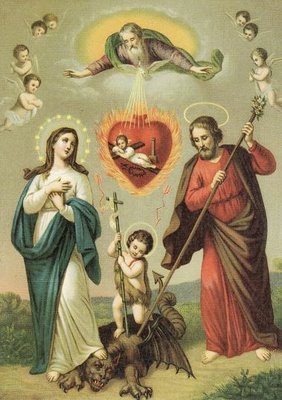
Holy Alliance Against Sin

January 2, 2011 – Feast of Epiphany

Posted: January 1, 2011 by CatholicJules in Sunday Reflections

SUNDAY BIBLE REFLECTIONS BY DR. SCOTT HAHN

A King to Behold

Readings:
Isaiah 60:1-6
Psalm 72:-12,7-8, 10-13
Ephesians 3:2-3,5-6
Matthew 2:1-12

An “epiphany” is an appearance. In today’s readings, with their rising stars, splendorous lights and mysteries revealed, the face of the child born on Christmas day appears.
Herod, in today’s Gospel, asks the chief priests and scribes where the Messiah is to be born. The answer Matthew puts on their lips says much more, combining two strands of Old Testament promise – one revealing the Messiah to be from the line of David (see 2 Samuel 2:5), the other predicting “a ruler of Israel” who will “shepherd his flock” and whose “greatness shall reach to the ends of the earth” (see Micah 5:1-3).
Those promises of Israel’s king ruling the nations resound also in today’s Psalm. The psalm celebrates David’s son, Solomon. His kingdom, we sing, will stretch “to the ends of the earth,” and the world’s kings will pay Him homage. That’s the scene too in today’s First Reading, as nations stream from the East, bearing “gold and frankincense” for Israel’s king.

The Magi’s pilgrimage in today’s Gospel marks the fulfillment of God’s promises. The Magi, probably Persian astrologers, are following the star that Balaam predicted would rise along with the ruler’s staff over the house of Jacob (see Numbers 24:17).
Laden with gold and spices, their journey evokes those made to Solomon by the Queen of Sheba and the “kings of the earth” (see 1 Kings 10:2,25; 2 Chronicles 9:24). Interestingly, the only other places where frankincense and myrrh are mentioned together are in songs about Solomon (see Song of Songs 3:6, 4:6,14).

One greater than Solomon is here (see Luke 11:31). He has come to reveal that all peoples are “co-heirs” of the royal family of Israel, as today’s Epistle teaches.
His manifestation forces us to choose: Will we follow the signs that lead to Him as the wise Magi did? Or will we be like those priests and the scribes who let God’s words of promise become dead letters on an ancient page?

The Word Took Our Nature From Mary

Posted: January 1, 2011 by CatholicJules in Memory Book

From a letter by Saint Athanasius, bishop

The Apostle tells us: The Word took to himself the sons of Abraham, and so had to be like his brothers in all things. He had then to take a body like ours. This explains the fact of Mary’s presence: she is to provide him with a body of his own, to be offered for our sake. Scripture records her giving birth, and says: She wrapped him in swaddling clothes. Her breasts, which fed him, were called blessed. Sacrifice was offered because the child was her firstborn. Gabriel used careful and prudent language when he announced his birth. He did not speak of “what will be born in you” to avoid the impression that a body would be introduced into her womb from outside; he spoke of “what will be born from you” so that we might know by faith that her child originated within her and from her.

By taking our nature and offering it in sacrifice, the Word was to destroy it completely and then invest it with his own nature, and so prompt the Apostle to say: This corruptible body must put on incorruption; this mortal body must put on immortality. This was not done in outward show only, as some have imagined. This is not so. Our Savior truly became man, and from this has followed the salvation of man as a whole. Our salvation is in no way fictitious, nor does it apply only to the body. The salvation of the whole man, that is, of soul and body, has really been achieved in the Word himself.

What was born of Mary was therefore human by nature, in accordance with the inspired Scriptures, and the body of the Lord was a true body: It was a true body because it was the same as ours. Mary, you see, is our sister, for we are all born from Adam.

The words of Saint John: the Word was made flesh, bear the same meaning, as we may see from a similar turn of phrase in Saint Paul: Christ was made a curse for our sake. Man’s body has acquired something great through its communion and union with the Word. From being mortal it has been made immortal; though it was a living body it has become a spiritual one; though it was made from the earth it has passed through the gates of heaven.

Even when the Word takes a body from Mary, the Trinity remains a Trinity, with neither increase nor decrease. It is for ever perfect. In the Trinity we acknowledge one Godhead, and thus one God, the Father of the Word, is proclaimed in the Church.

(Apologetics) John Vs Mike – 8

Posted: January 1, 2011 by CatholicJules in Apologetics

From the website: http://www.pro-gospel.org, by Mike Gendron.

Biblical Support for Purgatory
There is absolutely none! In fact, neither the word nor the concept of sin-purifying fire is found in Scripture. The Vatican was confronted with this in the 16th century when the Reformers protested its practice of buying and selling of God’s grace through indulgences. Backed into a corner, the  Council of Trent added the apocryphal books to its canon of Scripture. Rome now declares there is scriptural support for purgatory in the apocryphal book of Second Maccabees. The council ignored the fact that the Jewish scribes never recognized the apocryphal books as inspired or part of the Hebrew Scriptures. They were never included because of their many historical, theological and geographical errors. Since God is not the author of error, He obviously did not inspire the writers of the Apocrypha. This is why the Apocrypha was never included in the original canon of 66 books.

The apocryphal verses Rome uses to defend its doctrine of Purgatory refer to Jewish soldiers who died wearing pagan amulets around their necks. Judas Maccabees “sent twelve thousand drachmas of silver to Jerusalem for sacrifice to be offered for the sins of the dead…Judas hoped that these men who died fighting for the cause of God and religion, might find mercy: either because they might be excused from mortal sin by ignorance; or might have repented of their sin, at least at their death. It is therefore a holy and wholesome thought to pray for the dead, that they may be loosed from sins” (2 Maccabees 12:43-46). Rome argues that since Judas Maccabees prayed for the dead, there must be hope for those who die in sin. This of course, goes directly against God’s Word which declares, “It is appointed for men to die once and after this comes judgment” (Heb. 9:22). Rome’s attempt to give credence to Purgatory by using this ungodly practice of the Jews, who had a history of disobeying God, is pathetic.

In another attempt to find support for Purgatory, many Catholics point to this verse: “If any man’s work is burned up, he will suffer loss; but he himself will be saved, yet so as through fire” (1 Cor. 3:15). Clearly, the context of this verse is the testing of a man’s works by fire. The works that survive are the ones done for the glory of Christ and are called gold, silver and precious stones (Eph. 2:10). All the other superfluous works are burned in fire and are called wood, hay and stubble. It is not man’s sins that are being purged, it is man’s spurious works that are being burned and destroyed.

———————————————————————————————————–

Mike Gendron:

Biblical Support for Purgatory
There is absolutely none! In fact, neither the word nor the concept of sin-purifying fire is found in Scripture. The Vatican was confronted with this in the 16th century when the Reformers protested its practice of buying and selling of God’s grace through indulgences. Backed into a corner, the  Council of Trent added the apocryphal books to its canon of Scripture. Rome now declares there is scriptural support for purgatory in the apocryphal book of Second Maccabees. The council ignored the fact that the Jewish scribes never recognized the apocryphal books as inspired or part of the Hebrew Scriptures. They were never included because of their many historical, theological and geographical errors. Since God is not the author of error, He obviously did not inspire the writers of the Apocrypha. This is why the Apocrypha was never included in the original canon of 66 books.

John Martignoni:

First, he states that there is “absolutely” no biblical support for Purgatory, but then in the next two paragraphs he goes on to give a couple of biblical passages that support Purgatory.  How can he say there is no biblical support for Purgatory when he himself cites biblical passages that Catholics believe support the teaching on Purgatory?  Would it not be more honest to say that there are a number of biblical passages that Catholics cite in support of the teaching on Purgatory, but that his biased fallible interpretation of those passages disagrees with the Catholic interpretation of those passages?  That is the more accurate and honest way to describe the situation.

We’ll look at some of those passages below, including the ones cited by Mr. Gendron, and see if there is indeed “absolutely” no biblical support for Purgatory whatsoever.  But, before we get to that, let’s look at Gendron’s claim that Rome “added” the “apocryphal books” (the deuterocanon – Tobit, Judith, Wisdom, Sirach, Baruch, 1st & 2nd Maccabees) to the Bible at the Council of Trent, in order to be able to claim biblical support for Purgatory (2nd Macc 12:42-45).  Gendron claimed: “This is why the Apocrypha was never included in the original canon of 66 books.” His revisionist view of history is that the Catholic Church added those 7 books of the Old Testament to the Catholic bible only after Martin Luther confronted Rome with its lack of biblical evidence for indulgences (Purgatory).  Well, let’s look at the historical documents and see if that is indeed the case.

From the “Faith of the Early Fathers, Vol I,” edited by Jurgens, we see the “Decree of Damasus” (Pope St. Damasus I) from the Council of Rome, in 382 A.D. (1200 years before the Council of Trent supposedly added the deuterocanon to the Catholic bible).  In the Decree of Damasus, the 7 books of the Old Testament that Gendron claimed were not “added” until the Council of Trent, are listed as part of the canon (note: Baruch was initially included as part of Jeremias, as Baruch was Jeremiah’s scribe).  Hmmm.  And, if Gendron had bothered to look, he would have found, without too much trouble, that the Latin Vulgate – the official bible of the Catholic Church – which was translated by St. Jerome in the late 4th century, included those 7 books as part of its canon.  And, the Bible Martin Luther used while still a Catholic priest, had those 7 books in it as part of the canon.  And, Martin Luther admitted to throwing out those books from the bible as part of his rebellion against the Church.  So, Gendron’s claim that, “This is why the Apocrypha was never included in the original canon of 66 books,” is absolutely false.  And he is absolutely wrong in his claim that the Council of Trent added those books to the Bible.  I call on him to correct this falsehood on his website.  But, he won’t, because he doesn’t seem to be interested in the truth, he is only interested in making the Catholic Church look bad, and if it means having to not be as honest as he could be, well, so be it….

Furthermore, he states that the “Jewish scribes never recognized the apocryphal books as inspired or part of the Hebrew Scriptures.”  This, again, is a false claim.  How does he explain, for example, the Septuagint – the Greek language version of the Old Testament – which was put together by “Jewish scribes” and which contains the deuterocanonical books, and from which two-thirds of the Old Testament quotes in the New Testament come?  Plus, the Septuagint was indeed accepted by most of the Jews of the Diaspora (outside of Israel) as their Scriptures.  Besides, the fact that the deuterocanon was not accepted by “Jewish scribes,” according to Mr. Gendron, is not a very good argument for a Christian to make.  After all, the “Jewish scribes” did not accept any of the books of the New Testament as part of their Scripture either.  Does Mr. Gendron, to be consistent in his reasoning, then reject the New Testament books?

So, since 2 Maccabees was indeed part of the “original canon” of 73 books of the bible, we can indeed claim that it provides biblical support for the Catholic doctrine of Purgatory. After all, if there is only Heaven or Hell, then it is completely useless to pray for the dead.  Prayer is not needed for those in Heaven.  Prayer does nothing for those in Hell. Prayers for the dead imply that there is a place, or state of being, other than Heaven or Hell.

Mike Gendron:

The apocryphal verses Rome uses to defend its doctrine of Purgatory refer to Jewish soldiers who died wearing pagan amulets around their necks. Judas Maccabees “sent twelve thousand drachmas of silver to Jerusalem for sacrifice to be offered for the sins of the dead…Judas hoped that these men who died fighting for the cause of God and religion, might find mercy: either because they might be excused from mortal sin by ignorance; or might have repented of their sin, at least at their death. It is therefore a holy and wholesome thought to pray for the dead, that they may be loosed from sins” (2 Maccabees 12:43-46). Rome argues that since Judas Maccabees prayed for the dead, there must be hope for those who die in sin. This of course, goes directly against God’s Word which declares, “It is appointed for men to die once and after this comes judgment” (Heb. 9:22). Rome’s attempt to give credence to Purgatory by using this ungodly practice of the Jews, who had a history of disobeying God, is pathetic.

John Martignoni:

This is a perfect example of either Mike Gendron’s complete and total ignorance of Catholic teaching on Purgatory or his deliberate and willful distortion of Catholic teaching on Purgatory.  Do you see what he says in this paragraph that betrays him?  He uses Heb 9:22 to try and say the practice of praying for the dead is contrary to Scripture.  But, what exactly is it in Heb 9:22 that actually contradicts the doctrine of Purgatory or the practice of praying for the dead?  Answer: NOTHING!  Hebrews 9:22 states that after death, comes judgment.  Catholics believe and teach that.  When a person dies, they receive their particular judgment – either they are headed to Heaven or to Hell.  Purgatory has absolutely nothing to do with judgment, however.  Purgatory has to do with the final purification of a soul AFTER it has already been judged as being just.  So, Heb 9:22 in no way, shape, or form contradicts the doctrine of Purgatory.  Mike Gendron’s use of this verse to deny Purgatory is ignorant at best, malicious at worst.

Let’s re-visit the doctrine of Purgatory as taught by the Catholic Church: 1) “All who die in God’s grace [the just] and friendship, but still imperfectly purified, are indeed assured of their eternal salvation; but after death they undergo purification, so as to achieve the holiness necessary to enter the joy of heaven.”  (Catechism of the Catholic Church, #1030.)  2) Purgatory (Lat., “purgare”, to make clean, to purify) in accordance with Catholic teaching is a place or condition of temporal punishment for those who, departing this life in God’s grace are, not entirely free from venial faults, or have not fully paid the satisfaction due to their transgressions.  (Catholic Encyclopedia, article on Purgatory, http://www.newadvent.org.)  In other words, Purgatory has nothing to do with judgment, it pertains to a final purification of a just soul after it has received judgment.

Mike Gendron has read the Catechism and he has read the article on Purgatory found in the Catholic Encyclopedia, yet he still apparently does not “get it.”  Or, rather, he “gets it,” but accurately portraying Catholic teaching on Purgatory does not suit his purposes, so he chooses not to do it.

And, addressing 2 Maccabees 12 again, we see that it does, with its teaching on prayer for the dead, in fact provide biblical support for the doctrine of Purgatory.

Mike Gendron:

In another attempt to find support for Purgatory, many Catholics point to this verse: “If any man’s work is burned up, he will suffer loss; but he himself will be saved, yet so as through fire” (1 Cor. 3:15). Clearly, the context of this verse is the testing of a man’s works by fire. The works that survive are the ones done for the glory of Christ and are called gold, silver and precious stones (Eph. 2:10). All the other superfluous works are burned in fire and are called wood, hay and stubble. It is not man’s sins that are being purged, it is man’s spurious works that are being burned and destroyed.

John Martignoni:

First of all, let’s note that Mike Gendron is apparently making an infallible pronouncement on what the passage from 1 Cor 3:10-15 means.  A fallible man making an infallible pronouncement.  Sorry, Mike, but not only do you not have the authority to make an infallible pronouncement as to what any particular passage of Scripture means, but your interpretation is: 1) fairly ridiculous upon examination; and, 2) doesn’t actually respond to the Catholic argument regarding this verse.

1) Ridiculous interpretation: According to Gendron, “It is not man’s sins that are being purged, it is man’s spurious works that are being burned and destroyed.”  What does “spurious” mean?  It means false, or bogus.  Well, what else could we call a spurious or false or bogus work?  I think the word “sin” would fit most appropriately, don’t you?  After all, I think we could all agree that a “spurious” work is definitely not a good work, right?  So, if it’s not a good work, then it must be a bad work – it must be a morally bad work.  Why else is it being burned up and why else does man “suffer” because of it?

Does man suffer for morally good works?  No.  Does he suffer for morally neutral works?  No.  Does he suffer for morally bad works?  Indeed he does.  What is another name for a morally bad work?  Sin.  So, Gendron’s classification of these works as being “spurious” works vs. being sins, is a distinction without a difference.  It’s a distraction from the fact that he has no real answer to this passage, so he makes up “spurious” distinctions.  Can Gendron give us some examples of these “spurious” works that are “burned in fire?”

Plus, isn’t Gendron himself essentially admitting that this “burning in fire” of man’s spurious works is purifying man from his “spurious” works?  What else would you call the process described here if not a purification?  What is going on in Purgatory?  Purification.  Which leads to my second point…

2) Not answering the Catholic argument: So, Mr. Gendron, exactly where is it that man’s work is “burned in fire” and they suffer loss, yet are still saved?  Where exactly does this purification take place?  Heaven?  No, no purification is necessary once you reach Heaven.  Hell?  No, no purification is possible once you enter Hell.  Where then is this purification of man taking place, Mr. Gendron?

Furthermore, if Gendron’s once saved always saved sola fide theology is true, then where exactly does what is happening in 1 Cor 3:10-15, fit into that theology?  He admits that this purification is taking place, but he doesn’t tell us why it is taking place.  Why does there need to be this purification at all?  Isn’t the atoning death of Jesus Christ on the cross enough?  What is this purification by fire of a man’s “spurious” works all about?  I mean, if a man has accepted Jesus Christ as his personal Lord and Savior, thus entering the rank of the “saved,” and he’s going to Heaven no matter what, then why does he have to later be purified of his spurious works?  I’m really confused…

Okay, now let’s look at some of the “Catholic” verses of Scripture that support the Church’s teaching on Purgatory:

2 Sam 12:13-18, “David said to Nathan, ‘I have sinned against the Lord.’  And Nathan said to David, ‘the Lord also has put away your sin; you shall not die.  Nevertheless, because by this deed you have utterly scorned the Lord, the child that is born to you shall die.’  And the Lord struck the child that Uriah’s wife bore to David, and it became sick…On the seventh day the child died.”  Principle #1 – there is punishment for sin even after one has received forgiveness. See also Numbers 20:12 (Moses and Aaron being denied entrance into the Promised Land); Gen 3:16-19 (woman has increased pain in childbirth; man eats by the sweat of his brow)

Rev 21:27, “But nothing unclean shall enter it…”  The New Jerusalem – Heaven.  Principle #2 – nothing unclean, nothing with the stain of sin, will enter Heaven.  Mt 5:48, “You, therefore, must be perfect as your heavenly Father is perfect.”  That’s because of Principle #2 – nothing unclean will get into Heaven.

Heb 12:22-23, “But you have come to Mount Zion and to the city of the living god, the heavenly Jerusalem…and to the spirits of just men made perfect.”  The spirits of just men, made perfect.  Principle #3 – there is a way, a process, through which the spirits of the “just” are “made perfect”.

1 Cor 3:13-15, “…each man’s work will become manifest; for the Day [judgment day] will disclose it, because it will be revealed with fire, and the fire will test what sort of work each one has done.  If the work which any man has built on the foundation survives, he will receive a reward.  If any man’s work is burned up, he will suffer loss, though he himself will be saved, but only as through fire.”  Where is this place that a man, after he dies, suffers loss, as through fire, but is still saved.  Hell – once you’re in Hell, you don’t get out.  Heaven – you don’t suffer loss in Heaven.  Hmmm…must be somewhere else.  Principle #4 – there is a place other than Heaven or Hell.

Mt 12:32, “And whoever says a word against the Son of man will be forgiven; but whoever speaks against the Holy Spirit will not be forgiven, either in this age or in the age to come.”  Implies forgiveness in the age to come.  Where can you go to be forgiven in the age to come?  Heaven?  You don’t need forgiveness.  Hell?  There is no forgivenss.

Mt 18:32-35, “Then his lord summoned him and said to him, ‘You wicked servant!  I forgave you all that debt because you besought me; and should not you have had mercy on your fellow servant, as I had mercy on you?’  And in anger his lord delivered him to the jailers, till he should pay all his debt.  So also my heavenly Father will do to every one of you, if you do not forgive your brother from your heart.”  Where can you go, that is like jail, until you have paid your debt?  Heaven?  Hell?

Rev 20:13-14, “And the sea gave up the dead in it, Death and Hades gave up the dead in them…[Hades? We know Hades isn’t Hell because of the next verse]…Then Death and Hades were thrown into the lake of fire.”  The lake of fire is Hell.  So, Hades is some place besides Heaven and Hell.  Again, Principle #4 – there is a place besides Heaven and Hell.

So, let’s summarize these four principles: There is punishment for sin even after one has received forgiveness.  We have to be perfect as the Father is perfect, because nothing unclean will enter Heaven.  There is some way, or process, by which the spirits of the just are made perfect.  There is a place besides Heaven or Hell where you can suffer loss, yet be saved, but only as through fire; and where you can be forgiven of sins from a previous age; and where you will not get out until you have paid your entire debt.  Hmmm.

Principle #5 – there are several Scripture passages that simply make no sense in a Heaven and Hell only theology.  For instance, James 5:20, “Let him know that whoever brings back a sinner from the error of his way will save his soul from death and will cover a multitude of sins.”  Cover a multitude of sins?   1 Ptr 4:8, “Above all hold unfailing your love for one another, since love covers a multitude of sins.”  There it is again.  Something that we do, that covers a multitude of sins.  Wait a minute.  If Jesus did all there is to do in terms of payment for sin, then how can we do something that covers a multitude of sins?  Unless…unless, there is a penalty for sin, even after we have been forgiven, as we saw with King David, and if we cooperate with Jesus in our redemption, we can “cover” the penalty for our sins by bringing sinners back to the truth and by loving others.

Col 1:24, “I rejoice in my sufferings for your sake, and in my flesh I complete what is lacking in Christ’s afflictions for the sake of His body, that is, the Church…”  How can Paul suffer for our sake?  And, how in the world can he complete what is lacking in Christ’s afflictions?  Is there something lacking in Christ’s afflictions?  Like the previous two verses, this verse makes no sense in a Heaven and Hell only theological system.

Finally, Heb 12:14, “Strive for peace with all men and for the holiness without which no one will see the Lord.”  We have to be holy in order to see the Lord (be ye perfect as your heavenly Father is perfect), and if we are not perfectly holy at the moment we die – and most people will admit that they are not perfectly holy at the present moment – then there must be some way that those who are in a state of grace (saved), but not yet perfected, can be perfected.  As Catholics, we call that process of being perfected after death – Purgatory.

Our Joint Musical Entitled ‘The Log Cabin’

Posted: December 31, 2010 by CatholicJules in Life's Journeys, Memory Book

Held On 27th Dec 7:30pm

This slideshow requires JavaScript.

Samson and Delilah (The Bible Collection) (1996)

Posted: December 30, 2010 by CatholicJules in DVD Review

Actors: Dennis Hopper, Elizabeth Hurley, Eric Thal, Michael Gambon, Diana Rigg
Directors: Nicolas Roeg
Writers: Allan Scott
Producers: Eleonora Andreatta, Gerald Rafshoon, Heinrich Krauss, Lorenzo Minoli, Luca Bernabei
Format: Closed-captioned, Color, DVD, Subtitled, NTSC
Language: English
Subtitles: English, French, Spanish
Aspect Ratio: 1.33:1
Number of discs: 1
Rated: NR (Not Rated)
Studio: Turner Home Ent
DVD Release Date: September 6, 2005
Run Time: 180 minutes

Product Description

Samson is a simple shepherd with the strength of a titan and the destiny to fight the Philistines and General Tariq. Delilah is a Philistine beauty, torn between her love for the shepherd and loyalty to her people. As told in the Old Testament, Samson’s betrayal by Delilah left him in slavery. But Samson’s epic revenge vanquished his Philistine foes and made him one of the greatest heroes of the Bible. Samson and Delilah is the powerful tale of a deception that brought down an empire… and sealed their names in eternity.
Review :

Visually stunning with lots of liberties taken in the retelling of this famous bible tale.  However the essence of the story is intact.  Some may find certain scenes offensive in that they can be quite brutal while others may find the sex scene between Samson and Delilah distasteful. ( NO it did not border on porn in any way)  I on the other hand applaud them for trying to make this as accurate as possible how else would you be able to see just what a temptress Delilah really was!

I did however have problem with the casting of Dennis Hopper as the fictional Philistine General Tariq, I reckon they spent too much time developing his fictional character as a result and this indeed was not one of his better performances.  Diana Rigg was exceptional as Mara while Eric Thal did a very convincing portrayal of Samson.  Liz Hurley is as usual visually stunning on film.


Christian, Remember Your Dignity

Posted: December 28, 2010 by CatholicJules in Memory Book

From a sermon by Saint Leo the Great, pope

Dearly beloved, today our Savior is born; let us rejoice. Sadness should have no place on the birthday of life. The fear of death has been swallowed up; life brings us joy with the promise of eternal happiness.

No one is shut out from this joy; all share the same reason for rejoicing. Our Lord, victor over sin and death, finding no man free from sin, came to free us all. Let the saint rejoice as he sees the palm of victory at hand. Let the sinner be glad as he receives the offer of forgiveness. Let the pagan take courage as he is summoned to life.

In the fullness of time, chosen in the unfathomable depths of God’s wisdom, the Son of God took for himself our common humanity in order to reconcile it with its creator. He came to overthrow the devil, the origin of death, in that very nature by which he had overthrown mankind.

And so at the birth of our Lord the angels sing in joy: Glory to God in the highest, and they proclaim peace to his people on earth as they see the heavenly Jerusalem being built from all the nations of the world. When the angels on high are so exultant at this marvellous work of God’s goodness, what joy should it not bring to the lowly hearts of men?

Beloved, let us give thanks to God the Father, through his Son, in the Holy Spirit, because in his great love for us he took pity on us, and when we were dead in our sins he brought us to life with Christ, so that in him we might be a new creation. Let us throw off our old nature and all its ways and, as we have come to birth in Christ, let us renounce the works of the flesh.

Christian, remember your dignity, and now that you share in God’s own nature, do not return by sin to your former base condition. Bear in mind who is your head and of whose body you are a member. Do not forget that you have been rescued from the power of darkness and brought into the light of God’s kingdom.

Through the sacrament of baptism you have become a temple of the Holy Spirit. Do not drive away so great a guest by evil conduct and become again a slave to the devil, for your liberty was bought by the blood of Christ.


December 26, 2010 – Feast of the Holy Family

Posted: December 26, 2010 by CatholicJules in Sunday Reflections

SUNDAY BIBLE REFLECTIONS BY DR. SCOTT HAHN

Saving Family

Readings:
Sirach 3:2-6,12-14
Psalm 128:1-2, 3, 4-5
Colossians 3:12-21
Matthew 2:13-15, 19-23
Underlying the wisdom offered in today’s Liturgy is the mystery of the family in God’s divine plan.

The Lord has set father in honor over his children and mother in authority over her sons, we hear in today’s First Reading. As we sing in today’s Psalm, the blessings of the family flow from Zion, the heavenly mother of the royal people of God (see Isaiah 66:7,10-13; Galatians 4:26).

And in the drama of today’s Gospel, we see the nucleus of the new people of God – the Holy Family – facing persecution from those who would seek to destroy the child and His Kingdom.
Moses, called to save God’s first born son, the people of Israel (see Exodus 4:22; Sirach 36:11), was also threatened at birth by a mad and jealous tyrant (see Exodus 1:15-16). And as Moses was saved by his mother and sister (see Exodus 2:1-10; 4:19), in God’s plan Jesus too is rescued by His family.

As once God took the family of Jacob down to Egypt to make them the great nation Israel (see Genesis 46:2-4), God leads the Holy Family to Egypt to prepare the coming of the new Israel of God – the Church (see Galatians 6:16).

At the beginning of the world, God established the family in the “marriage” of Adam and Eve, the two becoming one body (see Genesis 2:22-24). Now in the new creation, Christ is made “one body” with His bride, the Church, as today’s Epistle indicates (see Ephesians 5:21-32).

By this union we are made God’s chosen ones, holy and beloved. And our families are to radiate the perfect love that binds us to Christ in the Church.
As we approach the altar on this feast, let us renew our commitment to our God-given duties as spouses, children and parents. Mindful of the promises of today’s First Reading, let us offer our quiet performance of these duties for the atonement of our sins


From a sermon by Saint Augustine, bishop
Truth has arisen from the earth, and justice looked down from heaven

Awake, mankind! For your sake God has become man. Awake, you who sleep, rise up from the dead, and Christ will enlighten you. I tell you again: for your sake, God became man.

You would have suffered eternal death, had he not been born in time. Never would you have been freed from sinful flesh, had he not taken on himself the likeness of sinful flesh. You would have suffered everlasting unhappiness, had it not been for this mercy. You would never have returned to life, had he not shared your death. You would have been lost if he had not hastened to your aid. You would have perished, had he not come.

Let us then joyfully celebrate the coming of our salvation and redemption. Let us celebrate the festive day on which he who is the great and eternal day came from the great and endless day of eternity into our own short day of time.

He has become our justice, our sanctification, our redemption, so that, as it is written: Let him who glories glory in the Lord.

Truth, then, has arisen from the earth: Christ who said, I am the Truth, was born of a virgin. And justice looked down from heaven: because believing in this new-born child, man is justified not by himself but by God.

Truth has arisen from the earth: because the Word was made flesh. And justice looked down from heaven: because every good gift and every perfect gift and every perfect gift is from above.

Truth has arisen from the earth: flesh from Mary. And justice looked down from heaven: for man can receive nothing unless it has been given him from heaven.

Justified by faith, let us be at peace with God: for justice and peace have embraced one another. Through out Lord Jesus Christ: for Truth has arisen from the earth. Through whom we have access to that grace in which we stand, and our boast is in our hope of God’s glory. He does not say: “of our glory,” but of God’s glory: for justice has not proceeded form us but has looked down from heaven. Therefore he who glories, let him glory, not in himself, but in the Lord.

For this reason, when our Lord was born of the Virgin, the message of the angelic voices was: Glory to God in the highest, and peace to his people on earth.

For how could there be peace on earth unless Truth has arisen from the earth, that is, unless Christ, were born of our flesh? And he is our peace who made the two into one: that we might be men of good will, sweetly linked by the bond of unity.

Let us then rejoice in this grace, so that our glorying may bear witness to our good conscience by which we glory, not in ourselves, but in the Lord. That is why Scripture says: He is my glory, the one who lifts up my head. For what greater grace could God have made to dawn on us than to make his only Son become the son of man, so that a son of man might in his turn become the son of God?

Ask if this were merited; ask for its reason, for its justification, and see whether you will find any other answer but sheer grace.

Nazareth, A Model

Posted: December 24, 2010 by CatholicJules in Memory Book

From an address by Pope Paul VI
(Nazareth, January 5, 1964)
Nazareth, a model

Nazareth is a kind of school where we may begin to discover what Christ’s life was like and even to understand his Gospel. Here we can observe and ponder the simple appeal of the way God’s Son came to be known, profound yet full of hidden meaning. And gradually we may even learn to imitate him.

Here we can learn to realize who Christ really is. And here we can sense and take account of the conditions and circumstances that surrounded and affected his life on earth: the places, the tenor of the times, the culture, the language, religious customs, in brief everything which Jesus used to make himself known to the world. Here everything speaks to us, everything has meaning. Here we can
learn the importance of spiritual discipline for all who wish to follow Christ and to live by the teachings of his Gospel.

How I would like to return to my childhood and attend the simple yet profound school that is Nazareth! How wonderful to be close to Mary, learning again the lesson of the true meaning of life, learning again God’s truths. But here we are only on pilgrimage. Time presses and I must set aside my desire to stay and carry on my education in the Gospel, for that education is never finished. But I cannot leave without recalling, briefly and in passing, some thoughts I take with me from Nazareth.

First, we learn from its silence. If only we could once again appreciate its great value. We need this wonderful state of mind, beset as we are by the cacophony of strident protests and conflicting claims so characteristic of these turbulent times. The silence of Nazareth should teach us how to meditate in peace and quiet, to reflect on the deeply spiritual, and to be open to the voice of God’s inner wisdom and the counsel of his true teachers. Nazareth can teach us the value of study and preparation, of meditation, of a well- ordered personal spiritual life, and of silent prayer that is known only to God.

Second, we learn about family life. May Nazareth serve as a model of what the family should be. May it show us the family’s holy and enduring character and exemplifying its basic function in society: a community of love and sharing, beautiful for the problems it poses and the rewards it brings; in sum, the perfect setting for rearing children – and for this there is no substitute.

Finally, in Nazareth, the home of a craftsman’s son, we learn about work and the discipline it entails. I would especially like to recognize its value – demanding yet redeeming – and to give it proper respect. I would remind everyone that work has its own dignity. On the other hand, it is not an end in itself. Its value and free character, however, derive not only from its place in the economic system, as they say, but rather from the purpose it serves.

In closing, may I express my deep regard for people everywhere who work for a living. To them I would point out their great model,
Christ their brother, our Lord and God, who is their prophet in every cause that promotes their well being.

Some Q & A(s)

Posted: December 23, 2010 by CatholicJules in Questions & Answers

Answers By Fr. Hugh Barbour, O.Praem

Q. In a previous answer, you said it’s permissible to confess sins already confessed and absolved, as long as it’s not done out of scrupulosity. I admit that it might be good to recall past sins in order to grow in gratitude for God’s forgiveness, but how is it appropriate to confess them again?

A. In 1304, Pope Benedict XI, in the constitution Inter Cunctas Sollicitudines taught: “Even though it is not necessary to do so, we judge it spiritually helpful to confess the same sins over again on account of the contrition, which is a great part of this sacrament.” The “matter” of the sacrament of penance is contrition for sin, the sin is only the necessary motive for the sorrow. Thus any confession which increases contrition, as well as our purpose of amendment, is helpful to the fruitful reception of the sacrament. As we grow in the love of God, reflecting on our past sins, even though they are forgiven, strengthens our resolve to avoid sin, it deepens our sorrow for our sins, and it can make our reception of the sacrament more effective in rooting out the remaining sources of sin in us.


Q. When I hear that the devil can tempt us, I am frightened. Is he able to get inside of us and make us sin? Can he force us to give in to his temptations?

A. The only way that the devil can tempt us is, in principle, the way in which other human beings can tempt us. He can approach us only from the “outside,” through our senses and sense imagination and memory. The devil cannot force our spiritual will or our immaterial intellect. He can only work on the aspects of our soul which are completely dependent on physical sensation. The difference with the devil is that, being by nature an angel (although a fallen one) he is able to “see” into our imagination and memory, even though we may not be expressing their contents by words or actions. This gives him a slight advantage, more ammunition, to use against us. However, he never is able to be sure we have really given in, because he can only guess whether we have given full consent or completely understand, or have reflected sufficiently that what we have done or want to do is sinful. This is because he cannot see our intellect or will. This can only be seen by God. This is why the earliest teachers on Christian prayer and spiritual discipline, the Fathers of the Desert, emphasize how important control of our imagination is in fighting the devil. By constant prayer, by short aspirations prayed inwardly or out loud as we go about our daily work, short prayers like “My Jesus, Mercy” or “Mary, Help,” by thinking about the life of Our Lord, Our Lady, and the Saints, by avoiding useless words and images on TV and radio, we can clean up our imagination, and give the devil less to work on. We will recognize temptations more easily, and reject them more successfully, if we have a purer inner life. The best example of this is Our Lord and Our Lady. When the devil tempted Christ, he was not sure He was the Son of God and Messiah. This means that Our Lord had so complete a control of His imagination that nothing entered there which he did not want to, so the devil was perplexed at a man with an imagination and memory so pure and holy, so he was forced to come out into the open and ask. (What a humiliation for him, and a lesson for us!) In World War II, there were posters with sinking ships over the caption “somebody talked.” If we can quiet our imagination by prayer and silence, we can avoid many an attack of the evil one. Lets remember the words of St. Peter: “Be sober and vigilant. Your opponent the devil is prowling around like a roaring lion looking for someone to devour. Resist him, steadfast in faith, knowing that your fellow believers throughout the world undergo the same sufferings. The God of all grace who called you to His eternal glory through Christ will Himself restore, confirm, strengthen, and establish you after you have suffered a little” (1 Peter 5:8-10).


Q. A nun recently told me its possible that we have more than one life on earth, through reincarnation. I showed her paragraph 1013 in the Catechism, which says there is no such thing as reincarnation. She shrugged and said that teaching is “non-infallible” and were free to hold other opinions. Is reincarnation compatible with the Catholic Faith?

A. The problem with reincarnation isnt’ that a soul could be reunited with a body after death. After all, Christians believe in exactly that: the resurrection of the dead, in which our souls will be reunited with our bodies.
The problem is that reincarnation entails the notion that the body is not an essential aspect of the human person, but only a shell, or an instrument of the spiritual soul. The Church solemnly defined at the Council of Vienna in 1312 that the human soul is not only a spirit, but is per se and essentially the form of a body. The council taught that the contrary view was heretical. The Catechism (CCC #365) quotes this definition of the fifteenth ecumenical council. Our Catholic Faith presents death as a tragic consequence of sin, not as a natural passage from one state to another. Christ’s death triumphs over the death brought about by sin by rising from the dead in His own identical body. So too our future resurrection will be the same body which we now are, materially reconstituted by the ministry of angels and reunited with the soul by the miraculous power of Christ. Resurrection in the same body means the re-uniting of body and soul (CCC #997), not the taking on of a new body not previously our own. Reincarnation has a tantalizing attraction for many since it satisfies their curiosity about themselves without coming to grips with the permanent, everlasting nature of our bodily individuality. Christianity believes so strongly that the body is an essential part of our makeup and happiness, that even God, to redeem us had to take on flesh, die, and rise again, and feed us with His own Body. The Fathers say “Christ did not redeem what He did not assume.” The Incarnation and Resurrection are the Catholic responses to the error of reincarnation. Archbishop Christoph Scho‘nborn of Vienna (the main architect of the Catechism) has written a book on reincarnation, available from Ignatius Press of San Francisco.

..

Posted: December 21, 2010 by CatholicJules in Personal Thoughts & Reflections

Lord Jesus I decrease myself and ask that you increase within me Oh Lord.

From a letter to Diognetus….

Posted: December 20, 2010 by CatholicJules in Memory Book

God has revealed his love through the Son

No man has ever seen God or known him, but God has revealed himself to us through faith, by which alone it is possible to see him. God, the Lord and maker of all things, who created the world and set it in order, not only loved man but was also patient with him. So he has always been, and is, and will be: kind, good, free from anger, truthful; indeed, he and he alone is good.

He devised a plan, a great and wonderful plan, and shared it only with his Son. As long as he preserved this secrecy and kept his own wise counsel he seemed to be neglecting us, to have no concern for us. But when through his beloved Son he revealed and made public what he had prepared from the very beginning, he gave us all at once gifts such as we could never have dreamt of, even sight and knowledge of himself.

When God had made all his plans in consultation with his Son, he waited until a later time, allowing us to follow our own whim, to be swept along by unruly passions, to be led astray by pleasure and desire. Not that he was pleased by our sins: he only tolerated them. Not that he approved of that time of sin: he was planning this era of holiness. When we had been shown to be undeserving of life, his goodness was to make us worthy of it. When we had made it clear that we could not enter God’s kingdom by our own power, we were to be enabled to do so by the power of God.

When our wickedness had reached its culmination, it became clear that retribution was at hand in the shape of suffering and death. The time came then for God to make known his kindness and power (how immeasurable is God’s generosity and love!). He did not show hatred for us or reject us or take vengeance; instead, he was patient with us, bore with us, and in compassion took our sins upon himself; he gave his own Son as the price of our redemption, the holy one to redeem the wicked, the sinless one to redeem sinners, the just one to redeem the unjust, the incorruptible one to redeem the corruptible, the immortal one to redeem mortals. For what else could have covered our sins but his sinlessness? Where else could we—wicked and sinful as we were—have found the means of holiness except in the Son of God alone?

How wonderful a transformation, how mysterious a design, how inconceivable a blessing! The wickedness of the many is covered up in the holy One, and the holiness of One sanctifies many sinners.

December 19, 2010 – Fourth Sunday of Advent

Posted: December 19, 2010 by CatholicJules in Sunday Reflections

SUNDAY BIBLE REFLECTIONS BY DR. SCOTT HAHN

God Is With Us

Readings:Isaiah 7:10-14
Psalm 24:1-6
Romans 1:1-7
Matthew 1:18-24


The mystery kept secret for long ages, promised through His prophets in the holy Scriptures, is today revealed (see Romans 16:25-26).

This is the “Gospel of God” that Paul celebrates in today’s Epistle – the good news that “God is with us” in Jesus Christ. The sign promised to the House of David in today’s First Reading is given in today’s Gospel. In the virgin found with child, God himself has brought to Israel a savior from David’s royal line (see Acts 13:22-23).

Son of David according to the flesh, Jesus is the Son of God, born of the Spirit. He will be anointed with the Spirit (see Acts 10:38), and by the power of Spirit will be raised from the dead and established at God’s right hand in the heavens (see Acts 2:33-34; Ephesians 1:20-21).

He is the “King of Glory” we sing of in today’s Psalm. The earth in its fullness has been given to Him. And as God swore long ago to David, His Kingdom will have no end (see Psalm 89:4-5).

In Jesus Christ we have a new creation. Like the creation of the world, it is a work of the Spirit, a blessing from the Lord (see Genesis 1:2). In Him, we are saved from our sins, are called now “the beloved of God.”

All nations now are called to belong to Jesus Christ, to enter into the House of David and Kingdom of God, the Church. Together, through the obedience of faith, we have been made a new race – a royal people that seeks for the face of the God of Jacob.

He has made our hearts clean, made us worthy to enter His holy place, to stand in His presence and serve Him.

In the Eucharist, the everlasting covenant is renewed, the Advent promise of virgin with child – God with us – continues until the end of the age (see Matthew 28:20; Ezekiel 37:24-28).


Return To Rome…

Posted: December 17, 2010 by CatholicJules in Great Catholic Articles

All Information Highways lead to Rome


By Diane Kamer


A cradle Catholic, I’d spent my early years in an Irish-American ghetto in inner-city Boston. Here, during the pious ’50s, I’d developed an awed fascination with Catholic culture. I loved its mysterious milieu: the statues, votive candles and stained glass…the Latin hymns, May processions and novenas…the dimly-lit churches filled with incense during High Mass and Benediction. I eagerly read Lives of the Saints, borrowed from the public library’s bookmobile. And like many little girls of that era, I dreamed of becoming a nun.

But after we moved to the suburbs when I was eight, the Catholic influence faded. My mom, who’d always inclined toward skepticism, gradually withdrew from parish involvement. By my teens, I too had become a skeptic. I stopped attending Mass and drifted into unreflecting agnosticism. Then, in my late teens, something happened. After a disastrous semester at an “experimental” college, I was living at home, listlessly looking for a job. On weekend nights, my hippie friends and I hung out at a “coffeehouse” sponsored by the local Congregational church. Soon several friends invited me to a Bible study at the home of a local lady who’d helped organize the coffeehouse. I had nothing better to do, so I tagged along. In the weeks that followed, as we plowed through the Synoptic Gospels, I found myself powerfully attracted to Jesus. I argued, balked, objected; but I kept coming back for more. Finally, our hostess took us for an overnight trip to a Christian coffeehouse in western Massachusetts. There, when the youth ministers asked if I was ready to receive Jesus, I surprised myself by saying yes. The next morning, on the trip back home, I felt elated, freed. I knew little about the faith I’d just embraced, but I did know I’d passed a turning point. Everything seemed fresh and new. A few months later, when I returned to college, I discovered that some of my classmates had also “accepted Jesus.” But after flirting with Pentecostalism, these friends had hankered for a richer, more liturgical tradition. Now they were attending a local “high church” Episcopal parish. Under their influence, I too journeyed from Fundamentalism to Anglicanism — and eventually back to Catholicism.

Near the outset of my return to the Catholic Church, I received the “Baptism of the Holy Spirit” at a Full Gospel Businessmen’s Meeting. I began praying in tongues, and soon I was involved heavily in the local Catholic charismatic renewal. Unfortunately, my grasp of Catholic spirituality was weak. Although I was studying medieval history, I knew and cared little about prayer traditions that predated Vatican II. Caught up in the post-conciliar spirit, I neglected the Rosary and other age-old devotions in favor of more spontaneous worship. And, hungry for a deeper experience of God, I often focused on “feelings” — what the mystics call “consolations” — rather than on Jesus Himself. After college, back in big, impersonal Boston, I hung onto my faith for a while. But gradually, under the pressure of the sexual revolution, I abandoned both my beliefs and my chastity. I remember once sitting in the passenger seat as a colleague with whom I was carpooling raced helter-skelter down Route 128. “We’re going to crash,” I thought, “and I’m going to die in mortal sin.” The thought scared me — but not enough to drive me back to Confession.

Ironically, I reached a low point during my mid-20s, while I was studying Church history at Harvard Divinity School. I suppose I must have still believed something — otherwise, why study Church history? — but I certainly didn’t live my faith. I spent only a year at Harvard before deciding to rejoin the real world. But the Lord was accomplishing His will in me even then, for at Harvard, I met the man who would eventually become my husband. Steve was working toward his doctorate in Byzantine history at Harvard’s Graduate School of Arts and Sciences. We took a class together, then lost touch. A year after I’d left school, we ran into each other outside the subway kiosk in the center of Harvard Square. We exchanged phone numbers, then launched a stormy dating relationship. Some months later, we moved in together and set up house. In fall 1980, while I was working at a well-known Boston publishing house, I became pregnant. At the time, Steve was earning scanty wages as a non-resident tutor at Harvard’s Leverett House. I was making nearly as little at my publishing job. Depressed and anxious about my career, I opted for abortion. Steve accompanied me to the feminist-run clinic and held my hand as I writhed in pain during the agonizing suction procedure. Afterward, I felt no remorse, only relief. It would be years before I would face the consequences of my “choice.”

Still, the Lord refused to give up on me. Even as I persisted in terrible sin, He kept drawing me gently to Himself. A year or so later, I formally joined the Episcopal Church. Here, I thought, I’d find Catholic ritual and richness, without Catholicism’s “rigid” moral strictures. Translation: I could be an Episcopalian in good standing and still live with my boyfriend. In 1982, Steve and I were married in an Episcopalian ceremony at Harvard’s Memorial Church. The following summer, we headed down to rural northwest Louisiana, where Steve had taken a teaching job. Over the next six or seven years, we moved up and down the East Coast: first to north-central Vermont, then to southern Vermont, then back south to North Carolina. Early on, we’d agreed to remain “childless by choice,” and through the years, we consistently practiced birth control — a barrier method, the diaphragm, since I was afraid of the Pill. Off and on, we kept attending Episcopal churches. Sometimes, fed up with politically-correct Anglican theology, we’d wander into the local Catholic church. Yet we always felt like interlopers. Usually I would shuffle down the aisle at Communion time. But I’d make sure to receive the Sacred Host from the lay Eucharistic minister, not from the priest. Superstitiously, I feared that the priest could look into my soul and see my mortal sin — my past abortion and my present contraceptive practices. Despite my outward bravado, I felt inner shame. Even when I curtly told a Catholic friend that her objections to birth control were “hogwash,” deep down inside, I knew I was sinning. By the time we settled down near Winston-Salem, N.C., I knew I couldn’t return to Anglicanism. Steve and I both felt turned off by our Episcopal Church experiences. We were tired of watered-down, left-wing teaching. But where could we go from there?

Steve started exploring Evangelicalism — an easy thing to do here in the Carolina Piedmont, a Southern Baptist stronghold. But while I too felt the lure of Baptist theology — get saved once, and you’re set — I couldn’t be comfortable in a stark, bare church, with no liturgy or tradition. During an illness, Steve experienced a profound conversion to Jesus. He began avidly reading the Bible and listening to Evangelical radio. One day he was struck by Christ’s words, “Whoever receives a little child for My sake, receives Me.” Soon afterward, on New Year’s Day, he announced that we could try to conceive. I was overjoyed. At age 40, I felt none of my earlier aversion to motherhood. Now I yearned for a baby. I was suffering from undiagnosed Graves’ Disease — overactive thyroid — so it took me awhile to get pregnant. But finally, that November, I noticed unmistakable symptoms. Then a home pregnancy test turned out positive. Memories of my abortion flooded my mind and heart. Deeply penitent, I felt unworthy of this precious new gift the Lord had graciously given me. I started longing to go back to Confession. At the time, we were attending a tiny Catholic mission church not too far from our backwoods home. Largely run by its lay members, it was extremely “laid back.” No stained glass, no kneelers. No rigorous moral demands. Just plenty of feel-good fellowship.

During the Advent penance service, I made my first Confession in at least 15 years. Father listened sympathetically as I confessed the abortion. Then I hesitantly brought up the issue of artificial birth control. I knew Steve planned to return to contraception once I’d delivered the baby. How could I honestly confess something I fully intended to keep doing? Father let me off the hook. Natural Family Planning, he said, was the Church’s “ideal,” but we can’t always live up to ideals. Besides, my relationship with Steve was of prime importance. The Lord didn’t want us bickering over birth control. If we honestly couldn’t abstain during fertile times, so be it. Artificial contraception, he implied, was the lesser of two evils, preferable to marital discord. I left Confession convinced I could keep using the diaphragm. Even in retrospect, however, I can’t fully blame Father for this. He had told me what I wanted to hear, but it was my fault for wanting to hear it. Now I was “officially” back in the Catholic Church, but I still didn’t feel at home. My prayer life was a mess. I couldn’t connect with God. My faith seemed to make little or no difference in my life. Why couldn’t I live like a “new creature,” in the joy, peace and freedom of the Lord? This question haunted me. Yet it never occurred to me that the answer was my disobedience. Like so many others, I’d become a cafeteria Catholic. Deep inside, I knew better, but I just couldn’t bring myself to submit wholeheartedly to Church teaching. Unfortunately, Steve felt even more strongly than I that it was okay to pick and choose among Catholic beliefs. He pooh-poohed my suggestion that perhaps we should play by the rules — all the rules — rather than decide for ourselves which ones to obey.

Again, though, I have only myself to blame. Steve’s views suited my own inclinations, so I took the path of least resistance. Our son John Michael was born in July 1992, on the Feast of Our Lady of Mount Carmel. As soon as my fertility returned, I went back to the diaphragm. But now I was a mother, and what a difference that made. When I rocked my baby in my arms and lost myself in his gaze, I gained a whole new perspective on birth control. Who was I to roadblock the miracle of life? How dare I thwart the Creator? Gradually, I began to believe contraception was wrong. Torn between Steve and God, I started taking secret chances. Sometimes I “forgot” to apply spermicide to the diaphragm. Occasionally, I just plain “forgot” the diaphragm. I figured at my age, the risk of conception was low. Yet 19 months later, I was pregnant again. Our son Paul Stephen was born in October 1994. Once more, I returned to the diaphragm, but this time with strong reluctance. I began to pray that Steve would agree to Natural Family Planning (NFP). Yet I had little hope of this. Every time I broached the subject, he flatly refused. And I do mean flatly!

It was in this context that I began to explore cyberspace. At the time, I was still nursing Paul off and on, although I’d returned to my copywriting job at a local advertising agency. In the evenings, I’d sit at the computer, cradling Paul in one arm as he placidly nursed. With the other hand, I’d bang out e-mail notes and bulletin board messages. Still a Net novice, I started with the easy stuff: America Online’s message boards. Right away, I delved into the Religion and Culture forum, where I discovered Christianity Online. But after a few forays into cyber-Evangelicalism, I gravitated toward the Catholic boards. Even at the time, I felt the Holy Spirit’s powerful pull toward the true Faith. From the start, the Catholic message boards shocked me, for they were crowded with postings from Catholics half my age. Here were these hip Gen-Xers eagerly discussing theology and arguing doctrinal fine points. But that wasn’t the most startling part. No. What really shook me was their orthodoxy. At our little mission church, with its ’60s-redux atmosphere, orthodoxy was considered passe. Yet these youngsters took it for granted. For them, Catholicism was cool. They weren’t talking about cafeteria Catholicism, however, with its tendency to throw out the baby with the post-conciliar bathwater. They meant the genuine article, complete with total loyalty to the Magisterium and absolute submission to Church authority.

Sick of their parents’ compromises, these kids were busy recovering the heritage they’d lost: the ancient devotions and prayers, the Eucharistic and Marian piety. Browsing among their messages, I could feel the Catholic atmosphere of my childhood and sense the awesome mystery of our Faith. Whatever these youngsters had, I wanted it. I craved a strong, sinewy alternative to theological mush. I longed to adore God totally and obey Him unreservedly. With a sense of exultant freedom, I realized I didn’t have to buy into the tepid liberal Catholicism favored by my Baby Boom peers. In fact, the liberal boomers were behind the curve. Orthodoxy was back in style. I began to post messages agreeing with the more orthodox postings. I found myself defending positions I didn’t even know I held — the necessity of both faith and works for salvation; the crucial role of Mary. Yet while I did so, I had a nagging sense that I was an impostor. After all, I myself was not an orthodox Catholic in good standing. What would my cyber-chums say, I wondered, if they knew I still practiced birth control? That’s when I ran smack into Blessed Faustina.

I was browsing through AOL’s Catholic message boards one evening, when one subject line caught my eye: “Divine Mercy.” Well, I certainly needed that. I’d always had a hard time believing God truly loved me. I clicked on the subject line, and the message bloomed open. As I scanned it, I began to breathe faster. Here, allegedly, were the actual words of Jesus, spoken in private revelation to a little Polish nun more than 60 years ago. “I am Love and Mercy itself,” He had reportedly told Blessed Faustina. “Let the weak, sinful soul have no fear to approach Me, for even if it had more sins than there are grains of sand in the world, all would be drowned in the unmeasurable depths of My mercy.” Could it be true? Could Jesus love me so ardently? I knew the Gospel spoke of Our Lord’s endless mercy, but somehow I didn’t believe it. The words were so familiar, they hardly registered. Besides, it seemed different people could interpret them different ways. The local Evangelicals, for instance, often promoted the Calvinist view that God washes His hands of hardened sinners. After all, He has predestined the reprobates to wrath, right?

On the conscious level, I rejected Calvinism, yet this fearful view of God still haunted me. What if it was correct? What if God wasn’t willing to lavish His grace on a persistent sinner like me? Now, suddenly, this fear evaporated. As I re-read the electronic message, I realized God is Love. He yearns to save every soul on earth, and He does everything in His power to draw each one to Himself. It is only we — with our free will — who frustrate Him. We choose hell. As Faustina noted, “God condemns no one.” What a liberating message! Awed, I zinged back an e-mail reply to the young man who’d posted the “Divine Mercy” excerpts: “Wow! Please tell me more!”

Soon the young man and I were corresponding. At his suggestion, I purchased Divine Mercy in My Soul, Blessed Faustina’s diary, recording Our Lord’s words to her. I read it cover to cover and still hungered for more. So I began praying a novena consisting of the Chaplet of Divine Mercy. (Recited on ordinary Rosary beads, the Chaplet is comprised of two basic prayers: “Eternal Father, I offer You the Body and Blood, Soul and Divinity, of Your dearly beloved Son, Our Lord Jesus Christ, in atonement for our sins and those of the whole world,” and “For the sake of His Sorrowful Passion, have mercy on us and on the whole world.”) One of my novena intentions concerned birth control. As always, I figured my husband would never agree to NFP, yet I prayed for it anyway, just on the off chance he would. At the end of the novena, I once again asked Steve if we could switch to NFP. I fully expected another “No.” To my shock, he said “Yes.” Thrilled, I reported this unexpected response to my cyber-acquaintance. In passing, I mentioned that Steve and I had been practicing contraception, with my confessor’s apparent okay. In my own defense, I stressed that I’d merely been “obeying my husband.” It didn’t occur to me that I was not obliged to obey Steve when his demands contravened faith and morals.

My cyber-acquaintance responded promptly. He was glad Steve and I were no longer contracepting. But he picked up on my stunning ignorance of Church teaching. Sin was sin, he said. We must honestly acknowledge our sin in order to receive Divine Mercy. God can’t forgive a sin we insist isn’t even there. Whew! Just a few months before, such a response would have offended and angered me. But now it convicted me. I realized that — despite my novena prayers — I still regarded NFP as an “option,” rather than something that was required. This was wrong. To experience the freedom I longed for, I must renounce mortal sin entirely. So I did. I even cut the diaphragm into ribbons. That was the beginning of my long spiritual journey back into the bosom of the Church — back to the Eucharist and frequent Confession, to the Rosary and Marian devotion. In the process, my prayer life has blossomed, and my relationship with Jesus has deepened. I feel closer than ever before to His Merciful Sacred Heart. And I feel closer to my neighbor, too, since I can finally see every person through the prism of Christ’s boundless love. I have also discovered the power of redemptive suffering — the joy of offering up hurts and annoyances for the salvation of souls. And I have only scratched the surface. Conversion is a continual process, involving frequent setbacks, spiritual warfare, daily repentance and renewal. But I cannot imagine life any other way. And I can never return to the cafeteria Catholicism that trapped me just a few years ago, before I encountered God’s marvelous mercy in cyberspace.


Under the ancient law prophets and priests sought from God revelations and visions which indeed they needed, for faith had as yet no firm foundation and the gospel law had not yet been established. Their seeking and God’s responses were necessary. He spoke to them at one time through words and visions and revelations, at another in signs and symbols. But however he responded and what he said and revealed were mysteries of our holy faith, either partial glimpses of the whole or sure movements toward it.

But now that faith is rooted in Christ, and the law of the gospel has been proclaimed in this time of grace, there is no need to seek him in the former manner, nor for him so to respond. By giving us, as he did, his Son, his only Word, he has in that one Word said everything. There is no need for any further revelation.

This is the true meaning of Paul’s words to the Hebrews when he urged them to abandon their earlier ways of conversing with God, as laid down in the law of Moses, and to set their eyes on Christ alone: In the past God spoke to our fathers through the prophets in various ways and manners; but now in our times, the last days, he has spoken to us in his Son. In effect, Paul is saying that God has spoken so completely through his own Word that he chooses to add nothing. Although he had spoken but partially through the prophets he has now said everything in Christ. He has given us everything, his own Son.

Therefore, anyone who wished to question God or to seek some new vision or revelation from him would commit an offense, for instead of focusing his eyes entirely on Christ he would be desiring something other than Christ, or beyond him.

God could then answer: This is my beloved Son in whom I am well pleased; hear him. In my Word I have already said everything. Fix your eyes on him alone for in him I have revealed all and in him you will find more than you could ever ask for or desire.

I, with my Holy Spirit, came down upon him on Mount Tabor and declared:This is my beloved Son in whom I am well pleased; hear him. You do not need new teachings or ways of learning from me, for when I spoke before it was of Christ who was to come, and when they sought anything of me they were but seeking and hoping for the Christ in whom is every good, as the whole teaching of the evangelists and apostles clearly testifies.

Noel – The Priests

Posted: December 12, 2010 by julesplife in Life's Journeys

This is now the third album from the Priests and still a must buy! What can I say….I’m a holy fan!… 🙂

  • Audio CD (November 2, 2010)
  • Original Release Date: 2010
  • Number of Discs: 1
  • Label: RCA VICTOR
  • ASIN: B0041HSODI
  • Playlists

    1. Ding Dong Merrily On High
    2. The First Nowell
    3. Sussex Carol
    4. Little Drummer Boy/Peace On Earth
    5. The Holly And The Ivy
    6. Away In A Manger
    7. God Rest Ye Merry Gentlemen
    8. In The Bleak Midwinter
    9. In Dulci Jubilo
    10. Joy To The World
    11. Silent Night
    12. Come All Ye Faithful
    13. What Child Is This
    14. Hark The Herald Angels Sing
    15. Little Drummer Boy/Peace On Earth

    December 12, 2010 – Third Sunday of Advent

    Posted: December 11, 2010 by CatholicJules in Sunday Reflections

    Sunday Bible Reflections by Dr. Scott Hahn

    Here is Your God

    Readings:
    Isaiah 35:1-6,10
    Psalm 146:6-10
    James 5:7-10
    Matthew 11:2-11

    John questions Jesus from prison in today’s Gospel – for his disciples’ sake and for ours.

    He knows that Jesus is doing “the works of the Messiah,” foretold in today’s First Reading and Psalm. But John wants his disciples – and us – to know that the Judge is at the gate, that in Jesus our God has come to save us.

    The Liturgy of Advent takes us out into the desert to see and hear the marvelous works and words of God – the lame leaping like a stag, the dead raised, the good news preached to the poor (see Isaiah 29:18-20; 61:1-2).

    The Liturgy does this to give us courage, to strengthen our feeble hands and make firm our weak knees. Our hearts can easily become frightened and weighed down by the hardships we face. We can lose patience in our sufferings as we await the coming of the Lord.

    As James advises in today’s Epistle, we should take as our example the prophets who spoke in the name of the Lord.

    Jesus also points us to a prophet – holding up John as a model. John knew that life was more than food, the body more than clothing. He sought the kingdom of God first, confident that God would provide (see Matthew 6:25-34). John did not complain. He did not lose faith. Even in chains in his prison cell, he was still sending his disciples – and us – to our Savior.

    We come to Him again now in the Eucharist. Already He has caused the desert to bloom, the burning sands to become springs of living water. He has opened our ears to hear the words of the sacred book, freed our tongue to fill the air with songs of thanksgiving (see Isaiah 30:18).

    Once bowed down, captives to sin and death, we have been ransomed and returned to His Kingdom, crowned with everlasting joy. Raised up we now stand before His altar to meet the One who is to come: “Here is your God.”

    On A Recent Visit To St Bernadette Church..

    Posted: December 10, 2010 by CatholicJules in Life's Journeys

    12 Zion Road Singapore

    I attended a talk by Michelle Moran on the 7th Dec, however before I went in to the main hall I decided to pay a visit to the adoration room which was located on a 2nd floor.

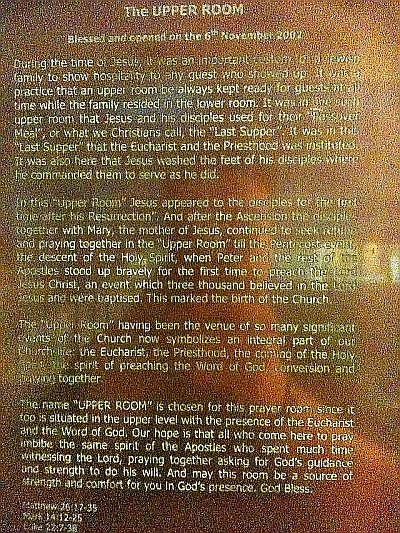
    The adoration room was simply breathtakingly beautiful! I wonder if there are others like it in Singapore?  This interesting and informative plaque was placed outside the entrance :-

    The Upper Room

    Blessed and opened on the 6th November 2002

    During the time of Jesus, it was an important custom for a jewish family to show hospitality to any guest who showed up.  It was a practice that an upper room be always kept ready for guests at all time while the family resided in the lower room.  It was in one such upper room that Jesus and his disciples used for their “Passover meal”, or what we Christians call, the “Last Supper”.  It was in this “Last Supper” that the Eucharist and the Priesthood was instituted.  It was also here that Jesus washed the feet of this disciples when he commanded them to serve as he did.

    In this “Upper Room” Jesus appeared to the disciples for the first time after his Resurrection.  And after the Ascension the disciples together with Mary, the mother of Jesus, continued to see refuge and praying together in the “Upper Room” till the Pentecost event, the descent of the Holy Spirit, when Peter and the rest of the Apostles stood up bravely for the first time to preach the Lord Jesus Christ, an event which three thousand believed the Lord Jesus and were baptized. This marked the birth of the Church.

    The “Upper Room” having been the venue of so many significant events of the Church now symbolizes the integral part of our Church life, the Eucharist, the Priesthood, the coming of the Holy Spirit, the spirit of preaching the Word of God, conversion and praying together.

    The name “Upper Room” is chosen for this prayer room since it too is situated in the upper level with the presence of the Eucharist and the Word of God.  Our hope is that all who come here to pray imbibe the same spirit of the Apostles who spent much time witnessing the Lord, praying together asking for God’s guidance and strength to do his will.  And may this room be a source of strength and comfort for you in God’s presence. God Bless.

    Matthew 26:17-35
    Mark 14:12-25
    Luke 22:7-38

    (Apologetics) John Vs Mike – 7

    Posted: December 7, 2010 by CatholicJules in Apologetics

    From http://www.pro-gospel.org, by Mike Gendron 

    The Motivation for Purgatory

    Over the centuries billions of dollars have been paid to Roman Catholic priests to obtain relief from imaginary sufferings in Purgatory’s fire. The Catholic clergy has always taught that the period of suffering in Purgatory can be shortened by purchasing indulgences and novenas, buying Mass cards and providing gifts of money. When a Catholic dies, money is extracted from mourning loved ones to shorten the deceased’s punishment in Purgatory. When my dear old dad passed away as a devout Catholic of 79 years, I was amazed at the hundreds of Mass cards purchased for him by well-meaning friends. We have heard of other Catholics who have willed their entire estates to their religion so that perpetual masses could be offered for them after they die. It is no wonder that the Catholic religion has become the richest institution in the world. The buying and selling of God’s grace has been a very lucrative business for the Vatican.

    Another motivation for Rome to fabricate the heretical doctrine of Purgatory is its powerful effect on controlling people. Ultimately, the enslavement and subjugation of people is the goal of every false religion, and Purgatory does exactly that. The concept of a terrifying prison with a purging fire, governed by religious leaders, is a most brilliant invention. It holds people captive, not only in this life but also in the next life. Catholic clergy will not say how many years people have to suffer for their sins or how many Masses must be purchased before they can be released from the flames. This dreadful fear and uncertainty is the most ruthless form of religious bondage and deception!

    —————————————————————————————————–
    Mike Gendron:
    The Motivation for PurgatoryOver the centuries billions of dollars have been paid to Roman Catholic priests to obtain relief from imaginary sufferings in Purgatory’s fire. The Catholic clergy has always taught that the period of suffering in Purgatory can be shortened by purchasing indulgences and novenas, buying Mass cards and providing gifts of money. When a Catholic dies, money is extracted from mourning loved ones to shorten the deceased’s punishment in Purgatory. When my dear old dad passed away as a devout Catholic of 79 years, I was amazed at the hundreds of Mass cards purchased for him by well-meaning friends. We have heard of other Catholics who have willed their entire estates to their religion so that perpetual masses could be offered for them after they die. It is no wonder that the Catholic religion has become the richest institution in the world. The buying and selling of God’s grace has been a very lucrative business for the Vatican. 

    John Martignoni:

    Let’s take this sentence by sentence: “Over the centuries billions of dollars have been paid to Roman Catholic priests to obtain relief from imaginary sufferings in Purgatory’s fire.” Let’s re-phrase this sentence to make it more accurate: Over the centuries, potentially billions of dollars have been paid to Roman Catholic priests for Mass stipends as priests offered literally millions of Masses for the sanctification of the dead.  Just as Job offered sacrifice for the sanctification of his sons (Job 1:5) and Judas Maccabeus took up a collection and sent it to Jerusalem to provide a sin offering for the atonement of the dead (2 Macc 12:43-45), so we ask our priests to offer sacrifice for our dead.  Mr. Gendron is upset over a practice of the Catholic Church that is fully supported by Scripture.

    Has a lot of money, in total, come into the pockets of the priests over the centuries as a result of them saying Masses for the dead?  Absolutely.  But what is Mr. Gendron ignoring with his accusation?  Well, first, he is ignoring the fact that these “billions of dollars” went to literally millions and millions of priests.  In other words, no priest is getting rich, which is the underlying contention of Mr. Gendron’s statement, from Mass stipends.   Plus, money earned from stipends often goes not into the priest’s private bank account, it often goes to help pay for the cost to the parish of having a funeral – paying the cantor, the organist, paying for electricity, and so on.  But, compare what a priest makes from a Mass stipend (usual stipend that I’m aware of is $5 or so) to what Mr. Gendron charges for preaching salvation to people – it pales in comparison.  Also, when the stipends go to a religious order, they go straight to providing for the good works these orders are doing – providing food, shelter, clothing, medicine, education, and more for the poor, and quite often for the poorest of the poor.

    What else is Mr. Gendron ignoring?  The fact that if a priest does keep money from a Mass stipend for his personal use, it goes to support the priest’s physical well-being – to provide food, shelter, clothes, etc. for the priest.  Is that contrary to Scripture, Mr. Gendron?  Don’t think so.  Does not Scripture say, “For the laborer is worthy of his wage,” (Luke 10:7; 1 Tim 5:18) and, “You shall not muzzle an ox when it is treading out the grain,” (1 Cor 9:9; 1 Tim 5:18) and, “If we have sown spiritual good among you, is it too much if we reap your material benefits,” (1 Cor 9:11)?

    So, let me offer a parallel to Mr. Gendron’s statement: Over the past 5 centuries, tens of billions of dollars have been paid to Protestant ministers (and lay people such as Mike Gendron) to preach a false doctrine of salvation (sola fide), and to hold non-scriptural altar calls, and many Protestant ministers have gotten materially rich from preaching this false doctrine of salvation, and by giving millions upon millions of people a false sense of security in regard to their salvation.

    Next sentence from Mr. Gendron:  “The Catholic clergy has always taught that the period of suffering in Purgatory can be shortened by purchasing indulgences and novenas, buying Mass cards and providing gifts of money.”  This is a patently false and absurd statement.  There may have been a short time where some members of the clergy, contrary to Catholic teaching, “sold” indulgences, but it has never been a teaching of the Catholic Church that indulgences could be sold.  If it happened, it was an abuse of Catholic teaching.  One does not “buy” an indulgence.  Furthermore, I, personally, have never heard of “purchasing” a novena.  Regarding the buying of Mass cards – providing a stipend to a priest for saying a Mass on behalf of the dead – that was dealt with above.  As far as, “providing gifts of money,” to shorten the period of suffering in Purgatory, I ask Mr. Gendron to provide evidence that this has “always” been taught by the “Catholic clergy.”  Mr. Gendron, please give the papal encyclical, Council documents, or paragraph in the Catechism where this claim of yours can be found?  Have you noticed, folks, that in the other paragraphs he at least quoted Catholic sources – out of context, but at least he mentioned them – yet in these two paragraphs he doesn’t even try to quote a single Catholic source – even out of context!  He is taking a biblical principle – that those who provide spiritual services to people deserve to be compensated for those services – and basically saying it does not apply to the Catholic clergy, and he is, quite simply, just making a lot of this garbage up.

    Next sentence from Mr. Gendron: “When a Catholic dies, money is extracted from mourning loved ones to shorten the deceased’s punishment in Purgatory.” Notice his use of the word, “extracted,” as if it is an act of extortion or some such thing.  Again, Mr. Gendron shows his bias and bigotry towards the Catholic Church.  His comments can in no way be described as being fair and objective, which is what a self-professed Christian should strive for.  First of all, as far as I know, no priest comes to the family of the deceased and says, “For a Mass stipend of $xxx, I will say a Mass to get your loved one out of Purgatory early.”  I have never, ever, heard of such a thing.  The stipend for a Mass is offered voluntarily by the family, out of gratitude for the priest’s service to them and according to the scriptural principle mentioned above, “The laborer is worthy of his wage.”  It is never “extracted” from the “mourning loved ones.”

    Next Gendron sentence: “When my dear old dad passed away as a devout Catholic of 79 years, I was amazed at the hundreds of Mass cards purchased for him by well-meaning friends. Mr. Gendron, when your “dear old dad” died (may God rest his soul), did the priest come to you and tell you that he would not say a funeral Mass for your dad until you paid a certain amount of money?  Please let the world know how much money the priest “extracted” from you before he would say a funeral Mass for your dad.  Surely this happened to you since you say it is the common practice of the Catholic clergy.  You must have experienced it personally, right?  Well, let us know how much money they “extracted” from you before they said your dad’s funeral Mass.

    More from Gendron: “We have heard of other Catholics who have willed their entire estates to their religion so that perpetual masses could be offered for them after they die. As if giving all of your money to the Church is a horrible thing?  I guess it’s okay if Protestants do it, but not if Catholics do it.  And, I wonder if Mr. Gendron would turn down the money if someone willed their entire estate to him?  I seriously doubt it.

    More from Gendron: “It is no wonder that the Catholic religion has become the richest institution in the world. The buying and selling of God’s grace has been a very lucrative business for the Vatican.”  Here, again, we run into the myth of the wealth of the Vatican.  The Vatican is getting rich from all of these Mass stipends.  Really?!  I don’t know of a single penny that goes to the Vatican from the average Mass stipend.  Mr. Gendron, could you please trace the path of the money for us?  Can you give us your sources for this statement?  No, you can’t, can you?  Sorry, but that money pretty much stays at the local parish or in the particular religious congregation.  For more on the myth of the “wealth” of the Vatican, I would ask the reader to check out Issue #49 on the “Newsletter” page of our website (www.biblechristiansociety.com), where that particular topic is covered in more detail.

    Mike Gendron:

    Another motivation for Rome to fabricate the heretical doctrine of Purgatory is its powerful effect on controlling people. Ultimately, the enslavement and subjugation of people is the goal of every false religion, and Purgatory does exactly that. The concept of a terrifying prison with a purging fire, governed by religious leaders, is a most brilliant invention. It holds people captive, not only in this life but also in the next life. Catholic clergy will not say how many years people have to suffer for their sins or how many Masses must be purchased before they can be released from the flames. This dreadful fear and uncertainty is the most ruthless form of religious bondage and deception!

    John Martignoni:

    This paragraph is about as ridiculous as something can get.  One billion plus Catholics being “controlled” by the doctrine of Purgatory.  I ask Mr. Gendron, as I did before, if he felt “controlled” by the doctrine of Purgatory when he was Catholic?  Was it Purgatory and Purgatory alone that kept him Catholic…that caused him to be “enslaved” by the Catholic Church? Gendron makes it seem that Purgatory is the one thing that keeps Catholics Catholic, and it does so by fomenting fear among Catholics.  Yet, in the Catechism of the Catholic Church, with some 2865 paragraphs, the doctrine of Purgatory is contained in all of three (3) of those paragraphs.  I find it odd that the one doctrine which the Church uses to enslave its people gets such short shrift in the Catechism, don’t you?  I also find it odd that there is a complete lack of personal testimony from Mr. Gendron about how he felt “enslaved” by Purgatory and about how much money was extorted from him by the Catholic clergy in return for them saying a funeral Mass for his dad.  Come on, Mike, tell us your personal experiences in these regards.

    Finally, the statement: Catholic clergy will not say how many years people have to suffer for their sins or how many Masses must be purchased before they can be released from the flames. This dreadful fear and uncertainty is the most ruthless form of religious bondage and deception! My older brother died about 15 years ago.  My father died 8 years ago.  I do not have a “dreadful fear and uncertainty” regarding their ultimate fate that causes me to keep pouring money into the coffers of the Vatican, as Mr. Gendron claims.  I don’t know of any Catholics that do in regard to their deceased loved ones.  Oh, there is concern for the fate of the loved ones, especially when the loved ones did not appear to be living a very holy life, but “dreadful fear” that results in a ruthless “religious bondage?!”  Absolutely not.  The Church, on the contrary, teaches us that God is in control, and teaches us to turn any concern over the fate of our loved ones over to the mercy of God.  Besides, Mr. Gendron seems to be ignorant of the fact that the “Catholic clergy” cannot tell anyone the number of “years” someone has to suffer for their sins in Purgatory, because there is no time in Purgatory.  Purgatory is outside of time.  There are no “years” in Purgatory.  Furthermore, does Mr. Gendron not believe that it is God and God alone who can judge when someone is deserving of Heaven?  Why does he “blame” the Catholic clergy for not being able to judge what God alone can judge?


    Debate Between Robert Spencer And Peter Kreeft

    Posted: December 6, 2010 by CatholicJules in Videos/Audio

    This is a great debate and a must watch, however you’ll need to sit down totally focussed for over an hour.

    Good Muslim / Bad Muslim


    What are the Advent Stations?

    The Advent Stations take us on a tour of the Old Testament.  Like the traditional Lenten Stations of the Cross, these Advent “stations” or “stopping points” provide a way to ponder the mystery of how God prepared the world to receive his Son at the moment of Annunciation.  Each station contains an Old Testament foreshadowing of the incarnation, a meditation, the New Testament fulfillment in Christ, and then a prayer.  They can be prayed alone, or with you family, or even in the church with a group of the faithful.

    Join me as we prepare ourselves for the coming of our Lord, Jesus.

    The 7 Adventstations (Click Here)

    December 5th, 2010 – Second Sunday in Advent

    Posted: December 4, 2010 by julesplife in Sunday Reflections

    Sunday Bible Reflections by Dr. Scott Hahn

    Kingdom Come

    Readings:
    Isaiah 11:1-10
    Psalm 72:1-2, 7-8, 12-13, 17
    Romans 15:4-9
    Matthew 3:1-12

    “The kingdom of heaven is at hand,” John proclaims. And the Liturgy today paints us a vivid portrait of our new king and the shape of the kingdom He has come to bring.

    The Lord whom John prepares the way for in today’s Gospel is the righteous king prophesied in today’s First Reading and Psalm. He is the king’s son, the son of David – a shoot from the root of Jesse, David’s father (see Ruth 4:17).

    He will be the Messiah, anointed with the Holy Spirit (see 2 Samuel 23:1; 1 Kings 1:39; Psalm 2:2), endowed with the seven gifts of the Spirit – wisdom, understanding, counsel, strength, knowledge, piety and fear of the Lord.

    He will rule with justice, saving the poor from the ruthless and wicked. His rule will be not only over Israel – but will extend from sea to sea, to the ends of the earth. He will be a light, a signal to all nations. And they will seek Him and pay Him homage.

    In Him, all the tribes of the earth will find blessing. The covenant promise to Abraham (see Genesis 12:3), renewed in God’s oath to David (see Psalm 89:4,28), will be fulfilled in His dynasty. And His name will be blessed forever.

    In Christ, God confirms His oath to Israel’s patriarchs, Paul tells us in today’s Epistle. But no longer are God’s promises reserved solely for the children of Abraham. The Gentiles, too, will glorify God for His mercy. Once strangers, in Christ they will be included in “the covenants of promise” (see Ephesians 2:12).

    John delivers this same message in the Gospel. Once God’s chosen people were hewn from the rock of Abraham (see Isaiah 51:1-2). Now, God will raise up living stones (see 1 Peter 2:5) – children of Abraham born not of flesh and blood but of the Spirit.

    This is the meaning of the fiery baptism He brings – making us royal heirs of the kingdom of heaven, the Church.

    Witness To The Grace/s Of God

    Posted: December 4, 2010 by julesplife in Life's Journeys, Memory Book

    Just wanted to list some if not as many….of the times I encountered/witness His great love for us on a personal level. I sincerely doubt if I’ll ever forget them, but then again I am only human with a body and mind that was not built to last my whole human lifetime.

    I’ve listed a few already in some of my entries in the past…..here are the newer ones

    • Prayer for Cynthia’s mother
    • Prayer for Mae Ann’s Dad
    • Prayer for a couple I’ve never met who lost a young daughter to HMFD.
    • Call for a young man to our faith and another to comeback ‘Home’.
    • Reaching out to two daughters who strayed/stayed away from the faith.
    • Peace at Home from a very trying disagreement.
    • Intervention of a wayward act i.e. the overboard public display of affections by a young teenage couple on the train. 
    • Help with my missing crucifix link.
    • Help with a plumbing incident.
    • Personal healing
    • Seth’s healing from a stomach flu attack.
    • Help with understanding Scripture.

    Will share in detail with anyone who asks…..

    Thought Of The Day..

    Posted: December 2, 2010 by CatholicJules in Personal Thoughts & Reflections

    “It is only when we die unto ourselves that we can rise with Jesus, our Saviour.”


    On The Twofold Coming Of Christ

    Posted: December 1, 2010 by CatholicJules in Memory Book

    From a catechetical instruction by Saint Cyril of Jerusalem, bishop

    We do not preach only one coming of Christ, but a second as well, much more glorious than the first. The first coming was marked by patience; the second will bring the crown of a divine kingdom.

    In general, whatever relates to our Lord Jesus Christ has two aspects. There is a birth from God before the ages, and a birth from a virgin at the fullness of time. There is a hidden coming, like that of rain on fleece, and a coming before all eyes, still in the future. At the first coming he was wrapped in swaddling clothes in a manger. At his second coming he will be clothed in light as in a garment. In the first coming he endured the cross, despising the shame; in the second coming he will be in glory, escorted by an army of angels. We look then beyond the first coming and await the second. At the first coming we said: Blessed is he who comes in the name of the Lord. At the second we shall say it again; we shall go out with the angels to meet the Lord and cry out in adoration: Blessed is he who comes in the name of the Lord.

    The Savior will not come to be judged again, but to judge those by whom he was judged. At his own judgment he was silent; then he will address those who committed the outrages against him when they crucified him and will remind them: You did these things, and I was silent.

    His first coming was to fulfill his plan of love, to teach men by gentle persuasion. This time, whether men like it or not, they will be subjects of his kingdom by necessity. The prophet Malachi speaks of the two comings. And the Lord whom you seek will come suddenly to his temple:that is one coming.

    Again he says of another coming: Look, the Lord almighty will come, and who will endure the day of his entry, or who will stand in his sight? Because he comes like a refiner’s fire, a fuller’s herb, and he will sit refining and cleansing.

    These two comings are also referred to by Paul in writing to Titus: The grace of God the Savior has appeared to all men, instructing us to put aside impiety and worldly desires and live temperately, uprightly, and religiously in this present age, waiting for the joyful hope, the appearance of the glory of our great God and Savior, Jesus Christ. Notice how he speaks of a first coming for which he gives thanks, and a second, the one we still await.

    That is why the faith we profess has been handed on to you in these words: He ascended into heaven, and is seated at the right hand of the Father, and he will come again in glory to judge the living and the dead, and his kingdom will have no end.

    Our Lord Jesus Christ will therefore come from heaven. He will come at the end of the world, in glory, at the last day. For there will be an end to this world, and the created world will be made new.


    God Has The Answer…

    Posted: November 30, 2010 by CatholicJules in Memory Book

    HANDY LITTLE CHART

    GOD HAS THE ANSWER:

    YOU SAY GOD SAYS BIBLE VERSES
    You say: ‘It’s impossible’ God says:  All things are possible ( Luke 18:27)
    You say: ‘I’m too tired’ God says: I will give you rest ( Matthew 11:28-30)
    You say: ‘Nobody really loves me’ God says: I love you ( John 3:1  6 & John 3:34 )
    You say: ‘I can’t go on’ God says: My grace is sufficient (II Corinthians 12:9 & Psalm 91:15)
    You say:  ‘I can’t figure things out’ God says: I will direct your steps (Proverbs 3:5-   6)
    You say: ‘I can’t do it’ God says: You can do all things ( Philippians 4:13)
    You say: ‘I’m not able’ God says: I am able (II Corinthians 9:8)
    You say: ‘It’s not worth it’ God says: It will be worth it (Roman 8:28 )
    You say: ‘I can’t forgive myself’ God says: I Forgive you (I John 1:9 & Romans 8:1)
    You say: ‘I can’t manage’ God says: I will supply all your needs ( Philippians 4:19)
    You say: ‘I’m afraid’ God says: I have not given you a spirit of fear ( II Timothy 1:7)
    You say: ‘I’m always worried and frustrated’ God says: Cast all your cares on ME (I Peter 5:7)
    You say: ‘I’m not smart enough’ God says: I give you wisdom (I Corinthians 1:30)
    You say: ‘I feel all alone’ God says: I will never leave you or forsake you (Hebrews 13:5)

    From a Sermon by Saint Augustine, Bishop

    Posted: November 29, 2010 by CatholicJules in Memory Book

    A truly beautiful sermon that needs to be shared with all….(Catholic Jules)

    Let us sing alleluia to the good God who delivers us from evil

    Let us sing alleluia here on earth, while we still live in anxiety, so that we may sing it one day in heaven in full security. Why do we now live in anxiety? Can you expect me not to feel anxious when I read: Is not man’s life on earth a time of trial? Can you expect me not to feel anxious when the words still ring in my ears: Watch and pray that you will not be put to the test? Can you expect me not to feel anxious when there are so many temptations here below that prayer itself reminds us of them, when we say: Forgive us our trespasses, as we forgive those who trespass against us? Every day we make out petitions, every day we sin. Do you want me to feel secure when I am daily asking pardon for my sins, and requesting help in time of trial? Because of my past sins I pray: Forgive us our trespasses, as we forgive those who trespass against us, and then, because of the perils still before me, I immediately go on to add: Lead us not into temptation. How can all be well with people who are crying out with me: Deliver us from evil? And yet, brothers, while we are still in the midst of this evil, let us sing alleluia to the good God who delivers us from evil.

    Even here amidst trials and temptations let us, let all men, sing alleluia.God is faithful, says holy Scripture, and he will not allow you to be tried beyond your strength. So let us sing alleluia, even here on earth. Man is still a debtor, but God is faithful. Scripture does not say that he will not allow you to be tried, but that he will not allow you to be tried beyond your strength. Whatever the trial, he will see your through it safely, and so enable you to endure. You have entered upon a time of trial but you will come to no harm – God’s help will bring you through it safely. You are like a piece of pottery, shaped by instruction, fired by tribulation. When you are put into the oven therefore, keep your thoughts on the time when you will be taken out again; for God is faithful, and he will guard both your going in and your coming out.

    But in the next life, when this body of ours has become immortal and incorruptible, then all trials will be over. Your body is indeed dead, and why? Because of sin. Nevertheless, your spirit lives, because you have been justified. Are we to leave our dead bodies behind then? By no means. Listen to the words of holy Scripture: If the Spirit of him who raised Christ from the dead dwells within you, then he who raised Christ from the dead will also give life to your own mortal bodies. At present your body receives its life from the soul, but then it will receive it from the Spirit.

    O the happiness of the heavenly alleluia, sung in security, in fear of no adversity! We shall have no enemies in heaven, we shall never lose a friend. God’s praises are sung both there and here, but here they are sung by those destined to die, there, by those destined to live for ever; here they are sung in hope, there, in hope’s fulfillment; here they are sung by wayfarers, there, by those living in their own country.

    So, then, my brothers, let us sing now, not in order to enjoy a life of leisure, but in order to lighten our labors. You should sing as wayfarers do – sing, but continue your journey. Do not be lazy, but sing to make your journey more enjoyable. Sing, but keep going. What do I mean by keep going? Keep on making progress. This progress, however, must be in virtue; for there are some, the Apostle warns, whose only progress is in vice. If you make progress, you will be continuing your journey, but be sure that your progress is in virtue, true faith and right living. Sing then, but keep going.

    Emmanuel Praise & Worship Session

    Posted: November 28, 2010 by CatholicJules in Upcoming Events

    In preparation for the coming of our beloved Lord Jesus Christ, Emmanuel will be conducting 4 sessions during Advent on Wednesdays at 8.00 p.m. beginning on 1st Dec ‘10.

    We invite you to join us in our desire in making this a spirituallymeaningful season.

    Venue

    Church of St Anthony
    25 Woodlands Avenue 1
    Singapore 739064
    Thomas Aquinas Room

    For Directions Click Here

    November 28, 2010 – First Sunday in Advent

    Posted: November 27, 2010 by CatholicJules in Sunday Reflections

    SUNDAY BIBLE REFLECTIONS BY DR. SCOTT HAHN

    In a Dark Hour

    Readings
    Isaiah 2:1-5
    Psalm 122:1-9
    Romans 13:11-14
    Matthew 24:37-44 “The Gospel of Fulfillment”
    )


    Jesus exaggerates in today’s Gospel when He claims not to know the day or the hour when He will come again.

    He occasionally makes such overstatements to drive home a point we might otherwise miss (see Matthew 5:34; 23:9; Luke 14:26).

    His point here is that the exact “hour” is not important. What is crucial is that we not postpone our repentance, that we be ready for Him – spiritually and morally – when He comes. For He will surely come, He tells us – like a thief in the night, like the flood in the time of Noah.

    In today’s Epistle, Paul too compares the present age to a time of advancing darkness and night.

    Though we sit in the darkness, overshadowed by death, we have seen arise the great light of our Lord who has come into our midst (see Matthew 4:16; John 1:9; 8:12). He is the true light, the life of the world. And His light continues to shine in His Church, the new Jerusalem promised by Isaiah in today’s First Reading.

    In the Church, all nations stream to the God of Jacob, to worship and seek wisdom in the House of David. From the Church goes forth His word of instruction, the light of the Lord – that all might walk in His paths toward that eternal day when night will be no more (see Revelation 22:5).

    By our Baptism we have been made children of the light and day (see Ephesians 5:8; 1 Thessalonians 5:5-7). It is time we start living like it – throwing off the fruitless works of darkness, the desires of the flesh, and walking by the light of His grace.

    The hour is late as we begin a new Advent. Let us begin again in this Eucharist.

    As we sing in today’s Psalm, let us go rejoicing to the House of the Lord. Let us give thanks to His name, keeping watch for His coming, knowing that our salvation is nearer now than when we first believed.

    The Gospel of ‘Fulfillment’

    With the First Sunday in Advent we begin a new “cycle” (Cycle A) of the Church’s Liturgical Year. Sunday by Sunday for the next year we’ll be reading the Gospel of Matthew.

    Matthew’s Gospel is a prime example of what St. Augustine was talking about when he said: the New Testament is concealed in the Old and the Old Testament is revealed in the New.

    You can’t read Matthew without having your ear tuned to the Old Testament. He quotes or alludes to the Old Testament an average of four or five times per chapter – or more than 100 times in his Gospel.

    Matthew writes this way because he wants his fellow Israelites to see that their Old Covenant with God has been “fulfilled” in Jesus. Get used to words like “fulfill” and “fulfillment” – you’re going to hear them repeatedly in Matthew’s gospel.

    On the Fourth Sunday of Advent, for instance, Matthew explains how Mary is found with child: “All this took place to fulfill what the Lord had said through the prophet: ‘Behold the virgin shall be with child and bear a son, and they shall call him Emmanuel” (see Matthew 1:22-23).

    Again, on Palm Sunday, when He is arrested in the garden, Jesus says: “All this has come to pass that the writings of the prophets may be fulfilled” (see Matthew 26:54,56).

    The numerous “fulfillments” Matthew tells us about are intended to signal one thing – that in Jesus, God is finally delivering on the promises He made throughout salvation history.


    Judgement & scenes from the Day Of Wrath

    Posted: November 26, 2010 by CatholicJules in Holy Pictures

    By Aldo Locatelli, Found in the Church Of San Pellegrino

    “My flesh is real food; My blood is true drink,”

    Posted: November 25, 2010 by CatholicJules in Apologetics

    “My Flesh Is Real Food”
    Here’s a brief, step by step way to explain the Real presence of Christ in the Eucharist.

    By Tim Staples

    Scenario:

    You’re at the annual family reunion barbecue. In the midst of the fun you overhear your cousin Mark (who left the Church in college and now attends a Fundamentalist Baptist church) arguing heatedly about religion with several of your Catholic relatives. He’s got his Bible out and is vigorously explaining why the Catholic doctrine of the Eucharist is “unbiblical.” “You don’t really believe that you eat Jesus when you receive Communion, do you?” he rolls his eyes, shaking his head at the very thought. “It’s obvious from Scripture that Jesus was speaking symbolically when He talked about eating His flesh and drinking His blood. He didn’t mean that literally.” Your relatives are no match for Mark’s energy and confidence. And besides, they don’t have Bibles with them, so he’s pretty much in charge of the conversation, that is, until you walk over and with a big smile you ask, “Mark, if I can show you from the Bible that your argument is wrong and that Christ did teach that He is really present in the Eucharist, will you come back to the Catholic Church?” Mark’s sermon stops in mid syllable. He grins and shakes his head. “There is no way you can prove that from the Bible. And besides, you’re a Catholic. Your doctrines don’t come from the Bible, anyway.”

    Your response:

    “Well, we’ll see about that. But please answer my question. If I can show you from the Bible that the Catholic teaching is true, will you come back to the Church?” “Heck yeah,” he snorts, confident your proposition is one he can’t lose. “Go ahead and try. But first, answer me this: In John 10:1, Jesus said He is a ‘door.’ Do you believe He has hinges and a doorknob on His body? In John 15:1, Jesus said He is a ‘vine.’ Do you take Him literally there? If not, why do you take His words literally in John 6 where He talked about His flesh and blood being like food and drink? You Catholics are inconsistent.”

    Step One:

    Explain that if Jesus was not speaking literally in John 6 (“My flesh is real food; My blood is true drink,” etc.), He would have been a poor teacher. After all, everyone listening to Him speak those words understood that He meant them literally. They responded, “How can this man give us His flesh to eat?” In the cases of Jesus saying He is a “door” or a “vine,” we find no one asking, “How can this man be a door made out of wood?” or, “How can this man claim to be a plant?” It was clear from the context and the Lord’s choice of words in those passages that He was speaking metaphorically. But in John 6 He was speaking literally. In John 6:41, the Jews “murmured” about Christ’s teaching precisely because it was so literal. Christ certainly knew they were having difficulty imagining that He was speaking literally, but rather than explain His meaning as simply a metaphor, He emphasized His teaching, saying, “I am the living bread that came down from heaven. Whoever eats this bread will live forever, and the bread that I will give is My flesh for the life of the world” (John 6:51). Why would Christ reinforce the literal sense in the minds of His listeners if He meant His words figuratively? Now point out how the Lord dealt with other situations where His listeners misunderstood the meaning of His words. In each case, He cleared up the misunderstanding. For example, the disciples were confused about His statement, “I have meat to eat that you know not of” (John 4:32). They thought he was speaking about physical food, real meat. But He quickly cleared up the misunderstanding with the clarification, “My meat is to do the will of Him that sent Me, that I may perfect his work” (Matt. 4:34; cf. 16:5-12). Back to John 6. Notice that the Jews argued among themselves about the meaning of Christ’s words. He reiterated the literal meaning again: “Amen, Amen, I say to you, unless you eat the flesh of the Son of Man and drink His blood, you do not have life within you” (verses 53-54). In verse 61 we see that no longer was it just the wider audience but “the disciples” themselves who were having difficulty with this radical statement. Surely, if Christ were speaking purely symbolically, it’s reasonable to expect that He would clear up the difficulty even if just among His disciples. But He doesn’t. He stands firm and asks, “Does this shock you? What if you were to see the Son of Man ascending to where He was before?” (Verse 62-63). Did Christ “symbolically” ascend into heaven after the Resurrection? No. As we see in Acts 1:9-10, His ascension was literal. This is the one and only place in the New Testament where people abandon Christ over one of His teachings. Rather than try to correct any mistaken understanding of His words, the Lord asks His Apostles, “Do you also want to leave?” (verse 67). His Apostles knew He was speaking literally. St. Paul emphasizes the truth of the Real Presence: “Whoever eats the bread or drinks the cup of the Lord unworthily, shall be guilty of the body and blood of the Lord . . . .Whoever eats and drinks without recognizing the body, eats and drinks judgment on himself” (1 Cor. 11:27-29). If the Eucharist is merely a symbol of the Lord’s body and blood, then St. Paul’s words here make no sense. For how can one be “guilty of the body and the blood of the Lord” if it’s merely a symbol? This Greek phrase for being “guilty of someone’s body and blood” (enokos estai tou somatos kai tou haimatos tou kuriou) is a technical way of saying “guilty of murder.” If the Eucharist is merely a symbol of Christ, not Christ Himself, this warning would be drastically, absurdly overblown.

    Step Two:

    Next point out the fact that the “Real Presence” of Christ in the Holy Eucharist was a doctrine believed and taught unanimously by the Church since the time of Christ. The Catholic “literal” sense was always and only the sense in which the early Christians understood Christ’s words in John 6. The “figurative” or “metaphorical” sense was never held by the Church Fathers or other early orthodox Christians. This can be proven not just by appealing to the writings of the Fathers, but also by the fact that ancient Christian traditions such as the Copts and the Orthodox Churches also hold and teach the doctrine of the Real Presence, just as the Catholic Church does. St. Ignatius of Antioch, a disciple of St. John the Apostle and successor of St. Peter as bishop of Antioch, wrote: “They [the heretics] abstain from the Eucharist and from prayer, because they do not confess that the Eucharist is the Flesh of our Savior Jesus Christ, Flesh which suffered for our sins and which the Father, in His goodness, raised up again” (Epistle to the Smyrnaeans 6 [A.D. 107]).

    Even Martin Luther himself admitted that the early Church was unanimous in the literal interpretation of Christ’s words in John 6: “Who, but the devil, hath granted such license of wresting the words of holy Scripture? Who ever read in the Scriptures that my body is the same as the sign of my body?. . . It is only the devil, that imposeth upon us by these fanatical men. . .Not one of the Fathers, though so numerous, ever spoke [thus] . . . they are all of them unanimous.”

    Step Three:

    You can make your case another way. Say, for the sake of argument, that Christ intended His words in John 6 to be understood metaphorically. Even if this were granted, the anti-Catholic argument your cousin Mark is using still falls apart. Here’s why: The phrases “eat flesh” and “drink blood” did indeed have a symbolic meaning in the Hebrew language and culture of our Lord’s time. You can demonstrate this by quoting passages such as Psalm 27:1-2, Isaiah 9:18-20, Isaiah 49:26, Micah 3:3, and Revelation 17:6,16. In each case, we find “eating flesh” and “drinking blood” used as metaphors to mean “to persecute,” “to do violence to,” “to assault,” or “to murder.” Now, if Christ were speaking metaphorically, the Jews would have understood him to be making an absured statement: “Unless you persecute and assault Me, you shall not have life in you. Amen, amen, I say to you, unless you do violence to Me and kill Me, you shall not have life within you.” Besides being an absurd understanding of these words, there’s one further problem with the “metaphorical” view: Jesus would have been encouraging- exhorting!- His hearers to commit violent mortal sins. If it were immoral, in any sense, for Christ to promise to give us His flesh to eat and His blood to drink, then he could not have command us to even symbolically eat and drink His body and blood. Even symbolically performing an immoral act is of its very nature immoral. You can see your explanations are hitting home, but you’re not done yet. Mark still has a few arguments left. “Look,” he sighs. “You haven’t convinced me. After all, Jesus Himself said in John 6:63 that He wasn’t speaking literally: ‘It is the spirit that gives life, while the flesh is of no avail. The words I have spoken to you are spirit and life.’ How do you get around that?”

    Your response:

    The word “spirit” (Greek: pnuema) is never used anywhere in Scripture to mean “symbolic.” John 4:24 says God is “spirit” (pneuma). Does that mean He is “symbolic?” Hebrews 1:14 tells us that angels are “spirit” (pneuma). Are angels merely symbols? Of course not. You can multiply the examples of the constant use of the word “spirit” as a literal, not figurative, reality. Now point out that sarx, the Greek term for “flesh,” is sometimes used in the New Testament to describe the condition of our fallen human nature apart from God’s grace. For example, St. Paul says that if we are “in the flesh,” we cannot please God (cf. Rom. 8:1-14). He also reminds us that, “the natural person does not accept what pertains to the Spirit of God, for to him it is foolishness, and he cannot understand it because it is judged spiritually” (1 Cor. 2:14). Remind Mark that it doesn’t require grace to look at Communion as just grape juice and crackers. It does, however, require faith and “spiritual judgment” to see and believe Christ’s promise that He would give us His body, blood, soul and divinity under the appearances of bread and wine. The one who is “in the flesh,” operating in the realm of mere natural understanding, won’t see this truth. Your cousin has a comeback ready. “But Jesus says, ‘I am the bread of life. Whoever comes to me will never hunger, and whoever believes in me will never thirst.’ I believe this means that coming to Him is what He really means by “eating” and believing in Him is what He really means by “drinking.” Not so. Point out that “coming to” and “believing in” Christ are definite requirements for having this life He promises, but not the only ones. It would, after all, be a sacrilege to receive the Eucharist without believing (cf. 1 Cor. 11:27-29). But this doesn’t erase the fact that Christ repeatedly said, “My flesh is real food, and My blood is real drink.” This literal dimension of the passage can’t be explained away by appealing to “coming” and “believing.” To do that would be to make the mistake of focusing solely on just one aspect of the Lord’s teaching and ignoring the rest of it. Mark is starting to look a little uncomfortable. You’re still smiling. He’s not. “Wait!” he says. “Leviticus 17:10 condemns eating blood. There’s no way Jesus would contradict this. He would have been encouraging cannibalism if He really meant for us to eat His body and drink His blood. That would be immoral.”

    Step Four:

    Acknowledge that Leviticus 17:10 indeed condemns “eating blood.” Then say, “If we’re going to be consistent with the Levitical Law, then we must also perform animal sacrifices – lambs, pigeons, turrtledoves- according to Leviticus 12:8. But as Christians, we are not under the Levitical Law. We’re under the ‘law of the spirit of life in Christ Jesus'” (Rom. 8:2). Hebrews 7:11-12 tells us the Levitical Law has passed away with the advent of the New Covenant. A New Testament commandment always abrogates an Old Testament commandment. For example, in Matthew 5, the Lord repeatedly uses the formula, “You have heard that it was said (quoting an Old Testament law), But I say unto you . . .” In each instance, Christ supercedes the Old Testament law with a new commandment of His own, such as the commandment against divorce and remarriage, overagainst Moses’ allowance for it in Deuteronomy 24:1 (cf. Matt. 5:21-22, 27-28, 31-32, 33-34, 38-39, 43-44). This is what we see in John 6. The blood prohibition in Leviticus 17:11-12 was replaced by Christ’s new teaching in John 6:54: “Unless you eat the flesh of the Son of Man and drink His blood, you shall have no life in you.” Eating blood was prohibitted in the Old Testament, “Because the life of the flesh is found in the blood” (Lev. 17:11). Blood is sacred and the life of each creature is in its blood. Many pagans thought they could acquire “more” life by ingesting the blood of an animal or even a human being. But obviously this was foolish. No animal or human person has the capacity to do this. But in the case of Christ, it’s different. John 6:54 tells us that our eternal life depends on His blood: “Unless you eat the flesh of the Son of Man and drink His blood, you shall have no life in you.”

    Step Five:

    By now Cousin Mark has run out of things to say. Rather than hold him to his promise to become Catholic on the spot, give him a hug, tell him you’re praying for his return to the Church and that he’s always welcome to come home. Then go get another helping of Aunt Mary’s potato salad. You’ve earned it.

    Thought Of Day…

    Posted: November 24, 2010 by CatholicJules in Personal Thoughts & Reflections

    As I was reflecting on why it is so difficult for one to remain holy.


    For the fascination of wickedness obscures what is good, and roving desire perverts the innocent mind.

    Wisdom 4:12


    And then I was led to this passage….


    For the lowliest may be pardoned in mercy, but the mighty will be mightily tested.

    Wisdom 6:6


    (Apologetics) John Vs Mike – 6

    Posted: November 23, 2010 by CatholicJules in Apologetics

    From the website: http://www.pro-gospel.org, by Mike Gendron

    Mike Gendron:

    The Deception of Purgatory

    Purgatory comes from the Latin word “purgare,” which means to make clean or to purify. The Catholic Encyclopedia defines purgatory as “a place or condition of temporal punishment for those who, departing this life in God’s grace, are not entirely free from venial faults, or have not fully paid the satisfaction due to their transgressions.” They must be purified of these “venial” sins before they can be allowed into heaven. Here we see Catholicism perpetuating the seductive lie of Satan by declaring “you will not surely die” when you commit venial sins (Gen. 3:4). The Council of Trent dares to declare that “God does not always remit the whole punishment due to sin together with the guilt. God requires satisfaction and will punish sin…The sinner, failing to do penance in this life, may be punished in another world, and so not be cast off eternally from God.” (Session 15, Can. XI). Those Catholic Bishops had the audacity to declare that the suffering and death of God’s perfect man and man’s perfect substitute was not sufficient to satisfy divine justice for sin.

    John Martignoni

    He correctly quotes the Catholic Encyclopedia, and then notice what he does: He inserts his own meaning into that quote.  He decides, based on his bias towards, and hatred of, the Catholic Faith, that the Catholic teaching on Purgatory means that we are agreeing with the devil when he told Eve, “You will not die,” if she ate of the fruit of the tree that God told her and Adam not to eat from.

    First of all, I am not following the logic here.  How is saying that you need to be completely purified of even the smallest sins before you enter Heaven, the equivalent of telling the same lie as the devil told Eve in the Garden?  That makes no sense.  Is Mr. Gendron saying that we don’t need to be purified of venial sins before we enter Heaven?  If so, then he is saying that something unclean can get into Heaven, which is contrary to Rev 21:27, which states that nothing unclean shall enter it?  Who should we believe, the Bible or Mr. Gendron?

    Or, is he saying this because he contends that Catholics are wrong to teach that venial sins will not cause one to lose their salvation?   If so, then again he goes contrary to Scripture which states very clearly, “There is sin which is mortal [unto death (KJV)]…All wrongdoing is sin, but there is sin which is not mortal [unto death].”  The Bible makes it very clear that there is sin which does not lead to death, or loss of one’s salvation.  Is Mr. Gendron denying this?  Well, he seems to be.  So, who should we believe, the Bible or Mr. Gendron?

    He then goes on to quote the Council of Trent when it said that God does not always remit the whole punishment due to sin along with the guilt of that sin.  And what does he do after he quotes a Catholic source?  He injects his own personal, fallible, biased, and bigoted interpretation into what that source said.  He marvels that the Catholic bishops at the Council of Trent would have the “audacity” to “declare that the suffering and death of God’s perfect man and man’s perfect substitute was not sufficient to satisfy divine justice for sin.”

    Uhmm, Mike…that’s not what they said.  Those are your words, Mike, not those of the Council of Trent.  When the Council of Trent said that God does not always remit the “whole punishment” due to sin along with the “guilt” of that sin, all they were doing was verbalizing a pretty obvious fact found in the Bible.  For example, when Moses disobeyed God, he was subsequently forgiven by God, right?  But, was all of the punishment due to that sin remitted at the moment Moses’ was forgiven?  According to Mr. Gendron beliefs it had to have been, but the Bible tells us no, it was not.  Moses was punished by God, even after being forgiven by God, by not being allowed to enter into the Promised Land.  So, even though the whole guilt of Moses sin was fully forgiven, the whole punishment was not remitted at the same time the guilt was forgiven, just as the Bishops at the Council of Trent stated.

    Another example is David’s affair with Bathsheba and the murder of Bathsheba’s husband.  We see in 2 Samuel 12:13-18 that God “puts away David’s sin,” which means that David was fully forgiven of his sin.  So, according to Mr. Gendron, the whole punishment due to David’s sin was remitted at the very moment David was forgiven by God.  Yet, in the Bible, we see that the whole punishment due to David’s sin was not remitted at the same time the guilt was forgiven, just as the Bishops at the Council of Trent stated.  Mr. Gendron, do you have these stories in your Bible?

    Also, has the full punishment due because of Adam’s original sin been remitted?  According to Mr. Gendron, it has.  Which is why we are all right now back in the Garden of Eden, right?!  Not quite.  Read God’s words to Adam and Eve in Genesis 3:16-19.  Is woman still bringing forth children in pain?  Is man still having to toil to eat of the produce of the ground?  Oh yes they are.

    Another thing to consider, the New Testament tells us that by bringing someone back from the error of their ways, and that through love, we will “cover a multitude of sins,” (James 5:19-20; 1 Peter 4:8).  I doubt Mr. Gendron has ever considered those passages, or if he’s even seen them.  How can our love “cover a mulitude of sins,” if the whole punishment due to sin is remitted at the exact same time the sin is forgiven?  In what way, Mr. Gendron, can we cover our sins, or “hide” them as the King James Version (KJV) states in James 5:20, if we play no role whatsoever in the remission of the punishment due to our sins?  Hey, that sounds like a good question for my “Questions Protestants Can’t Answer” series.

    The Catholic Bishops at the Council of Trent did not teach then, nor has the Catholic Church ever taught, “that the suffering and death of God’s perfect man and man’s perfect substitute was not sufficient to satisfy divine justice for sin,” as Mr. Gendron falsely claims.  Christ paid the full price for the guilt of our sins.  He is the only one who could ever pay that price for our sins.  However, Divine Justice demands that we contribute what we are able, by the grace of God, to the remission of the punishment that is due to those sins, either in this life or in the next.

    We do not obtain forgiveness of our sins through our efforts – Jesus is the only one Who can do that for us – but we can contribute to the remission of the punishment due to our sins.  This is why Scripture says that we can indeed cover a multitude of sins through our love, or through bringing someone back from the error of their ways.  And, we can say, as Paul said, that we “rejoice in our sufferings” and that “in [our] flesh we complete what is lacking in Christ’s afflictions for the sake of His body, that is, the church,” (Colosssians 1:24).  Was something “lacking” in Christ’s suffering?  Not in and of itself, but what is lacking is our participation in that suffering.  That is why we have to pick up our cross daily to follow Him (Luke 9:23).

    That’s it for now, I’ve got to go catch a plane.  More on Gendron and Purgatory in the next issue…


    BY ROBIN MARK

    Amazing grace, how sweet the sound
    That saved a wretch like me
    I once was lost but now am found
    Was blind but now I see

    ‘Twas grace that taught my heart to fear
    And grace my fears relieved
    How precious did that grace appear?
    The hour I first believed

    Through many dangers, toils and snares
    We have already come
    ‘Twas Grace that brought my heart to fear
    And Grace will lead me home

    When we’ve been there ten thousand years
    Bright shining as the sun
    We’ve no less days to sing God’s praise
    Then when we first begun

    No not by might
    Nor even power
    But by Your spirit oh Lord
    Healer of hearts
    Binder of wounds
    Lives that are lost restored
    Flow through this land
    ‘Till every one
    Praises Your name once more

    Are you washed in the blood,
    In the soul-cleansing blood of the Lamb?
    Are your garments spotless?
    Are they white as snow?
    Are you washed in the blood of the Lamb?

    (To listen click on |> button top left hand side under my pic with the words ‘Play Song while reading’ Will keep it there till maybe end Dec)

    November 21, 2010 – Solemnity of Christ the King

    Posted: November 20, 2010 by CatholicJules in Sunday Reflections

    SUNDAY BIBLE REFLECTIONS BY DR. SCOTT HAHN

    Kingdom of the Son

    Readings:

    2Samuel 5:1-3
    Psalm 122:1-5
    Colossians 1:12-20
    Luke 23:35-43

    Week by week the Liturgy has been preparing us for the revelation to be made on this, the last Sunday of the Church year.

    Jesus, we have been shown, is truly the Chosen One, the Messiah of God, the King of Jews. Ironically, in today’s Gospel we hear these names on the lips of those who don’t believe in Him – Israel’s rulers, the soldiers, a criminal dying alongside Him.

    They can only see the scandal of a bloodied figure nailed to a cross. They scorn Him in words and gestures foretold in Israel’s Scriptures (see Psalm 22:7-9; 69:21-22; Wisdom 2:18-20). If He is truly King, God will rescue Him, they taunt. But He did not come to save Himself, but to save them – and us.

    The good thief shows us how we are to accept the salvation He offers us. He confesses his sins, acknowledges he deserves to die for them. And He calls on the name of Jesus, seeks His mercy and forgiveness.

    By his faith he is saved. Jesus “remembers” him – as God has always remembered His people, visiting them with His saving deeds, numbering them among His chosen heirs (see Psalm 106:4-5).

    By the blood of His cross, Jesus reveals His Kingship – not in saving His life, but in offering it as a ransom for ours. He transfers us to “the Kingdom of His beloved Son,” as today’s Epistle tells us.

    His Kingdom is the Church, the new Jerusalem and House of David that we sing of in today’s Psalm.

    By their covenant with David in today’s First Reading, Israel’s tribes are made one “bone and flesh” with their king. By the new covenant made in His blood, Christ becomes one flesh with the people of His Kingdom – the head of His body, the Church (see Ephesians 5:23-32).

    We celebrate and renew this covenant in every Eucharist, giving thanks for our redemption, hoping for the day when we too will be with Him in Paradise.

    GISS – “Witnessing the power of the Holy Spirit”.

    Posted: November 19, 2010 by CatholicJules in Upcoming Events

    GISS = Growth In The Spirit

    Dearest Brothers & Sisters in Christ,

    We will be having a praise and worship session followed by a Talk “Witnessing the power of the Holy Spirit”. By Christian Chua this Wednesday 24 Nov 2010 from 8pm to 9:30pm.

    All are welcome but kindly let us know if you attending by leaving a message in the comments section so that we can prepare a seat for you by 22 Nov. If you are new to the Church then I can meet you if you like at the foyer to usher you in, again let me know in the comments section.

    Venue

    Church of St Anthony
    25 Woodlands Avenue 1
    Singapore 739064
    Thomas Aquinas Room

    For Directions Click Here

    For and on behalf of the Emmanuel Group


    Some Q & As

    Posted: November 19, 2010 by CatholicJules in Questions & Answers

    Q : May I have a lozenge before Communion?

    I am a newbie so I don’t know if I am doing this “right”. I just wanted to pose a question about reception of Communion. If you start coughing during Mass and have to use a lozenge, can you still receive the Eucharist?

    A: Hi,

    Yes;  it’s medicine and meds don’t break the fast. However, you should spit it into your handkerchief before receiving.

    Fr. Vincent Serpa, O.P.

    Q : Who cares if same-sex marriage is “unnatural”?

    How do we answer advocates of same-sex “marriage” when they respond saying: “There are many things humans do that can be considered ‘unnatural’ such as flying planes.”

    A: Same-sex “marriage” isn’t “unnatural” for humans in the way that flying is “unnatural.” It is “unnatural” in the way murder is unnatural. In other words, it is opposed to the natural law, which Fr. John Hardon, S.J., defined this way:

    As distinct from revealed law, it is “nothing else than the rational creature’s participation in the eternal law” (Summa Theologica, 1a, 2ae, quest. 91, art. 2). As coming from God, the natural law is what God has produced in the world of creation; as coming to human beings, it is what they know (or can know) of what God has created. It is therefore called natural law because everyone is subject to it from birth (natio), because it contains only those duties which are derivable from human nature itself, and because, absolutely speaking, its essentials can be grasped by the unaided light of human reason (source).


    Flying is “unnatural” for humans because we do not have wings. Same-sex “marriage” is unnatural not because humans lack a physical attribute that would make it possible, but because it violates the same moral law inherent to every human being that also prohibits murder

    Catholic Answers Apologist Michelle Arnold

    Book Review: An Invitation To Faith

    Posted: November 17, 2010 by CatholicJules in Book Review

    Author: Pope Benedict XVI
    Length: 110 pages
    Edition: Hardcover

    As soon as he was elected to the Papacy, Benedict XVI immediately challenged the relativism of our times that rejects God, that sees nothing as definitive, and that, according to the Pope, sets as the ultimate yardstick the individual’s own ego and desires alone. The Pope offers instead an opposing standard: Christ, the Son of God, the true man. The Pope’s words are rousing and demand an examination of conscience. His words are meant for all.

    With strong words, Benedict XVI invites us to place God at the center of our lives. Thus, this book is a selection of key words from the teachings of the Holy Father since he began his Pontificate, presented in alphabetical order. Each key word leads to an inspiring and insightful meditation from the Pope on various important spiritual themes and topics. Benedict XVI invites us in these words to become daily actors in the real revolution that comes from God and is called Love.

    This volume is a handy little primer on the thought of the beloved Pontiff in which the reader can pick out any key word or topic from the alphabetical order of meditations throughout the book to meditate and focus on.

    Review :

    I love this book! his Holiness Pope Benedict XVI shares with us his powerful thoughts and insights to our faith in a relatively easy to understand and concise way.  I have personally reflected deeply on some of his teachings and it has opened new windows for me.

    So YES I highly recommend this book! It’s only a hundred and ten pages and so for those who have a slight concentration problem as you’ve aged, 😉  know that you’ll only need to read a passage or two a day. The rest of the day can be used for meditation or reflection on those passages.


    For a Biography of His Holiness Pope Benedict XVI Click HERE

    The 7 Books and Their Myths

    Posted: November 15, 2010 by CatholicJules in Great Catholic Articles

    “5 Myths about 7 Books”


    Here are the answers to five common arguments Protestants give for rejecting the Deuterocanonical books of the Old Testament


    By Mark Shea

    People don’t talk much about the deuterocanon these days. The folks who do are mostly Christians, and they usually fall into two general groupings: Catholics – who usually don’t know their Bibles very well and, therefore, don’t know much about the deuterocanonical books, and Protestants – who may know their Bibles a bit better, though their Bibles don’t have the deuterocanonical books in them anyway, so they don’t know anything about them either. With the stage thus set for informed ecumenical dialogue, it’s no wonder most people think the deuterocanon is some sort of particle weapon recently perfected by the Pentagon.

    The deuterocanon (ie. “second canon”) is a set of seven books – Sirach, Tobit, Wisdom, Judith, 1 and 2 Maccabees, and Baruch, as well as longer versions of Daniel and Esther – that are found in the Old Testament canon used by Catholics, but are not in the Old Testament canon used by Protestants, who typically refer to them by the mildly pejorative term “apocrypha.” This group of books is called “deuterocanonical” not (as some imagine) because they are a “second rate” or inferior canon, but because their status as being part of the canon of Scripture was settled later in time than certain books that always and everywhere were regarded as Scripture, such as Genesis, Isaiah, and Psalms.

    Why are Protestant Bibles missing these books? Protestants offer various explanations to explain why they reject the deuterocanonical books as Scripture. I call these explanations “myths” because they are either incorrect or simply inadequate reasons for rejecting these books of Scripture. Let’s explore the five most common of these myths and see how to respond to them.

    Myth 1

    The deuterocanonical books are not found in the Hebrew Bible. They were added by the Catholic Church at the Council of Trent after Luther rejected it.

    The background to this theory goes like this: Jesus and the Apostles, being Jews, used the same Bible Jews use today. However, after they passed from the scene, muddled hierarchs started adding books to the Bible either out of ignorance or because such books helped back up various wacky Catholic traditions that were added to the gospel. In the 16th century, when the Reformation came along, the first Protestants, finally able to read their Bibles without ecclesial propaganda from Rome, noticed that the Jewish and Catholic Old Testaments differed, recognized this medieval addition for what it was and scraped it off the Word of God like so many barnacles off a diamond. Rome, ever ornery, reacted by officially adding the deuterocanonical books at the Council of Trent (1564-1565) and started telling Catholics “they had always been there.”

    This is a fine theory. The problem is that its basis in history is gossamer thin. As we’ll see in a moment, accepting this myth leads to some remarkable dilemmas a little further on.

    The problems with this theory are first, it relies on the incorrect notion that the modern Jewish Bible is identical to the Bible used by Jesus and the Apostles. This is false. In fact, the Old Testament was still very much in flux in the time of Christ and there was no fixed canon of Scripture in the apostolic period. Some people will tell you that there must have been since, they say, Jesus held people accountable to obey the Scriptures. But this is also untrue. For in fact, Jesus held people accountable to obey their conscience and therefore, to obey Scripture insofar as they were able to grasp what constituted “Scripture.”

    Consider the Sadducees. They only regarded the first five books of the Old Testament as inspired and canonical. The rest of the Old Testament was regarded by them in much the same way the deuterocanon is regarded by Protestant Christians today: nice, but not the inspired Word of God. This was precisely why the Sadducees argued with Jesus against the reality of the resurrection in Matthew 22:23-33: they couldn’t see it in the five books of Moses and they did not regard the later books of Scripture which spoke of it explicitly (such as Isaiah and 2 Maccabees) to be inspired and canonical. Does Jesus say to them “You do greatly err, not knowing Isaiah and 2 Maccabees”? Does He bind them to acknowledge these books as canonical? No. He doesn’t try to drag the Sadducees kicking and screaming into an expanded Old Testament. He simply holds the Sadducees accountable to take seriously the portion of Scripture they do acknowledge: that is, He argues for the resurrection based on the five books of the Law. But of course, this doesn’t mean Jesus commits Himself to the Sadducees’ whittled-down canon.

    When addressing the Pharisees, another Jewish faction of the time, Jesus does the same thing. These Jews seem to have held to a canon resembling the modern Jewish canon, one far larger than that of the Sadducees but not as large as other Jewish collections of Scripture. That’s why Christ and the Apostles didn’t hesitate to argue with them from the books they acknowledged as Scripture. But as with the Sadducees, this doesn’t imply that Christ or the Apostles limited the canon of Scripture only to what the Pharisees acknowledged.

    When the Lord and His Apostles addressed Greek-speaking Diaspora Jews, they made use of an even bigger collection of Scripture – the Septuagint, a translation of the Hebrew Scriptures into Greek – which many Jews (the vast majority, in fact) regarded as inspired Scripture. In fact, we find that the New Testament is filled with references to the Septuagint (and its particular translation of various Old Testament passages) as Scripture. It’s a strange irony that one of the favorite passages used in anti-Catholic polemics over the years is Mark 7:6-8. In this passage Christ condemns “teaching as doctrines human traditions.” This verse has formed the basis for countless complaints against the Catholic Church for supposedly “adding” to Scripture man-made traditions, such as the “merely human works” of the deuterocanononical books. But few realize that in Mark 7:6-8 the Lord was quoting the version of Isaiah that is found only in the Septuagint version of the Old Testament.

    But there’s the rub: The Septuagint version of Scripture, from which Christ quoted, includes the Deuterocanonical books, books that were supposedly “added” by Rome in the 16th century. And this is by no means the only citation of the Septuagint in the New Testament. In fact, fully two thirds of the Old Testament passages that are quoted in the New Testament are from the Septuagint. So why aren’t the deuterocanonical books in today’s Jewish Bible, anyway? Because the Jews who formulated the modern Jewish canon were a) not interested in apostolic teaching and, b) driven by a very different set of concerns from those motivating the apostolic community.

    In fact, it wasn’t until the very end of the apostolic age that the Jews, seeking a new focal point for their religious practice in the wake of the destruction of the Temple, zeroed in with white hot intensity on Scripture and fixed their canon at the rabbinical gathering, known as the “Council of Javneh” (sometimes called “Jamnia”), about A.D. 90. Prior to this point in time there had never been any formal effort among the Jews to “define the canon” of Scripture. In fact, Scripture nowhere indicates that the Jews even had a conscious idea that the canon should be closed at some point.

    The canon arrived at by the rabbis at Javneh was essentially the mid-sized canon of the Palestinian Pharisees, not the shorter one used by the Sadducees, who had been practically annihilated during the Jewish war with Rome. Nor was this new canon consistent with the Greek Septuagint version, which the rabbis regarded rather xenophobically as “too Gentile-tainted.” Remember, these Palestinian rabbis were not in much of a mood for multiculturalism after the catastrophe they had suffered at the hands of Rome. Their people had been slaughtered by foreign invaders, the Temple defiled and destroyed, and the Jewish religion in Palestine was in shambles. So for these rabbis, the Greek Septuagint went by the board and the mid-sized Pharisaic canon was adopted. Eventually this version was adopted by the vast majority of Jews – though not all. Even today Ethiopian Jews still use the Septuagint version, not the shorter Palestinian canon settled upon by the rabbis at Javneh. In other words, the Old Testament canon recognized by Ethiopian Jews is identical to the Catholic Old Testament, including the seven deuterocanonical books (cf. Encyclopedia Judaica, vol. 6, p. 1147).

    But remember that by the time the Jewish council of Javneh rolled around, the Catholic Church had been in existence and using the Septuagint Scriptures in its teaching, preaching, and worship for nearly 60 years, just as the Apostles themselves had done. So the Church hardly felt the obligation to conform to the wishes of the rabbis in excluding the deuterocanonical books any more than they felt obliged to follow the rabbis in rejecting the New Testament writings. The fact is that after the birth of the Church on the day of Pentecost, the rabbis no longer had authority from God to settle such issues. That authority, including the authority to define the canon of Scripture, had been given to Christ’s Church.

    Thus, Church and synagogue went their separate ways, not in the Middle Ages or the 16th century, but in the 1st century. The Septuagint, complete with the deuterocanononical books, was first embraced, not by the Council of Trent, but by Jesus of Nazareth and his Apostles.

    Myth 2

    Christ and the Apostles frequently quoted Old Testament Scripture as their authority, but they never quoted from the deuterocanonical books, nor did they even mention them. Clearly, if these books were part of Scripture, the Lord would have cited them.

    This myth rests on two fallacies. The first is the “Quotation Equals Canonicity” myth. It assumes that if a book is quoted or alluded to by the Apostles or Christ, it is ipso facto shown to be part of the Old Testament. Conversely, if a given book is not quoted, it must not be canonical.

    This argument fails for two reasons. First, numerous non-canonical books are quoted in the New Testament. These include the Book of Enoch and the Assumption of Moses (quoted by St. Jude), the Ascension of Isaiah (alluded to in Hebrews 11:37), and the writings of the pagan poets Epimenides, Aratus, and Menander (quoted by St. Paul in Acts, 1 Corinthians, and Titus). If quotation equals canonicity, then why aren’t these writings in the canon of the Old Testament?

    Second, if quotation equals canonicity, then there are numerous books of the protocanonical Old Testament which would have to be excluded. This would include the Song of Songs, Ecclesiastes, Esther, Obadiah, Zephaniah, Judges, 1 Chronicles, Ezra, Nehemiah, Lamentations and Nahum. Not one of these Old Testament books is ever quoted or alluded to by Christ or the Apostles in the New Testament.

    The other fallacy behind Myth #2 is that, far from being ignored in the New Testament (like Ecclesiastes, Esther, and 1 Chronicles) the deuterocanonical books are indeed quoted and alluded to in the New Testament. For instance, Wisdom 2:12-20, reads in part, “For if the just one be the son of God, he will defend him and deliver him from the hand of his foes. With revilement and torture let us put him to the test that we may have proof of his gentleness and try his patience. Let us condemn him to a shameful death; for according to his own words, God will take care of him.”

    This passage was clearly in the minds of the Synoptic Gospel writers in their accounts of the Crucifixion: “He saved others; he cannot save himself. So he is the king of Israel! Let him come down from the cross now, and we will believe in him. He trusted in God; let Him deliver him now if he wants him. For he said, I am the Son of God'” (cf. Matthew 27:42-43).

    Similarly, St. Paul alludes clearly to Wisdom chapters 12 and 13 in Romans 1:19-25. Hebrews 11:35 refers unmistakably to 2 Maccabees 7. And more than once, Christ Himself drew on the text of Sirach 27:6, which reads: “The fruit of a tree shows the care it has had; so too does a man’s speech disclose the bent of his mind.” Notice too that the Lord and His Apostles observed the Jewish feast of Hanukkah (cf. John 10:22-36). But the divine establishment of this key feast day is recorded only in the deuterocanonical books of 1 and 2 Maccabees. It is nowhere discussed in any other book of the Old Testament. In light of this, consider the importance of Christ’s words on the occasion of this feast: “Is it not written in your Law, ‘I have said you are gods’? If he called them ‘gods,’ to whom the word of God came – and the Scripture cannot be broken – what about the One Whom the Father set apart as His very own and sent into the world?” Jesus, standing near the Temple during the feast of Hanukkah, speaks of His being “set apart,” just as Judas Maccabeus “set apart” (ie. consecrated) the Temple in 1 Maccabees 4:36-59 and 2 Maccabees 10:1-8. In other words, our Lord made a connection that was unmistakable to His Jewish hearers by treating the Feast of Hanukkah and the account of it in the books of the Maccabees as an image or type of His own consecration by the Father. That is, He treats the Feast of Hanukkah from the so-called “apocryphal” books of 1 and 2 Maccabees exactly as He treats accounts of the manna (John 6:32-33; Exodus 16:4), the Bronze Serpent (John 3:14; Numbers 21:4-9), and Jacob’s Ladder (John 1:51; Genesis 28:12) – as inspired, prophetic, scriptural images of Himself. We see this pattern throughout the New Testament. There is no distinction made by Christ or the Apostles between the deuterocanonical books and the rest of the Old Testament.

    Myth 3

    The deuterocanonical books contain historical, geographical, and moral errors, so they can’t be inspired Scripture.

    This myth might be raised when it becomes clear that the allegation that the deuterocanonical books were “added” by the Catholic Church is fallacious. This myth is built on another attempt to distinguish between the deuterocanonical books and “true Scripture.” Let’s examine it.

    First, from a certain perspective, there are “errors” in the deuterocanonical books. The book of Judith, for example, gets several points of history and geography wrong. Similarly Judith, that glorious daughter of Israel, lies her head off (well, actually, it’s wicked King Holofernes’ head that comes off). And the Angel Raphael appears under a false name to Tobit. How can Catholics explain that such “divinely inspired” books would endorse lying and get their facts wrong? The same way we deal with other incidents in Scripture where similar incidents of lying or “errors” happen.

    Let’s take the problem of alleged “factual errors” first. The Church teaches that to have an authentic understanding of Scripture we must have in mind what the author was actually trying to assert, the way he was trying to assert it, and what is incidental to that assertion.

    For example, when Jesus begins the parable of the Prodigal Son saying, “There was once a man with two sons,” He is not shown to be a bad historian when it is proven that the man with two sons He describes didn’t actually exist. So too, when the prophet Nathan tells King David the story of the “rich man” who stole a “poor man’s” ewe lamb and slaughtered it, Nathan is not a liar if he cannot produce the carcass or identify the two men in his story. In strict fact, there was no ewe lamb, no theft, and no rich and poor men. These details were used in a metaphor to rebuke King David for his adultery with Bathsheba. We know what Nathan was trying to say and the way he was trying to say it. Likewise, when the Gospels say the women came to the tomb at sunrise, there is no scientific error here. This is not the assertion of the Ptolemiac theory that the sun revolves around the earth. These and other examples which could be given are not “errors” because they’re not truth claims about astronomy or historical events.

    Similarly, both Judith and Tobit have a number of historical and geographical errors, not because they’re presenting bad history and erroneous geography, but because they’re first-rate pious stories that don’t pretend to be remotely interested with teaching history or geography, any more than the Resurrection narratives in the Gospels are interested in astronomy. Indeed, the author of Tobit goes out of his way to make clear that his hero is fictional. He makes Tobit the uncle of Ahiqar, a figure in ancient Semitic folklore like “Jack the Giant Killer” or “Aladdin.” Just as one wouldn’t wave a medieval history textbook around and complain about a tale that begins “once upon a time when King Arthur ruled the land,” so Catholics are not reading Tobit and Judith to get a history lesson.

    Very well then, but what of the moral and theological “errors”? Judith lies. Raphael gives a false name. So they do. In the case of Judith lying to King Holofernes in order to save her people, we must recall that she was acting in light of Jewish understanding as it had developed until that time. This meant that she saw her deception as acceptable, even laudable, because she was eliminating a deadly foe of her people. By deceiving Holofernes as to her intentions and by asking the Lord to bless this tactic, she was not doing something alien to Jewish Scripture or Old Testament morality. Another biblical example of this type of lying is when the Hebrew midwives lied to Pharaoh about the birth of Moses. They lied and were justified in lying because Pharaoh did not have a right to the truth – if they told the truth, he would have killed Moses. If the book of Judith is to be excluded from the canon on this basis, so must Exodus.

    With respect to Raphael, it’s much more dubious that the author intended, or that his audience understood him to mean, “Angels lie. So should you.” On the contrary, Tobit is a classic example of an “entertaining angels unaware” story (cf. Heb. 13:2). We know who Raphael is all along. When Tobit cried out to God for help, God immediately answered him by sending Raphael. But, as is often the case, God’s deliverance was not noticed at first. Raphael introduced himself as “Azariah,” which means “Yahweh helps,” and then rattles off a string of supposed mutual relations, all with names meaning things like “Yahweh is merciful,” “Yahweh gives,” and “Yahweh hears.” By this device, the author is saying (with a nudge and a wink), “Psst, audience. Get it?” And we, of course, do get it, particularly if we’re reading the story in the original Hebrew. Indeed, by using the name “Yahweh helps,” Raphael isn’t so much “lying” about his real name as he is revealing the deepest truth about who God is and why God sent him to Tobit. It’s that truth and not any fluff about history or geography or the fun using an alias that the author of Tobit aims to tell.

    Myth 4

    The deuterocanonical books themselves deny that they are inspired Scripture.

    Correction: Two of the deuterocanonical books seem to disclaim inspiration, and even that is a dicey proposition. The two in question are Sirach and 2 Maccabees. Sirach opens with a brief preface by the author’s grandson saying, in part, that he is translating grandpa’s book, that he thinks the book important and that, “You therefore are now invited to read it in a spirit of attentive good will, with indulgence for any apparent failure on our part, despite earnest efforts, in the interpretation of particular passages.” Likewise, the editor of 2 Maccabees opens with comments about how tough it was to compose the book and closes with a sort of shrug saying, “I will bring my own story to an end here too. If it is well written and to the point, that is what I wanted; if it is poorly done and mediocre, that is the best I could do.”

    That, and that alone, is the basis for the myth that the deuterocanon (all seven books and not just these two) “denies that it is inspired Scripture.” Several things can be said in response to this argument.

    First, is it reasonable to think that these typically oriental expressions of humility really constitute anything besides a sort of gesture of politeness and the customary downplaying of one’s own talents, something common among ancient writers in Middle Eastern cultures? No. For example, one may as well say that St. Paul’s declaration of himself as “one born abnormally” or as being the “chief of sinners” (he mentions this in the present, not past tense) necessarily makes his writings worthless.

    Second, speaking of St. Paul, we are confronted by even stronger and explicit examples of disclaimers regarding inspired status of his writings, yet no Protestant would feel compelled to exclude these Pauline writings from the New Testament canon. Consider his statement in 1 Corinthians 1:16 that he can’t remember whom he baptized. Using the “It oughtta sound more like the Holy Spirit talking” criterion of biblical inspiration Protestants apply to the deuterocanonical books, St. Paul would fail the test here. Given this amazing criterion, are we to believe the Holy Spirit “forgot” whom St. Paul baptized, or did He inspire St. Paul to forget (1 Cor. 1:15)?

    1 Corinthians 7:40 provides an ambiguous statement that could, according to the principles of this myth, be understood to mean that St. Paul wasn’t sure that his teaching was inspired or not. Elsewhere St. Paul makes it clear that certain teachings he’s passing along are “not I, but the Lord” speaking (1 Cor. 7:10), whereas in other cases, “I, not the Lord” am speaking (cf. 1 Cor. 7:12). This is a vastly more direct “disclaimer of inspiration” than the oblique deuterocanonical passages cited above, yet nobody argues that St. Paul’s writings should be excluded from Scripture, as some say the whole of the deuterocanon should be excluded from the Old Testament, simply on the strength of these modest passages from Sirach and 2 Maccabees.

    Why not? Because in St. Paul’s case people recognize that a writer can be writing under inspiration even when he doesn’t realize it and doesn’t claim it, and that inspiration is not such a flat-footed affair as “direct dictation” by the Holy Spirit to the author. Indeed, we even recognize that the Spirit can inspire the writers to make true statements about themselves, such as when St. Paul tells the Corinthians he couldn’t remember whom he had baptized.

    To tweak the old proverb, “What’s sauce for the apostolic goose is sauce for the deuterocanonical gander.” The writers of the deuterocanonical books can tell the truth about themselves – that they think writing is tough, translating is hard, and that they are not sure they’ve done a terrific job – without such admissions calling into question the inspired status of what they wrote. This myth proves nothing other than the Catholic doctrine that the books of Sacred Scripture really were composed by human beings who remained fully human and free, even as they wrote under the direct inspiration of God.

    Myth 5

    The early Church Fathers, such as St. Athanasius and St. Jerome (who translated the official Bible of the Catholic Church), rejected the deuterocanonical books as Scripture, and the Catholic Church added these books to the canon at the Council of Trent.

    First, no Church Father is infallible. That charism is reserved uniquely to the pope, in an extraordinary sense and, in an ordinary sense, corporately to all the lawful bishops of the Catholic Church who are in full communion with the pope and are teaching definitively in an ecumenical council. Second, our understanding of doctrine develops. This means that doctrines which may not have been clearly defined sometimes get defined. A classic example of this is the doctrine of the Trinity, which wasn’t defined until A.D. 325 at the Council of Nicaea, nearly 300 years after Christ’s earthly ministry. In the intervening time, we can find a few Fathers writing before Nicaea who, in good faith, expressed theories about the nature of the Godhead that were rendered inadequate after Nicaea’s definition. This doesn’t make them heretics. It just means that Michael Jordan misses layups once in awhile. Likewise, the canon of Scripture, though it more or less assumed its present shape – which included the deuterocanonical books – by about A.D. 380, nonetheless wasn’t dogmatically defined by the Church for another thousand years. In that thousand years, it was quite on the cards for believers to have some flexibility in how they regarded the canon. And this applies to the handful of Church Fathers and theologians who expressed reservations about the deuterocanon. Their private opinions about the deuterocanon were just that: private opinions.

    And finally, this myth begins to disintegrate when you point out that the overwhelming majority of Church Fathers and other early Christian writers regarded the deuterocanonical books as having exactly the same inspired, scriptural status as the other Old Testament books. Just a few examples of this acceptance can be found in the Didache, The Epistle of Barnabas, the Council of Rome, the Council of Hippo, the Third Council of Carthage, the African Code, the Apostolic Constitutions, and the writings of Pope St. Clement I (Epistle to the Corinthians), St. Polycarp of Smyrna, St. Irenaeus of Lyons, St. Hippolytus, St. Cyprian of Carthage, Pope St. Damasus I, St. Augustine, and Pope St. Innocent I.

    But last and most interesting of all in this stellar lineup is a certain Father already mentioned: St. Jerome. In his later years St. Jerome did indeed accept the Deuterocanonical books of the Bible. In fact, he wound up strenuously defending their status as inspired Scripture, writing, “What sin have I committed if I followed the judgment of the churches? But he who brings charges against me for relating the objections that the Hebrews are wont to raise against the story of Susanna, the Son of the Three Children, and the story of Bel and the Dragon, which are not found in the Hebrew volume (ie. canon), proves that he is just a foolish sycophant. For I wasn’t relating my own personal views, but rather the remarks that they [the Jews] are wont to make against us” (Against Rufinus 11:33 [A.D. 402]). In earlier correspondence with Pope Damasus, Jerome did not call the deuterocanonical books unscriptural, he simply said that Jews he knew did not regard them as canonical. But for himself, he acknowledged the authority of the Church in defining the canon. When Pope Damasus and the Councils of Carthage and Hippo included the deuterocanon in Scripture, that was good enough for St. Jerome. He “followed the judgment of the churches.”

    Martin Luther, however, did not. And this brings us to the “remarkable dilemmas” I referred to at the start of this article of trusting the Protestant Reformers’ private opinions about the deuterocanon. The fact is, if we follow Luther in throwing out the deuterocanonical books despite the overwhelming evidence from history showing that we shouldn’t (ie. the unbroken tradition of the Church and the teachings of councils and popes), we get much more than we bargained for.

    For Luther also threw out a goodly chunk of the New Testament. Of James, for example, he said, “I do not regard it as the writing of an Apostle,” because he believed it “is flatly against St. Paul and all the rest of Scripture in ascribing justification to works” (Preface to James’ Epistle). Likewise, in other writings he underscores this rejection of James from the New Testament, calling it “an epistle full of straw . . . for it has nothing of the nature of the gospel about it” (Preface to the New Testament).

    But the Epistle of James wasn’t the only casualty on Luther’s hit list. He also axed from the canon Hebrews, Jude, and Revelation, consigning them to a quasi-canonical status. It was only by an accident of history that these books were not expelled by Protestantism from the New Testament as Sirach, Tobit, 1 and 2 Maccabees and the rest were expelled from the Old. In the same way, it is largely the ignorance of this sad history that drives many to reject the deuterocanonical books.

    Unless, of course, we reject the myths and come to an awareness of what the canon of Scripture, including the deuterocanonical books, is really based on. The only basis we have for determining the canon of the Scripture is the authority of the Church Christ established, through whom the Scriptures came. As St. Jerome said, it is upon the basis of “the judgment of the churches” and no other that the canon of Scripture is known, since the Scriptures are simply the written portion of the Church’s apostolic tradition. And the judgment of the churches is rendered throughout history as it was rendered in Acts 15 by means of a council of bishops in union with St. Peter. The books we have in our Bibles were accepted according to whether they did or did not measure up to standards based entirely on Sacred Tradition and the divinely delegated authority of the Body of Christ in council and in union with Peter.

    The fact of the matter is that neither the Council of Trent nor the Council of Florence added a thing to the Old Testament canon. Rather, they simply accepted and formally ratified the ancient practice of the Apostles and early Christians by dogmatically defining a collection of Old Testament Scripture (including the deuterocanon) that had been there since before the time of Christ, used by our Lord and his apostles, inherited and assumed by the Fathers, formulated and reiterated by various councils and popes for centuries and read in the liturgy and prayer for 1500 years.

    When certain people decided to snip some of this canon out in order to suit their theological opinions, the Church moved to prevent it by defining (both at Florence and Trent) that this very same canon was, in fact, the canon of the Church’s Old Testament and always had been.

    Far from adding the books to the authentic canon of Scripture, the Catholic Church simply did its best to keep people from subtracting books that belong there. That’s no myth. That’s history.

    November 14, 2010 – 33rd Sunday in Ordinary Time

    Posted: November 13, 2010 by CatholicJules in Sunday Reflections

    SUNDAY BIBLE REFLECTIONS BY DR. SCOTT HAHN

    ‘Today’ is the Day

    Readings:Malachi 3:19-20

    Psalm 98:5-92

    Thessalonians 3:7-12

    Luke 21:5-19

    It is the age between our Lord’s first coming and His last. We live in the new world begun by His life, death, Resurrection and Ascension, by the sending of His Spirit upon the Church. But we await the day when He will come again in glory.

    “Lo, the day is coming,” Malachi warns in today’s First Reading. The prophets taught Israel to look for the Day of the Lord, when He would gather the nations for judgment (see Zephaniah 3:8; Isaiah 3:9; 2 Peter 3:7).

    Jesus anticipates this day in today’s Gospel. He cautions us not to be deceived by those claiming “the time has come.” Such deception is the background also for today’s Epistle (see 2 Thessalonians 2:1-3).

    The signs Jesus gives His Apostles seem to already have come to pass in the New Testament. In Acts, the Epistles and Revelation, we read of famines and earthquakes, the Temple’s desolation. We read of persecutions – believers imprisoned and put to death, testifying to their faith with wisdom in the Spirit.

    These “signs” then, show us the pattern for the Church’s life – both in the New Testament and today.

    We too live in a world of nations and kingdoms at war. And we should take the Apostles as our “models,” as today’s Epistle counsels. Like them we must persevere in the face of unbelieving relatives and friends, and forces and authorities hostile to God.

    As we do in today’s Psalm, we should sing His praises, joyfully proclaim His coming as Lord and King. The Day of the Lord is always a day that has already come and a day still yet to come. It is the “today” of our Liturgy.

    The Apostles prayed marana tha – “O Lord come!” (see 1 Corinthians 16:22; Revelation 22:20). In the Eucharist He answers, coming again as the Lord of hosts and the Sun of Justice with its healing rays. It is a mighty sign – and a pledge of that Day to come.

    (Apologetics) John Vs Mike – 5

    Posted: November 12, 2010 by CatholicJules in Apologetics

    From the website: http://www.pro-gospel.org, by Mike Gendron

    Mike Gendron:

    Purgatory: Purifying Fire or Fatal Fable

    Catholics who believe a purifying fire will purge away their sins are deluded victims of a fatal fabrication. The invention of a place for purification of sins called Purgatory is one of the most seductive attractions of the Roman Catholic religion. Pastor John MacArthur of Grace Community Church described this deceptive hoax brilliantly. He said: “Purgatory is what makes the whole system work. Take out Purgatory and it’s a hard sell to be a Catholic. Purgatory is the safety net, when you die, you don’t go to hell. You go [to Purgatory] and get things sorted out and finally get to heaven if you’ve been a good Catholic. In the Catholic system you can never know you’re going to heaven. You just keep trying and trying…in a long journey toward perfection. Well, it’s pretty discouraging. People in that system are guilt-ridden, fear-ridden and have no knowledge of whether or not they’re going to get into the Kingdom. If there’s no Purgatory, there’s no safety net to catch me and give me some opportunity to get into heaven. It’s a second chance, it’s another chance after death” (from “The Pope and the Papacy”).

    The Origin of Purgatory

    There was no mention of Purgatory during the first two centuries of the church. However, when Roman Emperor Theodosius (379-395) decreed that Christianity was to be the official religion of the empire, thousands of pagans flooded into the Church and brought their pagan beliefs and traditions with them. One of those ancient pagan beliefs was a place of purification where souls went to make satisfaction for their sins.

    The concept became much more widespread around 600 A.D. due to the fanaticism of Pope Gregory the Great. He developed the doctrine through visions and revelations of a Purgatorial fire. According to the Catholic Encyclopedia (CE), Pope Gregory said Catholics “will expiate their faults by purgatorial flames,” and “the pain [is] more intolerable than any one can suffer in this life.” Centuries later, at the Council of Florence (1431), it was pronounced an infallible dogma. It was later reaffirmed by the Council of Trent (1564). The dogma is based largely on Catholic tradition from extra- biblical writings and oral history. “So deep was this belief ingrained in our common humanity that it was accepted by the Jews, and in at least a shadowy way by the pagans, long before the coming of Christianity” (CE). It seems incomprehensible that Rome would admit to using a pagan tradition for the defense of one of its most esteemed “Christian” doctrines.

    —————————————————————————————————————————————

    Mike Gendron:

    The Origin of Purgatory

    There was no mention of Purgatory during the first two centuries of the church. However, when Roman Emperor Theodosius (379-395) decreed that Christianity was to be the official religion of the empire, thousands of pagans flooded into the Church and brought their pagan beliefs and traditions with them. One of those ancient pagan beliefs was a place of purification where souls went to make satisfaction for their sins.

    John Martignoni

    I commented on the 1st paragraph of Gendron’s article in the last issue (#141) which you can find on the “Newsletter” page of our website (www.biblechristiansociety.com), so I’ll start with “The Origin of Purgatory” in this issue.

    Okay, what’s the first thing wrong with what he says here?  He’s arguing from silence.  He states that there is “no mention of Purgatory during the first two centuries of the church.”  My response is, “So what!?”  First of all, do we have every single thing that was written by Christians during the first two centuries of the Church?  Not hardly.

    Second of all, if he is going to offer the supposed silence of the early Church (as found or not found, I assume, in early Christian writings) as proof that the doctrine of Purgatory is a false doctrine, then he would also have to believe that salvation by faith alone (Sola Fide) is a false doctrine, so also Sola Scriptura (Scripture as the sole rule of faith for Christians), so also Once Saved Always Saved, so also individual interpretation of Scripture, so also Baptism as being merely symbolic, and many other doctrines that Mr. Gendron holds near and dear.  Nowhere are any of these beliefs of Mr. Gendron mentioned in the early centuries by the Church (nor in later centuries, either).  Mr. Gendron, I ask you, where in the writings of the early Church do we see the teaching of salvation by faith alone?  We don’t.  That is a dogma formulated by Martin Luther and his “church.”

    The next thing wrong with what he says is this: He offers absolutely no back up for his claim that the belief in Purgatory was brought into the Church when “thousands of pagans flooded into the Church” in the late 4th century.  Please Mr. Gendron, can you give us some 4th century source documents that support this claim of yours?  Or, are you relying solely on “tradition” for this belief?  Fact of the matter is, Mr. Gendron is indeed relying on tradition for this statement.  And it’s a tradition that stems from a complete lack of integrity in historical scholarship, or rather, from just a complete lack of historical scholarship period.

    Let’s look at a few sources that place the Christian belief in Purgatory before the 379-395 AD timeframe cited by Mr. Gendron.  First of all, we see Tertullian clearly talking about what we call Purgatory, although he called it Hades, in his Treatise on the Soul which was written around 210 AD: “In short, if we understand that prison of which the Gospel speaks to be Hades, and if we interpret the last farthing (see Matt 5:25-26) to be the light offense which is to be expiated there before the resurrection, no one will doubt that the soul undergoes some punishments in Hades….”  Lanctatius offers purgatorial language in The Divine Institutions around 310 AD: “But also when God will judge the just, it is likewise in fire that He will try them.  At that time, they whose sins are uppermost, either because of their gravity or their number, will be drawn together by the fire and burned [Purgatory].  Those, however, who have been imbued with full justice and maturity of virtue, will not feel that fire…”

    Also, we have citations of the Christian tradition of praying and offering sacrifices for the dead from before the timeframe cited by Mr. Gendron as to when the “innovation” of Purgatory was first introduced.  These citations are important, because if there is no Purgatory, then Christiian prayers for the dead are useless since if you’re in Hell, prayer is of no avail to you, and if you’re in Heaven, prayer is not necessary for you.  Only if one has a belief in the concept of Purgatory do prayers for the dead make sense.

    From the Epitaph of Abercius, who was Bishop of Hierapolis, from about 180 AD: “May everyone who is in accord with this and who understands it, pray for Abercius [after his death].”  But why if there is only Heaven or Hell?

    Tertullian, from his treatise, The Crown, around 211 AD: “A woman, after the death of her husband…prays for his soul…And each year, on the anniversary of his death, she offers the sacrifice.”

    St. Cyril of Jerusalem, when discussing the Mass in his Catechetical Lectures, around 350 AD, describes the prayers in the Sacred Liturgy: “Next, we make mention also of the holy fathers and bishops who have already fallen asleep, and of all among us who have already fallen asleep; for we believe that it will be of very great benefit to the souls of those for whom the petition is carried up, while this holy and most solemn Sacrifice is laid out.”  How could it possibly benefit the souls of the deceased if there is only Heaven or Hell?

    All of which shows, that when one uses actual historical documents, rather than a fabricated history that grows out of bigotry towards the Catholic Church, it is quite easy to show that the Christian belief in Purgatory pre-dates the period that Mr. Gendron claims it was brought into the Church by pagans.  And not only do these actual documents show that Christian belief in the concept of Purgatory pre-dated the timeframe given by Mr. Gendron, but these actual historical documents tend to point to the fact that the belief was widespread and existed in the earliest period of Christianity.

    By the way, Mr. Gendron, what Church was it that these “thousands of pagans” came into?  You obviously believe it was the Catholic Church.  So, by your words here, you are, in essence, admitting that the Catholic Church was the original Christian Church, are you not?  So, if the Catholic Church was the original Christian Church, can we not say that it was the Church Jesus was speaking of when He said, “And the gates of Hell shall not prevail against it?” (Matt 16:18).  Yet, you believe that the gates of Hell did indeed prevail against it.

    Mike Gendron:

    The concept became much more widespread around 600 A.D. due to the fanaticism of Pope Gregory the Great. He developed the doctrine through visions and revelations of a Purgatorial fire. According to the Catholic Encyclopedia (CE), Pope Gregory said Catholics “will expiate their faults by purgatorial flames,” and “the pain [is] more intolerable than any one can suffer in this life.” Centuries later, at the Council of Florence (1431), it was pronounced an infallible dogma. It was later reaffirmed by the Council of Trent (1564). The dogma is based largely on Catholic tradition from extra- biblical writings and oral history. “So deep was this belief ingrained in our common humanity that it was accepted by the Jews, and in at least a shadowy way by the pagans, long before the coming of Christianity” (CE). It seems incomprehensible that Rome would admit to using a pagan tradition for the defense of one of its most esteemed “Christian” doctrines.

    John Martignoni

    Don’t you love it!?  The “fanaticism” of Pope Gregory the Great.  Again, his claim that this “concept” of Purgatory became much more widespread in the 600’s has already been proven false by the documents I cited earlier.  The concept of Purgatory was already shown to be widespread in the early centuries of the Church.

    I also love how he quotes the Catholic Encyclopedia (CE) to show the “fanaticism” of Gregory the Great.  Furthermore, he claims that Pope Gregory “developed” the doctrine through “visions and revelations,” yet offers no source for these claims.  I’m not saying that Gregory didn’t have visions about Purgatory – I don’t know if he did or didn’t – my point is, Mr. Gendron always and everywhere offers no corroboration for his claims.

    He then makes the claim that the doctrine of Purgatory is ” based largely on Catholic tradition from extra- biblical writings and oral history,” as if there is absolutely no scriptural evidence for this doctrine.  I ask each of you to go to http://www.newadvent.org, click on the “Encyclopedia” tab, and then look up Purgatory in the Catholic Encyclopedia there.  See if you think Mr. Gendron is being a bit disingenuous in his claim after you read all of the Scripture verses – Old Testament and New – cited in that article.  It’s one thing to disagree with the Church and the Early Church Fathers as to how to interpret this or that Scripture verse, it is something of an entirely different nature to pretend that the Church depends not a whit on Scripture for the certainty of its teaching on this particular doctrine.

    Finally, his last sentence above speaks volumes regarding Mr. Gendron’s integrity.  It seems incomprehensible that Rome would admit to using a pagan tradition for the defense of one of its most esteemed “Christian” doctrines. His method of selectively quoting Catholic sources and then offering his own biased and bigoted interpretation of those selected quotes, is disingenous at best, and downright dishonest at worst.  Let me put the quote from the CE that he cites as “using a pagan tradition for the defense” of the doctrine of Purgatory, in context:

    From the Catholic Encyclopedia:

    “Purgatory (Lat., “purgare”, to make clean, to purify) in accordance with Catholic teaching is a place or condition of temporal punishment for those who, departing this life in God’s grace, are, not entirely free from venial faults, or have not fully paid the satisfaction due to their transgressions.

    The faith of the Church concerning purgatory is clearly expressed in the Decree of Union drawn up by the Council of Florence (Mansi, t. XXXI, col. 1031), and in the decree of the Council of Trent which (Sess. XXV) defined:

    “Whereas the Catholic Church, instructed by the Holy Ghost, has from the Sacred Scriptures and the ancient tradition of the Fathers taught in Councils and very recently in this Ecumenical synod (Sess. VI, cap. XXX; Sess. XXII cap.ii, iii) that there is a purgatory, and that the souls therein are helped by the suffrages of the faithful, but principally by the acceptable Sacrifice of the Altar; the Holy Synod enjoins on the Bishops that they diligently endeavor to have the sound doctrine of the Fathers in Councils regarding purgatory everywhere taught and preached, held and believed by the faithful” (Denzinger, “Enchiridon”, 983).

    Further than this the definitions of the Church do not go, but the tradition of the Fathers and the Schoolmen must be consulted to explain the teachings of the councils, and to make clear the belief and the practices of the faithful.
    Temporal punishment

    That temporal punishment is due to sin, even after the sin itself has been pardoned by God, is clearly the teaching of Scripture. God indeed brought man out of his first disobedience and gave him power to govern all things (Wisdom 10:2), but still condemned him “to eat his bread in the sweat of his brow” until he returned unto dust. God forgave the incredulity of Moses and Aaron, but in punishment kept them from the “land of promise” (Numbers 20:12). The Lord took away the sin of David, but the life of the child was forfeited because David had made God’s enemies blaspheme His Holy Name (2 Samuel 12:13-14). In the New Testament as well as in the Old, almsgiving and fasting, and in general penitential acts are the real fruits of repentance (Matthew 3:8; Luke 17:3; 3:3). The whole penitential system of the Church testifies that the voluntary assumption of penitential works has always been part of true repentance and the Council of Trent (Sess. XIV, can. xi) reminds the faithful that God does not always remit the whole punishment due to sin together with the guilt. God requires satisfaction, and will punish sin, and this doctrine involves as its necessary consequence a belief that the sinner failing to do penance in this life may be punished in another world, and so not be cast off eternally from God.
    Venial sins

    All sins are not equal before God, nor dare anyone assert that the daily faults of human frailty will be punished with the same severity that is meted out to serious violation of God’s law. On the other hand whosoever comes into God’s presence must be perfectly pure for in the strictest sense His “eyes are too pure, to behold evil” (Habakkuk 1:13). For unrepented venial faults for the payment of temporal punishment due to sin at time of death, the Church has always taught the doctrine of purgatory.

    So deep was this belief ingrained in our common humanity that it was accepted by the Jews, and in at least a shadowy way by the pagans, long before the coming of Christianity. (“Aeneid,” VI, 735 sq.; Sophocles, “Antigone,” 450 sq.).”

    After citing Sacred Scripture and Sacred Tradition, the Catholic Encyclopedia mentions, pretty much as an afterthought, that even the pagans believed in the concept of Purgatory, “in at least a shadowy way,” and so what does Mr. Gendron focus on as Catholic justification for a belief in Purgatory?  Pagan tradition.  Do you think the people reading his article on Purgatory get a fair, honest, and objective view of why the Church believes as it does on Purgatory?  Absolutely not.  He seems to frequently use tactics that are less honorable than they could be.  He turns a brief mention of pagans believing in Purgatory in a “shadowy way” into Rome admitting that it uses “a pagan tradition for the defense of one of its most esteemed ‘Christian’ doctrines.”  All the CE was saying is that this belief in Purgatory was pretty much recognized as a universal truth.  I have heard Christian apologists, when making an argument for the existence of God, talk about how all ancient cultures believed, in some way, in the concept of a god, in order to merely show that this was a universal truth believed by pagans, Jews, and Christians.  Does that mean that Christian apologists depend on “pagan tradition” as a defense for their belief in God?  What a ludicrous statement!

    Finally, what do you want to bet that Mr. Gendron wears a wedding ring?  Odds are that he does.  Problem is, where does the tradition of wearing a wedding ring come from?  Christianity?  Nope.  It comes from Paganism.  Oh my…

    Are You Catholic By Name Or By Faith?

    Posted: November 10, 2010 by CatholicJules in Life's Journeys

    By Catholicjules.net

    Here are some questions for you to help you discern…

    • Is Sunday a day of obligation which you have to attend or do you yearn to attend the Eucharistic Celebration on your own accord?
    • Do you attend Mass to see and be seen?
    • Do you get upset when your usual seat is taken?
    • Do you gossip before,during or even after the Eucharistic Celebration?
    • Do you have a reverence for the Lord our God in that you would not dress inappropriately and immodestly? And that you do not use your mobile phone in the presence of the Blessed Sacrament or the Altar? Also you do not talk as to distract others in prayer?
    • Do you consciously/unconsciously litter in God’s house? Do you see litter and yet not clear it because you did not put it there in the first place?
    • Are you obedient to the Pope our father, to his teaching and council?
    • Do you sing the hymns with vigour?
    • Are you able to understand the Liturgy of the Word? Do you even know what this means?
    • Are you able to draw connections between the New and the Old Testaments in the readings and the Gospel?
    • Do you reflect on the Word said during the Mass for the rest of the week?
    • Do you feel the Lord’s presence and if not do you know that he is?
    • Do you say the Creed with conviction and do you fully understand your declaration?
    • Do you know and understand the Sacraments of the Church?
    • Do you feel love for your brethren?
    • Do you pray for your brethren, especially for the least of your brethren?
    • Are you able to feel constant peace and joy in your life?
    • Have you forgiven?
    • Are you in communion with the brethren (especially the least of)  in your Church and in all the other Churches?
    • Are you able to speak the Truth everyday in your life?
    • Are you able to share your faith with others?
    • Do you make an effort to deepen your faith?
    • Do you have a personal relationship with God, Jesus your saviour and Blessed Mother Mary?
    • Do you pray daily and often enough to strengthen your relationship?
    • Do you know and treat your body as the temple of God? (Do you drink excessively or smoke?, or abuse it in someway)
    • Do you think it is okay to view or treat women /men as objects? ( esp. in Movies,Television,Magazines etc.)
    • Are you Pro-Life or Pro-Choice?
    • “We are a Catholic Family“, Do you know this?
    • Do you try your very best each and every time to see Jesus in others?
    • Do you try your very best each and every time to be Jesus for others?

    These two readings, followed by the Gospel was taken from a morning Mass. See how beautifully interwoven it is? Also if you reflect on all three, you will see just how wonderful it is to be Church.

    Come, let us worship Christ, whose bride is the Church.

    First reading

    Ezekiel 47:1-2,8-9,12

    The angel brought me to the entrance of the Temple, where a stream came out from under the Temple threshold and flowed eastwards, since the Temple faced east. The water flowed from under the right side of the Temple, south of the altar. He took me out by the north gate and led me right round outside as far as the outer east gate where the water flowed out on the right-hand side. He said, ‘This water flows east down to the Arabah and to the sea; and flowing into the sea it makes its waters wholesome. Wherever the river flows, all living creatures teeming in it will live. Fish will be very plentiful, for wherever the water goes it brings health, and life teems wherever the river flows. Along the river, on either bank, will grow every kind of fruit tree with leaves that never wither and fruit that never fails; they will bear new fruit every month, because this water comes from the sanctuary. And their fruit will be good to eat and the leaves medicinal.’

    Second reading

    1 Corinthians 3:9-11,16-17

    We are fellow workers with God; you are God’s farm, God’s building. By the grace God gave me, I succeeded as an architect and laid the foundations, on which someone else is doing the building. Everyone doing the building must work carefully. For the foundation, nobody can lay any other than the one which has already been laid, that is Jesus Christ. Didn’t you realise that you were God’s temple and that the Spirit of God was living among you? If anybody should destroy the temple of God, God will destroy him, because the temple of God is sacred; and you are that temple.


    Gospel

    John 2:13-22

    Just before the Jewish Passover Jesus went up to Jerusalem, and in the Temple he found people selling cattle and sheep and pigeons, and the money changers sitting at their counters there. Making a whip out of some cord, he drove them all out of the Temple, cattle and sheep as well, scattered the money changers’ coins, knocked their tables over and said to the pigeon-sellers, ‘Take all this out of here and stop turning my Father’s house into a market.’ Then his disciples remembered the words of scripture: Zeal for your house will devour me. The Jews intervened and said, ‘What sign can you show us to justify what you have done?’ Jesus answered, ‘Destroy this sanctuary, and in three days I will raise it up.’ The Jews replied, ‘It has taken forty-six years to build this sanctuary: are you going to raise it up in three days?’ But he was speaking of the sanctuary that was his body, and when Jesus rose from the dead, his disciples remembered that he had said this, and they believed the scripture and the words he had said.


    We are the Church of Christ, from Mother Church to Mother Church.”


    Practical Pointers On Growing In Humility By Mother Theresa

    Posted: November 9, 2010 by CatholicJules in Memory Book

    Q&A – Salvation Has No Conditions?

    Posted: November 8, 2010 by CatholicJules in Life's Journeys, Questions & Answers

    Q I had a discussion with an Evangelical friend on the virginity of Our Blessed Mother. I pointed out that Protestant reformers Luther, Calvin, and Zwingli taught the historic Christian doctrine of Mary’s perpetual virginity. He didn’t care and said that our salvation doesn’t depend on belief about Mary’s virginity. All we have to do, he said, is believe that Jesus is our personal Lord and Savior and we will be saved. He also said Catholicism isn’t “true” Christianity. What should I tell him?

    A – The Reformers indeed taught the doctrine of Mary’s perpetual virginity, but that usually doesn’t impress modern-day Protestants like your friend. Protestants agree with the Catholic Church’s teaching that faith in Christ is necessary for salvation. But faith in Christ includes faith in and assent to what He taught His commandments and doctrines. Your friend’s minimalist attitude toward what is necessary to salvation risks turning Christianity into a mechanical ideology: “Say the sinner’s prayer’ and you’re in, nothing else matters. Just don’t become a Catholic.”

    Point out that if there are no conditions for salvation other than faith in Christ as one’s Savior, then not being a Catholic cannot be a condition for salvation. If he says you can’t be a Catholic and be saved, then he’s added a condition and is being inconsistent. This may help him see that there’s more to salvation than mere faith in Christ. Jesus reminded us that faith alone isn’t sufficient: “Why do you say to me, Lord, Lord,’ but do not do the things I command?” (Luke 6:46-47; cf. Matt, 7:21-23). This includes believing in all that He and the Apostles taught. And that includes the truth of Mary’s perpetual virginity. You see, all of revelation is connected. One cannot say, for example, I’m willing to accept this doctrine but I won’t accept that one. That’s completely contrary to Christ’s will. Your friend’s point of view is common among Protestants, who have a tendency to reduce “faith in Christ” to simply the belief that He is our Savior. But let’s remember what “Savior” means. It means that Christ is saving us from something, He is saving us for something, His salvation comes to us in a certain way and under certain conditions (eg. believe, repent, be baptized, etc.). This also tells us who He is: God Himself. You see what a wealth of doctrinal implications are contained in the word “savior”: sin, death, and hell, the commandments, grace, heaven, sacrifice, merit, sacraments, the Church, the Trinity, the Incarnation, His death, Resurrection, and Second Coming. For those who know and love Christ, there is nothing about Him, His life, His friends, His teachings that is not of interest or help to them.

    Christ came to “bear witness to the truth” (John 18:37) and to reveal many supernatural mysteries about God and the kingdom of God which we could never have known by the power of unaided human reason. Believing the truths about Christ contained in Sacred Scripture are part of having faith in Him. We can’t separate faith in the person of Christ from faith in His life and message, in the prophets who preceded Him, and the Apostles and their successors who followed after Him. These Apostles the early Church magisterium proclaimed the truth with the teaching authority Christ gave them: “He who hears you, hears Me” (Luke 10:16; cf. Matt. 16:18, 18:18).

    And remember what Christ command the magisterium of His Church to do: “Go, therefore, and make disciples of all nations . . . teaching them to observe all that I have commanded you” (Matt. 28:19-20). Christ wants Christians to assent to and profess all the doctrines contained in the Deposit of Faith, including the doctrine of Mary’s perpetual virginity. He reminds us that, “Not everyone who says to me, ‘Lord, Lord,’ will enter the kingdom of heaven, but only the one who does the will of My Father in Heaven” (Matt. 7:21).

    Answered By Fr. Hugh Barbour, O.Praem

    (DVD Review) The Bibile – Jeremiah

    Posted: November 7, 2010 by CatholicJules in DVD Review

    Product Details

    Actors: Patrick Dempsey, Oliver Reed, Klaus Maria Brandauer, Vincent Regan, Leonor Varela
    Directors: Harry Winer
    Writers: Harry Winer
    Producers: Lorenzo Minoli, Luca Bernabei, Paolo Lucidi, Paolo Piria
    Format: Closed-captioned, Color, DVD, NTSC
    Language: English
    Region: Region 1 (U.S. and Canada only. Read more about DVD formats.)

    Aspect Ratio: 1.33:1
    Number of discs:
     Run Time: 90 minutes

    Product Description

    Jeremiah tells the story of the prophet who abandons his family and the woman he loves in order to relay God’s message in Jerusalem. Although he is persecuted and branded as a traitor for warning others of the destruction of the Holy City he continues fearlessly with his mission. When his prophecy is fulfilled he experiences first-hand Jerusalem’s destruction by the Babylonians.

    Review

    Most great stories comes from the Bible and yet the scriptwriters decided to take some liberties in including some fictitious characters such as Jeremiah’s early ‘love interest’ ‘Judith’ (Lenor Varela)  and ‘General Safan’ (Oliver Reed) to make it even better.  Also Jeremiah is somewhat younger in this story but played superbly by Patrick Dempsey.  Well I must say they did an impressive job of even condensing it without compromising the heart of the Biblical story which they kept intact. 

    The only thing I didn’t like was the portrayal of God which appeared to Jeremiah in the form of a little girl and an old man.  If one can look past this then this definitely a film worth watching.  Best scene for me was when Jeremiah the gentle looking man does not flinch from forcefully speaking the Word when it is needed especially when he first addressed the people at the temple calling for repentance.

    November 7, 2010 – 32nd Sunday in Ordinary Time

    Posted: November 6, 2010 by CatholicJules in Sunday Reflections

    SUNDAY BIBLE REFLECTIONS BY DR. SCOTT HAHN
    To Rise Again

    Readings:
    2 Maccabees 7:1-2, 9-14
    Psalm 17:1,5-6,8,15
    2 Thessalonians 2:16-3:5
    Luke 20:27-38

    With their riddle about seven brothers and a childless widow, the Sadducees in today’s Gospel mock the faith for which seven brothers and their mother die in the First Reading.

    The Maccabean martyrs chose death – tortured limb by limb, burned alive – rather than betray God’s Law. Their story is given to us in these last weeks of the Church year to strengthen us for endurance – that our feet not falter but remain steadfast on His paths.

    The Maccabeans died hoping that the “King of the World” would raise them to live again forever (see 2 Maccabees 14:46).

    The Sadducees don’t believe in the Resurrection because they can’t find it literally taught in the Scriptures. To ridicule this belief they fix on a law that requires a woman to marry her husband’s brother if he should die without leaving an heir (see Genesis 38:8; Deuteronomy 25:5).

    But God’s Law wasn’t given to ensure the raising up of descendants to earthly fathers. The Law was given, as Jesus explains, to make us worthy to be “children of God” – sons and daughters born of His Resurrection.

    “God our Father,” today’s Epistle tells us, has given us “everlasting encouragement” in the Resurrection of Christ. Through His grace, we can now direct our hearts to the love of God.

    As the Maccabeans suffered for the Old Law, we will have to suffer for our faith in the New Covenant. Yet He will guard us in the shadow of His wing, keep us as the apple of His eye, as we sing in today’s Psalm.

    The Maccabeans’ persecutors marveled at their courage. We too can glorify the Lord in our sufferings and in the daily sacrifices we make.

    And we have even greater cause than they for hope. One who has risen from the dead has given us His word – that He is the God of the living, that when we awake from the sleep of death we will behold His face, be content in His presence (see Psalm 76:6; Daniel 12:2).


    GISS – In Cooperation With The Holy Spirit

    Posted: November 5, 2010 by CatholicJules in Upcoming Events

    GISS = Growth In The Spirit

    Dearest Brothers & Sisters in Christ,

    We will be having a praise and worship session followed by a Talk ‘In Cooperation With The Holy Spirit’ By Brother Emmanuel Gaudette this Wednesday 10 Nov 2010 from 8pm to 9:30pm.

    All are welcome but kindly let us know if you attending by leaving a message in the comments section so that we can prepare a seat for you by 9 Nov. ( Seats are limited)  If you are new to the Church then I can meet you if you like at the foyer to usher you in, again let me know in the comments section.

    Venue

    Church of St Anthony
    25 Woodlands Avenue 1
    Singapore 739064
    Thomas Aquinas Room

    For Directions Click Here

    For and on behalf of the Emmanuel Group

    For My Home…

    Posted: November 5, 2010 by CatholicJules in Life's Journeys

    I want to replace my metal altar crucifix, with one I that I can more fully connect with.  In such a way that by merely gazing upon the face of Jesus who died for us would be a prayer in itself.

    However for the longest time I couldn’t seem to find one.  In fact it appears they have lots of very beautiful, even handcrafted wall crucifixes but not home altar ones.  So I am going to get a wall crucifix and make a stand for it.

    I hope to get this one soon…..


    I have been reflecting on this very question for nearly a month now, and it all started with a lady who said this in a prayer meeting.  She said, “If you think about it, Jesus didn’t really have to die but he did so for us to remember.”

    She has a point, though it is an overly simplistic and minuscule one.

    Upon deep reflection, I have found that to answer this question ,”Why did Jesus have to die.”  You must first ask, “Why did he live?”

    And you would have found your answer…..


    If at the end of your reflection on this, you still have no answer then perhaps we can arrange a sit down and I will share what I have learnt with you.  Else I can always share my very own personal testimony with you (no matter how hard it is for me) and we can go from there….