The Paschal Sacrament Brings Together In Unity Of Faith

Posted: April 11, 2011 by CatholicJules in Memory Book

The paschal sacrament brings together in unity of faith those physically separated from each other.

From an Easter letter by Saint Athanasius, bishop

Brethren, how fine a thing it is to move from festival to festival, from prayer to prayer, from holy day to holy day. The time is now at hand when we enter on a new beginning: the proclamation of the blessed Passover, in which the Lord was sacrificed. We feed as on the food of life, we constantly refresh our souls with his precious blood, as from a fountain. Yet we are always thirsting, burning to be satisfied. But he himself is present for those who thirst and in his goodness invites them to the feast day. Our Savior repeats his words: If anyone thirsts, let him come to me and drink.

He quenched the thirst not only of those who came to him then. Whenever anyone seeks him he is freely admitted to the presence of the Savior. The grace of the feast is not restricted to one occasion. Its rays of glory never set. It is always at hand to enlighten the mind of those who desire it. Its power is always there for those whose minds have been enlightened and who meditate day and night on the holy Scriptures, like the one who is called blessed in the holy psalm: Blessed is the man who has not followed the counsel of the wicked, or stood where sinners stand, or sat in the seat of the scornful, but whose delight is in the law of the Lord, and who meditates on his law day and night.

Moreover, my friends, the God who first established this feast for us allows us to celebrate it each year. He who gave up his Son to death for our salvation, from the same motive gives us this feast, which is commemorated every year. This feast guides us through the trials that meet us in this world. God now gives us the joy of salvation that shines out from this feast, as he brings us together to form one assembly, uniting us all in spirit in every place, allowing us to pray together and to offer common thanksgiving, as is our duty on the feast. Such is the wonder of his love: he gathers to this feast those who are far apart, and brings together in unity of faith those who may be physically separated from each other.


April 10, 2011 – 5th Sunday of Lent

Posted: April 8, 2011 by CatholicJules in Sunday Reflections

Sunday Bible Reflections with Dr. Scott Hahn

At Lazarus’ Tomb

Readings:

Ezekiel 37:12-14
Psalm 130:1-8
Romans 8:8-11
John 11:1-45

________________________________________

As we draw near to the end of Lent, today’s Gospel clearly has Jesus’ passion and death in view.

That’s why John gives us the detail about Lazarus’ sister, Mary – that she is the one who anointed the Lord for burial (see John 12:3,7). His disciples warn against returning to Judea; Thomas even predicts they will “die with Him” if they go back.

When Lazarus is raised, John notices the tombstone being taken away, as well as Lazarus’ burial cloths and head covering – all details he later notices with Jesus’ empty tomb (see John 20:1,6,7).

Like the blind man in last week’s readings, Lazarus represents all humanity. He stands for “dead man” – for all those Jesus loves and wants to liberate from the bands of sin and death.

John even recalls the blind man in his account today (see John 11:37). Like the man’s birth in blindness, Lazarus’ death is used by Jesus to reveal “the glory of God” (see John 9:3). And again like last week, Jesus’ words and deeds give sight to those who believe (see John 11:40).

If we believe, we will see – that Jesus loves each of us as He loved Lazarus, that He calls us out of death and into new life.

By His Resurrection Jesus has fulfilled Ezekiel’s promise in today’s First Reading. He has opened the graves that we may rise, put His Spirit in us that we may live. This is the Spirit that Paul writes of in today’s Epistle. The same Spirit that raised Jesus from the dead will give life to we who were once dead in sin.

Faith is the key. If we believe as Martha does in today’s Gospel – that Jesus is the resurrection and the life – even if we die, we will live.

“I have promised and I will do it,” the Father assures us in the First Reading. We must trust in His word, as we sing in today’s Psalm – that with Him is forgiveness and salvation.

Contemplating The Lord’s Passion

Posted: April 8, 2011 by CatholicJules in Memory Book

From a sermon by Saint Leo the Great, pope

True reverence for the Lord’s passion means fixing the eyes of our heart on Jesus crucified and recognizing in him our own humanity.

The earth—our earthly nature—should tremble at the suffering of its Redeemer. The rocks—the hearts of unbelievers—should burst asunder. The dead, imprisoned in the tombs of their mortality, should come forth, the massive stones now ripped apart. Foreshadowings of the future resurrection should appear in the holy city, the Church of God: what is to happen to our bodies should now take place in our hearts.

No one, however weak, is denied a share in the victory of the cross. No one is beyond the help of the prayer of Christ. His prayer brought benefit to the multitude that raged against him. How much more does it bring to those who turn to him in repentance. Ignorance has been destroyed, obstinacy has been overcome. The sacred blood of Christ has quenched the flaming sword that barred access to the tree of life. The age-old night of sin has given place to the true light.

The Christian people are invited to share the riches of paradise. All who have been reborn have the way open before them to return to their native land, from which they had been exiled. Unless indeed they close off for themselves the path that could be opened before the faith of a thief.

The business of this life should not preoccupy us with its anxiety and pride, so that we no longer strive with all the love of our heart to be like our Redeemer, and to follow his example. Everything that he did or suffered was for our salvation: he wanted his body to share the goodness of its head.

First of all, in taking our human nature while remaining God, so that the Word became man, he left no member of the human race, the unbeliever excepted, without a share in his mercy. Who does not share a common nature with Christ if he has welcomed Christ, who took our nature, and is reborn in the Spirit through whom Christ was conceived?

Again, who cannot recognize in Christ his own infirmities? Who would not recognize that Christ’s eating and sleeping, his sadness and his shedding of tears of love are marks of the nature of a slave?

It was this nature of a slave that had to be healed of its ancient wounds and cleansed of the defilement of sin. For that reason the only-begotten Son of God became also the son of man. He was to have both the reality of a human nature and the fullness of the godhead.

The body that lay lifeless in the tomb is ours. The body that rose again on the third day is ours. The body that ascended above all the heights of heaven to the right hand of the Father’s glory is ours. If then we walk in the way of his commandments, and are not ashamed to acknowledge the price he paid for our salvation in a lowly body, we too are to rise to share his glory. The promise he made will be fulfilled in the sight of all:Whoever acknowledges me before men, I too will acknowledge him before my Father who is in heaven.


Catholic Q & As

Posted: April 5, 2011 by CatholicJules in Questions & Answers

Can God Take A Joke?
Q: Is it a sin to tell jokes? From time to time in old Christian writings I find statements such as “Christians should not indulge in jesting, laugh or tolerate buffoons” (St. Basil) and the like. I often rely on humor to get along with people and with myself. I’ll try to be less zany in the future, but I still feel frightened at the thought that I shouldn’t try to make people laugh. What should I do?

A: Did you hear the one about the man who . . . Well, okay, I’ll hold off on that for now. Perhaps an adequate answer is provided by some recent newspaper reports on the approaching beatification of Pope John XXIII. They recalled his humor and, in particular, his response to an American visitor who — honoring the interest in statistics that most Americans have inherited in their genes — asked the Pope, “How many people work in the Vatican?” Pope John is reputed to have looked at him and answered (with a pontifical grin, one imagines), “Oh, about half.”

The present successor of St. Peter, especially in situations where he is most at home — in Poland or with young people — loves bantering and joking. It’s possible that St. Basil didn’t have a great sense of humor. More likely, however, he was quite right in the context he was referring to. There are situations where jesting and laughing are clearly out of place. But mirth and humor also have a legitimate, even important, place in life. The key here is balance. If you don’t have that balance, when it comes to joking and humor, you have to find that balance.

As for buffoons, if the dictionary is right in its description of such a blighter (that’s Irish lingo) as someone who is “a low, vulgar or indecent jester, one without self-respect,” I couldn’t have more sympathy with St. Basil. In fact, I’d be tempted to utter a loud British “Hear, hear, old chap!” and vote for the buffoon to be sent off to a special purgatory where he would have to listen to replays of himself for about two millennia. On second thought, that might qualify as “cruel and unusual punishment.” Two days of some people’s “humor” would be excruciating.

Anyway, whatever you think of the above arguments, here’s the clincher: If jesting and laughing were unacceptable
for Christians, we would long since have died under an avalanche of anathemas. And while there are a few people out there who wish that such a thing had happened, so far not a single prelate has chimed in to accuse us of “execrable and perfidious levity unbecoming of Christians,” or of any similarly impressive crime. So there.

Q: We have a serious problem in our parish with a particular lay “liturgist.” One of our parish priests, Fr. N., is from another country. He’s a wonderful man and an excellent priest, but he’s been told by our bishop that he’s “here to learn, not to change anything.” (Apparently this translates to mean that the priest is not allowed to (re)introduce any of the traditional devotions that have fallen by the way in our parish.) The problem stems from the “liturgist” who says: “RCIA is my ministry, and Father N. has nothing to do with it.” She also claims that it’s mandated by the National Conference of Catholic Bishops to use the RCIA program, as opposed to allowing people to receive individual instructions in the Faith, something which Father N. has said he would be happy to provide, if it was requested of him (which it has). The parish “Liturgist” seems determined to thwart any effort by Father N. to do an “end run” around her RCIA position of power. Is there some reliable and authoritative ecclesiastical source I could turn to that would either support her claims or prove them false?

A: You’ve probably heard the standard line about liturgists. Question: “What’s the difference between a liturgist and a terrorist?” Answer: “You can negotiate with a terrorist.”

Ahem. Well, to be fair, I do know some excellent liturgists, people who are orthodox theologically, and blessed with great humility and a genuine spirit of cooperation. Unfortunately, there are also liturgists who are not theologically orthodox, who don’t evince the virtue of humility (something crucial for all Christians, of course, but especially for those who serve the Church with Her sacred ministry of the Sacraments and the Liturgy), and who are intransigent in their opposition to traditional forms of Catholic piety. Some of these liturgists have staked out their own liturgical fiefdom and will defend it with the territorial élan of a terrier.

For the benefit of those who are unfamiliar with the acronym (though it’s invoked with such fervor everywhere these days that it’s hard to imagine anyone who frequents a Catholic parish could possibly have avoided running into it), RCIA stands for the Rite of Christian Initiation of Adults. What does the Church have to say about adults who will be initiated into Christian life?

According to Canon 851 of the Code of Canon Law (Church law, that is universally binding in the Latin Rite), “An adult who intends to receive baptism is to be admitted to the catechumenate and, as far as possible, brought through the various stages to sacramental initiation, in accordance with the rite of initiation as adapted by the Episcopal Conference and with the particular norms issued by it.” We’re also told (Can. 788 §3): “It is the responsibility of the Episcopal Conference to establish norms concerning the arrangement of the catechumenate, determining what should be done by catechumens and what should be their prerogatives.” In the United States, the National Conference of Catholic Bishops (NCCB) effectively determined “what should be done by catechumens” by establishing the Rite of Christian Initiation of Adults.

Nevertheless, judging by what those nationally responsible for it say about it, your local liturgist is laboring under some fairly serious misconceptions about what “RCIA” is. With modesty, flexibility and reason (which goes to prove that the liturgist joke is unfair as a generalization!), what they say is the following (emphases are mine): “The Rite of Christian Initiation is not a program. It is the Church’s way of ministering sensitively to those who seek membership. For that reason some people will need more time than others to prepare for the lifetime commitment that comes with membership in the Catholic Church. The usual length of preparation is from one to two years. For those already baptized and who seek full communion in the Catholic Church, the time may also vary. It seems reasonable that catechumens or candidates experience the yearly calendar of Catholic practice at least one time around in order to make an informed decision.”
I think it’s fairly obvious that there’s a great deal of flexibility and adjustment to the situation of each candidate. And most importantly, it’s “not a program”; individual instruction can be “ministering sensitively” to candidates, and therefore part of RCIA.

The second part of the question is, can the priest intervene? Well, assuming he’s the pastor of the parish, he’s obliged to do so. At the very least, he should evaluate what the liturgists or catechists are proposing to do in order to decide whether to endorse and approve it.
According to Canon 519, “The parish priest is the proper pastor of the parish entrusted to him. He exercises the pastoral care of the community entrusted to him under the authority of the diocesan Bishop, whose ministry of Christ he is called to share, so that for this community he may carry out the offices of teaching, sanctifying and ruling with the cooperation of other priests or deacons and with the assistance of lay members of Christ’s faithful, in accordance with the law.” Moreover (Canon 528 §1), he “has the obligation of ensuring that the word of God is proclaimed in its entirety to those living in the parish. He is therefore to see to it that the lay members of Christ’s faithful are instructed in the truths of faith . . . . ”

That, too, seems clear enough. The pastor is the one who is primarily responsible before God for the spiritual well-being of his parish (i.e. all his parishioners, the souls of the men, women, and children entrusted to his care). He can exercise his responsibility with the assistance of others, but they aren’t somehow independent operators.

The bishop can remove him as pastor if he so wishes, but as long as he leaves him there as pastor, he can’t redefine the role entrusted to the parish priest by canon law. And if he removes him, he must name another priest in his place (no, the lay liturgist can’t become the pastor). That new priest, in turn, must take upon himself the pastoral care of the faithful of his parish. That’s why he’s the pastor!

Certainly, the pastor is “under the authority of the diocesan bishop,” and the bishop can instruct him to follow a particular process in preparing adults for initiation into the Sacraments. But you can take it as certain that nowhere is it said that the pastor is “under the authority of the parish liturgist.” Father, then, has plenty to do with it, since RCIA is most certainly a ministry of “teaching and sanctifying.”
That said, it’s not clear why there should necessarily be a preference for “individual instruction” by the priest over whatever the liturgist is proposing to do. If he or she understands and communicates that faith well, perhaps this person will do it better than the priest. There’s plenty of room and need for those lay collaborators; the priest is not a one-man orchestra.


Answers By Fr. Brian Wilson, L.C.

Book Review : A Life Of Our Lord For Children

Posted: April 2, 2011 by CatholicJules in Book Review

Product Description

Marigold Hunt begins with Adam and Eve and goes quickly through the Old Testament to Jesus, whom she presents simply but not trivially, so children encounter Him in His goodness, His suffering, and His majesty.Hunt speaks in words and phrases that young children understand and explains terms they may not know. She includes devotions from the Bible (such as the Magnificat, the Beatitudes, and the Canticle of Zachary) along with many of Christ’s parables (which she explains).

A Life of Our Lord for Children will make sense of Scripture for your children and help them be more attentive during Mass when they hear the same tales directly from the Gospels.

About the Author

Marigold Hunt was a speaker for the Catholic Evidence Guild and served for many years as advertising manager of Sheed and Ward publishing company. In addition to this book, she wrote St. Patrick’s Summer, A Book of Angels, and The First Christians: The Acts of the Apostles for Children.
  • Reading level: Young Adult
  • Paperback: 200 pages
  • Publisher: Sophia Institute Press (December 1, 2003)
  • Language: English
  • ISBN-10: 1928832644
  • ISBN-13: 978-1928832645
  • Product Dimensions: 8.5 x 5.5 x 0.5 inches

Dear Children:

“The Gospels are four very short books that tell you about our Lord’s life. You can read them quite fast. The reason the same story takes so much longer to tell in this book is that the men who wrote the Gospels just went straight on and hardly even stopped to explain anything. They couldn’t be expected to know how we would live, and that we would have forgotten how people dressed and spoke and built houses, and the other customs they had in those days. So in this book, I have to stop and explain all the time, but after you’ve read it, the explaining will have been done, and you can start reading the Gospels yourself any time you want.”

So says the author of this rich retelling of the life of Christ, a tale that possesses the interest, lucidity, and dignity that marks the best of books for children.

Marigold Hunt begins with Adam and Eve and goes quickly through the Old Testament to Jesus, whom she presents simply but not trivially, so children encounter Him in His goodness, His suffering, and His majesty.

Hunt speaks in words and phrases that young children understand and explains terms they may not know. She includes devotions from the Bible (such as the Magnificat, the Beatitudes, and the Canticle of Zachary) along with many of Christ’s parables (which she explains).

A Life of Our Lord for Children will make sense of Scripture for your children and help them be more attentive during Mass when they hear the same tales directly from the Gospels.

Personal Review’


I highly recommend this book for children! *psst shhhh see hidden text by highlighting between the arrows* -> Adults can learn lots from this book, bet she wrote this for us too i.e. children at heart <-

Marigold writing style is straight forward clear and concise and my children are always eager for me to read it to them.  In fact I got both my sons to read out loud passages from time to time.  What I like most about this book apart from the easy to grasp explanations, is that she even takes the time to explain the period, the way the people lived, dressed and their customs.  This makes the Gospels come to life for both children and parents.

April 3rd, 2011 – 4th Sunday of Lent

Posted: April 2, 2011 by CatholicJules in Sunday Reflections

Sunday Bible Reflections with Dr. Scott Hahn


Eyesight to the Blind

Readings:

1 Samuel 16:1, 6-7, 10-13

Psalm 23:1-6

Ephesians 5:8-14

John 9:1-41

________________________________________

God’s ways of seeing are not our ways, we hear in today’s First Reading. Jesus illustrates this in the Gospel – as the blind man comes to see and the Pharisees are made blind.

The blind man stands for all humanity. “Born totally in sin” he is made a new creation by the saving power of Christ.

As God fashioned the first man from the clay of the earth (see Genesis 2:7), Jesus gives the blind man new life by anointing his eyes with clay (see John 9:11). As God breathed the spirit of life into the first man, the blind man is not healed until he washes in the waters of Siloam, a name that means “Sent.”

Jesus is the One “sent” by the Father to do the Father’s will (see John 9:4; 12:44). He is the new source of life-giving water – the Holy Spirit who rushes upon us in Baptism (see John 4:10; 7:38-39).

This is the Spirit that rushes upon God’s chosen king David in today’s First Reading. A shepherd like Moses before him (see Exodus 3:1; Psalm 78:70-71), David is also a sign pointing to the good shepherd and king to come – Jesus (see John 10:11).

The Lord is our shepherd, as we sing in today’s Psalm. By his death and Resurrection He has made a path for us through the dark valley of sin and death, leading us to the verdant pastures of the kingdom of life, the Church.

In the restful waters of Baptism He has refreshed our souls. He has anointed our heads with the oil of Confirmation and spread the Eucharistic table before us, filling our cups to overflowing.

With the once-blind man we enter His house to give God the praise, to renew our vow: “I do believe, Lord.”

“The Lord looks into the heart,” we hear today. Let Him find us, as Paul advises in today’s Epistle, living as “children of light” – trying always to learn what is pleasing to our Father.


Let’s Us Pray This Psalm Together….

Posted: March 31, 2011 by CatholicJules in Life's Journeys

Dearest Sisters & Brothers In Christ,

God is our Hope and he is always present when we reach out to him.  Pray this Psalm together with me as we draw closer to Celebration of life at the end of his Lenten journey.

Psalm 63

Comfort and Assurance in God’s Presence A Psalm of David, when he was in the Wilderness of Judah.

2 O God, you are my God– for you I long! For you my body yearns; for you my soul thirsts, Like a land parched, lifeless, and without water.

3 So I look to you in the sanctuary to see your power and glory.

4 For your love is better than life; my lips offer you worship!

5 I will bless you as long as I live; I will lift up my hands, calling on your name.

6 My soul shall savor the rich banquet of praise, with joyous lips my mouth shall honor you!

7 When I think of you upon my bed, through the night watches I will recall

8 That you indeed are my help, and in the shadow of your wings I shout for joy.

9 My soul clings fast to you; your right hand upholds me.

10 But those who seek my life will come to ruin; they shall go down to the depths of the earth!

11 They shall be handed over to the sword and become the prey of jackals!

12 But the king shall rejoice in God; all who swear by the Lord shall exult, for the mouths of liars will be shut!


The Spiritual Offering Of Prayer

Posted: March 31, 2011 by CatholicJules in Memory Book

From the treatise On Prayer by Tertullian, priest

Prayer is the offering in spirit that has done away with the sacrifices of old. What good do I receive from the multiplicity of your sacrifices? asks God. I have had enough of burnt offerings of rams, and I do not want the fat of lambs and the blood of bulls and goats. Who has asked for these from your hands?

What God has asked for we learn from the Gospel. The hour will come,he says, when true worshipers will worship the Father in spirit and in truth. God is a spirit, and so he looks for worshipers who are like himself.

We are true worshipers and true priests. We pray in spirit, and so offer in spirit the sacrifice of prayer. Prayer is an offering that belongs to God and is acceptable to him: it is the offering he has asked for, the offering he planned as his own.

We must dedicate this offering with our whole heart, we must fatten it on faith, tend it by truth, keep it unblemished through innocence and clean through chastity, and crown it with love. We must escort it to the altar of God in a procession of good works to the sound of psalms and hymns. Then it will gain for us all that we ask of God.

Since God asks for prayer offered in spirit and in truth, how can he deny anything to this kind of prayer? How great is the evidence of its power, as we read and hear and believe.

Of old, prayer was able to rescue from fire and beasts and hunger, even before it received its perfection from Christ. How much greater then is the power of Christian prayer. No longer does prayer bring an angel of comfort to the heart of a fiery furnace, or close up the mouths of lions, or transport to the hungry food from the fields. No longer does it remove all sense of pain by the grace it wins for others. But it gives the armor of patience to those who suffer, who feel pain, who are distressed. It strengthens the power of grace, so that faith may know what it is gaining from the Lord, and understand what it is suffering for the name of God.

In the past prayer was able to bring down punishment, rout armies, withhold the blessing of rain. Now, however, the prayer of the just turns aside the whole anger of God, keeps vigil for its enemies, pleads for persecutors. Is it any wonder that it can call down water from heaven when it could obtain fire from heaven as well? Prayer is the one thing that can conquer God. But Christ has willed that it should work no evil, and has given it all power over good.

Its only art is to call back the souls of the dead from the very journey into death, to give strength to the weak, to heal the sick, to exorcise the possessed, to open prison cells, to free the innocent from their chains. Prayer cleanses from sin, drives away temptations, stamps out persecutions, comforts the fainthearted, gives new strength to the courageous, brings travelers safely home, calms the waves, confounds robbers, feeds the poor, overrules the rich, lifts up the fallen, supports those who are falling, sustains those who stand firm.

All the angels pray. Every creature prays. Cattle and wild beasts pray and bend the knee. As they come from their barns and caves they look out to heaven and call out, lifting up their spirit in their own fashion. The birds too rise and lift themselves up to heaven: they open out their wings, instead of hands, in the form of a cross, and give voice to what seems to be a prayer.

What more need be said on the duty of prayer? Even the Lord himself prayed. To him be honor and power for ever and ever. Amen.


March 27th, 2011 – 3rd Sunday of Lent

Posted: March 25, 2011 by CatholicJules in Sunday Reflections

Sunday Bible Reflections with Dr. Scott Hahn

Striking the Rock

Readings:

Exodus 17:3-7
Psalm 95:1-2, 6-9
Romans 5:1-2, 5-8
John 4:5-15,19-26,39-42


The Israelites’ hearts were hardened by their hardships in the desert.

Though they saw His mighty deeds, in their thirst they grumble and put God to the test in today’s First Reading – a crisis point recalled also in today’s Psalm.

Jesus is thirsty too in today’s Gospel. He thirsts for souls (see John 19:28). He longs to give the Samaritan woman the living waters that well up to eternal life.

These waters couldn’t be drawn from the well of Jacob, father of the Israelites and the Samaritans. But Jesus was something greater than Jacob (see Luke 11:31-32).

The Samaritans were Israelites who escaped exile when Assyria conquered the Northern Kingdom eight centuries before Christ (see 2 Kings 17:6,24-41). They were despised for intermarrying with non-Israelites and worshipping at Mount Gerazim, not Jerusalem.

But Jesus tells the woman that the “hour” of true worship is coming, when all will worship God in Spirit and truth.

Jesus’ “hour” is the “appointed time” that Paul speaks of in today’s Epistle. It is the hour when the Rock of our salvation was struck on the Cross. Struck by the soldier’s lance, living waters flowed out from our Rock (see John 19:34-37).

These waters are the Holy Spirit (see John 7:38-39), the gift of God (see Hebrews 6:4).

By the living waters the ancient enmities of Samaritans and Jews have been washed away, the dividing wall between Israel and the nations is broken down (see Ephesians 2:12-14,18). Since His hour, all may drink of the Spirit in Baptism (see 1 Corinthians 12:13).

In this Eucharist, the Lord now is in our midst – as He was at the Rock of Horeb and at the well of Jacob.

In the “today” of our Liturgy, He calls us to believe: “I am He,” come to pour out the love of God into our hearts through the Holy Spirit. How can we continue to worship as if we don’t understand? How can our hearts remain hardened?

Photos : EMC 2010 & 2011

Posted: March 24, 2011 by CatholicJules in Photos

This slideshow requires JavaScript.

DVD St Anthony – The Miracle Worker Of Padua

Posted: March 21, 2011 by CatholicJules in DVD Review


DVD Details

Actors: Daniele Liotti, Enrico Brignano, Jose Sancho

Directors: Umberto Marino

Format: Full Screen, Closed-captioned,

NTSCLanguage: ItalianSubtitles: English

Region: Region 1 (U.S. and Canada only. Read more about DVD formats.)

Number of discs: 1Rated: NR (Not Rated)

Studio: Ignatius PressDVD

Release Date: January 1, 2005

Run Time: 95 minutes

Product Description

The first major feature length drama on the life of St. Anthony of Padua, one of the most popular saints in Christian history. Made in Italy with top-notch acting talent, and superb cinematography, this is an outstanding film on the inspiring life of St. Anthony. It presents Anthony as a strong and appealing person who sacrificed wealth, popularity and looks for the Kingdom of God. It beautifully portrays the power of his preaching, the holiness of his life, his love for the poor and oppressed, and the wonders of his miracles. Sure to be a very popular film!

Personal Review

I love this movie for the actors, storyline and cinematography, though I cannot comment on the historical accuracy of the film.   Still the life and the Scripture knowledge of this remarkable Saint is inspiring and I have developed a deep fondness for St Anthony.  I definitely recommend watching it!

Perhaps this extract of a review done by Madeline P Nugent will help with the historical accuracy bit in this movie.

Here are just some of the things that the movie portrayed that are not in any of the histories:

1. That Anthony killed a man in knightly combat.
2. That Anthony had a girl friend by any name (she is called Teresa in the movie)
3. That Anthony was depressed

Here are some wonderful, true incidents in the life of St. Anthony that were not in the movie but, in my opinion, should have been:

1. The power of his preaching. The preaching he is shown giving is sappy, in my opinion, when we actually have volumes of his stirring sermon notes and lofty and beautiful theology. I could have preached better than he did in the movie.
2. The confrontation with heretics (he was called the Hammer of Heretics) yet his love for them. We have hints of this in the movie but don’t get a good sense of why he had enemies (the religious and political controversy involving Catharism is not explained well enough).
3. His miracles such as the poor woman’s broken wine glass restored or the maid that ran through the rain with vegetables for the friars and didn’t get wet or the band of robbers that went to hear him and were all converted.

A great deal of the movie concerned fiction that is not in any of the biographies of the saint while leaving out some of the major and powerful aspects of his life. The movie is worth seeing, but it falls short of the saint. I hope someone remakes a movie of St. Anthony and sticks close to his life as we have it historically because such a movie would be stirring indeed.

March 20, 2011 – 2nd Sunday of Lent

Posted: March 19, 2011 by CatholicJules in Sunday Reflections

Sunday Bible Reflections by Dr. Scott Hahn

Listen to Him

Readings:

Genesis 12:1-4
Psalm 33:4-5,18-20, 22
2 Timothy 1:8-10
Matthew 17:1-9

Today’s Gospel portrays Jesus as a new and greater Moses.

Moses also took three companions up a mountain and on the seventh day was overshadowed by the shining cloud of God’s presence. He too spoke with God and his face and clothing were made radiant in the encounter (see Exodus 24,34).

But in today’s Lenten Liturgy, the Church wants us to look back past Moses. Indeed, we are asked to contemplate what today’s Epistle calls God’s “design…from before time began.”

With his promises to Abram in today’s First Reading, God formed the people through whom He would reveal himself and bestow His blessings on all humanity.

He later elevated these promises to eternal covenants and changed Abram’s name to Abraham, promising that he would be father of a host nations (see Genesis 17:5). In remembrance of His covenant with Abraham he raised up Moses (see Exodus 2:24; 3:8), and later swore an everlasting kingdom to David ‘s sons (see Jeremiah 33:26).

In Jesus’ transfiguration today, He is revealed as the One through whom God fulfills his divine plan from of old.

Not only a new Moses, Jesus is also the “beloved son” promised to Abraham and again to David (see Genesis 22:15-18; Psalm 2:7; Matthew 1:1).

Moses foretold a prophet like him to whom Israel would listen (see Deuteronomy 18:15,18) and Isaiah foretold an anointed servant in whom God would be well-pleased (see Isaiah 42:1). Jesus is this prophet and this servant, as the Voice on the mountain tells us today.

By faith we have been made children of the covenant with Abraham (see Galatians 3:7-9; Acts 3:25). He calls us, too, to a holy life, to follow His Son to the heavenly homeland He has promised. We know, as we sing in today’s Psalm, that we who hope in Him will be delivered from death.

So like our father in faith, we go forth as the Lord directs us: “Listen to Him!”


I had a strong desire a few years ago to serve in our Church in whatever Ministry that allowed me some form of flexibility in managing my time.  The reason for this, is because I am doing shift work at my employ and so it is almost impossible to commit to a fixed weekly schedule.   To my limited knowledge at that time, I knew a few ministries and almost all of them would require a rather fixed schedule.  So I shelved the idea, thinking it best that I wait till either I find an office hour job or serve when I retire.   Deep in my heart I wanted to serve as an Extraordinary Minister Of Communion, but felt that I was not worthy as I led a rather sinful life.  So in my mind I was considering an alternative, and that it would likely be to serve  in the capacity of a warden.

After a few years had passed and as my elder son was preparing that year to receive his first Holy Communion.  Parents had to meet regularly with the Parish Priest so that all of us could equip ourselves with the knowledge necessary to share our faith with our kids.  While this was going on, our Parish Priest was also started a basic bible knowledge course of which both my wife and I made a commitment to attend, as we were learning so much from him.  That was how I received my calling to the EMC.

I desperately needed to change my lifestyle and my life! But how?  So I prayed earnestly to God to for help and His guidance and was led to join the LISS seminars.  Needless to say that it was life changing, thereafter I developed a deeper and closer relationship with the one triune God.

Close to a year now since I started this journey, I am now serving as EMC.  On the first two occasions that I served during Mass, it was slightly overwhelming because not only was I elated to serve, but had to observe and remember quite a fair bit all while being reverent.  I have pondered and prayed and still pray everyday on how I can serve our Lord to the best of my ability.  The other day as I prayed on how to always remain focussed on Jesus especially when I am serving Mass as EMC, the Holy Spirit led me with this thought, “You are holding Jesus in your hand” then I had a vision of St Anthony holding the child Jesus.  I teared with joy in my heart…….and uttered a resounding AMEN.

~~~~~~~~~~~~~~~~~~~~~~~~~~~~~~~~~~~~~~~~~~~~~~~~~~~~~~~~~~~~~~~~~~~~~~~~~~~

I extracted this from a book which I think is wonderful and does an incredible job in describing what it truly means to be a Eucharistic Minister of Holy Communion….

For special ministers of Holy Communion, there is another dignity and responsibility: you must become what you give.  You must become and live as the Body of Christ that you give to your brothers and sisters.  In you as in the bread and wine of the Eucharist, God the Father starts with the human and brings out the beyond-the-human.  God the Father gives you a share in a ministry that humans could not deserve and would not dare ask for their own! Your call to serve is as unexpected and as undeserved as the young boy’s at the multiplication of the loaves and fishes out of thin air. (John 6:1-15) He could have, but didn’t.  When Jesus wanted to feed the large, hungry crowd of his hearers, he didn’t ask the Father to create loaves and fishes out of thin air.  He could have, but he didn’t.  Jesus began this great miracle with loaves and fishes provided by a young boy.  How happy and surprised that boy must have felt in knowing that Jesus had chosen to use his loaves and fishes in so great a miracle!  The boy and the crowd that shared his lunch realized that God likes to start with the human when he is acting for and with human beings,  God starts with the human-with-us to lead us beyond human possibilities.  That is what Jesus did for the hungry crowd on the hillside in Galilee; that is what Jesus does for us who accept God’s call to ministry and for those we serve.

Through your humble service as minister of Communion, God unites you to your fellow members of the Body of Christ and actually forms all of you into that Body.  But God doesn’t do this without the human: God loves the human too much to ignore it! A special minister’s human, personal, interior qualities will either build up or tear down the Body of Christ, that temple for God in the Spirit made up of brothers and sisters in Christ.  The “Rite of Commissioning Special Ministers of Holy Communion” contains words that are worth recalling often: “In this ministry, you must be examples of Christian living in faith and conduct; you must strive to grow in holiness through this sacrament of unity and love.  Remember that, through many, we are one body because we share the one bread and one cup.”

There must be an essential unity between your life inside and outside the liturgy, as the liturgical scholar Aidan Kavanagh states: “The common end for which the diverse liturgical ministries work is not a ceremony but a corporate life in faithful communion with all God’s holy people and holy things.  For this reason liturgical ministers should never be seen to do in the liturgy what they are regularly seen to do outside the liturgy.”  To put his another way: your service as ministers inside the liturgy should only make visible the faith and love you are seen to manifest outside the liturgy.  Generous self-giving, conformed to the pattern of Chris’s self giving unto death, must mark both your interior and exterior life both inside and outside the liturgy.

St Augustine exhorted his hearers to such self-giving while praising St Lawrence , deacon and martyr , who had ministered the chalice of the Lord’s Blood:”Just as he had partaken of a gift of self at the table of the Lord, so he prepared to offer such a gift. In his life he loved Christ; in his death he followed his footsteps.”  Similarly, your love for Christ present in the Eucharist and in his people will make the bread and wine you minister to others genuine signs of Christ’s self-sacrifice and your own.  The bread and wine that you minister to others will be outward signs of the love that flows from the heart of Christ and from your own heart.

“If then, you want to understand the body of Christ,” says Saint Augustine, “remember what the Apostle says: ‘You are the body of Christ and members thereof’(1Cor 12:27).  If, then, you are the body of Christ and his members, it is your mystery which is set forth on the Lord’s table; it is your own mystery that you receive.  You say ‘Amen’ to what you are, and in saying ‘Amen’ you subscribe to it.  For you hear the words ‘The body of Christ,” and you answer ‘Amen.’ Be members of the body of Christ then, so that your ‘Amen’ may be authentic.”  As special ministers of Holy Communion, you join with your brothers and sisters to say “Amen” to Christ as you receive him in the Eucharist; you also lead your brothers and sisters, through their “Amen,” to make a personal act of faith in the Christ who is present in the Eucharist and in themselves. Let your “Amen” to being a member of the Body of Christ be true, so that you can help make others’ “Amen” to being members of the Body of Christ also be true.  This true “Amen” is a Christian Commitment: the liturgical ministries, ”As special ways of living out the baptismal life of faith….demand a renewal of faith in view of the new charge given by the community to the individual.  These moments of personal dedication demand reflection, prayer, and discernment so that the decisions to be made may be truly responsive to God’s call.

Such reflection, prayer, and discernment are not one-time only nourishment, but a necessary diet for sustaining a life of generous service to God’s people, both inside and outside the liturgy.  Your life as a special minister of Holy Communion must be one of both being and giving the Body of Christ .  Let your “Amen” to that life of service be real and complete.  Then you will find great joy in the Lord who chooses to be present in you, in those your serve, and in the Eucharist that forms you into his Body.

SGCatholics Iphone App

Posted: March 17, 2011 by CatholicJules in Life's Journeys, Memory Book
Tags:

This is a great, easy to use, easy to update IPhone App for both Catholic Tourists and locals who want to attend the Eucharistic celebration here in Singapore.

It has a list of all the churches here and maps which can be launched manually or by location service. It also not only provides timings for mass but devotions as well.

Now if only their next update will include how to get there i.e. Bus nos nearest MRT stations. Hmmmm

The friendship of God

Posted: March 15, 2011 by CatholicJules in Memory Book

From the treatise Against Heresies by Saint Irenaeus, bishop


Our Lord, the Word of God, first drew men to God as servants, but later he freed those made subject to him. He himself testified to this: I do not call you servants any longer, for a servant does not know what his master is doing. Instead I call you friends, since I have made known to you everything that I have learned from my Father. Friendship with God brings the gift of immortality to those who accept it.

In the beginning God created Adam, not because he needed man, but because he wanted to have someone on whom to bestow his blessings. Not only before Adam but also before all creation, the Word was glorifying the Father in whom he dwelt, and was himself being glorified by the Father. The Word himself said: Father, glorify me with that glory I had with you before the world was.

Nor did the Lord need our service. He commanded us to follow him, but his was the gift of salvation. To follow the Savior is to share in salvation; to follow the light is to enjoy the light. Those who are in the light do not illuminate the light but are themselves illuminated and enlightened by the light. They add nothing to the light; rather, they are beneficiaries, for they are enlightened by the light.

The same is true of service to God: it adds nothing to God, nor does God need the service of man. Rather, he gives life and immortality and eternal glory to those who follow and serve him. He confers a benefit on his servants in return for their service and on his followers in return for their loyalty, but he receives no benefit from them. He is rich, perfect and in need of nothing.

The reason why God requires service from man is this: because he is good and merciful he desires to confer benefits on those who persevere in his service. In proportion to God’s need of nothing is man’s need for communion with God.

This is the glory of man: to persevere and remain in the service of God. For this reason the Lord told his disciples: You did not choose me but I chose you. He meant that his disciples did not glorify him by following him, but in following the Son of God they were glorified by him. As he said: I wish that where I am they also may be, that they may see my glory.


March 13, 2011 – 1st Sunday of Lent

Posted: March 12, 2011 by CatholicJules in Sunday Reflections

Sunday Bible Reflections by Dr. Scott Hahn

Tale of Two Adams

Readings:
Genesis 2:7-9; 3:1-7
Psalm 51:3-6; 12-14,17
Romans 5:12-19
Matthew 4:1-11

 In today’s Liturgy, the destiny of the human race is told as the tale of two “types” of men – the first man, Adam, and the new Adam, Jesus (see 1 Corinthians 15:21-22; 45-59).

Paul’s argument in the Epistle is built on a series of contrasts between “one” or “one person” and “the many” or “all.” By one person’s disobedience, sin and condemnation entered the world, and death came to reign over all. By the obedience of another one, grace abounded, all were justified, and life came to reign for all.

This is the drama that unfolds in today’s First Reading and Gospel.

Formed from the clay of the ground and filled with the breath of God’s own Spirit, Adam was a son of God (see Luke 3:38), created in his image (see Genesis 5:1-3). Crowned with glory, he was given dominion over the world and the protection of His angels (see Psalms 8:6-8; 91:11-13). He was made to worship God – to live not by bread alone but in obedience to every word that comes from the mouth of the Father.

Adam, however, put the Lord his God to the test. He gave in to the serpent’s temptation, trying to seize for himself all that God had already promised him. But in his hour of temptation, Jesus prevailed where Adam failed – and drove the devil away.

Still we sin after the pattern of Adam’s transgression. Like Adam, we let sin in the door (see Genesis 4:7) when we entertain doubts about God’s promises, when we forget to call on Him in our hours of temptation.

But the grace won for us by Christ’s obedience means that sin is no longer our master.

As we begin this season of repentance, we can be confident in His compassion, that He will create in us a new heart (see Romans 5:5; Hebrews 8:10). As we do in today’s Psalm, we can sing joyfully of our salvation, renewed in His presence

Prayer Is The Light Of The Spirit

Posted: March 12, 2011 by CatholicJules in Memory Book

From A Homily By Saint John Chrysostom, Bishop


Prayer and converse with God is a supreme good: it is a partnership and union with God. As the eyes of the body are enlightened when they see light, so our spirit, when it is intent on God, is illumined by his infinite light. I do not mean the prayer of outward observance but prayer from the heart, not confined to fixed times or periods but continuous throughout the day and night.

Our spirit should be quick to reach out toward God, not only when it is engaged in meditation; at other times also, when it is carrying out its duties, caring for the needy, performing works of charity, giving generously in the service of others, our spirit should long for God and call him to mind, so that these works may be seasoned with the salt of God’s love, and so make a palatable offering to the Lord of the universe. Throughout the whole of our lives we may enjoy the benefit that comes from prayer if we devote a great deal of time to it.

Prayer is the light of the spirit, true knowledge of God, mediating between God and man. The spirit, raised up to heaven by prayer, clings to God with the utmost tenderness; like a child crying tearfully for its mother, it craves the milk that God provides. It seeks the satisfaction of its own desires, and receives gifts outweighing the whole world of nature.

Prayer stands before God as an honored ambassador. It gives joy to the spirit, peace to the heart. I speak of prayer, not words. It is the longing for God, love too deep for words, a gift not given by man but by God’s grace. The apostle Paul says: We do not know how we are to pray but the Spirit himself pleads for us with inexpressible longings.

When the Lord gives this kind of prayer to a man, he gives him riches that cannot be taken away, heavenly food that satisfies the spirit. One who tastes this food is set on fire with an eternal longing for the Lord: his spirit burns as in a fire of utmost intensity.

Practice prayer from the beginning. Paint your house with the colors of modesty and humility. Make it radiant with the light of justice. Decorate it with the finest gold leaf of good deeds. Adorn it with the walls and stones of faith and generosity. Crown it with the pinnacle of prayer. In this way you will make it a perfect dwelling place for the Lord. You will be able to receive him as in a splendid palace, and through his grace you will already possess him, his image enthroned in the temple of your spirit.

Rachel’s Vineyard Retreat 21 Mar 11 – 23 Mar 11

Posted: March 11, 2011 by CatholicJules in Upcoming Events

Rachel’s Vineyard Retreats are a beautiful opportunity for any person struggling with the emotional or spiritual pain of an abortion. The retreat helps a person to find healing and courage in their life journey.

Date: Monday, 21 Mar 2011 to Wednesday, 23 Mar 2011
Venue: Kingsmead Hall
(behind church of St Ignatius),
8 Victoria Park Road

Event Date : 21 Mar 11 – 23 Mar 11
Location : Kingsmead Hall (behind church of St Ignatius), 8 Victoria Park Road
Organised By : Rachel’s Vineyard
Booking information : For more information, please contact Rose Boon at 98185102 or drop her an email at rachelvineyard@familylife.sg
Contact Email : rachelvineyard@familylife.sg
Website : http://www.rachelsvineyard.sg

Miracles Are Real Today…

Posted: March 11, 2011 by CatholicJules in Videos/Audio

My Lenten Prayer For You..

Posted: March 10, 2011 by CatholicJules in Personal Thoughts & Reflections

I pray for you my dear brothers and sisters in Christ, as I hope you’d pray for me….
That as we have embarked on this Lenten journey, we never lose focus on Jesus our Lord and Saviour who is leading us closer and deeper into our Father’s bosom.
That we remain humble, prayerful and steadfast in relinquishing all bonds we have that is of our kingdom, for it is His kingdom we seek to rest in. Let us be beacons of light for one another instead of candle snuffers. May the Grace of God be upon us and may He unite all of us in His love.
Amen.

ash-wednesday11

Ask most Catholics and they will tell you that Ash Wednesday marks the start of Lent and that it is a day of abstinence and fasting.  And if they have gone to mass before work on Ash Wednesday then you would notice a cross like mark made with ash on their foreheads, but not all of them know the history behind the symbolic ritual.

Why smudge ash on our foreheads? Why is it a symbol of Lenten repentance?  In search of answers to this questions, we need to look to our past, but before we do that  here is a little excerpt I found, which may bring greater clarity as we journey back….

In Jewish and Christian history, ashes are a sign of mortality and repentance. Mortality, because when we die, our bodies eventually decompose and we become dust/ dirt/ash/whatever. Repentance:, because long ago, when people felt remorse for something they did, they would put ashes on their head and wear “sackcloth” to remind them that sin is pretty uncomfortable and leads to a sort of death of the spirit. This was their way of confessing their sins and asking for forgiveness.

*In the period of the Old Testament, the prophets of Israel often speak of ashes as a symbol of repentance. Jeremiah for example, calls for repentance as the enemy threatens Jerusalem: “O daugther of my people, gird on sackcloth, roll in the ashes” (Jeremiah 6:26). Daniel when he prayed for Israel’s deliverance used ashes too: “I turned to the Lord God pleading in earnest prayer, with fasting, sackcloth and ashes” The preaching of Jonah in Nineveh was so effective in bringing about the conversion of that city that the text says, “When the news reached the king of Nineveh, he rose from his throne, laid aside his robe, covered himself with sackcloth, and sat in the ashes” (Jonah 3:6).

The prophet Isaiah challenges the sincerity of wearing sackcloth and ashes, but in doing so he indicates that it was a recognized  custom in Israel:” Is this the manner of fasting I wish, of keeping a day of penance: that a man bow his head like a reed, and lie in sackcloth and ashes? Do you call this a fast, a day acceptable to the Lord?” (Isaiah 58:5)

In the New Testament , Jesus attests to this practice, too: “Woe to you, Chorazin! Woe to you, Bethsaida! For if the mighty deeds done in your midst had been done in Tyre and Sidon, they would long ago have repented in sackcloth and ashes” (Matthew 11:21, Luke 10:13)

Once we move beyond biblical times, the use of ashes does not appear clearly in Church documents until about the sixth century after Christ.  We discover then that it first used as part of a ritual of admitting people into the Order of Penitents.  This Order in the church was modeled on the catechumenate as a process of conversion.  As the catechumenate sought the initial conversion of those seeking Baptism, the Order of Penitents sought a renewed conversion of those who had fallen into serious sin after Baptism.  Penitents would confess their sins to the bishop or his representative and then be assigned a penance to be done over a period of weeks or months.  The penance was intended to foster a true conversion and a change of heart and behavior.  After the penance was completed, the penitents would be formally reconciled by the bishop in the presence of the community, often in Holy Thursday.

Though the confesstion was private, the rest of the process was a communal one.  The whole community prayed for the penitents and then welcomed them back to Communion when they were reconciled.  One of the symbols used in enrolling people in this Order was the imposition of ashes.

By the 11th century, it had become customary for all the faithful to receive ashes at the beginning of Lent, cleary imitating the penitents and expressing their own need for forgiveness and renewal.  At the end of the century, Pope Urban II called for the general use of ashes on the Wednesday before the First Sunday of Lent, and later the day came to be known as Ash Wednesday.

Though we do not have formal penitents in most of our communities today, our reception of ashes commits us to a ‘conversion’ journey similar to theirs.  We acknowledge our sinfulness and our need of forgiveness.  We admit that we had not fully lived up to the commitments of our Baptisms, so we seek healing and renewal.  We must always remember that Lent is a baptismal time.  Some Church documents speak of it as both baptismal and penitential, but the penitential dimension is based on the baptismal.  We do penance and we celebrate the sacrament of Reconciliation because we need to renew our baptismal commitment.

It is appropriate then, for those who are already baptized to include the celebration of the sacrament of Reconciliation as part of their journey through Lent.  This may be part of a parish penance service or it might be a time for individual Confession.  If the celebration is to be truly fruitful, it is important to prepare for it well.*

The Ashes
The ashes are made from the blessed palms used in the Palm Sunday celebration of the previous year. The ashes are christened with Holy Water and are scented by exposure to incense. While the ashes symbolize penance and contrition, they are also a reminder that God is gracious and merciful to those who call on Him with repentant hearts. His Divine mercy is of utmost importance during the season of Lent, and the Church calls on us to seek that mercy during the entire Lenten season with reflection, prayer and penance.

*Main Source* from an article by Father Lawrence E. Mick Archdiocese of Cincinnati

Additional Notes *

Abstinence is not about NOT Watching TV or NOT GOING to the PUB, it is about doing more this Lentern period as we journey towards forgiveness and moving closer to God.  That means not just saying/doing I will Not Watch TV but it is because I want to read the bible or saying I will NOT go to the pub this lentern period because I want to reflect and pray.

Fasting is not about losing weight, it is about emptying ourselves of worldly pleasures etc. so that we can meditate and reflect in prayer as we ask for forgiveness for our sins.

Alms Giving is not just about Money, there is more to it than that.  Making time for a friend in need is alms giving, taking care and consoling the sick is alms giving etc..

March 6, 2011 – 9th Sunday in Ordinary Time

Posted: March 5, 2011 by CatholicJules in Sunday Reflections

Sunday Bible Reflections with Dr. Scott Hahn

Solid Rock

Readings:
Deuteronomy 11:18, 26–28
Psalm 31:2–4, 17, 25
Romans 3:21–25, 28
Matthew 7:21–27


This Sunday’s Gospel takes us to the end of Jesus’ Sermon on the Mount. Like Moses in this week’s First Reading, Jesus climbed a mountain to deliver the Word of God’s covenant to His people (Ex 24:12–18). This covenant Word requires a great deal from us. Far more than our simple hearing and acceptance of Jesus’ “message.”

That’s because the Gospel is not a philosophy, a set of good ideas for living. It is God’s fatherly will for history. It is the good news of His kingdom, of the divine family He has come to create on earth in His Church.

The Word of God comes to us as a call to the obedience of faith (Rm 16:26). We must take this Word to heart, letting it dwell richly within our souls (Col 3:16). We must allow ourselves to be led, to be guided by the Word that comes to us in His name.

That’s what we mean in this week’s Psalm—when we sing of the Lord as our rock of refuge. Jesus also gives us this image of the solid rock. He promises that if we live by His Word we will have an eternal foundation to withstand the storms and trials of our lives.

Jesus is the new Solomon, bringing us the Wisdom of God (1Kings 3:10–12). And like Solomon, he builds a house of God, a Temple, on a rock of foundation (1Kings 5:17; 8:27). Jesus is the Wisdom of God made flesh. The Church is the new household and Temple of God, built on the cornerstone of Christ (Lk 7:35; Eph 2:19–22).

We will be judged by his Word. But this is not a matter of external works, as Jesus makes clear. That is Paul’s point too in this week’s Epistle. We must do the Father’s will, which is our sanctification—knowing we’ve been justified, made right before God, by Christ’s saving death (1Thes 4:3). It’s this redemption, our expiation by His blood, that we celebrate and participate in this Eucharist.

Whenever There Is Silence

Posted: March 2, 2011 by CatholicJules in Memory Book, Personal Thoughts & Reflections

Whenever there is silence around me,
by day or night,
I am startled by a cry.
The first time I heard it,
I went out and searched
and found a man in the throes of crucifixion.

I went to him and said,
“I will take you down.”
And I began to take the nails
out of his hands and his feet.
But he stopped me and said,
“You cannot take me down.
For I cannot come down
until every man, every woman, and every child in the world
shall come together to take me down.

“But sir,” I said, “your cry: I cannot bear your cry.”

“This cry,” he told me,
“It is the anguish of those with no food,
of those who thirst,
the ones huddled naked against the cold,
the cry of those who are lonely and in prisons.
This is the cry of the homeless,
of the ones rejected and hated by society.
It is the cry of those whose lives are snuffed out
by anger, hate or fear.
This is the cry of those living on the edge of war,
those made to wander from their homes in search of peace.”

“Then what am I to do?” I asked him.

“Go about the world,” he said,
“Tell everyone you meet: It is a shared cross on which we all do hang.”


For A nice PDF copy Download it here


Adapted by Bill Huebsch from an unknown source.

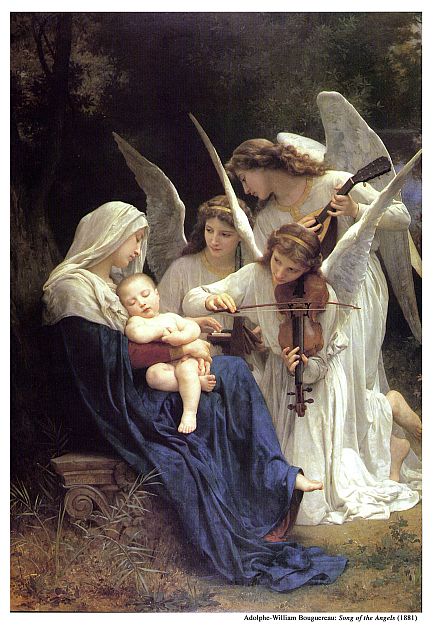
Song Of Angels – Bouguereau

Posted: March 2, 2011 by CatholicJules in Holy Pictures


A lovely and tender depiction of angels serenading the Infant Jesus by famed artist William Bouguereau.

Adolphe-William Bouguereau was a famous portrait artist born in La Rochelle, France on November 30, 1825. He followed the classical style of 16th century painters such as Raphael. Bouguereau painted for a number of Catholic Churches throughout the late 1800’s. He died in 1905.

Because We Belong To Christ

Posted: March 1, 2011 by CatholicJules in Memory Book

Everyday ask God to pour love for your brothers into your heart and to put love for you into theirs.  God can deny nothing to a community that prays this way, because it is His will that we love one another as he has loved us.

Where there is no love, put love and you will harvest love.  Susceptibility is charity’s worst enemy, humilty its best ally.  You should be intelligent and holy enough to be the first to give way in a quarrel; and never let squabbles over trifles harm your deep union with your brothers.  You may be in the right, but your duty is not to let the sun go down on your anger.  Resolve each day anew to pray for your brothers.  Pray that you may love, and love while you pray, and the grace of His love will find a way in.

Look on the call to brotherly love as the entry into an immense mystery, since it is your gateway into God Himself.  Where love is, there is God.  You, with your brethren, give God a body, express his presence, and signify His action.  Let your whole community become in this way a theophany of His love.

To express this love in authentic action, you must love sharing.  Share your time, table, roof,salaries and belongings.  Possess nothing so that one day you may, like Christ, be enriched by all you have given away.  Likewise, you should be able to say to each community member; all that is mine is yours.

THE JERUSALEM COMMUNITY RULE OF LIFE


Emmanuel Praise/Worship Session With Talk

Posted: February 27, 2011 by CatholicJules in Upcoming Events

Emmanuel

Date : 02 Mar 2011

Time : 8:00 pm

Topic : “Fasting & Almsgiving.” By Joseph Fernandez Of Gloria Patri Ministry.

Join us for the session followed by a potluck session at the end

Venue

Church of St Anthony
25 Woodlands Avenue 1
Singapore 739064
Thomas Aquinas Room

For Directions Click Here

February 27, 2011 – 8th Sunday in Ordinary Time

Posted: February 26, 2011 by CatholicJules in Sunday Reflections

Sunday Bible Reflections with Dr. Scott Hahn

Do Not Be Anxious

Readings:
Isaiah 49:14–15
Psalm 62:2–3, 6–9
1 Corinthians 4:1–5
Matthew 6:24–24

We are by nature prone to be anxious and troubled about many things.
In Sunday’s Gospel, Jesus confronts us with our most common fears. We are anxious mostly about how we will meet our material needs—for food and drink; for clothing; for security for tomorrow.
Yet in seeking security and comfort, we may unwittingly be handing ourselves over to servitude to “mammon,” Jesus warns. “Mammon” is an Aramaic word that refers to money or possessions.
Jesus is not condemning wealth. Nor is he saying that we shouldn’t work to earn our daily bread or to make provisions for our future.

It is a question of priorities and goals. What are we living for? Where is God in our lives?
Jesus insists that we need only to have faith in God and to trust in his Providence.
The readings this Sunday pose a challenge to us. Do we really believe that God cares for us, that he alone can provide for all our needs?

Do we believe that he loves us more than a mother loves the infant at her breast, as God himself promises in this week’s beautiful First Reading? Do we really trust that he is our rock and salvation, as we sing in the Psalm?
Jesus calls us to an intense realism about our lives. For all our worrying, none of us change the span of our days. None of us has anything that we have not received as a gift from God (see 1 Cor. 4:7).
St. Paul reminds us in the Epistle that when the Lord comes he will disclose the purposes of every heart.
We cannot serve both God and mammon. We must choose one or the other. Our faith cannot be partial. We must put our confidence in him and not be shaken by anxiety.

Let us resolve today to seek his Kingdom and his holiness before all else—confident that we are beloved sons and daughters, and that our Father in heaven will never forsake us.

The unfathomable depths of God

Posted: February 26, 2011 by CatholicJules in Memory Book

From an instruction by Saint Columban, abbot

God is everywhere in his immensity, and everywhere close at hand. As he says of himself: I am a God close at hand, not a God far off. The God we seek is not one who dwells at a distance from us, for we have him present with us, if only we are worthy. He dwells in us as the soul in the body, if only we are sound members of his, if we are dead to sin. Then in very truth he dwells in us, the one who said: I will dwell in them and walk among them. If we are worthy of his presence with us, then in truth we are made alive by him as his living members. As the Apostle says: In him we live and move and have our being.

Who, I ask, will search out the Most High in his own being, for he is beyond words or understanding? Who will penetrate the secrets of God? Who will boast that he knows the infinite God, who fills all things, yet encompasses all things, who pervades all things, yet reaches beyond all things, who holds all things in his hand, yet escapes the grasp of all things? No one has ever seen him as he is. No one must then presume to search for the unsearchable things of God: his nature, the manner of his existence, his selfhood. These are beyond telling, beyond scrutiny, beyond investigation. With simplicity, but also with fortitude, only believe that this is how God is and this is how he will be, for God is incapable of change.

Who then is God? He is Father, Son and Holy Spirit, one God. Do not look for any further answers concerning God. Those who want to understand the unfathomable depths of God must first consider the world of nature. Knowledge of the Trinity is rightly compared with the depth of the sea. Wisdom asks: Who will find out what is so very deep? As the depths of the sea are invisible to human sight, so the Godhead of the Trinity is found to be beyond the grasp of human understanding. If any one, I say, wants to know what he should believe he must not imagine that he understands better through speech than through belief; the knowledge of God that he seeks will be all the further off than it was before.

Seek then the highest wisdom, not by arguments in words but by the perfection of your life, not by speech but by the faith that comes from simplicity of heart, not from the learned speculations of the unrighteous. If you search by means of discussions for the God who cannot be defined in words, He will depart further from you than he was before. If you search for him by faith, wisdom will stand where wisdom lives, at the gates.Where wisdom is, wisdom will be seen, at least in part. But wisdom is also to some extent truly attained when the invisible God is the object of faith, in a way beyond our understanding, for we must believe in God, invisible as he is, though he is partially seen by a heart that is pure.


Meditation – The Foundation of Mental Prayer

Posted: February 24, 2011 by CatholicJules in Great Catholic Articles

Fr Andrew Apostoli, C.F.R.

If your spiritual life is to develop properly, you must learn how to meditate — the foundation of mental prayer. A great deal can be said about meditation, but we’ll have to limit ourselves to some basic points. I’d like to approach it by sharing something of my own experience.

When I first entered the seminary, I was already used to saying formal prayers, such as my morning and night prayers and some devotional prayers out of a little prayer booklet. But somehow, the idea of meditation seemed complicated. There was talk of different methods and steps in the meditation process. Even the meditation book from which a reflection was read daily to the community in the chapel listed “meditation points” to consider. I felt a bit apprehensive!

Nevertheless, after going to a few organized meditation periods, I realized that this basic form of mental prayer came quite naturally. There was nothing to be afraid of! I began by simply thinking about Jesus in the Gospels, about His words and actions, or about some important part of my Catholic faith, such as the Mass or God’s mercy. Then I found I wanted to talk to the Lord about what I was reflecting on.

In this way I came to realize that my thinking or reflecting (that’s the actual meditation) was leading me to new awareness and insights about Jesus and the truths of my Catholic faith. These insights, in turn, were stirring up various feelings within me (such feelings are called sentiments or affections). The more I meditated and came to new insights, the more I was led to speak with the Lord in my own words, having a loving conversation heart-to-Heart (mine with His). And that, quite simply, was mental prayer.

The Rosary and Stations of the Cross
In fact, I came to realize that I’d actually known for a long time what it is to meditate. For example, I’d done it for years whenever I prayed the Rosary. When reciting each of the fifteen decades, we meditate on one of the joyful, sorrowful, or glorious mysteries or significant events in the life of Jesus and His Blessed Mother.

As I constantly meditated on these mysteries, they became more meaningful for me. I began to see Jesus’ and Mary’s love in each mystery, and gradually realized they have that same love for me, too. By meditating, I was growing to know and love them more personally.

A similar thing was happening when I made the Stations of the Cross. Meditating on fourteen scenes from the passion and death of Our Lord, I experienced feelings (those sentiments or affections) of deeper gratitude to Jesus for all He suffered for me. There were feelings of deeper sorrow for my sins as well, since they caused Jesus to suffer so much. This, in turn, moved me to be more resolved, with the help of His grace, not to commit these sins again in the future.

Judging, then, from my own experience, I would say that many of us Catholics first learn to meditate by simply reciting the Rosary or making the Stations. As we seek to deepen this part of our mental prayer life, a few practical points about meditation and mental prayer may be helpful.

Formal Prayer vs. Mental Prayer
First, mental prayer (also called the prayer of the mind) usually develops naturally from formal prayer (or the prayer of the lips), as my own experience shows. A comparison between these two types of prayer can be useful. Recall St. John Damascene’s famous definition of prayer as “the raising of the mind and the heart to God.” In formal prayer, when we focus on the words of the prayer with our minds, the heart is then moved to love God with the sentiments contained in those words.

For example, if we recite an “Act of Faith,” the words prayed would logically stir up feelings or sentiments of faith in our hearts as we say something such as this: “God, You are all-knowing, and You reveal to us what we need to know and do to get to heaven. I believe in all that You have revealed to us! Please grant me a strong faith so that I will always believe what You teach us through Your Church.”

In mental prayer, however, the focus is not restricted by the words of a prayer formula. Rather, the focus of meditation is usually on a story, such as an event from the life of Jesus; or a teaching He gave, such as a parable; or something from the life of a saint, such as St. Thérèse; or something contained in a good spiritual book. My mind isn’t limited to the words, but moves through various details of the story or ideas contained in the teaching.

The mind, by reflecting on these details, can produce a far wider range of insights, which then stir more sentiments in the heart. The mind is freer to roam through this spiritual landscape. Thus the difference between formal prayer and the meditation of mental prayer is like the difference between reciting a poem, where each specific word is already given, and telling a story freely in your own words.

The Benefits of Meditation
Meditation as form of mental prayer has many benefits. One is a greater understanding and clarity regarding the teachings of our Catholic faith. By meditating, we go deeper into these realities and discover many valuable new insights that weren’t obvious at first sight.

St. John of the Cross used the image of mining for precious metals to describe this spiritual activity. If “there’s gold in them thar hills,” then the more you mine, the more you’ll find! The treasures of the Sacred Scriptures and other truths of our faith aren’t always obvious on the surface, but they’re limitless for those who bother to search for them.

Another benefit, as we’ve seen, is that our reflections stir up the vital sentiments of the heart so needed for loving and serving the Lord faithfully. These sentiments are really the most important fruit of mental prayer. They lead us to talk to God!

In fact, without these sentiments, we’d end up with a purely intellectual exercise, a mere reasoning process. Prayer requires talking with God, and that requires the sentiments.

In this regard, we should mention that beginners practicing mental prayer typically do much more reasoning or reflecting in the mind than speaking from the heart. But as time goes on, less reflection is needed to produce more sentiments. It’s like the growth of a human friendship.

When friends first meet, they need to ask lots of questions and share lots of facts about themselves to get to know each other better. After the friendship has grown, however, there are fewer questions but a deeper knowledge and more intense love for each other. In fact, when the reasoning in prayer becomes significantly less and the sentiments in the heart begin to predominate, it’s usually a sign that we’ve come to the third state or kind or prayer, called affective prayer (or the prayer of the heart).

Finally, the meditation of mental prayer helps us form the resolutions we need to grow in the love of God and our neighbor by a more conscious and consistent practice of the Christian virtues. Our meditations, in the light of the Holy Spirit and with the assistance of His grace, give us insights into how to apply the values of the Gospel, Church teachings, and the wisdom of the saints to our own daily lives. For all these reasons, the meditation that provides a foundation for mental prayer is a must for growth in Christian holiness!

Fr. Andrew Apostoli, C.F.R., is a priest of the Franciscan Friars of the Renewal, St. Felix Friary, 15 Trinity Plaza, Yonkers, NY 10701; 914-476-7279

Emmanuel Praise/Worship Session With Talk

Posted: February 20, 2011 by CatholicJules in Upcoming Events

Emmanuel

Date : 23rd Feb 2011

Time : 8:00 pm

Topic : “Setting The Right Frequency- God is communicating with you.” By Christian Chua from Church Of Christ The King Charismatic Group.  Christian is noted speaker in the Commercial Sector, he has used his oratorical gift to serve God and has much to share.

Join us for the session followed by a potluck session at the end

Venue

Church of St Anthony
25 Woodlands Avenue 1
Singapore 739064
Thomas Aquinas Room

For Directions Click Here

February 20, 2011 – Seventh Sunday in Ordinary Time

Posted: February 18, 2011 by CatholicJules in Sunday Reflections

SUNDAY BIBLE REFLECTIONS BY DR. SCOTT HAHN

February 20, 2011 – Seventh Sunday in Ordinary Time

Holy as God

Readings:
Leviticus 19:1–2, 17–18
Psalm 103:1–4, 8, 10, 12–13
1 Corinthians 3:16–23
Matthew 5:38–48

We are called to the holiness of God. That is the extraordinary claim made in both the First Reading and Gospel this Sunday.

Yet how is possible that we can be perfect as our Father in heaven is perfect?

Jesus explains that we must be imitators of God as his beloved children (Eph. 5:1–2).

As God does, we must love without limit—with a love that does not distinguish between friend and foe, overcoming evil with good (see Rom. 12:21).

Jesus himself, in his Passion and death, gave us the perfect example of the love that we are called to.

He offered no resistance to the evil—even though he could have commanded twelve legions of angels to fight alongside him. He offered his face to be struck and spit upon. He allowed his garments to be stripped from him. He marched as his enemies compelled him to the Place of the Skull. On the cross he prayed for those who persecuted him (see Matt. 26:53–54, 67; 27:28, 32; Luke 23:34).

In all this he showed himself to be the perfect Son of God. By his grace, and through our imitation of him, he promises that we too can become children of our heavenly Father.

God does not deal with us as we deserve, as we sing in this week’s Psalm. He loves us with a Father’s love. He saves us from ruin. He forgives our transgressions.

He loved us even when we had made ourselves his enemies through our sinfulness. While we were yet sinners, Christ died for us (see Rom. 5:8).

We have been bought with the price of the blood of God’s only Son (see 1 Cor. 6:20). We belong to Christ now, as St. Paul says in this week’s Epistle. By our baptism, we have been made temples of his Holy Spirit.

And we have been saved to share in his holiness and perfection. So let us glorify him by our lives lived in his service, loving as he loves.


A Catholic on National Talk Radio

Posted: February 16, 2011 by CatholicJules in Great Catholic Articles

A Catholic on National Talk Radio | Daily News | NCRegister.com.

A scan on the radio dial at just about any time of the day will surface a handful of radio talk shows with hosts clamoring to be the voice of reason and to have the answers to solving problems of all types.

One host, however, is very confident that he truly does have something to offer as he unabashedly gives his Catholic take on today’s headline issues. His name is Allen Hunt, and his show, the Allen Hunt Show can be heard each weeknight on 150 stations across the nation.

His viewpoint wasn’t always Catholic, however. He recently sat down to talk about his conversion to the Catholic faith and how it has shaped his radio platform.
Tell me about your journey from Methodist pastor for 20 years to entering the Catholic Church.

I grew up in a culture of Methodist pastors. My uncle, grandfather and great-grandfather were all Methodist pastors. I didn’t know much about the Catholic Church when I was growing up. After I finished seminary at Emory University in Atlanta, I went on to do some graduate-level work at Yale University on early Christian history and the New Testament.

My first exposure to the Catholic Church came while I was there in New England. Much of it came from my friendship with a Dominican friar who was also in the graduate program. That was in the 1990s, and many seeds were planted then. In the next decade or so, God used a number of experiences to bring me home to the Church. I became Catholic on Jan. 6, 2008, on the feast of the Epiphany.
What finally brought you home?

There were three big things that led to me entering the Church. First was a growing sense of Christ’s real presence in the Eucharist. Secondly is what I call doctrine by democracy. In general, in the Protestant church, everything is up to a vote every few years. For instance, in the Methodist church, every four years we would get together to vote whether or not homosexual behavior is acceptable or not and whether it was time to ordain openly gay pastors.

The third area of reflection was Jesus’ prayer in John 17. There, Jesus pleads for unity in the body of Christ. The Protestant church has split into 33,000 different strands. What message does that fractioning send to the world? As well, how much this division must grieve God’s heart.

I am only one person, but am trying to repair some of that damage by coming home to the mother Church.
At the time of your decision to pursue the Catholic Church you were leading a megachurch in Atlanta. How did your congregation react to your decision?

I had stepped down from my role as senior pastor July 1, 2007, to go into full-time radio ministry. Once I had left the role of pastor, it gave me the freedom to explore and discover the faith.

By and large, most people were supportive of my decision. As is typical of many megachurches, a lot of the members are ex-Catholics. I got a lot of e-mails and phone calls from people who were asking, “What do you see that I don’t see?” There were only a handful of people who were hostile towards me. But after years of being a pastor, I was used to people being hostile towards me.

Tell me about the Allen Hunt Show.

We started the show in 2006 with just a few hours on Sunday afternoon. We didn’t plan on being on Christian or Catholic radio. The show began as a way to engage the mainstream on all the issues of life through the lens of faith.

We want to come at things with a moral compass and engage people of all walks of life. I am unapologetic and non-defensive on who I am, what I stand for and where I’m coming from. It is mainstream radio done for you by a very Catholic guy.
Is there an evangelization element to your program?

I share my Catholic faith, but I don’t promote it — and I think that is at the heart of the show. I am who I am, and I am comfortable with who I am. I want to engage people who agree or disagree with me in a grace-filled way, as opposed to bomb throwing, which seems to be the standard these days. 

I think a lot of people find it very heartening that there is someone like them on mainstream radio. Then there is another group of people who find this fact strange to them. And then there is a small, vocal group who can’t stand my faith, but they keep listening. As long as they are listening, I’m content with that. Let’s talk and have a civil conversation.
What’s the future for you and the program?

We need to continue to do what God wants us to do. I think what that means is to continue to engage the culture with a reasonable voice of faith. Our long-term goal is to be on over 300 stations each week, Monday through Friday.
What is your take on the debate on whether or not conservative talk radio was to blame for the Tuscon shooting, the assassination attempt on Rep. Gabrielle Giffords?
Neither talk radio nor inflamed political rhetoric caused a mentally deranged young man to indiscriminately shoot people in Tucson any more than they caused the Virginia Tech massacre or even the silly Dunkin Donuts drive-through tirade last month regarding the lack of sprinkled donuts.
As you talk to America, day in and day out, what are two or three issues or themes that come up again and again? What is the temperament or the mood of the nation, so to speak?

In general, there is a self-confidence crisis in America. We have forgotten who we are. People are concerned and feel like we have lost something, even though they cannot always pinpoint what that is. Part of this is a natural response to a very long recession that has drained a lot of people’s passion and optimism. They worry we may never emerge from it. Part of this is a response to the lack of moral compass that we now routinely experience in our public life together, in our entertainment and even in our public schools.

Register correspondent Eddie O’Neill writes from Green Bay, Wisconsin.

February 13, 2011 – 6th Sunday in Ordinary Time

Posted: February 12, 2011 by CatholicJules in Sunday Reflections

Sunday Bible Reflections with Dr. Scott Hahn

Affair of the Heart

Readings:
Sirach 15:15–20
Psalm 119:1–2, 4–5, 17–18, 33–34
1 Corinthians 2:6–10
Matthew 5:17–37

Jesus tells us in the Gospel this week that he has come not to abolish but to “fulfill” the Law of Moses and the teachings of the prophets.

His Gospel reveals the deeper meaning and purpose of the Ten Commandments and the moral Law of the Old Testament. But his Gospel also transcends the Law. He demands a morality far greater than that accomplished by the most pious of Jews, the scribes and Pharisees.

Outward observance of the Law is not enough. It is not enough that we do not murder, commit adultery, divorce, or lie.

The law of the new covenant is a law that God writes on the heart (see Jer. 31:31–34). The heart is the seat of our motivations, the place from which our words and actions proceed (see Matt. 6:21; 15:18–20).

Jesus this week calls us to train our hearts, to master our passions and emotions. And Jesus demands the full obedience of our hearts (see Rom. 6:17). He calls us to love God with all our hearts, and to do his will from the heart (see Matt. 22:37; Eph. 6:6)

God never asks more of us than we are capable. That is the message of this week’s First Reading. It is up to us to choose life over death, to choose the waters of eternal life over the fires of ungodliness and sin.

By his life, death, and resurrection, Jesus has shown us that it is possible to keep his commandments. In baptism, he has given us his Spirit that his Law might be fulfilled in us (Rom. 8:4).

The wisdom of the Gospel surpasses all the wisdom of this age that is passing away, St. Paul tells us in the Epistle. The revelation of this wisdom fulfills God’s plan from before all ages.

Let us trust in this wisdom, and live by his Kingdom law.

As we do in this week’s Psalm, let us pray that we grow in being better able to live his Gospel, and to seek the Father with all our heart.

FTFF

Posted: February 10, 2011 by CatholicJules in Memory Book, Personal Thoughts & Reflections

Freely, Totally, Faithfully, Fruitfully


Christ gives us all the above, when he gives of himself in the Eucharist he instituted.

Use this easy to remember gauge or rather ‘A Love Standard’ when we give of ourselves whether in marriage, or in servitude of others.

I think this is a simple but wonderful prayer…..

In Search Of…

Posted: February 6, 2011 by CatholicJules in Great Catholic Articles

In Search Of The Full Gospel

By Deborah Danielski

Like many converts to the Catholic Church, Deborah Danielski wandered through a variety of back roads and cul-de-sacs on her way home. Her search for the full gospel was a frustrating one, filled with wrong turns and complicated by a drinking problem and two abusive marriages. But Christ calls His sheep by name, and Deborah heard His voice and followed Him home to the Catholic Church. She recounts for you the details of her conversion story and how she found the fullness of the Christian Faith where she least expected it.

As my husband Ed and I drove down a quiet rural Illinois highway one day, we passed a large wooden sign at the side of the road. The hand-painted lettering on the sign proclaimed, “Full Gospel Church —1/2 mile.” “What is a ‘full gospel’ church?” Ed asked. As I attempted to explain, a light came on in my mind, and suddenly I knew. The “full gospel” was what I had been searching for all of my adult life, at times actively, at other times without even being aware of what it was I sought. ”

Almost immediately, I sensed a brilliant light that seemed to move toward me. I felt immersed in God’s presence and love. I simultaneously laughed and cried and when I opened my mouth to speak, I was singing praises to God in a language I had never learned.” 

Apart from a brief encounter with Jesus at age 6, I grew up pretty much without religion. When I got to my teens, I took the route all-too-common in the ’60s, “looking for love in all the wrong places.” Just before my 17th birthday, I found myself pregnant and standing before a minister, vowing to “love, honor and obey” my 17-year-old boyfriend, while thinking about the red-checkered tablecloth I’d buy for our tiny new kitchen. 

By the time I reached my mid-20s, I was into my second abusive marriage and was the mother of three. I’d messed up my life just about as much as I possibly could. Near despair, I determined it was time to make some effort to change my miserable life. I began by seeking counseling. That was when a series of incredible “coincidences” began to occur through which the Spirit of the Lord led me to the gospel.

“How much do you drink?” the counselor asked only a short way into the first session. “What does that have to do with anything?” I wondered to myself. “Oh, not too much,” I responded. “Maybe about a six-pack a day.” He raised his eyebrows. ” ‘Not too much?’ Six beers a day is ‘not too much?’ ” Had I been completely honest, I would have told him that I often drank more than that. Much to my surprise, he referred me to an alcohol abuse counselor. I was pretty sure drinking wasn’t my problem, but knowing I had exhausted my own resources, I made the appointment.

“The first thing you have to do is admit the problem is beyond your control and submit it to God,” said the counselor. “Oh great,” I thought. “This will never work.” Sure, I could admit the problem was beyond my control, otherwise I wouldn’t have been there, but submit it to God? No way.

“I don’t believe in God,” I countered. “It doesn’t have to be any particular god,” she said, “but some form of ‘supreme being,’ however you understand Him.” I shook my head. “I don’t believe in any supreme being.” The counselor smiled. “You consider yourself a pretty open-minded person, don’t you?” It was exactly the right question. I felt I was the most open-minded person I knew. “Definitely,” I shot back. “But you’ve closed your mind to God,” she suggested. She was right. I had closed my mind and heart to God. Perhaps I could give it a try, I thought. I had nothing to lose. My stress goes down but my curiosity goes up. 

Out of hand, I rejected Christianity as too “traditional.” So, in search of a more palatable option, I went to the local library and checked out a couple of books on yoga and Hinduism and began my search for “God.” Soon I was practicing transcendental meditation at least 20 minutes a day. I was more relaxed, less stressed out about my problems, but I hadn’t found God. And I knew it.

At the same time, my husband Melvin was commuting to work with a man who was a Jehovah’s Witness. Every day Melvin would come home from work telling me something new John had said about God, Jesus, and the Bible. I had never read the Bible and we didn’t even own one, but I was sure what John was telling Melvin couldn’t possibly be true. Nonetheless, I found myself getting more and more curious. Then one day I was reading a book about yoga and came across the following claim, “Truly spiritual people are always vegetarians. Even in the Hebrew Bible, God gave man the fruits of the trees to be their food, not the animals of the field.” I was puzzled. I’d known many Christians over the years, and not one of them had been a vegetarian.

My curiosity got the best of me. I went out to the store and bought a Bible. I just had to know if what that author and the Jehovah’s Witness were saying was true. That night, I began to read the Gospel of Matthew, and immediately fell in love with Jesus. I knew without a doubt that no mere man could have invented the stories I read. If man were even capable of imagining God would become human, he would at least have Him born in a castle, I thought, but never in a manger. “Blessed are the poor in spirit, for theirs is the kingdom of heaven,” Jesus told me in Scripture. “Blessed are they who mourn, for they shall be comforted. Blessed are the meek, for they will inherit the earth.” 

These were definitely not the words of a mere man. In my experience, the meek never inherited anything but trouble. I lay there in bed, reading all night long, continuing into Mark, Luke and John. Just before daybreak, I rose, knelt by the side of my bed and began to pray. As I prayed, I experienced an overwhelming sense of Christ’s presence. It was as though He stood at my side with His hand resting on my shoulder, and I was nearly overcome with a feeling of love more powerful than any I had ever imagined. I knew without a doubt that Jesus loved me, and I knew my sinful past was forgiven as I surrendered my life to this incomprehensible God/Man Who captured my heart. St. Paul knew what he was talking about.

“Coincidentally,” my children were attending Bible school that week with our Baptist neighbors. That Sunday morning, I attended a worship service at their small, independent Baptist church and publicly professed my faith in Christ. The next week I was baptized by immersion. For the next year, I seldom missed a Sunday morning, Sunday evening or Wednesday night service. And I seldom allowed a day to pass without spending some time reading the Holy Scriptures and in prayer. I had tasted that the Lord was good, but I began to sense there was more to Christ than I had found. There was something missing. I sensed that I had not yet found the full gospel.

A friend and fellow Baptist, Marsha, began to tell me about the “baptism of the Holy Spirit” and the gifts of the Spirit. I searched the Scriptures and read every publication I could find on the subject. Marsha was involved in the “Women’s Aglow Fellowship,” an interdenominational women’s group associated with the “Full Gospel Businessmen’s Association.” I attended their next monthly meeting and was excited by the freedom with which this group praised God. 

Expecting to feel uneasy if any of the gifts of the Spirit were manifested, I was amazed when the group began to glorify God in a host of other languages and the only things I felt were joy, peace and fulfillment. “Yes, this is it,” I thought. This was what I had been missing. 

At the end of the service, I went forward for prayer. More than anything in the world I wanted this “full gospel.” As I knelt at the altar with my eyes closed in prayer, the leader laid her hands on my head. Almost immediately, I sensed a brilliant light in a far corner of the room that seemed to move toward me, and I soon felt immersed in God’s presence and love. I simultaneously laughed and cried and when I opened my mouth to speak, I was singing — singing praises to God in a language I had never learned.

Those were some of the best years of my life. I loved God, I loved my family, I loved everyone. Certainly there were trials, but I had the Spirit of God to uphold me through anything, or so I thought. Since my Baptist pastor did not believe in the gifts of the Spirit, I soon moved my membership to an Assembly of God. After a while, I came to believe that as a child of God, I had the “right” to walk always in divine health and material prosperity. With God as my Father, I believed nothing evil could touch me. I was satisfied that I had found the fullness of God and was convinced I was beyond reproach. I still avidly read Scripture, but I must have missed St. Paul’s warning: “Therefore let any one who thinks that he stands take heed lest he fall” (1 Cor. 10:12). Did God betray me? There was a major fall in store for me and when it hit, the entire structure of my new life was shattered.

For six years Melvin and I had prayed for a child. I had my two children from my first marriage with me only on weekends. When Melvin’s brother had been tragically killed two years before, we adopted his 3-year-old son. But Melvin desperately wanted a child of his own. One Wednesday evening as I stood praising God at the end of a worship service, I felt a sudden pain in my lower abdomen. I “rebuked” it, as I had been taught. But nothing happened. In fact, the pain grew worse. I went forward to the altar and asked two friends to help pray for my healing. We prayed and prayed. Still the pain worsened. The pastor was closing the church, so seven friends and I went to one of their homes, where we continued to pray and rebuke the pain in my abdomen. Still it did not yield. Finally I asked someone to take me to the hospital. I was experiencing my second tubal pregnancy. The tube burst and immediate surgery was required to save my life. Nothing that was tried could save my baby. I was devastated. Not only had my faith failed to heal my body, but it was now evident that I would never have another child, and my husband would never have one of his own — at least not with me.

As soon as I was released from the hospital, I was back in church, just in time to hear a sermon I will never forget. “Anyone who claims to be a Christian,” the preacher roared, “and would willingly go into a hospital and let someone cut on them with a knife is deluded!” I sat through the remainder of that sermon about “true faith,” but when it ended, I left that church, never to return. I wasn’t sure whether their theology was skewed or I had just utterly failed, but it put me into a tailspin. What had it all meant?, I wondered. Was what happened to me really due to a lack of faith? Was it my own fault? What could I have done differently? Or could all I had previously experienced — all the joy in praying, the warm feelings, the power I felt in “rebuking” sickness and evil, and speaking in “tongues” — could all that have been nothing more than wishful thinking?

I never spoke to that pastor again and my friends just didn’t seem to have the answers I needed. I soon stopped reading Scripture and stopped praying. I felt God had betrayed me, and I had no idea where to turn. I still believed in Him. I still believed in the gospel, but I no longer knew what it meant for me, and frankly, I was no longer inclined to find out.

I left my husband and found my mother. Melvin soon returned to his excessive drinking and abuse. My faith was shattered, but a spark of self-esteem remained. For the first time in my life, I felt I could make it on my own. Though I made far too little money to support myself in the manner to which I had grown accustomed, that no longer mattered. All I wanted was a little peace. I knew I would rather live in a hole in a wall in peace, than to continue the nearly constant battles with my husband. It was not easy to admit to another failure, but after 13 years in my second marriage, I left Melvin and obtained a second divorce.

Three years later, God gave me one of the greatest gifts I would ever receive from Him, my current husband, Ed. Though I had turned my back on Him, Christ had not abandoned me. Not long after my marriage to Ed, a series of “coincidences” began to occur in my life that made it impossible for me to ignore Christ and His full gospel any longer. My friend Judy, a Catholic with whom I had never discussed God or religion, unexpectedly gave me a book for my 43rd birthday. One glance at the cover of the book made me question her sanity. The book was about apparitions of the Virgin Mary, and the cover bore her picture. Though I knew nothing about apparitions, I had strong convictions about the Virgin Mary. I knew she had existed and I knew she’d given birth to our Lord, but apart from that, I’d rarely given her a second thought, except to condemn Catholics for “worshipping” her.

“I don’t know if you’ll like it,” Judy said as I held the book in my hand, looking incredulously at its cover. “It’s . . . spiritual.” I was polite. “Oh, I like spiritual books,” I said, all the while wondering what could ever have possessed anyone to give me a book about Mary. My being polite was a big mistake. It opened the door for Judy to spend the next hour-and-a-half telling me all about her new and wonderful relationship with the Virgin Mary. She told me Mary had become her dearest friend and closest confidante. I thought she’d gone over the edge. “Lord, help her,” I prayed. But I reluctantly accepted the book and out of curiosity, went home and began to read it.

Almost immediately, I felt the Holy Spirit move in my heart for the first time in years. I continued to read, and soon sensed Christ asking me to open my heart to His mother. My life was not such a mess as it had been when I first began to seek the Lord. Considering my past mistakes, I was relatively happy and successful. I hadn’t consciously felt a need for anything more. But God in His infinite wisdom and mercy stirred again in me that lifelong yearning to know Him in His fullness. In my hands that day was the answer. How better to learn the “full gospel” than from the very Mother of God? Who could more effectively lead me to the fullness of Christ than the human being who carried our Lord in her womb, nourished Him at her breast and lived physically and intimately with Him every moment of His life — the one who not only bore witness to the Word, but actually bore the Word? “And immediately something like scales fell…” 

I finished the book Judy gave me and proceeded to read everything I could get my hands on about apparitions and visions of the Blessed Mother. I devoured anything I could find regarding Fatima. I came to believe there was a profound message behind these Marian apparitions. “There will never be peace for individuals or mankind until you turn your hearts back to your Creator,” Mary seemed to be saying. “God loves you. Repent and pray for your own conversion, and for the conversion of the world.” I began to do just that, and many of my misconceptions about Catholicism were soon unmasked. Catholics didn’t worship Mary, I realized. They were devoted to her as the Mother of Christ. They reverenced Mary as the first Christian. They embraced Christ’s precious gift from the Cross — the gift of His mother to His body, the Church (cf. John 19:25-27). Statues of Mary in Catholic churches were no more “false idols” than were the pictures of my beloved husband and children in my home. 

I fell in love with my spiritual mother. I studied the Roman Catholic Faith. I read books by Scott Hahn, Alan Schreck, Karl Keating, Mark Shea, Patrick Madrid and Thomas Howard. I reread chapter six of the Gospel of John. “Unless you eat the flesh of the Son of Man and drink his blood, you do not have life in you,” Christ said to the skeptical Jews. I realized Holy Communion could be much more than symbolic of the Last Supper. By the power of the Holy Spirit in the Catholic Mass, Christ is truly present and imparts His life through the bread and wine. 

While wrestling with the Catholic meaning of the communion of saints, Christ’s words to the Sadducees in Matthew 22:31-32 came to life. “Have you not read what was said to you by God, ‘I am the God of Abraham, the God of Isaac, and the God of Jacob’? He is not God of the dead, but of the living.” It excited me to learn that the saints who lived before us had not been cut off from the Body of Christ just because they had died. I was as free to ask any of them to pray for me as I was to ask anyone here on earth. As I learned more about our covenant relationship with God, infant baptism took on a whole new meaning. Why wouldn’t our Father provide a means for our newborn children to enter that relationship, just as He had for the Jews in circumcision? In direct contrast to what I’d previously believed, I found Catholics had an objective faith totally absent from any other church I’d attended. I learned God always imparts His grace through the sacraments, regardless of the recipient’s faith. Sure, faith was necessary for the sacramental grace to flourish, but it was God Who acted first, not man.

“Catholics don’t believe in reading the Bible,” I’d been taught. But when I began to attend Mass, I heard far more Scripture read at every service than I had ever heard at any Protestant church.

“No priest can forgive sin,” I’d previously believed. But if Christ were present on earth, would I choose to sit in my own home and confess mentally to Him, hoping and praying I’d been forgiven? Or would I go to Him in person and hear the words of forgiveness directly from His mouth? That is exactly the reassurance the sacrament of reconciliation offers, I realized. Christ is indeed present and available to forgive sin, in His Body the Church, and in His representatives, the priests. It all began to make sense, and it was all found in the Catholic Church, the one Church on earth I had believed I would never enter. Much to my surprise, everything I learned about the Catholic Church expanded and enriched my faith, but I continued to have one major concern. Would I have to give up my belief in the baptism and gifts of the Holy Spirit in order to become Catholic? One final obstacle to the fullness of truth and grace.

I was still struggling with that dilemma when Ed and I attended a Marriage Encounter weekend (I’m currently going through the process prescribed by the Church of having my marriage situation regularized). At the closing Mass, the couples formed a circle as Father Tom Griffith distributed Holy Communion. Having not yet committed to or been accepted into the Catholic Church, I gently shook my head when Father Tom came to me. Rather than passing on to the next person, he stopped, laid hands on Ed and me, and prayed. When Father Tom prayed, I felt so overwhelmed by the power of the Holy Spirit that my knees grew weak and I nearly fell over. I was astonished. I had never believed a Catholic priest could pray with such power. I was delighted to discover the Holy Spirit was indeed alive and well in at least some members of the Catholic Church.

Having come this far in my journey toward Catholicism, I had to know immediately what my own parish priest believed about the baptism and gifts of the Spirit. “Is it okay for a Catholic to believe in the baptism and gifts of the Holy Spirit?” I nervously asked Father Tony Nugent. “Of course!” he responded. “Though we receive the Holy Spirit at baptism, we don’t always experience a full release of the power of the Spirit until much later,” he continued, relating his own experience of “the full release of the Spirit” as an adult priest. “Praise God,” I gasped. Relieved and encouraged by his incredible response, I poured out my soul. I told Father Tony all about my previous spiritual experiences, including the one that had led me to abandon my faith in God. “Do you believe it is always God’s will to heal?” I asked. “Yes,” he responded. “But He may not always heal in the way we want or expect. If God had granted you the physical healing you sought that day, you would not be here with me today,” he said, assuring me I was on the right path. “He healed you spiritually instead.”

In that moment, I recalled Romans 8:28: “We know that in everything God works for good with those who love him, who are called according to his purpose.” What had seemed to be the worst experience of my life, God had worked for my ultimate good. Another enormous burden was lifted from my soul. Finally, I knew I had it all. I had a loving Heavenly Father Who called me out of darkness and offered me life through the Body and Blood of His only begotten Son, nearly 2,000 years ago in the crucifixion, and today in the Holy Eucharist. I had the Son, Who humbled Himself, became man and was obedient unto death to give the power of the Holy Spirit to His Body, the Church. I had the Holy Spirit, Who enlightens, cleanses and empowers. I had His spouse, my spiritual mother, the Blessed Virgin Mary, to show me the way. I had Christ’s Church, built upon the rock, led by the Holy Spirit into all truth and against which the gates of hell will never prevail. And within that Church, I had priests and the fellowship of a group of believers who embraced both the gifts of the Holy Spirit and devotion to our Blessed Mother. At last, the full gospel was mine.

February 6, 2011 – 5th Sunday in Ordinary Time

Posted: February 5, 2011 by CatholicJules in Sunday Reflections

Sunday Bible Reflections by Dr. Scott Hahn

Light Breaking Forth

Readings:
Isaiah 58:7-10
Psalm 112:4-9
1 Corinthians 2:1-5
Matthew 5:13-16

Jesus came among us as light to scatter the darkness of a fallen world.

As his disciples, we too are called to be “the light of the world,” he tells us in the Gospel this Sunday (see John 1:4–4, 9; 8:12; 9:5).

All three images that Jesus uses to describe the Church are associated with the identity and vocation of Israel.

God forever aligned his Kingdom with the Kingdom of David and his sons by a “covenant of salt,” salt being a sign of permanence and purity (see 2 Chron. 13:5, 8; Lev. 2:13; Ezek. 43:24).

Jerusalem was to be a city set on a hill, high above all others, drawing all nations towards the glorious light streaming from her Temple (see Isa. 2:2; 60:1–3).

And Israel was given the mission of being a light to the nations, that God’s salvation would reach to the ends of the earth (see Isa. 42:6; 49:6).

The liturgy shows us this week that the Church, and every Christian, is called to fulfill Israel’s mission.

By our faith and good works we are to make the light of God’s life break forth in the darkness, as we sing in this week’s Psalm.

This week’s readings remind us that our faith can never be a private affair, something we can hide as if under a basket.

We are to pour ourselves out for the afflicted, as Isaiah tells us in the First Reading. Our light must shine as a ray of God’s mercy for all who are poor, hungry, naked, and enslaved.

There must be a transparent quality to our lives. Our friends and family, our neighbors and fellow citizens, should see reflected in us the light of Christ and through us be attracted to the saving truths of the Gospel.

So let us pray that we, like St. Paul in the Epistle, might proclaim with our whole lives, “Christ and him crucified.”

(Apologetics) John Vs Mike – 10

Posted: February 4, 2011 by CatholicJules in Apologetics


Mike Gendron 

John,

Your rebuke of God’s word is not backed up by any official references from the Catholic religion. In my article I state the source of my information but you appear to give your opinions instead of backing up your claims with the laughable “infallible” teachings of the magesterium.

You say Catholics are in purgatory because “they are not yet free from imperfections.” They ought to convert to Christ because born again Christians are made perfect forever at the moment of justification by the one offering of Jesus 2000 years ago (Heb. 10:14).

Where do you get the statement “grace earned for us by Jesus with His death on the Cross.” Did Jesus really have to earn grace?

Where do you get the idea that the fire of Purgatory is “the burning fire of God’s love for us.”
You said, “And how is it that we are able to be purified by God’s love?  By the merits and grace earned for us by Jesus with His death on the Cross.  In other words, the purging of imperfections that souls experience in Purgatory is as a result of the merits and grace earned for us by Jesus with His death on the Cross.  It is by the blood of Christ that souls in Purgatory are perfected.  There is no other means of perfection available to us.”
According to paragraph-1475 it has nothing to do with God’s love or Jesus but instead the merits of other Catholics. “In the communion of saints, “a perennial link of charity exists between the faithful who have already reached their heavenly home, those who are expiating their sins in purgatory and those who are still pilgrims on earth. between them there is, too, an abundant exchange of all good things.” In this wonderful exchange, the holiness of one profits others, well beyond the harm that the sin of one could cause others. Thus recourse to the communion of saints lets the contrite sinner be more promptly and efficaciously purified of the punishments for sin.”


You say “Catholic teaching that the Mass is the re–presentation of the sacrifice of Christ on the Cross and that the Mass is all about the Body and Blood of Jesus.  Therefore, if Masses are being offered for those in Purgatory, then it means that any sins and inclination to sin and punishment due to sin that are purged  So, to represent the Catholic Faith as teaching that the purgations of Purgatory have absolutely nothing to do with the blood of Christ, after what he said earlier about Masses being said for those in Purgatory, seems to me to be a deliberate misrepresentation of Catholic teaching.”

It is you who appears not know what the Mass is?  It is, according to your Catechism 1367 The sacrifice of Christ and the sacrifice of the Eucharist are one single sacrifice: “The victim is one and the same: the same now offers through the ministry of priests, who then offered himself on the cross; only the manner of offering is different.” “And since in this divine sacrifice which is celebrated in the Mass, the same Christ who offered himself once in a bloody manner on the altar of the cross is contained and is offered in an unbloody manner. Let me ask you this – how can say the purging in Purgatory is “by the blood of Christ” when the Mass is offered in an unbloody manner. Catholic teaching is not only false it is without logic or consistency.


John, I have compassion for you and all those who are being deceived in the name of Christ. Come out of your false religion and worship God in Spirit and truth before it is too late.

Mike Gendron

————————————————————————————

Mike Gendron

John,

Your rebuke of God’s word is not backed up by any official references from the Catholic religion. In my article I state the source of my information but you appear to give your opinions instead of backing up your claims with the laughable “infallible” teachings of the magesterium. You say Catholics are in purgatory because “they are not yet free from imperfections.” They ought to convert to Christ because born again Christians are made perfect forever at the moment of justification by the one offering of Jesus 2000 years ago (Heb. 10:14).

John Martignoni

Mike,

Gee, good thing you don’t like condescending emails, right?  Anyway, I am not rebuking God’s Word, I am rebuking man’s word and, in particular, I am rebuking your word.  Your fallible, man-made, non-authoritative, biased and bigoted word.

You speak of the “laughable infallible teachings of the [M]agisterium,” yet you tend to also speak as if you yourself are infallible.  Do you believe your private interpretations of Scripture to indeed be infallible?  And, if not, will you then admit that your private, fallible interpretations of Scripture, in regard to Purgatory and other such Catholic teachings, could be wrong?  You won’t admit that, though, will you?  You know why?  Pride, Mike…pride.  You are too proud to admit that you could be wrong.  That your interpretations are indeed fallible and, therefore, prone to error.

Heb 10:14, “For by a single offering He has perfected for all time those who are sanctified.”  Absolutely. But, you seem to be claiming to be perfect, Mike, is that right?  So, you are without sin?  You never commit any sin, whatsoever?  You never have a bad thought or do a bad deed?  Really?!

Well, Mike, Catholic teaching is in perfect unison with Heb 10:14, as it is with each and every passage of Scripture. But, contrary to your fallible private interpretation of this passage, it is not saying that those who are perfected are automatically perfected for all time and can never again sin, if so, then why does Paul so often remind the Christians he writes to about avoiding sin?  If you look at the context, this verse is comparing the sacrifice of Christ to the sacrifices of the Old Covenant.  Those had to be offered over and over again and did not take away sins.  The sacrifice of Christ, however, was once for all time.  This one sacrifice was indeed sufficient to sanctify and perfect all men for all of time, but this verse is not saying that a man cannot lose his sanctification if he later turns away from the Lord and sins.

Look at Heb 10:38, “…but my righteous one shall live by faith and if he shrinks back, my soul has no pleasure in him.” Why would God talk about His righteous one shrinking back, if his righteous one has been perfected for all time?  And, in Heb 6:4-6, it talks about those who have repented, and who have “tasted the heavenly gift” and who have “become partakers of the Holy Spirit” and who have “tasted the goodness of the Word of God.”  Those are Christians, right?  I mean, non-believers can’t be said to have become partakers of the Holy Spirit, can they?  Of course not.  So, what does this passage then say about these Christians?  It says that they can commit apostasy.  What does that do to your fallible interpretation of Heb 10:14?  Kind of messes it up, doesn’t it?

Regarding giving you my opinion, I do no such thing.  All throughout my dissection of your article on Purgatory and your article on false teachers, I have cited Scripture and the teachings of the Church.  Now, you may not agree with what the Church teaches, but that is not justification to knowingly misrepresent what the Church teaches.  Which you have done throughout your articles.  By the way, what sources did you give?  You cited the Catechism, out of context, and you give your private, fallible interpretation of Scripture.  Is that what you consider your sources?

Mike Gendron

Where do you get the statement “grace earned for us by Jesus with His death on the Cross.” Did Jesus really have to earn grace?  Where do you get the idea that the fire of Purgatory is “the burning fire of God’s love for us.” You said, “And how is it that we are able to be purified by God’s love?  By the merits and grace earned for us by Jesus with His death on the Cross.  In other words, the purging of imperfections that souls experience in Purgatory is as a result of the merits and grace earned for us by Jesus with His death on the Cross.  It is by the blood of Christ that souls in Purgatory are perfected.  There is no other means of perfection available to us.” According to paragraph-1475 it has nothing to do with God’s love or Jesus but instead the merits of other Catholics. “In the communion of saints, “a perennial link of charity exists between the faithful who have already reached their heavenly home, those who are expiating their sins in purgatory and those who are still pilgrims on earth. between them there is, too, an abundant exchange of all good things.” In this wonderful exchange, the holiness of one profits others, well beyond the harm that the sin of one could cause others. Thus recourse to the communion of saints lets the contrite sinner be more promptly and efficaciously purified of the punishments for sin.

John Martignoni

Jesus did not have to earn anything for himself – once again you twist someone’s words to suit your purposes.  Jesus’ death on the Cross opened up for us the floodgates of God’s mercy and grace.  He didn’t earn it for Himself, He did it for us.  Do you believe we could merit God’s grace all on our own without Jesus’ death on the Cross?  That’s what you seem to be implying here.

Where did I get the idea that the fire of Purgatory is “the burning fire of God’s love for us?”  Well, how about from the Bible?  Heb 12:29, “For our God is a consuming fire.”  1 Cor 3:14, “If the work which any man has built on the foundation (Jesus Christ) survives, he will receive a reward.  If any man’s work is burned up (consumed), he will suffer loss, though he himself will be saved, but only as through fire.”  Let’s see, our God is a consuming fire and anyone who is in Purgatory has their works of wood, hay, or stubble consumed by fire…hmmm.  What fire could that be?  By the way, Mike, you said that men have their “spurious works” burned up by fire.  Please be more specific as to what kind of “spurious works,” what is the nature of the fire that burns them up (is it related to God or not), and where exactly is it this burning up of a man’s spurious works takes place?

Regarding your assertion that the burning fires of Purgatory have nothing to do with God’s love, you once again quote the Catechism (#1475) out of context.  What does paragraph #1474 of the Catechism say?  “The life of each of God’s children is joined in Christ and through Christ in a wonderful way to the life of all the other Christian brethren in the supernatural unity of the Mystical Body of Christ, as in a single mystical person.”  And, Who is that single person to whom all Christians are joined?  Jesus Christ.  So, the merits shared in the Communion of Saints have nothing to do with Jesus and with God’s love?

#1476 of the Catechism, “On the contrary the ‘treasury of the church is the infinite value, which can never be exhausted, which Christ’s merits have before God.  They were offered so that the whole of mankind could be set free from sin and attain communion with the Father.  In Christ, the Redeemer Himself, the satisfactions and merits of His Redemption exist and find their efficacy.”  You still want to say that it has nothing to do with Jesus?

In other words, Mike, you failed to note that the link that binds together the Communion of Saints is Jesus Christ Himself.  It is only in Him, with Him, and through Him that the holiness of one is able to benefit another, because it is all ultimately the holiness of Christ Himself that the members of His Body share.  Does not what benefits one member of the Body benefit all members of the Body?  So for you to say that the burning fires of Purgatory have nothing at all to do with the love of God or with Jesus seems to be, quite simply, a lie.  And I say it is a lie because you have obviously read the Catechism, so what you’re saying is not out of ignorance but seems to be rather a deliberate misrepresentation of what the Catholic Faith teaches.

Mike Gendron

You say “Catholic teaching that the Mass is the re–presentation of the sacrifice of Christ on the Cross and that the Mass is all about the Body and Blood of Jesus.  Therefore, if Masses are being offered for those in Purgatory, then it means that any sins and inclination to sin and punishment due to sin that are purged  So, to represent the Catholic Faith as teaching that the purgations of Purgatory have absolutely nothing to do with the blood of Christ, after what he said earlier about Masses being said for those in Purgatory, seems to me to be a deliberate misrepresentation of Catholic teaching.”

It is you who appears not know what the Mass is?  It is, according to your Catechism 1367 The sacrifice of Christ and the sacrifice of the Eucharist are one single sacrifice: “The victim is one and the same: the same now offers through the ministry of priests, who then offered himself on the cross; only the manner of offering is different.” “And since in this divine sacrifice which is celebrated in the Mass, the same Christ who offered himself once in a bloody manner on the altar of the cross is contained and is offered in an unbloody manner. Let me ask you this – how can say the purging in Purgatory is “by the blood of Christ” when the Mass is offered in an unbloody manner. Catholic teaching is not only false it is without logic or consistency.

John Martignoni

Regarding how I can say the “purging in Purgatory” is by the blood of Christ when the Mass is offered in an unbloody manner…is that really the best you can do?  Mike, do you not claim to have been saved by the blood of Christ?  Of course you do.  Yet, how can this be since Christ stopped bleeding two thousand years ago and you weren’t “saved” until what, the 1980’s?  Did Christ have to be crucified again in order for you to be saved and His blood literally poured on you or some such thing? Was not Christ’s blood applied to you in an unbloody manner?  If so, how can you say that you were saved by the blood of Jesus?  He isn’t bleeding anymore is He, Mike?!  Just as you can be perfected by the blood of Christ without having it literally poured over you, so, too, can the souls in Purgatory be perfected by the blood of Christ without having it literally poured over them.

The sacrifice of the Mass, as you well know, Mike, is the re-presentation of the sacrifice of Christ on the Cross to the Father.  It is our participation in Christ’s spilling of blood on the Cross, in response to Jesus’ command to “do this” in remembrance of Him.  It is our participation in the cup of the “blood of the covenant.”  The cup in which we participate at Mass, the cup which is “poured out” for us, is the new covenant in Jesus’ blood.  No, Mike, we are not bled on at the Mass, just as you were not bled on when you were supposedly “saved” by the blood of Christ.  The Mass is the offering to God of Jesus’ sacrifice on the cross.  It is not a re-crucifixion, it is a re-presentation of that offering.  Is not Christ in Heaven as our High Priest and does He not continually intercede for us with the Father?  What does He do when He intercedes for us with the Father, Mike?  Does He say, “C’mon, Father, Mike’s a good guy, it’s okay to save him?”  No.  He points to the blood He spilled on the Cross, He re-presents His sacrifice to the Father, and says, “See, Father.  See what I did for Mike.”  And that is how you are able to be saved, Mike.  Not because Jesus was re-sacrificed for you, but because His sacrifice was put before the Father on your behalf.   Just so the souls in Purgatory are perfected, because of the grace and the merits which are available to them because of Christ shedding His blood on the Cross.  The grace and merits which Christ makes available to us through the Mass.  The blood of Christ, offered through the Mass, for the souls in Purgatory.  Is that really the best you can do?

Mike Gendron

John, I have compassion for you and all those who are being deceived in the name of Christ. Come out of your false religion and worship God in Spirit and truth before it is too late.

John Martignoni

Save your compassion for yourself, Mike.  I pray that the Holy Spirit will grant you the grace for you to see through the darkness which has enveloped you and that the scales will one day fall from your eyes.  Your soul is in serious jeopardy, Mike Gendron, and you need to be praying to God to send you the Spirit of Truth.

(Meditation) God Present In The Mustard Seed

Posted: January 29, 2011 by CatholicJules in Memory Book

  It is often said that God is in everything by his essence, presence, and power.  To understand this, we must grasp that someone is said to be in everything which is subject to him by his power, just as the king is said to be in the whole kingdom which is subject to him, without really being there in his presence and essence.  Through his presence, someone is said to be in all realities that are under his gaze, as the king is said to be through his presence in his palace.  But someone is said to be in realities through his essence, which is his substance, as the king is [in his own individuality] in a single, determined place.

  We say that God is everywhere in the world by his power, because everything is subject to him – “If I ascend to the heavens, you are there…if I take the wings of the dawn and dwell in the utmost ends of the sea, there too your hand guide me and your right hand shall hold me fast (Ps 139:8). God is also everywhere by his presence, for “everything in the world is naked and open to his sight” (Heb 4:13).  Finally, God is everywhere by his essence, for its essence is what it most intimate in every reality…Now God created and preserves all things according to the act of being in each reality.  And since the act of being is what is most intimate in each reality, it is manifest that God is in all realities by his essence, through which he creates them.

Saint Thomas Acquinas


January 30, 2011 – 4th Sunday in Ordinary Time

Posted: January 29, 2011 by CatholicJules in Sunday Reflections

Sunday Bible Reflections with Dr. Scott Hahn

The Blessed Path

Readings:
Zephaniah 2:3; 3:12-13
Psalm 146:6-10
1 Corinthians 1:26-31
Matthew 5:1-12

In the readings since Christmas, Jesus has been revealed as the new royal son of David and Son of God. He is sent to lead a new exodus that brings Israel out of captivity to the nations and brings all the nations to God.

As Moses led Israel from Egypt through the sea to give them God’s law on Mount Sinai, Jesus too has passed through the waters in baptism. Now, in today’s Gospel, He goes to the mountain to proclaim a new law – the law of His Kingdom.

The Beatitudes mark the fulfillment of God’s covenant promise to Abraham – that through his descendants all the nations of the world would receive God’s blessings (see Genesis 12:3; 22:18).

Jesus is the son of Abraham (see Matthew 1:1). And through the wisdom He speaks today, He bestows the Father’s blessings upon “the poor in spirit.”

God has chosen to bless the weak and lowly, those foolish and despised in the eyes of the world, Paul says in today’s Epistle. The poor in spirit are those who know that nothing they do can merit God’s mercy and grace. These are the humble remnant in today’s First Reading – taught to seek refuge in the name of the Lord.

The Beatitudes reveal the divine path and purpose for our lives. All our striving should be for these virtues – to be poor in spirit; meek and clean of heart; merciful and makers of peace; seekers of the righteousness that comes from living by the law of Kingdom.

The path the Lord sets before us today is one of trials and persecution. But He promises comfort in our mourning and a great reward.

The Kingdom we have inherited is no earthly territory, but the promised land of heaven. It is Zion where the Lord reigns forever. And, as we sing in today’s Psalm, its blessings are for those whose hope is in the Lord.


Emmanuel Praise & Worship Session

Posted: January 25, 2011 by CatholicJules in Upcoming Events

Emmanuel PW Ministry invites you and your family to a Praise & Worship Session, followed by a talk entitled “Here I Am Lord” by Gerard Francisco from Singapore Archdiocesan Catholic Charismatic Renewal (SACCRE).

Church of St Anthony
25 Woodlands Avenue 1
Singapore 739064

Date : 26 Jan 2011
Time : 8pm in St Thomas Aquinas Room

January 23, 2011 – 3rd Sunday in Ordinary Time

Posted: January 22, 2011 by CatholicJules in Sunday Reflections

History Redeemed

Readings:
Isaiah 8:23-9:3
Psalm 27:1,4,13-14
1 Corinthians 1:10-13,17
Matthew 4:12-23


Today’s Liturgy gives us a lesson in ancient Israelite geography and history.

Isaiah’s prophecy in today’s First Reading is quoted by Matthew in today’s Gospel. Both intend to recall the apparent fall of the everlasting kingdom promised to David (see 2 Samuel 7:12-13; Psalm 89; Psalm 132:11-12).

Eight centuries before Christ, that part of the kingdom where the tribes of Zebulun and Naphtali lived was attacked by the Assyrians and the tribes were hauled off into captivity (see 2 Kings 15:29; 1 Chronicles 5:26).

It marked the beginning of the kingdom’s end. It finally crumbled in the sixth century B.C., when Jerusalem was seized by Babylon and the remaining tribes were driven into exile (see 2 Kings 24:14).

Isaiah prophesied that Zebulun and Naphtali, the lands first to be degraded, would be the first to see the light of God’s salvation. Jesus today fulfills that prophecy – announcing the restoration of David’s kingdom at precisely the spot where the kingdom began to fall.

His gospel of the Kingdom includes not only the twelve tribes of Israel but all the nations – symbolized by the “Galilee of the Nations.” Calling His first disciples, two fishermen on the Sea of Galilee, He appoints them to be “fishers of men” – gathering people from the ends of the earth.

They are to preach the gospel, Paul says in today’s Epistle, to unite all peoples in the same mind and in the same purpose – in a worldwide kingdom of God.

By their preaching, Isaiah’s promise has been delivered. A world in darkness has seen the light. The yoke of slavery and sin, borne by humanity since time began, has been smashed.

And we are able now, as we sing in today’s Psalm, to dwell in the house of the Lord, to worship Him in the land of the living.


The Truth About Mary Through Scripture

Posted: January 21, 2011 by CatholicJules in Videos/Audio


  • Hardcover: 256 pages
  • Publisher: Ignatius Press; 1St Edition edition (November 24, 2010)
  • Language: English
  • ISBN-10: 1586176064
  • ISBN-13: 978-1586176068
  • Product Dimensions: 8.1 x 5.4 x 1.1 inches
  • Product Description

    Foreword by George Weigel

    Never has a Pope, in a book-length interview, dealt so directly with such wide-ranging and controversial issues as Pope Benedict XVI does in Light of the World. Taken from a recent week-long series of interviews with veteran journalist Peter Seewald, this book tackles head-on some of the greatest issues facing the world of our time. Seewald poses such forthright questions to Pope Benedict as:

    What caused the clergy sexual abuse in the Catholic Church?
    Was there a “cover up”?
    Have you considered resigning?
    Does affirming the goodness of the human body mean a plea for “better sex”?
    Can there be a genuine dialogue with Islam?
    Should the Church rethink Catholic teaching on priestly celibacy, women priests, contraception, and same-sex relationships?
    Holy Communion for divorced-and-remarried Catholics?
    Is there a schism in the Catholic Church?
    Should there be a Third Vatican Council?
    Is there any hope for Christian unity?
    Is Christianity the only truth?
    Can the Pope really speak for Jesus Christ?
    How can the Pope claim to be “infallible”?
    Is there a “dictatorship of relativism” today?

    Twice before these two men held wide-ranging discussions, which became the best-selling books Salt of the Earth and God and the World. Then, Seewald’s discussion partner was Joseph Ratzinger, head of the Vatican’s chief doctrinal office. Now, Joseph Ratzinger is Pope Benedict XVI, the spiritual leader of the world’s over one billion Catholics. Though Seewald now interviews the Pope himself, the journalist “pulls no punches”, posing some of the thorniest questions any Pope has had to address. Believers and unbelievers will be fascinated to hear Benedict’s thoughtful, straightforward and thought-provoking replies. This is no stern preachment or ponderous theological tract, but a lively, fast-paced, challenging, even entertaining exchange.

    Personal Book Review

    Brilliant! Calling all Catholics….here is y0ur chance to own a piece of history! Never before has such a lengthly interview been conducted with any of our Popes and on such a wide range of topics!

    His Holiness Pope Benedict XVI is truly an amazing, humble servant of God.  Gifted with a brilliant mind that is so far reaching in depth that some might have difficulty resurfacing when engaged in his line of thought.  His answers to most of the thought provoking questions on our Catholic faith as well as those on humanity are perennial while others will last decades to come.

    We are truly blessed to have him as our Holy Father immediately after the Great Pope John Paul II.

    January 16, 2011 – 2nd Sunday in Ordinary Time

    Posted: January 15, 2011 by CatholicJules in Sunday Reflections

    SUNDAY BIBLE REFLECTIONS BY DR. SCOTT HAHN

    Perfect Offering

    Readings:Isaiah 49:3,5-6
    Psalm 40:2,4,7-101
    Corinthians 1:1-3
    John 1:29-34

    Jesus speaks through the prophet Isaiah in today’s First Reading.

    He tells us of the mission given to Him by the Father from the womb: “‘You are My servant,’ He said to Me.”

    Servant and Son, our Lord was sent to lead a new exodus – to raise up the exiled tribes of Israel, to gather and restore them to God. More than that, He was to be a light to the nations, that God’s salvation may reach to the ends of the earth (see Acts 13:46-47).

    Before the first exodus, a lamb was offered in sacrifice and its blood painted on the Israelites’ door posts. The blood of the lamb identified their homes and the Lord “passed over” these in executing judgment on the Egyptians (see Exodus 12:1-23,27).

    In the new exodus, Jesus is the “Lamb of God,” as John beholds Him in the Gospel today (see 1 Corinthians 5:7; 1 Peter 1:18-19). Our Lord sings of this in today’s Psalm. He has come, He says, to offer His body to do the will of God (see Hebrews 10:3-13).

    The sacrifices, oblations, holocausts, and sin-offerings given after the first exodus had no power to take away sins (see Hebrews 10:4). They were meant not to save but to teach (see Galatians 3:24). In offering these sacrifices, the people were to learn self-sacrifice – that they were made for worship, to offer themselves freely to God and to delight in His will.

    Only Jesus could make that perfect offering of himself. And through His sacrifice, He has given us ears open to obedience, made it possible for us to hear the Father’s call to holiness, as Paul says in today’s Epistle.

    He has made us children of God, baptized in the blood of the Lamb (see Revelation 7:14). And we are to join our sacrifice to His, to offer our bodies – our lives – as living sacrifices in the spiritual worship of the Mass (see Romans 12:1).


    Description

    The TRUTH and LIFE DRAMATIZED AUDIO BIBLE NEW TESTAMENT elegantly blends voices, sound effects and an original music score to create an aural environment that will totally immerse you in the Scriptures. The literal English RSV-CE New Testament is ‘performed’ for you in radio drama style by more than 70 actors including international stars: Neal McDonough as ‘Jesus,’ Julia Ormond as ‘Mary, Mother of God,’ Blair Underwood as ‘Mark,’ Stacy Keach as ‘John,’ Michael York as ‘Luke,’ Brian Cox as ‘The Voice of God,’ Sean Astin as ‘Matthew,’ Kristen Bell as ‘Mary Magdalene, ‘ Malcolm McDowell as ‘Caiaphas,’ and John Rhys-Davies as the Narrator.

    Product Details

    • Audio CD
    • Publisher: Zondervan (November 14, 2010)
    • Language: English
    • ISBN-10: 1591713250
    • ISBN-13: 978-1591713258


    **CatholicJules Personal Thoughts**

    This huge undertaking seems to have paid off for all those involved in this project.  In fact the reviews for this product speaks volumes!  I can hardly wait to get my own personal copy! In fact I’ve just placed an order….

    Can you imagine an audio Bible that has a full cast of very talented actors, a powerful music score, realistic sound effects? From what I’ve heard and read it is 23 hours long on 18 CD’s which comes in 3 cross-shaped CD holders.

    Can you see from the label who did the foreword on this? Wow!

    (Apologetics) John Vs Mike – 9

    Posted: January 11, 2011 by CatholicJules in Apologetics

    From the website: http://www.pro-gospel.org, by Mike Gendron. 

    The Biblical Rebuke of Purgatory

    God’s Word leaves absolutely no possibility for sin to be purged away by anything other than the blood of Jesus Christ. The beloved apostle John penned these words with irrefutable clarity. He wrote, “The blood of Jesus His Son cleanses us from all sin” and “all unrighteousness” (1 John 1:7, 9). John did not say “some” sins or “most” sins, but all sin! This soundly rebukes the need for a sin-purging fire. God’s Word also declares, “All things are cleansed with blood, and without shedding of blood there is no forgiveness” (Heb. 9:22). When Jesus “made purification of sins, He sat down at the right hand of the Majesty on high” (Heb. 1:3). Those who desire to have their sins purged need to trust a person, not a place. The blood of Christ is the only cleansing agent for sin! Those who come to the cross of Christ must come with empty hands of faith, bringing nothing but their sins.
    Every blood bought believer is instantly present with their Redeemer at the moment of death. To be “absent from the body” is to be “at home with the Lord” (2 Cor. 5:6-8). This good news was affirmed by the Lord Jesus with the promise He gave to the repentant thief at Calvary. He said to him, “Truly I say to you, today you shall be with Me in Paradise” (Luke 23:43). This habitual sinner did not need a fire to purge his sins.
    Catholics who believe in Purgatory need to be asked: “Who is in charge of releasing souls from the purging fire?” It cannot be God because of His promise to believers. “Their sins and iniquities I will remember no more” (Heb. 10:17). After conversion, God no longer counts sins against His children (2 Cor. 5:19).
    Purgatory is a travesty on the justice of God and a disgraceful fabrication that robs Christ Jesus of His glory and honor. He alone satisfied divine justice, once and for all, by the perfect and finished sacrifice of Himself. The fatal deception of Purgatory blinds Catholics from the glorious Gospel of grace. It is one of Satan’s many lies which keep his captives from knowing and trusting the sufficiency of Jesus Christ. It is Christ alone that will present us “faultless before the presence of his glory” (Jude 24).

    ——————————————————————————–

    Mike Gendron

    The Biblical Rebuke of Purgatory

    God’s Word leaves absolutely no possibility for sin to be purged away by anything other than the blood of Jesus Christ. The beloved apostle John penned these words with irrefutable clarity. He wrote, “The blood of Jesus His Son cleanses us from all sin” and “all unrighteousness” (1 John 1:7,9). John did not say “some” sins or “most” sins, but all sin! This soundly rebukes the need for a sin-purging fire. God’s Word also declares, “All things are cleansed with blood, and without shedding of blood there is no forgiveness” (Heb. 9:22). When Jesus “made purification of sins, He sat down at the right hand of the Majesty on high” (Heb. 1:3). Those who desire to have their sins purged need to trust a person, not a place. The blood of Christ is the only cleansing agent for sin! Those who come to the cross of Christ must come with empty hands of faith, bringing nothing but their sins.

    John Martignoni

    To make the claim, as he does here, that Purgatory and Jesus’ death on the Cross are completely unrelated is due, quite frankly, to either ignorance or malice.  How is it that anyone ends up in Purgatory?  They are in Purgatory because they have died in a state of grace, but they are not yet free from imperfections.  How is it they are able to be in a state of grace?  By the merits and grace earned for us by Jesus with His death on the Cross.  And what exactly is the burning fire of Purgatory?  It is, in essence, the burning fire of God’s love for us.  And how is it that we are able to be purified by God’s love?  By the merits and grace earned for us by Jesus with His death on the Cross.  In other words, the purging of imperfections that souls experience in Purgatory is as a result of the merits and grace earned for us by Jesus with His death on the Cross.  It is by the blood of Christ that souls in Purgatory are perfected.  There is no other means of perfection available to us.

    The thing is, Mr. Gendron is perfectly aware that this is Catholic belief.  We know this because of what he himself stated earlier in this very same article.  Did not Mr. Gendron complain that Catholic priests “extract” untold riches from poor frightened and fearful Catholics by telling them they need to offer Masses for the souls of their loved ones in order to get them out of Purgatory?  What is the Mass?  It is, according to Catholic belief – which Mr. Gendron well knows – the re-presentation before God of Jesus’ death on the Cross.  So, in one part of his article, Gendron complains that Purgatory is used by the Church to gain riches from people by saying Masses for those in Purgatory, and in another part of his article he says that Catholics believe that those in Purgatory are purged of their imperfections by something other than the blood of Christ!

    Now, Mr. Gendron obviously does not agree that the Mass is a re-presentation of Jesus’ death on the Cross, but he has to admit that it is Catholic teaching that the Mass is the re-presentation of the sacrifice of Christ on the Cross and that the Mass is all about the Body and Blood of Jesus.  Therefore, if Masses are being offered for those in Purgatory, then it means that any sins and inclination to sin and punishment due to sin that are purged in Purgatory are purged by the blood of Christ.  So, to represent the Catholic Faith as teaching that the purgations of Purgatory have absolutely nothing to do with the blood of Christ, after what he said earlier about Masses being said for those in Purgatory, seems to me to be a deliberate misrepresentation of Catholic teaching.  So, once again, Mr. Gendron, I adjure you to retract these falsehoods.  You claim to be a Christian, well, let us see your faith by your works.

    Mike Gendron

    Every blood bought believer is instantly present with their Redeemer at the moment of death. To be “absent from the body” is to be “at home with the Lord” (2 Cor. 5:6-8). This good news was affirmed by the Lord Jesus with the promise He gave to the repentant thief at Calvary. He said to him, “Truly I say to you, today you shall be with Me in Paradise” (Luke 23:43). This habitual sinner did not need a fire to purge his sins.

    John Martignoni
    Gendron claims: “Every blood-bought believer is instantly present with their Redeemer at the moment of their death.” Where in Scripture does it say this?  Oh, I know, he quotes 2 Cor 5:6-8 to “prove” his assertion, but those verses do nothing of the sort.  He actually splits up the main segment of the verses he quotes in order to make it say something it doesn’t actually say.  The verse he quotes from above is 2 Cor 5:8, which states, “We are of good courage, and we would rather be away from the body and at home with the Lord.”  It does not say, as Gendron tries to make it say, “to be absent from the body [is to be instantly at home] with the Lord.” There is nothing in this verse, when properly quoted, that rules out the existence of Purgatory.  Paul is not saying it’s either Heaven or Earth with no in-between, he’s saying he prefers Heaven to Earth, and that is the extent of what he said. 

    Regarding the repentant thief at Calvary being told that he would be with Jesus “today” in Paradise, well, exactly what does that mean?  There is only one day in Paradise, and that day is “today.” How do you count time outside of time?  “Today” is forever in Paradise. Plus, 3 days after Jesus’ resurrection, Jesus tells Mary not to touch Him because He has “not yet ascended to the Father.”  Which seems to contradict Gendron’s private, fallible intepretation of what Jesus said to the good thief.  After all, if Jesus, 3 days after His crucifixion, had not yet ascended to the Father, then how could the good thief have been with Jesus “today” in Paradise, when “today” was 3 days ago and Jesus apparently has not made it there yet?

    Plus, Gendron again seems to be ignorant that Catholic teaching does not say everyone has to go to Purgatory before they enter Paradise.  If the temporal punishment due to sin has been remitted in this lifetime, and one has been freed of their attachment to sin, then when they die they go straight to Heaven.  Is it possible that being crucified might suffice to requite the temporal punishment due to sin?  Which means that if the Good Thief did indeed go straight to Heaven, it does absolutely nothing to disprove Catholic teaching on Purgatory.

    All of which is to say that Gendron’s Scripture citations here do not prove his point, rather they prove that his private, fallible interpretation of any and all Scripture verses should be held as being highly suspect.

    One last point to make on this.  Earlier in this article, when trying to argue that 1 Cor 3:15 – “If any man’s work is burned up, he will suffer loss; but he himself will be saved, but only as through fire” – does not teach anything about purging of one’s sins, Mr. Gendron nonetheless admits that there is a purging of a man’s “spurious works,” as through fire, before he gets into Heaven.  His exact words were: “Clearly, the context of this verse is the testing of a man’s works by fire. The works that survive are the ones done for the glory of Christ and are called gold, silver and precious stones (Eph. 2:10). All the other superfluous works are burned in fire and are called wood, hay and stubble. It is not man’s sins that are being purged, it is man’s spurious works that are being burned and destroyed.
    So, in one part of his article, Gendron admits that there can be a purging, as through fire, that a man goes through before he enters Heaven, yet in another part of your article he claims that there can be no such purging because a man is “instantly present with their Redeemer at the moment of death.” Could you please explain, Mr. Gendron, that contradiction?  By the way, Mr. Gendron, where does this purging you claim takes place, at least in one part of your article, actually take place?
    Apparently Mr. Gendron believes that a man having his spurious works “burned and destroyed” in fire does not run contrary to his claim that a person is “instantly present with their Redeemer at the moment of death,” but a man having his sins or his punishment due to sin “burned and destroyed” in fire, does.  Seems we’ve found yet another inconsistency in his argumentation.  Why does having your spurious works burned in fire not slow you down on your way to being with Jesus, but having your sins or punishment due to sin burned in fire does slow you down on your way to Jesus?  After all, in both cases a man is being purged “as through fire,” so what’s the timing difference between the two, Mr. Gendron?
    Mike Gendron

    Catholics who believe in Purgatory need to be asked: “Who is in charge of releasing souls from the purging fire?” It cannot be God because of His promise to believers. “Their sins and iniquities I will remember no more” (Heb. 10:17). After conversion, God no longer counts sins against His children (2 Cor. 5:19).

    John Martignoni

    Here we get a little of Gendron’s once saved always saved theology which leads him, as it does many others, into taking absolutely ridiculous positions based upon their private, fallible interpretations of Scripture.  A soul is released from Purgatory once they have been purged of their imperfections.  Hebrews 12:22-23, “But you have come to Mount Zion and to the city of the living God, the heavenly Jerusalem…and to the spirits of just men made perfect.”  How were the spirits of the just in Heaven “made” perfect?  Hmmm.

    To answer Gendron’s question, God is “in charge” of releasing souls from Purgatory.  God is “in charge” of all things. But let’s look at Gendron’s logic, or lack thereof.  Let’s go, for the moment, with Gendron’s private, fallible interpretation of Heb 10:17 and 2 Cor 5:19.  When does someone get released from Purgatory?  When all their sins and imperfections are gone.  Or, to say it another way, when their sins have been “remembered no more.”  So, why does Gendron think God cannot be in charge of releasing a soul from Purgatory after they’ve been cleansed of all imperfections…after their sins have been remembered no more?

    Now, regarding the Scripture verses he is twisting, let’s take a look at them.  Heb 10:17 does indeed tell us that God will “remember their sins and their misdeeds no more.”  But does that mean, as Mr. Gendron apparently contends, that after you’re “saved” God will just give you a free pass on sin whether you confess your sins and repent of them or not?  That is a ridiculous thing to contend.  1 John 1:9, which Mr. Gendron cited a few paragraphs earlier, states that God will indeed forgive our sins “if” we confess them.  And Jesus states several times in the Gospels the need for repentance of sin.  So, even if someone is “saved” according to Mr. Gendron’s theological system, in order to have their sins forgiven, the Bible tells us they still have to confess those sins and repent of their sins.

    So, my question for you, Mr. Gendron, is this: If someone is saved, and they commit a venial sin after being saved, and they do not repent or confess that sin, do you contend that if they died immediately after committing that sin, they would not need to be cleansed of that sin before entering Heaven?  Does God “remember their sins and their deeds no more” even if they do not repent and confess their sins, as you seem to be contending?  Or, does God remember their sins up until the point they repent and confess their sins and their sins are purged?

    In addition to Gendron’s scriptural consistency problems with how and when God forgives sin, let’s look just a few verses down from Heb 10:17.  Heb 10:29 states, “How much worse punishment do you think will be deserved by the man who has spurned the Son of God, and profaned the blood of the covenant by which he was sanctified, and outraged the Spirit of grace.” Who is the man described here?  He is a man who was sanctified by the blood of Jesus Christ.  Is that someone, according to Gendron’s theological system who has been saved?  You bet it is.  I don’t know how he could say otherwise.  Yet, what happens to this man who has been saved, whose sins, according to Gendron’s private, fallible interpretation will no longer be held against him, when he then spurns the Son of God and profanes the blood of the covenant and outraged the Spirit of grace?  Are none of those sins held against him?  According to Gendron, they are not.  According to Scripture, this man receives a “fearful prospect of judgment” (Heb 10:27).  Once saved always saved?  I don’t think so!  Once again Gendron’s private, fallible interpretations of Scripture get him into scriptural hot water.

    Mike Gendron

    Purgatory is a travesty on the justice of God and a disgraceful fabrication that robs Christ Jesus of His glory and honor. He alone satisfied divine justice, once and for all, by the perfect and finished sacrifice of Himself. The fatal deception of Purgatory blinds Catholics from the glorious Gospel of grace. It is one of Satan’s many lies which keep his captives from knowing and trusting the sufficiency of Jesus Christ. It is Christ alone that will present us “faultless before the presence of his glory” (Jude 24).

    John Martignoni

    The only travesty of justice here is Gendron’s spreading of misconceptions, half-truths, and outright lies about Catholic teaching on Purgatory.  There is nothing in the Catholic teaching of Purgatory that “robs Jesus Christ of His glory and honor.” The Catholic teaching on Purgatory is perfectly consistent with Sacred Scripture and does nothing but glorify Jesus Christ through Whom and with Whom and in Whom we are saved.  I am Catholic and I believe in Purgatory and I believe in the “glorious Gospel of grace.”  And I believe, as do all Catholics, that it is indeed Christ alone that will present us “faultless before the presence of His glory.”  Mike Gendron’s claims to the contrary are without merit.


    7 Secrets of the Eucharist

    Posted: January 9, 2011 by CatholicJules in Book Review

    Book Description

    Pope John Paul II referred to the Holy Eucharist as the greatest treasure of the Church, and yet even many devoted Catholics have a very limited understanding of this powerful sacrament. This book will change all that. The reader will come away with a completely new awareness that the Eucharist is not just about receiving Communion; it’s about transforming your daily life.Deeply based on the Scriptures, the writings of the Saints, and the teachings of our two most recent Popes, this profound and remarkably readable book will introduce you to some of the hidden truths of the Eucharist truths that have always been embraced by theologians, saints, and mystics, but have rarely been passed on to the average person in a meaningful way. In 7 Secrets of the Eucharist, these truths are finally made accessible to all, as author Vinny Flynn shows how each reception of Holy Communion can be a life-changing experience.No matter how much or how little you already know about the Eucharist, the secrets revealed here will bring you to a new, personal Emmaus experience, again and again. Perfect for personal devotion, catechesis, study groups, book clubs, and theological studies, 7 Secrets of the Eucharist will rekindle the Eucharistic amazement called for by Pope John Paul II.

    Book Details
  • Paperback: 130 pages
  • Publisher: MercySong / Ignatius Press (December 18, 2006)
  • Language: English
  • ISBN-10: 1884479316
  • ISBN-13: 978-1884479311
  • Product Dimensions: 7.4 x 4.7 x 0.7 inches
  • Personal Book Review

    This is a book I recommend that every catholic should own.  After reading this very quick and easy to read book I find myself not only more truly committed and in union with Christ after receiving the Eucharist.  But I have experienced an overpowering grace of love and joy!

    January 9, 2011 – Baptism of the Lord

    Posted: January 8, 2011 by CatholicJules in Sunday Reflections

    Anointed Ones

    Readings:Isaiah 42:1-4, 6-7
    Psalm 29:1-4, 9-10
    Acts 10:34-38
    Matthew 3:13-17

    Jesus presents himself for John’s baptism in today’s Gospel, not because He is a sinner, but to fulfill the word of God proclaimed by His prophets. He must be baptized to reveal that He is the Christ (“anointed one”) – the Spirit-endowed Servant promised by Isaiah in today’s First Reading.

    His baptism marks the start of a new world, a new creation. As Isaiah prophesied, the Spirit descends upon Jesus like a dove – as the Spirit hovered over the face of the deep in the beginning (see Genesis 1:2).

    As it was in the beginning, at the Jordan also the majestic voice of the Lord thunders above the waters. The Father opens the heavens and declares Jesus to be His “beloved son.”

    God had long prepared the Israelites for His coming, as Peter preaches in today’s Second Reading. Jesus was anticipated in the “beloved son” given to Abraham (see Genesis 22:2,12,26), and in the calling of Israel as His “first-born son” (see Exodus 4:22-23). Jesus is the divine son begotten by God, the everlasting heir promised to King David (see Psalm 2:7; 2 Samuel 7:14).

    He is “a covenant of the people [Israel]” and “a light to the nations,” Isaiah says. By the new covenant made in His blood (see 1 Corinthians 11:25), God has gathered the lost sheep of Israel together with whoever fears Him in every nation.

    Christ has become the source from which God pours out his Spirit on Israelites and Gentiles alike (see Acts 10:45). In Baptism, all are anointed with that same Spirit, made beloved sons and daughters of God. Indeed, we are Christians – literally “anointed ones.”

    We are the “sons of God” in today’s Psalm – called to give glory to His name in His temple. Let us pray that we remain faithful to our calling as His children, that our Father might call us what he calls His Son – “my beloved. . . in whom I am well pleased.”


    Virtual Tour Of The Sistine Chapel

    Posted: January 5, 2011 by CatholicJules in Holy Pictures, Memory Book

    Click On The Picture To Begin The Tour